
Abstract:
A corrugated pipe extrusion line is a system that produces plastic pipes with a corrugated (ribbed) design that offers superior flexibility, consistency, and weightlessness when compared to smooth-wall pipes.
These systems are commonly employed in drainage, sewage, cable preservation, agricultural irrigation, and other projects. Despite the common use of corrugated pipes in modern buildings, the extrusion method associated with them is often misinterpreted or overgeneralized.
This article discusses the entire process of how a corrugated pipe extrusion line functions. It covers the selection of material, the principles of extrusion, the formation of corrugation, the cooling of the line, and the quality control of the line.
The discussion is based on established theory of polymer processing and has been backed by authoritative sources like the Plastics Extrusion Technology Handbook (Rosato), the Principles of Polymer Processing (Tadmor & Gogos), and technical publications from the Plastics Pipe Institute (PPI) and the ISO standards associated with plastic piping systems
Introduction: Why Corrugated Pipe Extrusion Matters in Modern Infrastructure
Plastic pipe with a corrugated design has become the foundation of modern infrastructure because of its mechanical strength, flexibility, corrosion resistance, and cost efficiency.
Contrasting with traditional, solid pipes made of concrete or metal, plastic corrugated pipes have the capacity to withstand soil movement, chemical exposure, and long-term environmental stress with minimal care.
The secret to this performance advantage is the extrusion line for corrugated pipe, a specialized production system that combines continuous extrusion with the process of corrugating.
Understanding the mechanism of this line is crucial to manufacturers who want to follow it:
- Increase the quality and consistency of the pipe
- Increase the efficiency of production
- Select the appropriate equipment for particular applications
What Is a Corrugated Pipe Extrusion Line?
A system that extrudes plastic pipes with a ribbed or corrugated outer layer is called a corrugated pipe extrusion line. This line is used to produce plastic pipes with a ribbed or corrugated inner layer.
The corrugations have a significant effect on increasing the stiffness of the ring while also decreasing the amount of material needed; this results in a strong and lightweight pipe.
Smooth extrusion of pipes is employed when manufacturing corrugated pipes.
Exact correspondence between extrusion volume and forming speed.
Customized corrugation patterns
Vacuum and controlled cooling systems
These requirements increase the technical difficulty of extruding corrugated pipe.
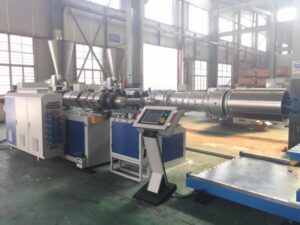
Typical Applications of Corrugated Pipes
Corrugated pipes that are manufactured using extrusion methods are commonly utilized in:
- Drainage systems for subterranean areas and rainfall-runoff systems
- Pipelines for sewage and wastewater
- Conduits for cable and wire protection
- Agricultural irrigation and drainage
- Highway and railroad infrastructure
Different applications have different requirements regarding pipe diameter, class of stiffness, and material composition, all of which have an effect on the design of extrusion lines.
Main Components of a Corrugated Pipe Extrusion Line
A full-scale extrusion line for corrugated pipes has several critical subsystems that each have their own importance in the quality of the extrusion line and the stability of the production.
- Feed the raw material
Common materials that are processed include:
- High-density polyethylene (HDPE)
- Πολυπροπυλένιο (PP)
- Πολυβινυλοχλωρίδιο (PVC)
Gravimetric or volumetric feeders are accurate in dosing, especially when supplemental chemicals like UV stabilizers or impact modifiers are employed.
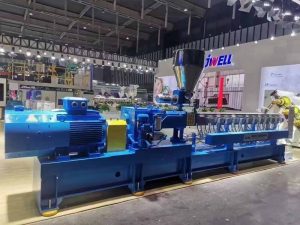
The extruder is the core of the corrugated pipe extrusion system. Its purpose is to:
- Melt the polymeric pellets
- Homogenize the mixture
- Provide a consistent, pressurized flow to the die
Single-screw extruders are typically employed; their design is optimized for:
- High output consistency
- Low thermal variation of the melt
- Constant measurement of viscosity
- Extrusion Die Bücher
The die’s shape determines the tubular form of the molten polymer before wrinkling. For the extrusion of corrugated pipe:
- The design must ensure that the walls have a uniform thickness
- The flow must be spread out uniformly across the circumference
- Poor design can cause uneven groovation, weak areas, or dimensional imbalance
The Corrugation Forming Process: How the Ribbed Structure Is Created
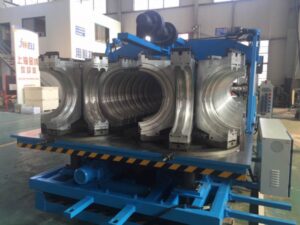
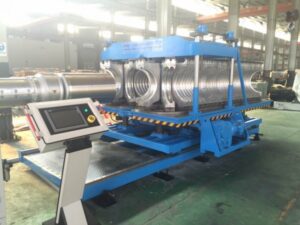
The most common attribute of a corrugated extrusion line is the corrugator, which creates the line’s distinguished ribbed appearance.
- The Corrugator’s Design and Operation
A corrugator has components that include:
- Two perpetual chains of corrugation generators
- A sealed forming channel
- Vacuum and cooling systems
As the molten pipe leaves the die, it will enter the corrugator, where:
- Vacuum causes the soft wall of the pipe to be drawn into the mold spaces
- Corrugations are created while the material is still malleable
- Precise coordination between the extrusion speed and the motion of the mold is essential
- Vacuum-forming mechanism
Vacuum’s importance is paramount to:
- Understanding the depth and shape of corrugation
- Verifying the accuracy of dimensions
- Avoiding flaws on the surface
Vacuum levels that are insufficient will cause shallow folds, while excessive levels will lead to material thinning.
- Cooling and Solidification
Once the corrugated shape is attained, the pipe must be swiftly cooled to compact the structure.
Cooling methods include:
- Water spraying as a form of cooling
- Water bath temperature control
- Internal air or water circulation
Constant cooling is crucial to avoiding:
- Warping
- Ovality
- Residual stress
- Cutting, Socketing, and Downstream Handling
After the process is complete, the pipe will pass through additional equipment that is downstream, such as:
- Haul-off units
- Systems of cutting
- Socket forming stations (for combined pipes)
Cutting can be:
- Online (corresponding to the extrusion speed)
- Off-line (for more exact results)
Single-Wall vs Double-Wall Corrugated Pipe Extrusion Lines
Corrugated pipe extrusion lines are typically divided into two varieties.
- Single-Wall Corrugated Pipeelines
Heavierweight and malleable
Commonly employed to shield and drain cabling.
A simpler equipment setup
- Two-Wall Corrugated Pipe Lines
Inner smoothness and outer corrugation
Increased tension in the ring
Utilized in conjunction with sewer and large-duct drainage systems.
Double walls are more intricate, demanding:
Combined extrusion systems
Precise control over the layer’s bonding.
Key Process Parameters in Corrugated Pipe Extrusion
| Παράμετρος | Typical Range | Impact on Pipe Quality |
| Melt temperature | 170–230°C | Affects surface finish and strength |
| Vacuum pressure | −0.03 to −0.08 MPa | Determines corrugation depth |
| Cooling water temperature | 10–25°C | Influences the dimensional stability |
| Line speed | 1–10 m/min | Affects corrugation accuracy |
| Pipe diameter | 40–1200 mm | Defines application scope |
Quality Control in Corrugated Pipe Production
Assessing quality is crucial to the extrusion of corrugated pipe.
Common assessments include:
- Stiffness of the ring
- Impact resistance evaluation
- The measurement of accuracy in dimensions
- Visual assessment of the uniformity of corrugation
Modern extrusion lines for corrugated pipe have advanced:
- Online measurement of diameter in the comfort of your home
- Defect detection that is automated
- Data recording for process documentation
Energy Efficiency and Production Optimization
Modern extrusion lines emphasize:
- Energy-efficient motors and drives
- Optimized screw and barrel design
- Intelligent temperature and vacuum control
Reducing energy consumption while maintaining pipe performance is a key competitive advantage for manufacturers.
Common Challenges in Corrugated Pipe Extrusion
Even with modern equipment, the production of corrugated pipe has several technical issues.
- Irregular Corrugation Appearance
Causes:
- Volatile melt temperature
- Poor control of the vacuum
- Wear or misaligned blocks for molding
Solutions:
- Minimize temperature fluctuations
- Constantly assess the effectiveness of the seal
- Maintain the alignment of the mold and maintain its hygienic nature
- Uneven Wall Thickness
Causes:
- Incorrectly designed die
- Volatile pressure extrusion
- Incorrectly formulated feed
Solutions:
- Use exacting heads
- Constantly increase or decrease the extruder speed and pressure
- Maintain a consistent level of raw material quality
- Defects on the surface and roughness of the finish
Causes:
- Polluted content
- Inappropriate cooling
- Over-exposure or destruction
Solutions:
- Increase the efficiency of material collection and drying
- Increase the efficiency of cooling
- Changing the speed and temperature of the adjustment
- Low Efficiency in Production
Causes:
- Frequent alterations in size
- Personal adjustments
- Outdated systems for controlling things
Solutions:
- Select a modular mold system
- Increase the automation degree
- Modernize the control software and vehicles
- High Energy Expenditure
Causes:
- Ineffective extruder design
- Poor insulation
- Overcooling or overheating
Solutions:
- Select powerful, efficient motors
- Balance the heating and cooling costs.
- Establish systems that observe energy usage
How to Choose the Right Corrugated Pipe Extrusion Line?
Selecting the appropriate corrugated pipe extrusion line is pivotal in achieving consistent production, quality, and efficiency over time. Corrugated pipes are commonly employed in drainage systems, sewage systems, cable protection, and other projects that require process stability and scalability.
- Describe the specifics of the Application and the Pipe
The first step is making sure the end goal is well-defined.
Key factors include:
- Pipe diameter range ( Small, medium, or large diameter)
- Single or dual wall corrugated structure
The material’s type (HDPE, PP, PVC, or combinations)
- The requirement for a ring to be stiff and supportive of heavy loads
- Adherent to the applicable standards in the industry or the city
Different uses, such as agricultural drainage versus subterranean cable protection, require different mechanical and dimensional properties.
- The configuration of the extruder and the capacity for output
The extruder is the central component of the line and directly affects the stability of the melt and the efficiency of production.
Consider:
- The design of the screws is optimized for the selected resin.
- The L/D ratio that is most effective for melting and uniformization is
- Constant output rate matching the target production volume
- Energy-saving motors and temperature-regulating systems
A proper extruder will produce a uniform melt flow, which is essential to producing consistent corrugation patterns.
- The Mold Block System and the Quality of Corrugation it provides
The mold block system affects the accuracy and consistency of the corrugation’s geometry.
Key factors that are selected:
- Mold material and methods of surface treatment to enhance wear resistance
- The efficiency of cooling and temperature uniformity
- Precision of the blocks and their alignment
- Capacity to quickly switch to different pipe sizes
High-quality blocks for molding increase the stability of dimensions and decrease the amount of downtime associated with size changes.
- Vacuum, cooling, and form technology
Stable forming is dependent on efficient vacuuming and cooling systems.
Look for:
- Constant pressure control of the vacuum
- Effective water and air conditioning systems
- Smooth decolaging without distortion
- Low sound and low energy expenditure
Poor control of the vacuum often results in unevenly deep or variable thickness of the wall.
- Automation and Control Technology
Today, modern extrusion lines for corrugated pipe that are intelligent have increased in popularity.
Significant features include:
- Control systems for industrial machines, such as robots, are also known asPLC.
- Real-time observation of temperature, pressure, and motion.
- Alarm and error detection functions
- Data recording for quality oversight
Advanced automation diminishes the dependence of the operator and increases consistency of production.
- Suppliant Support and After-Sales Service
Beyond the equipment’s specifications, the supplier’s capability has a significant impact.
Evaluate:
- Support for installation and commissioning
- Training programs for operators
- Repair parts accessibility
- Long-term technical support and enhancements
Reliable service reduces downtime and safeguards your investment.
FAQ: Corrugated Pipe Extrusion Line
Q1: What is a corrugated pipe extrusion line used for?
It is used to manufacture plastic pipes with a corrugated structure for drainage, sewage, cable protection, and infrastructure applications.
Q2: What materials are commonly used in corrugated pipe extrusion?
HDPE, PP, and PVC are the most common materials due to their strength, flexibility, and chemical resistance.
Q3: How does the corrugation form during extrusion?
Corrugation is formed by vacuum shaping molten pipe walls into moving mold cavities inside the corrugator.
Q4: What is the difference between single-wall and double-wall corrugated pipes?
Single-wall pipes are lightweight and flexible, while double-wall pipes offer higher stiffness with a smooth inner surface.
Q5: What determines the ring stiffness of corrugated pipes?
Material properties, corrugation geometry, wall thickness, and cooling conditions all influence ring stiffness.
Q6: Can recycled material be used in corrugated pipe extrusion lines?
Yes, controlled amounts of recycled material are commonly used, especially in non-pressure applications.
Q7: How is pipe length controlled in extrusion?
Length is controlled by synchronized haul-off and cutting systems integrated into the extrusion line.
Συμπέρασμα
A corrugated pipe extrusion line is a complex manufacturing process that combines the polymeric processing, mechanical precision, and thermal control necessary to produce long-lasting, lightweight piping supplies.
By understanding the process of extrusion in each stage—from preparation of the material to forming of the corrugation and quality control—manufacturers can enhance the efficiency of production and provide pipes that are stringent in their design and have a high degree of compliance with regulations.
During an era of increased infrastructure demand, well-designed extrusion lines for corrugated pipe remain important in the design of cost-effective and sustainable pipelines.



 English
  Russian
  Spanish
  Arabic
  German
  French
  Persian
  Turkish
  Bulgarian
  Czech
Czech  Dutch
Dutch  Greek
Greek  Indonesian
  Japanese
  Korean
  Polish
  Portuguese
  Romanian
  Slovenian
  Ukrainian