Abstract
A PET foam core production line is an industrial manufacturing system designed for the continuous production of polyethylene terephthalate (PET) foam cores. These cores are lightweight yet rigid materials that are widely used in composite panels, construction, transportation, and packaging industries.
These production lines integrate the processes of εξώθηση, foaming, cooling, and cutting to create PET foam sheets with precise density, thickness, and structural properties.
This article provides a comprehensive guide for engineers, manufacturers, and industry professionals by exploring the working principles, components, applications, and technological innovations of PET foam core production lines.
Introduction: The Role of PET Foam in Modern Industry
PET foam cores have become an essential material for industries requiring lightweight yet strong composite structures. These foams are particularly valued for the following properties:
- high strength-to-weight ratio
- dimensional stability
- chemical and moisture resistance
- thermal insulation properties
A PET foam core production line enables manufacturers to produce consistent, high-quality foam sheets on an industrial scale, replacing labour-intensive batch methods with automated, continuous production.
As global demand for composite panels in the aerospace, automotive, and construction industries grows, it is crucial to understand the operation, design, and benefits of PET foam core production lines in order to remain competitive and ensure quality.
Τι είναι μια Γραμμή Παραγωγής Πυρήνα Αφρού PET;
A PET foam core production line is a specialised extrusion system designed to transform PET granules or flakes into foamed sheets. The production line usually comprises the following:
- A feeding system that ensures a uniform supply of PET raw materials.
- Ένα εξωθητής, which melts the PET and incorporates a foaming agent.
- Foaming zone, introduces gases or chemical agents to expand the polymer.
- Calendering or casting unit: shapes the foam into sheets of the desired thickness.
- Cooling system: solidifies the foam structure.
- Cutting and winding equipment: trims and prepares the sheets for subsequent processes.
This process ensures controlled density, a uniform cell structure, and reproducible mechanical properties, all of which are critical for the performance of composite panels.
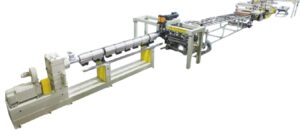
Core Components of a PET Foam Core Production Line
- Feeding and pre-mixing system
This automates the blending of PET granules with foaming agents and additives.
It ensures uniform distribution to avoid inconsistencies in the foam structure.
- Εξωθητήρας
Typically, a twin-screw extruder for homogeneous melting.
It provides precise temperature and pressure control to enable uniform foaming.
- Foaming zone
Introduces physical or chemical foaming agents.
It creates a microcellular structure within the PET material.
It controls the expansion ratio to achieve the desired foam density.
- Sheet forming unit
This can be calendar rollers or casting plates.
It adjusts the thickness and surface finish of the foam sheets.
It provides smooth, uniform surfaces for lamination or further processing.
- Cooling system
Uses water baths, chill rolls, or air cooling units.
It prevents the collapse of foam cells and stabilises the sheet.
- Κοπή και τύλιγμα
Trims sheets to standard dimensions.
It rolls or stacks finished foam sheets for storage or shipping.
Technical Specifications of PET Foam Cores
| Παράμετρος | Typical Range | Importance |
| Πυκνότητα | 50–300 kg/m³ | Determines strength and insulation |
| Πάχος | 3–50 mm | Critical for composite lamination |
| Cell size | 0.1–1 mm | Affects mechanical and thermal properties |
| Thermal conductivity | 0.035–0.045 W/mK | Insulation performance |
| Compressive strength | 1–10 MPa | Structural support in panels |
These specifications can be tailored during production by adjusting extrusion parameters, foaming agent content, and cooling rates.
Advantages of Using PET Foam Core Production Lines
PET foam cores are becoming increasingly popular in industries such as construction, packaging, and composites thanks to their superior mechanical and thermal properties. Using a PET foam core production line offers several key advantages.
- High production efficiency
Advanced extrusion and foaming technologies allow continuous, high-speed production.
- Reduced downtime
Automated control systems and stable extrusion processes reduce downtime.
- Consistent quality and uniformity
Optimised screw and die designs ensure uniform density and thickness
High reproducibility reduces material waste and enhances end-product reliability
- Enhanced material properties
PET foam cores offer lightweight construction, high strength and dimensional stability, as well as excellent thermal insulation, sound absorption, and compressive strength.
- Versatility in product customisation
Production lines allow adjustments to thickness, density, and width
Supports the integration of additives for flame retardancy, UV resistance, or colour customisation
- Αποδοτικότητα κόστους-αποτελεσματικότητας
High efficiency reduces energy consumption and operational costs per unit.
Minimal material waste is achieved through precise extrusion and foaming control.
- Περιβαλλοντική βιωσιμότητα
PET foam can incorporate recycled PET bottles or flakes, reducing environmental impact.
Eco-friendly production processes are increasingly compatible with green manufacturing standards.
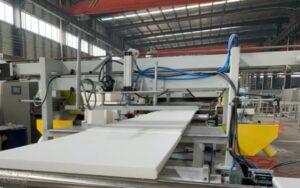
Applications of PET Foam Cores
PET foam cores are highly versatile and are used across a wide range of industries.
- Composite panels and construction materials
Core material for sandwich panels, lightweight walls, and roof insulation
Provides structural rigidity with reduced weight
- Transportation industry
Used in automotive, marine, and aerospace composite components
Enhances weight reduction, energy efficiency, and impact resistance
- Βιομηχανία συσκευασίας
Provides shock absorption and thermal insulation for high-value or sensitive goods
Eco-friendly packaging solutions using recycled PET foam cores
- Furniture and interior applications
Core material for laminated panels, table tops, and lightweight furniture
Combines durability with design flexibility
- Sports and leisure products
Used in skateboards, snowboards, skis, and other composite boards
Provides lightweight strength and enhanced performance characteristics

Process Workflow of a PET Foam Core Production Line
A PET foam core production line is designed to transform raw PET material into high-performance foam cores for use in the construction, transportation, packaging, and composites industries. Understanding the workflow enables manufacturers to optimise quality, efficiency, and cost-effectiveness.
- Raw material preparation
PET flakes or granules: The process begins with high-quality PET material, which may be virgin PET or recycled PET bottles.
Additive mixing: Depending on the product requirements, additives such as flame retardants, colourants, UV stabilisers, or foaming agents are blended into the raw PET.
Pre-drying: PET is hygroscopic, so pre-drying in industrial dryers reduces the moisture content, preventing bubbles and defects during extrusion.
- Εξώθηση
Feeding and melting: Pre-dried PET is fed into a twin-screw or single-screw extruder, where it is melted under controlled temperature and shear conditions.
Foaming action: A physical or chemical foaming agent is injected into the molten PET.
Mixing and homogenisation: The extruder ensures the foaming agent is distributed uniformly, creating consistent foam cells.
- Sheet formation
Die head extrusion: The melted and foamed PET is extruded through a precision die to form a continuous foam sheet.
Thickness and width control: Adjustable die lips and inline gauges maintain uniform thickness and width.
Initial cooling: The extruded sheet passes through calibration rollers or cooling belts to stabilise its shape and density.
- Calendering and surface treatment
Calendering: Optional rollers smooth the foam surface and improve dimensional stability.
Surface coating: Some production lines add protective coatings, skin layers, or anti-static treatments for specialised applications.
- Cooling and solidification
Cooling conveyors: The foam core is gradually cooled to room temperature to prevent warping or deformation.
Stabilisation: Proper cooling ensures consistent density, strength, and thermal insulation properties.
- Cutting and sizing
Sheet cutting: Large, continuous foam sheets are cut to custom lengths and widths using precision saws or guillotines.
Profiling: Optional contour cutting or CNC profiling is available for specialised applications in composites or packaging.
- Quality control and inspection
Thickness and density checks: In-line sensors ensure uniformity and adherence to specifications.
Surface and structural inspection: Detects bubbles, voids, or defects before packaging.
Mechanical testing: Optional compression and tensile tests are available for high-performance applications.
- Packaging and storage
Protective wrapping: Sheets are stacked and wrapped to prevent moisture absorption and surface damage.
Inventory Management: Stored in controlled environments until shipment.

Comparison of PET Foam vs Other Foam Materials
| Υλικό | Πυκνότητα | Thermal Insulation | Moisture Resistance | Εφαρμογή |
| PET Foam | 50–300 kg/m³ | Moderate–High | Εξαιρετικό | Composite panels, insulation |
| PVC Foam | 40–200 kg/m³ | Moderate | Μέτρια | Signage, construction |
| PU Foam | 20–150 kg/m³ | High | Low | Upholstery, cushioning |
| Polystyrene Foam | 10–50 kg/m³ | Μέτρια | Μέτρια | Packaging, insulation |
PET foam stands out for its combination of mechanical strength, moisture resistance, and recyclability.
Innovations and Trends in 2026
Sustainable PET feedstock: increasing use of recycled PET.
Advanced extrusion control: AI-driven temperature and pressure adjustments.
Hybrid foam lines – integrating additives to enhance flame retardancy or acoustic properties.
Energy efficiency: low-energy extruders and optimised cooling systems.
Common challenges in PET foam core production: maintaining uniform cell structure during scaling.
Controlling foam density for high-performance panels.
Avoiding contamination or inclusions in recycled PET feedstock.
Optimising cooling rates to prevent sheet warping.
Addressing these challenges requires precision engineering, skilled operators, and high-quality equipment.
FAQ: PET Foam Core Production Line
- What is a PET Foam Core Production Line used for?
It is used to manufacture PET foam sheets for applications in composite panels, insulation, packaging, and furniture.
- What materials are used in PET foam production?
Primarily virgin or recycled PET granules with physical or chemical foaming agents.
- What industries use PET foam cores?
Aerospace, automotive, construction, packaging, furniture, and marine industries.
- Can PET foam density be customized?
Yes, by adjusting foaming agent content, extrusion temperature, and cooling parameters.
- How is PET foam environmentally friendly?
PET foam is recyclable, and production lines can incorporate post-consumer PET bottles.
- What is the production capacity of a typical PET foam core line?
Industrial lines can produce hundreds of kilograms to tons per hour, depending on design.
- How does PET foam compare to PVC or PU foam?
PET foam has superior moisture resistance, recyclability, and mechanical strength, while PU and PVC foams may offer lighter weight or specific thermal performance.
- Are PET foam cores flame-retardant?
Flame-retardant additives can be incorporated during production to meet safety standards.
Συμπέρασμα
A PET foam core production line is a vital investment for manufacturers looking to produce high-quality, lightweight, and durable PET foam sheets. Advantages include consistent quality, scalable production, material optimisation, and environmental sustainability.
Thanks to innovations in extrusion technology, AI process control, and the use of recycled feedstock, PET foam cores are set to take over the composite and insulation markets by 2026 and beyond.
Understanding the process, components, and technical specifications enables engineers and production managers to optimise efficiency, reduce waste, and meet the industry’s evolving demands.




 English
  Russian
  Spanish
  Arabic
  German
  French
  Persian
  Turkish
  Bulgarian
  Czech
Czech  Dutch
Dutch  Greek
Greek  Indonesian
  Japanese
  Korean
  Polish
  Portuguese
  Romanian
  Slovenian
  Ukrainian