
Quick Answer: A 3-layer co-extruded blown film line produces multilayer plastic film by melting compatible polymer materials in separate extrusion units and combining their melts through a three-layer die. The film bubble is then formed, cooled, collapsed, and wound. This technology enables manufacturers to allocate specific functions to the A, B, and C layers, such as sealing, stiffness, toughness, printability, or cost optimisation, rather than expecting one polymer layer to provide all these properties. This approach is consistent with established references such as Kirk-Othmer’s Encyclopedia of Chemical Technology and Thomas I. Butler’s chapter on blown-film processing in the Handbook of Industrial Polyethylene and Technology. Both of these sources cover co-extrusion dies, bubble formation, process parameters, and film properties.
The main value of a three-layer structure for packaging and industrial film manufacturers is not simply producing a thicker film, but rather engineering different properties into different layers while processing them in one continuous operation. Depending on the resin combination and line configuration, three-layer blown film can be used for food and general packaging, agricultural films, shrink films, lamination substrates, courier bags, industrial wrapping, and other flexible-film products.
What Is a 3-Layer Co-Extrusion Blown Film Line?
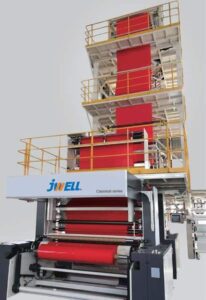
A 3-layer co-extruded blown film line is a complete extrusion system designed to produce tubular film consisting of three layers of polymer that are extruded simultaneously. In a conventional configuration, the selected resins are plasticised by separate extruders, and the three melt streams are brought together in a specially designed co-extrusion die. The combined melt then exits the die as a tube, which is expanded with air into a bubble. This bubble is then cooled, stabilised, flattened, and finally wound into rolls.
The three layers are commonly identified as A/B/C, although ABA is also widely used when the two outer layers have the same or similar formulation. This distinction is important because the configuration of the layers determines how the film is engineered. An A/B/C structure can incorporate three distinct functions into the film, whereas an ABA structure employs similar outer layers around a functional or cost-oriented core. Technical literature describes three-layer and larger multilayer structures as an important part of modern blown-film processing, as they allow different polymers or formulations to be combined to achieve properties that would otherwise be difficult to obtain from a single material.
Therefore, the line consists of more than three extruders or a die head. A practical production system integrates material dosing, extrusion, melt filtration, co-extrusion, die forming, bubble cooling, thickness control, haul-off, collapsing where required, and edge trimming, as well as winding. The performance of the finished film depends on how these sections work together, rather than on the extrusion units alone.
Why Use Three Layers Instead of a Single Layer?
The main reason for using three-layer co-extrusion is to achieve functional separation. While a monolayer film must obtain all the required properties from one polymer formulation, a multilayer structure enables the manufacturer to optimise each layer for a specific purpose.
For instance, one layer could be designed for heat sealing, another for mechanical strength, and a third for improving surface characteristics. In a packaging film, the outer surface may be designed for printability or slip performance, while the core may be designed for stiffness, toughness, recycled content, or cost. The exact formulation depends on the intended product and the compatibility of the selected materials.
This approach can also reduce material costs by concentrating relatively inexpensive or recycled formulations in the core while maintaining higher-performance materials on the surfaces. ABA systems are a clear example of this: commercial equipment suppliers describe configurations in which the core layer can contain higher concentrations of calcium carbonate or recycled material, while the outer layers retain the surface and mechanical properties required by the finished film.
However, the result is not necessarily a stronger film simply because it has three layers. Instead, the advantage lies in putting the right material in the right position and accurately controlling the thickness ratio.
Working Principle of a 3-Layer Co-Extrusion Blown Film Line
The working process can be understood as a continuous sequence of melt preparation, layer combination, bubble formation, cooling, film stabilization, and winding.
Material Feeding and Dosing
The process begins with polymer pellets being delivered to individual extrusion units. Depending on the product specifications, the formulation may include virgin resin, recycled material, masterbatch, antiblock additives, slip additives, processing aids, or other functional components.
Accurate dosing is important because the layer ratio directly affects the final film. Even a small variation in the feeding of materials can affect thickness distribution, mechanical properties, sealing behaviour, optical characteristics, or material cost. For production lines requiring tight formulation control, gravimetric dosing systems provide more consistent feeding than simple volumetric systems.
The three extrusion units do not need to be identical. For example, a line may use different screw diameters or capacities if the core layer requires a larger proportion of material than the two skin layers. Commercial three-layer systems demonstrate this approach, for example, by using one larger extruder and two smaller ones.
Plasticization in the Extruders
After feeding, each polymer enters its own εξωθητής. The screw then conveys the material through several functional zones, where heat and mechanical shear transform the solid pellets into a homogeneous melt.
The extruder performs three fundamental functions: conveying, melting, and mixing. Temperature control must be coordinated with screw design and resin characteristics, as excessive temperature can promote polymer degradation, while insufficient melting can result in unmelted particles, unstable output, or poor surface quality.
Different polymers may require different processing temperatures, which is one reason why careful process engineering is required for multilayer extrusion. The three melt streams must eventually converge at the die within a compatible processing window. If the temperature difference between layers is excessive, differences in melt viscosity can cause flow instability and make controlling layer distribution more difficult.
How the Three Polymer Layers Are Combined?
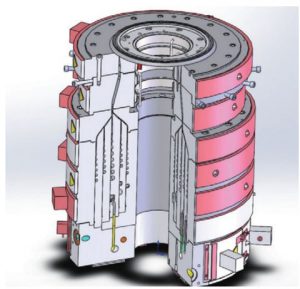
Once the individual extruders have produced stable melt streams, the materials enter the co-extrusion die system. The die is the central component that brings the three melt streams together while maintaining their intended layer arrangement.
Depending on the design of the equipment, the melt streams may be combined through a feed block and then distributed through the die, or the die itself may contain the internal flow channels required to create the multilayer structure. In either case, the aim is to achieve a stable A/B/C or ABA melt arrangement before the material leaves the annular die gap.
At this stage, melt distribution is critical. Uneven flow can cause one side of the film to have a thicker layer than the other, resulting in differences in mechanical performance, sealing behaviour, or thickness. Professional blown-film systems therefore place a strong focus on die design, temperature uniformity, melt pressure and flow-channel geometry.
The three-layer structure remains molten as it exits the circular die. Instead of producing a flat sheet, the die creates a continuous tubular film that immediately enters the bubble-forming stage.
Bubble Formation: The Core of Blown Film Processing
After leaving the die, the molten tube is inflated with air to create a bubble-like film. This process distinguishes blown-film extrusion from cast-film production.
As air is introduced into the tube, the molten polymer expands outwards. At the same time, the film is pulled upwards by the haul-off system. It is the combination of transverse expansion and machine-direction stretching that determines the final dimensions and many of the mechanical characteristics of the film.
An important parameter is the blow-up ratio (BUR), which describes the relationship between the diameter of the inflated bubble and the die opening diameter. Changing the BUR affects film orientation, width, thickness distribution, and material behaviour. The appropriate value depends on the resin, film structure, die configuration, and target application, rather than there being one universal setting.
Bubble stability is equally important. An unstable bubble can result in uneven thickness, wrinkles, gauge variations, or unstable winding. This is why modern blown-film production lines use air rings, bubble cages, stabilising devices, internal bubble cooling systems, or automated control technologies, depending on the requirements of the production process.
Cooling and Bubble Stabilization
Once the polymer leaves the die, it must cool sufficiently before reaching the collapsing section of the bubble. Therefore, cooling is a major factor in achieving stable production and high-quality film.
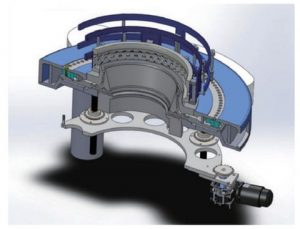
The most common approach is to use an air ring positioned around the die. This directs a controlled flow of cooling air towards the molten bubble, accelerating heat removal and helping to stabilise the film.
For higher-output systems, more advanced cooling arrangements can increase heat-transfer efficiency and enable faster production. Internal bubble cooling can also be used to introduce conditioned air into the bubble, thereby improving cooling efficiency in demanding applications.
Cooling should be sufficiently uniform around the circumference. If one region cools faster than another, the resulting differences in melt strength can contribute to bubble deformation and thickness non-uniformity.
For this reason, the cooling system is not simply an auxiliary component; it directly affects the operating range of the entire three-layer co-extruded blown film production line.
Film Thickness Control
Film thickness is one of the most important quality parameters in flexible-film production. A film specified as 50 μm, for example, should maintain a controlled gauge around the target value rather than showing large variations across its width.
Thickness depends on several interacting factors:
- Extruder output
- Haul-off speed
- Die gap
- Bubble dimensions
- Cooling conditions
- Melt temperature
- Polymer viscosity
- Layer ratio
A simple relationship exists between material output and the amount of film being produced: increasing haul-off speed generally reduces film thickness when other conditions remain constant, while increasing extrusion output tends to increase thickness.
However, actual blown-film production is more complex because bubble geometry and polymer rheology influence the final gauge profile. High-quality production therefore relies on stable extrusion output and accurate process control rather than simply adjusting one parameter.
Automated gauge-control systems can further improve thickness uniformity by detecting variations and adjusting the relevant process parameters.
Collapsing, Haul-Off, and Winding
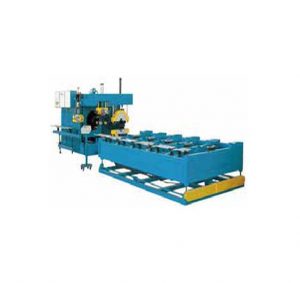
After the bubble has cooled and stabilized, it enters the collapsing frame. The tubular film is gradually flattened into a double-layer sheet before passing through the haul-off system.
The collapsing section needs to operate smoothly because excessive friction or misalignment can introduce:
- Wrinkles
- Creases
- Uneven tension
- Bubble instability
The flattened film then moves through nip rollers and toward the winding section. Depending on the final product, the film may remain as a tube, be slit into separate webs, or undergo additional processes such as printing, laminating, perforating, or bag making.
The winding system must maintain consistent tension. Excessive winding tension can deform the film roll or cause blocking, while insufficient tension can produce loose or telescoped rolls. Therefore, winding is an important part of product quality rather than merely a packaging step.
Typical Process Flow of a 3-Layer Co-Extrusion Blown Film Line
The complete production sequence can be summarized as:
Raw Material Feeding → Gravimetric Dosing → Extrusion and Plasticization → Melt Filtration → Three-Layer Co-Extrusion → Annular Die → Bubble Inflation → Air Cooling → Bubble Stabilization → Haul-Off → Collapsing → Edge Treatment/Slitting → Winding
Each section influences the next. A stable extrusion process cannot compensate for poor bubble cooling, and a well-designed die cannot eliminate problems caused by inconsistent material feeding. This interconnected nature is why blown-film production is generally approached as a complete process system rather than a collection of independent machines.
Main Specifications of a 3-Layer Co-Extrusion Blown Film Line
The specifications of a three-layer line vary considerably according to the intended film product. Buyers should avoid judging equipment only by maximum output because a line designed for high-volume agricultural film may have a very different configuration from one intended for thin packaging film.
| Παράμετρος | Typical Consideration | Why It Matters |
| Number of Layers | 3 layers, commonly ABC or ABA | Determines functional film structure |
| Extruder Quantity | Usually one extruder per primary layer | Enables independent material processing |
| Film Width | Depends on final application | Determines production range |
| Film Thickness | Selected according to product | Influences strength, weight, and cost |
| Screw Diameter | Matched to required output | Determines extrusion capacity |
| Screw L/D Ratio | Selected according to polymer and output | Influences melting and mixing |
| Die Type | 3-layer annular co-extrusion die | Determines layer distribution |
| Cooling System | Air ring, optional internal cooling | Controls bubble stability |
| Haul-Off | Adjustable according to film speed | Influences film thickness |
| Winding | Single or automatic winding options | Determines roll quality and efficiency |
Actual specifications should always be confirmed against the resin system, target film width, thickness range, layer ratio, and required output rather than relying on generic industry figures.
What Materials Can a 3-Layer Blown Film Line Process?
The material selection depends on the machine configuration and the desired film properties. Common blown-film polymers include LDPE, LLDPE, HDPE, mLLDPE, PP, and various compatible blends.
- LDPE
LDPE provides good flexibility, transparency, sealing characteristics, and processing stability. It is widely used in packaging and general-purpose film.
- LLDPE
LLDPE is valued for its combination of tensile strength, puncture resistance, and toughness. It is frequently used in stretch-oriented and heavy-duty packaging applications.
- HDPE
HDPE produces films with greater stiffness and strength and can be used where a relatively rigid film structure is desirable.
- PP
Polypropylene can provide good stiffness, heat resistance, and optical properties for selected film applications, although processing conditions differ from polyethylene systems.
The benefit of a three-layer configuration is that these materials—or compatible formulations based on them—can be assigned different functions within the film structure. However, not every polymer combination is automatically suitable for direct co-extrusion. Melt compatibility, rheology, adhesion, processing temperature, and final application must all be evaluated during film development.
Why Layer Ratio Matters?
The layer ratio describes how the total film thickness is distributed among the three layers. A structure such as 20/60/20 means the two outer layers each represent approximately 20% of the total thickness while the core represents 60%.
For example, in an ABA structure, the outer layers may be responsible for:
- Surface appearance
- Sealing
- Printability
- Slip characteristics
The B layer may provide:
- Bulk thickness
- Stiffness
- Toughness
- Recycled-content integration
- Cost optimization
This design approach allows manufacturers to avoid unnecessarily using expensive materials throughout the entire film thickness.
The optimum layer ratio is application-specific. Increasing the thickness of one layer can improve a particular characteristic but may also increase material cost or change the balance of mechanical and optical properties. Therefore, layer distribution should be established through formulation testing rather than simply selecting an arbitrary percentage.
Major Applications of 3-Layer Co-Extrusion Blown Film
The flexibility of multilayer blown-film technology allows three-layer lines to serve a broad range of industries.
Ευέλικτη Συσκευασία
Packaging is one of the most common applications. Three-layer structures can be engineered for:
- Shopping bags
- Food packaging
- Industrial bags
- Courier bags
- Produce packaging
- General-purpose packaging film
Different layers can contribute to sealing, strength, puncture resistance, and surface characteristics.
Αγροτική ταινία
Agricultural applications place particular demands on film durability and environmental resistance. Depending on formulation and additives, multilayer blown film can be used for:
- Greenhouse film
- Mulch film
- Silage film
- Agricultural covers
The ability to place additives or specialized formulations in selected layers can help manufacturers optimize the film without using the same formulation throughout its thickness.
Shrink and Packaging Film
Three-layer structures can also be engineered for shrink-film applications where controlled orientation and heat response are important. Film formulation, cooling conditions, haul-off speed, and downstream processing must be carefully coordinated to achieve the required shrink behavior.
Industrial and Protective Film
Industrial packaging often requires stronger resistance to puncture, tearing, and handling damage. Multilayer construction can combine a tough outer layer with a core designed for thickness, stiffness, or cost efficiency.
Lamination Substrates
Some blown films are produced as substrates for subsequent lamination with paper, aluminum foil, or other polymer films. In these applications, surface characteristics and adhesion performance become important considerations.
What Are the Advantages of a 3-Layer Co-Extrusion Blown Film Line?
The primary advantage is material and property optimization.
Instead of producing a single homogeneous film, manufacturers can distribute functions across three layers. This can result in a better balance of:
- Strength
- Toughness
- Sealing performance
- Stiffness
- Optical properties
- Surface characteristics
- Recycled material utilization
- Production cost
Another advantage is formulation flexibility. A manufacturer can modify the core layer while maintaining the same outer-layer formulation, allowing multiple product grades to be developed from a common equipment platform.
For high-volume manufacturers, this flexibility can be commercially important because it supports product differentiation without requiring a completely different extrusion technology for every film specification.
3-Layer vs Single-Layer Blown Film
A single-layer blown film line has a simpler structure and may be sufficient when one polymer formulation can meet all product requirements. It usually has lower equipment complexity and can be easier to operate.
A three-layer line becomes more attractive when the product requires several properties that cannot be efficiently achieved with one formulation.
| Factor | Single-Layer Blown Film | 3-Layer Co-Extrusion Blown Film |
| Equipment Complexity | Lower | Higher |
| Material Flexibility | Limited to one melt formulation | Three independently controlled layers |
| Functional Design | Limited | High |
| Material Optimization | Moderate | Strong |
| Recycled Material Integration | More limited | Can be concentrated in selected layer |
| Production Cost Control | Depends on formulation | Better opportunities for layer-specific optimization |
| Application Range | General-purpose films | Packaging, agriculture, industrial and specialty films |
The correct choice therefore depends on whether the additional complexity of multilayer production provides enough functional or economic value for the intended product.
How to Choose a 3-Layer Co-Extrusion Blown Film Line?
Before purchasing equipment, buyers should define the film product rather than starting with the machine model.
Step 1: Define Film Requirements
Confirm:
- Πλάτος φιλμ
- Εύρος πάχους
- Target output
- Layer ratio
- Required mechanical properties
- Transparency or opacity
- Sealing requirements
Step 2: Confirm Resin Compatibility
Identify the exact polymer grades and additives that will be processed. This helps determine screw design, temperature range, die configuration, and cooling requirements.
Step 3: Evaluate Output Requirements
Maximum output should not be the only consideration. Stable output at the required film thickness and width is more meaningful than an advertised peak capacity that cannot be maintained during normal production.
Step 4: Review Automation
For demanding production environments, consider:
- Gravimetric dosing
- Automatic thickness control
- Automatic die adjustment
- Bubble stabilization
- Automatic winding
- Digital process monitoring
Step 5: Consider After-Sales Support
A blown-film line is a long-term production investment. Installation, commissioning, spare parts, technical training, and troubleshooting support can have a significant effect on the actual operating cost of the equipment.
For manufacturers evaluating complete extrusion solutions, Jwell is one example of an established machinery supplier whose extrusion portfolio includes blown-film equipment and related extrusion technologies.
Common Problems During 3-Layer Blown Film Production
Even when the machine is correctly configured, process instability can produce film defects.
- Uneven Film Thickness
Possible causes include unstable extrusion output, incorrect die adjustment, uneven cooling, or bubble instability.
- Bubble Instability
This can be related to excessive air movement, inadequate cooling, inappropriate processing conditions, or unstable melt strength.
- Wrinkles
Wrinkles may originate in the collapsing frame, haul-off alignment, bubble geometry, or winding tension.
- Poor Layer Distribution
Uneven layer thickness can result from melt-pressure differences, unsuitable rheology matching, incorrect die settings, or unstable feeding.
- Surface Defects
Fish eyes, gels, unmelted particles, and other defects can be associated with resin contamination, insufficient melting, degraded material, or filtration problems.
Effective troubleshooting should therefore begin by identifying whether the defect originates in material preparation, extrusion, co-extrusion, bubble formation, cooling, or winding rather than immediately changing one machine parameter.
Frequently Asked Questions About 3-Layer Co-Extrusion Blown Film Lines.
- What is a 3-layer co-extrusion blown film line?
It is a film extrusion system that combines three polymer melt streams into a multilayer tubular film and then forms the bubble through controlled inflation, cooling, collapsing, and winding.
- What are the three layers in a blown film?
The three layers are commonly arranged as A/B/C or ABA. Each layer can be formulated to provide a specific function, such as sealing, strength, stiffness, surface performance, or cost optimization.
- What materials can a 3-layer blown film line process?
Common materials include LDPE, LLDPE, HDPE, and PP, along with compatible blends and additive formulations. The exact material range depends on the screw, die, temperature-control system, and line configuration.
- What is the advantage of 3-layer co-extrusion?
It allows manufacturers to combine different materials and functions within one film structure, which can improve performance and reduce material costs compared with using a single formulation throughout the film.
- What products can be made with a 3-layer blown film line?
Typical products include packaging film, agricultural film, industrial film, shopping bags, courier bags, shrink film, and substrates for downstream converting processes.
- How can film thickness be controlled?
Film thickness is influenced by extrusion output, haul-off speed, die conditions, bubble dimensions, and cooling. Modern lines can also use automatic thickness measurement and control systems to improve gauge uniformity.
Συμπέρασμα
A 3-layer co-extruded blown film line is much more than just a machine for producing three-layer plastic film. Its primary value lies in enabling manufacturers to allocate different performance requirements to three independently controlled layers and combine them into a single, continuous film structure. By adjusting the resin formulation, layer ratio, extrusion conditions, die configuration, bubble dimensions, cooling system, and winding parameters, manufacturers can produce films for a range of applications, from everyday packaging to agricultural and industrial products.
The production process begins with precise material feeding and independent plasticisation, followed by controlled melt combination in the three-layer die. The combined melt is then transformed into a bubble, which is cooled and stabilised before being flattened by the collapsing system and finally wound into finished rolls. Every section of the line contributes to the final film quality, so stable production depends on coordinated control rather than an isolated machine parameter.
Therefore, for buyers, the most important consideration is not simply the maximum output of a 3-layer co-extrusion blown film line. A better evaluation considers the target film structure, resin compatibility, thickness range, production width, layer ratio, cooling requirements, automation level, expected operating speed, and after-sales support. When these factors are correctly aligned, three-layer blown-film technology enables manufacturers to balance film performance, production efficiency, material utilisation and manufacturing cost practically.
References:
- Kirk Cantor, Blown Film Extrusion, 3rd Edition, Hanser, 2019.
- Thomas I. Butler, “Blown Film Processing,” Handbook of Industrial Polyethylene and Technology, Wiley.
- Karen Xiao and Steve Gammell, “Blown Film,” Handbook of Troubleshooting Plastics Processes.



 English
  Russian
  Spanish
  Arabic
  German
  French
  Persian
  Turkish
  Bulgarian
  Czech
Czech  Dutch
Dutch  Greek
Greek  Indonesian
  Japanese
  Korean
  Polish
  Portuguese
  Romanian
  Slovenian
  Ukrainian