
Blow molding machines have revolutionized the plastic manufacturing industry by enabling the mass production of hollow plastic products, such as bottles, containers, tanks, and industrial parts.
If you’ve ever used a plastic water bottle, detergent container, or fuel tank, chances are it was made by a blow molding process.
But what exactly is a blow molding machine, and how does it work?
This article provides a comprehensive explanation—from principles and types to productivity, materials, automation, and key performance questions that every manufacturer or buyer should know.
What Is a Blow Molding Machine?
A blow molding machine is a type of plastic processing equipment used to create hollow plastic products by inflating a heated plastic tube (known as a parison) inside a mold cavity. The plastic expands and takes the shape of the mold, forming a container once it cools and hardens.
In simple terms, blow molding is similar to glass blowing, but instead of glass, molten plastic is used.
Core Concept:
- Heat thermoplastic resin (e.g., PE, PP, PET).
- Form a hollow tube (parison or preform).
- Blow air into the tube inside a mold.
- Cool and eject the finished hollow part.
How Does a Blow Molding Machine Work?
The working process depends on the blow molding type, but the general steps include:
- Plastic Melting and Parison Formation
Plastic pellets are fed into the extruder, then heated to their melting temperature before they can be extruded into a parison (hollow tube-like structure). ͏ Plastic granules are fed into the extruder, heated until they melt, and extruded into a parison (a hollow, tube-like shape).
- Mold Clamping
This parison is sealed inside a 2-piece mold, which imparts the shape of the final product.͏
- Air Inflation (Blowing Process)
It is done by injecting compressed air through a blow pin, which will expand the molten parison against the inner surface of the mould.
- – 押出プロセスが完了したら、化合物は急速に冷却されて劣化を防ぎます。冷却には通常、水槽や空冷方式が用いられ、材料が望ましい特性を保持できるようになります。
Plastic is allowed to cool inside the mold until it becomes solid enough to retain its shape.
- Product Ejection
After cooling, the mold opens, and ejection of the finished product is done for trimming or any post-processing operation that may be required.
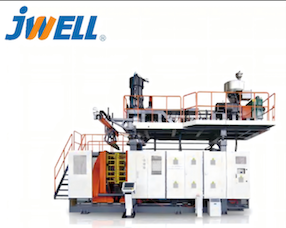
Step-by-Step Process: How a Blow Molding Machine Works
Blow Molding is a process popular for making hollow plastic articles. A Blow Molding Machine carries out the process through which bottles and jars to automotive parts and industrial containers are made. Below is the step-by-step process on how a blow molding machine works, which will help you garner an understanding about this elaborate method of production.
1、JWELL professional in design new generation of machine introducing to you the latest innovation in technology and features a state-of-the-art blow molding machine that will ensure high productivity needs and quality output product meeting all the various requirement of customers.
2、The blow molding process begins with raw material. In most cases, this is plastic pellet which is fed into the hopper of the machine from where they flow down to the extruder. The extruder heats and melts the plastic so that a molten resin is created- capable of taking up different forms
3、When the plastic melts, it is led into the parison mold and forms a hollow tube- that is called a parison. The parison mold has two halves between which sits a cavity representing the shape of the final product. The injection of molten resin into this cavity forms the parison.
4、Then, the parison is taken to the blow mold‹this is what makes up the final product. There are also two halves to the blow mold enclosing a cavity that matches the shape of the desired end product. The parison is placed between these halves and when closed, this particular machine starts its blow molding process.
5、During parison blow, the mold remains clamped as air is introduced into the parison thereby expanding it to take the shape of the cavity. The expansion is effected by applying air pressure inside the parison compelling it against the walls of the mold. This degree of control that can be exercised over how much air pressure is applied ensures that there is adequate product dimension consistency to a high degree of accuracy.
6、After the blow molding operation, the newly formed plastic article is allowed to cool and set. Cooling is very important so that the article can retain its shape and proper structural integrity. After sufficient cooling, the mold halves open and the machine ejects the article.
7、Jwell blow molding machines have premium features that enhance the optimization of the production process. It has quick mold change capabilities that reduce downtime between one batch and another, hence increased productivity per given time. The advanced control systems integrated into the machine monitor and adjust critical parameters such as temperature and pressure to maintain optimal conditions for quality products.
8、Blow molding machines are capable of extrusion, and injection. Each has its strength toward a certain application. The popular one used for bottles and containers is extrusion blow molding, whereas injection blow molding is more preferred when dealing with small and intricate products like pharmaceutical vials.
In conclusion, a blow molding machine is a sophisticated piece of equipment that plays a vital role in the manufacturing industry. JWELL is at the forefront of this technology, offering innovative solutions that enhance productivity, precision, and versatility. With our comprehensive understanding of the step-by-step process of how a blow molding machine works, we continue to push the boundaries of what is achievable in plastic product manufacturing.
Why Choose Blow Moulding?
The greatest advantage that the process gives to manufacturing projects is actually the amount of products it can give by using any of its three flexible and efficient methods. The plastic container may preserve the hygienic and attractive branding, shampoo bottles have good chemical resistance among other properties including the ability to take complex forms, automotive ducting as well as industrial tubs and drums provide robust durable strength in heavy industry, construction and many more demanding applications. The medical field values this manufacturing method for easy sanitization ability and being lightweight. In simple words, plastic blow-molded products have common places in domestic as well as commercial life.
Other advantages, ie the fact that extrusion blow molding, particularly, can make complex and highly bespoke shapes which can be accurately designed for precise sizes, finishes and wall thicknesses. E.g. Bottlenecks must match the grooves of the bottle top exactly to ensure a watertight seal once the cap is screwed on. The quality of the finished product tends to be very high; however tooling and manufacturing costs tend to be lower than other types of plastic manufacturing processes which certainly helps the bottom line. Disadvantages are that there is a limitation of variation in wall thicknesses because the product has to be hollowed out and yet it must retain adequate strength and integrity. The recyclability of the product can also be reduced if thermosetting polymers are used since these will not allow reshaping beyond the original shape, i.e., they cannot be softened or melted again for reforming or recycling.
Main Applications of Blow Molding Machines
Blow molding technology is used across multiple industries to manufacture lightweight, durable, and uniform plastic products.
| Industry | Common Products |
| パッケージング | Bottles for water, beverages, detergents, cosmetics |
| 自動車 | Fuel tanks, ducts, reservoirs |
| メディカル | IV bottles, containers |
| 工業 | Chemical drums, lubricant containers |
| 消費財 | Toys, household items |
| 農業 | Pesticide containers, sprayer tanks |
Blow molding’s ability to produce seamless hollow items makes it irreplaceable in modern manufacturing.
Types of Blow Molding Machines
Blow molding machines come in several types, depending on the process and end-use.
| タイプ | Description | Typical Material | 用途 |
| Extrusion Blow Molding (EBM) | Continuous extrusion of parison and inflation in mold | PE, PP | Bottles, drums, containers |
| Injection Blow Molding (IBM) | Preform injection + blowing in second mold | PET, PP | Small bottles, medical containers |
| Injection Stretch Blow Molding (ISBM) | Stretching + blowing for high clarity | PET | Beverage bottles, cosmetic jars |
| Accumulator Head Blow Molding | Used for large parts and thick walls | HDPE | Tanks, automotive parts |
| Co-extrusion Blow Molding | Multi-layer extrusion for barrier packaging | PE/EVOH | Fuel tanks, food containers |
Differences Between Blow Molding and Injection Molding
The terms blow molding and injection molding are used moldin processes more or less interchangeably though not the same processes. Blow molding and injection molding use liquid material to form a plastic product in a mold usually the same plastic material but the difference lies in the way that blow molding creates hollow objects and injection molding creates solid objects. This is the sole locally obtain test solution for any blowing company which meanwhile is likely to extricate more from the capitalist than would do any other solid industry.
Blow Molding Machine- A Right Choice A selection of a blow molding machine becomes appropriate concerning factors such as: Specifications of the Product – Size, shape, and material requirement of the product should be considered. Production Volume – The production capacity required should be identified and a machine supporting those needs should be selected. Material Compatibility – The intended plastic materials that need processing must have compatibility with the machine. Budget and Investment – Evaluate the cost of the machine including maintenance as well as operational expenses. When checking out tech stuff, see if it has some cool features like automation, control systems, or maybe something that helps save.
Production Capacity of a Blow Molding Machine
Production capacity varies based on:
- Machine size and automation
- Product size
- Cavity number
- Cycle time
Typical Range:
- Small bottle machine (single cavity): 1000–2000 pcs/hour
- Multi-cavity automatic machine: 4000–6000 pcs/hour
- Large drum/tank blow molding machine: 20–100 pcs/hour
What Plastics Are Suitable for Blow Molding?
Blow molding machines work best with thermoplastics that can melt and re-solidify without degradation.
| 素材 | 主な特長 | 用途 |
| HDPE (High-Density Polyethylene) | Strong, chemical-resistant | Bottles, tanks |
| LDPE (Low-Density Polyethylene) | Flexible, transparent | Food packaging |
| PP (Polypropylene) | Heat-resistant, rigid | Medical, auto parts |
| PET (Polyethylene Terephthalate) | High clarity, impact-resistant | Beverage bottles |
| PVC (Polyvinyl Chloride) | Transparent, chemical resistant | Industrial containers |
| PC (Polycarbonate) | High strength | Large containers |
The choice of material directly affects product performance, recyclability, and production cost.
How Are Blow Molding Molds Matched?
The mold is the heart of the blow molding system.
A precise mold ensures product consistency, weight balance, and durability.
Mold Matching Principles:
- Designed according to product shape and volume.
- Material selection: usually aluminum or steel with cooling channels.
- Mold thickness determines product wall uniformity.
- Mold cavity count affects production efficiency.
Tip: Always match mold design to the machine’s clamping force, extrusion head size, and cooling system capacity.
Automation and Smart Control in Blow Molding Machines
Modern blow molding machines are increasingly automated.
Automation improves efficiency, product uniformity, and operator safety.
Key Automation Features:
- PLC touchscreen control
- Servo-driven clamping system
- Automatic parison thickness control (moog system)
- Temperature and air pressure sensors
- Robotic part removal and trimming
- Remote monitoring & data logging
Benefits:
- Lower labor cost
- Consistent product quality
- Reduced material waste
- Real-time fault diagnostics
Many high-end models support Industry 4.0 integration, enabling smart factory connectivity.
Common Problems And Solutions In The Blowing Process Of The Bottle Blowing Machine
- What should I do with the bottom of the bottle blown by the bottle blowing machine?
The general adjustment for bottle accumulation is that the stretching rod has not been adjusted in place. The recommended stretching ratio between the preform and the bottle body should be 1:2.5 (excluding the mouth part). At the same time, readjustment of heating temperature comes in by extending pre-blowing.
- What should I do if the bottle’s mouth-blown by the bottle blowing machine is deformed?
Bottle mouth deformation In most cases, during the heating process of the preform, as the transmission chain drives the bottle base, transfers temperature to the preform mouth. During the heating process, temperature keeps accumulating resulting in bottle mouth bulging and deformation. It only requires increasing air-cooling or water cooling of the bottle mouth. If at the customer’s place conditions are available, you may refer to what is done in an imported machine by installing central air conditioning of production in a workshop to keep the ambient temperature of the workshop at average temperature.
- How to operate the bottle blowing machine, and which accessories should be checked?
So long as the equipment is strictly controlled in accordance with the method in the instruction manual and regular checking of the performance of each safety door, then it is safe. However, the most significant hidden danger of the equipment is mainly on seals of a water jacket and air jacket. For example, maintenance works are more troublesome when the water and air jackets are damaged.
- How much chiller is needed for the carbonated beverage bottle blowing machine to blow the bottle?
The chiller for the carbonated bottle is five times larger than that of the water bottle. A more effortless formula can be based on 1200 bottles/hp; e.g., 36000 bottles/hour may be equipped with a 30-hp chiller. In order to ensure the stress requirements of carbonate bottle bottoms, cooling time is normally 1.2 seconds and bottom mold temperature happens to be about 11 degrees. The number of lamp zones in the heating furnace can refer to a configuration of that within a hot filling machine, and adequate time for heating preforms should not be less than 33 seconds.
- What is the highest temperature resistance of the non-crystalline bottle mouth of the hot-filling bottle blowing machine? How many grams of preforms are needed?
Preform mouths currently used in the production of hot-filled bottles on the market are generally divided into crystalline mouths and non-crystalline mouths. The non-crystalline mouths are again divided into 28 mouths and 38 mouths. With respect to the bottle mouth, the crystalline mouth can bear 100 degrees without any deformation, but the non-crystal mouth has a lower limit of heat resistance-92 degrees. The preform and grammage applied for blowing the medium-temperature bottle shall be best chosen in line with the requirements of hot filling. If it is designed according to the single-mode 1700 bottles/ hour, then the single-mode cycle will amount to 2.1 seconds of which 1/4 time is the time taken to unlock the mould and the remaining 3/4 time is processing time minus some balance; sealing, stretching plus pre-blowing amounts to 0.2 seconds. The time for high-pressure forming and pressure-holding crystallization is only 1 second, cold blowing, and setting will take 0.3 seconds while closing and closing takes 0.1 seconds.
よくある質問
- What About Energy Consumption and Efficiency?
Energy use depends on the heating and air compression systems.
Newer models with servo motors and infrared heaters reduce energy consumption by 20–40% compared to older hydraulic systems.
- How About Maintenance and Wear Parts?
Common wear parts include:
Extrusion screw and barrel
Heating bands
Air valves and blow pins
Hydraulic seals
Regular lubrication and preventive maintenance can extend machine life beyond 10–15 years.
- How Consistent Is Product Quality?
Consistency depends on:
Parison wall thickness control
Temperature stability
Mold precision
Cooling time accuracy
Automatic thickness controllers greatly improve wall uniformity, reducing scrap rates.
- What Is the Cost and ROI?
Initial investment varies:
Small semi-auto machines: $10,000–$30,000
Full-automatic multi-cavity machines: $50,000–$250,000
Large accumulator head systems: $300,000+
With proper utilization, ROI typically occurs within 12–24 months, depending on production scale.
- What Safety Standards Apply?
International safety standards include:
CE (Europe)
UL (North America)
ISO 20430:2020 – Plastics machinery safety
GB/T 13508 – China blow molding standard
Machines must include emergency stops, interlock doors, and pressure release systems.
- Can Machines Be Upgraded or Modified?
Yes.
Many manufacturers offer retrofit kits to add:
Servo drives
Energy recovery systems
Smart control modules
Mold adapters for new products
This makes older machines compatible with modern efficiency requirements.
結論
Blow molding machines are the backbone of the plastic packaging and container industry.
They combine precision engineering, material science, and automation to create everything from water bottles to large industrial tanks.
In short:
- A blow molding machine forms hollow plastic products using air pressure.
- It works through melting, extrusion, inflation, cooling, and demolding.
- Modern machines offer automation, energy efficiency, and consistent quality.
- They support diverse materials like HDPE, PP, PET, and PVC.
- Proper selection of mold, machine type, and material ensures maximum productivity and ROI.
As global demand for sustainable plastic packaging rises, energy-efficient and recyclable blow molding systems will continue to lead the future of plastic manufacturing.


 English
  Russian
  Spanish
  Arabic
  German
  French
  Persian
  Turkish
  Bulgarian
  Czech
Czech  Dutch
Dutch  Greek
Greek  Indonesian
  Japanese
  Korean
  Polish
  Portuguese
  Romanian
  Slovenian
  Ukrainian