
Introduction: The Role of the Plastic Extruder in Modern Manufacturing
A 플라스틱 압출기 is a crucial machine in the plastics industry that converts raw polymeric materials (such as pellets, powders, or flakes) into continuous, shaped products. Think of sheets, profiles, films, and more that begin their lives in a plastic extruder. Understanding what a plastic extruder is and how it functions is crucial to both engineers and supervisors who are tasked with manufacturing plastic.
In this guide, we will explore the following aspects of Jwell extruders:
- The definition and essential components of a plastic extruder.
- Key varieties: single-screw extruders versus twin-screw extruders
- Elaborate working methods, one step at a time
- Design specifications (screws, barrels, heaters, dies)
- Downstream processes
- The consideration of energy consumption and efficiency.
- Common issues, troubleshooting, and regular updates
- Recent advances in extruder technology
By the end, you’ll have a comprehensive understanding of how plastic extruders work, their advantages and disadvantages, and how to maximize them for specific production objectives.
What Is a Plastic Extruder? Definition & Core Components
-
정의
A plastic 압출기 is a device that melts polymer under controlled conditions of heat and pressure. It also forces the molten material through a shaped channel to produce continuous profiles or products.
-
The essential components of a plastic extruder
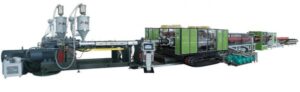
A typical plastic extruder has the following components:
Hopper: Where the raw polymer is deposited (as granules or pellets).
Feed forward: Transfers the plastic from the hopper to the barrel.
Screws: The cyclical component(s) that transport, compress, and combine the plastic.
배럴: A heated chamber that surrounds the screws. This chamber is divided into different zones of heating.
The head: At the conclusion of the barrel, it forms the plastic into the desired shape.
Breaker plate / Screen pack: It assists in the development of pressure and facilitates the melt flow through the die.
Cooling system: After the extrudate leaves the die, it is bathed in water, air, or a rolling motion to solidify.
Drive system: Motor, gearbox, and controller — all of these components contribute to the force that is applied to the screw.
Control system: Heaters, thermostats, and PID machines that maintain the temperature of the barrel.
These components are combined effectively to form a continual process: feed → melt → mix → shape → cool → produce.
Types of Plastic Extruders: Single-Screw vs Twin-Screw
Plastic extruders are available in different varieties, including single-screw and twin-screw extruders, the latter of which is more popular. The selection is based on the type of material, the production goal, the need for mixing, and the cost.
-
Single-Screw Exuder
This is the most basic and popular type. It’s composed of a single circular motionless rod inside a hot barrel.
The screw’s design typically has three distinct regions: feed, transition, and metering.
In the compression zone, the screw’s channel depth is decreased, which causes the polymer to be compacted, generate shear, and the material to melt.
In the metered zone, the polymer is completely melted and uniformly mixed; it functions as a pump that delivers a consistent flow to the die.
The single-screw extruder is popular for thermoplastics like PE, PP, PVC, and PS, and is common in film, profiles, sheets, and granulation patterns.
Advantages: Design simple, cost low, maintenance easy, and stable operation for many common polymers.
-
Twin-Screw Exuder
Twin-screw extruders utilize two screws that are arranged in parallel; either there is a mix of intermeshing and non-intermeshing, or there is only one.
In intermeshing dual-screw extruders, the screws can engage and create alternating chambers, which will facilitate a positive displacement transport, better mixing, and self-cleaning.
In non-intermeshing designs, the volume of free space between the screws is greater, which can promote the dissipation of shear-intensive materials.
The barrel is typically composed of multiple functional regions: feeding, compaction, and metering, which are similar to single-screw extruders.
Benefits: Excellent capacity for mixture, degasification (venting) capacity, handling of difficult combinations, and high volume.
How Does a Plastic Extruder Work? Step-by-Step Process
Understanding the fundamental principles of a plastic extruder requires traversing the major phases of operation:
-
Providing/transferring
The polymer’s raw material, in the form of pellets or powder, is deposited in the hopper.
Gravity and feeders facilitate the transport of the material to the zone of feed.
The circular motion of the screw moves the plastic forward across the length of the barrel, which initiates the melting process.
-
Melting and Plasticizing
As the substance progresses, it is subjected to mechanical pressure from the rotation of the screw and external heat from heaters in the barrel.
In single-screw extruders, the feeding area becomes a compression area, the depth of the channel decreases, and the material is sheared and compacted.
The melted polymer is homogenized in the zone of measurement, and the temperature is regulated so that the extruder produces a consistent melt.
-
Homogenization and Mixing
In single-screw machines that lack a rotor, the process of combining ingredients or colors is facilitated by the geometry of the screw. This helps to add additives or decorations.
In twin-screw extruders, the intermeshing screws have a high degree of rotation, which causes the material to be transported across the screws in a sheared state, then re-entered for a uniform distribution.
Twin-screw designs have extra features that allow for efficient addition of fibers, fillers, or agents that react with the plastic.
-
Completely stop the flow and pressurization
The extruder generates pressure as the melted plastic is moved toward the die. The plate/ screen pack that breaks the pack of cards maintains pressure and skips impurities.
The molten polymer is forced through the die and shaped into the desired profile across the board (pipe, sheet, filament, etc.).
-
Cooling and Solidification
Immediately following the exit of the die, the extrudate is solidified to become a solid. Different products have different cooling methods.
Water bath (common in pipes and profiles)
Air conditioning or fans that pull in fresh air and sheets.
Tables that roll or tables that are used to set dimensions and reduce distortion are crucial to the proper cooling process. This process ensures the stability of the final product and its mechanical properties.
-
Laterality of Attention
Once the product is cooled, it may require: slicing (e.g., pelletizing, pellet lines), winding (for film), sizing (for profiles), or additional processing (surface finishing).
Quality control inspections are often performed after, or incorporated into, downstream monitoring of dimensions, melt quality, and surface finish.
Key Design Parameters & Process Variables
To successfully operate a plastic extruder, engineers must consider the critical design and procedure variables:
-
Screw configuration
Length-to-Diameter Ratio (L/D): Its effects on residence time, shearing, and melting quality are dependent on the ratio. The typical L/D ratio is 20:1 to 30:1 for single-screw extruders.
Compression Ratio: It’s the ratio of the depth of the root to the distance between the feed and the compression zones; this ratio affects the melting and generation of pressure.
Pitch and flight geometry: It alters the efficiency of conveying things and the behavior of shear.
Combining Elements (for dual screws): Kneading blocks, reversed flights, combining paddles, etc., to achieve tailored mixing and shearing.
-
Temperature control of the barrel
The barrel is composed of multiple zones of heating (feed, compaction, metering) that are specifically designed to control the plasticization process.
External heaters (e.g., band heaters) and cooling zones are employed to ensure the temperature profile is of paramount importance.
Modern systems employ controllers like PID’s, thermocouples, and feedback that is real-time in order to maintain consistent process conditions.
-
The Design
The geometry determines the shape of the extrudate’s cross-section. Complexes that have multiple lumens, profiles, and multiple layers need to be designed with care in order to avoid imbalances in flow.
Breaker plates or screen packs located behind the die facilitate the maintenance of pressure and the removal of debris.
-
Throughput and Screw Speed
The frequency of the screws (RPM) is variable; higher RPMs lead to a higher volume of production, but they also increase the energy and shear consumption.
The frequency of feed and the speed of the screws must be equal in order to have a steady, stable extrusion.
-
Back pressure and consistency of the melt
Back-pressure (from packs of screws or plates that break) ensures that the melt is completely plasticized and lacks unmelted particles.
The proper combination of components and the design of the screws ensures the temperature is uniform and the flow is consistent.
-
에너지 효율성
Modern extruders have energy-saving capabilities: frequency converters that regulate the speed of motors, efficient heating components, and optimized thermal control.
Reducing energy consumption not only decreases costs but also increases sustainability.
Applications of Plastic Extruders in Industry
Plastic extruders are employed in a variety of manufacturing fields, including:
Profile extrusion: Creating pipes, tubing, window frames, and custom profiles from PVC, PE, and PP.
Film and Sheet Production: Creating plastic sheets, films for packaging, and other industrial films.
Wire & Cable: The extrusion of insulating sheaths around wire and cable.
Overlapping: In twin-screw extruders that combine polymers with supplementary components, fillers, colorants, glass fibers, and flame retardants.
Pelletizing / Regrinding: This method uses extruders to convert plastic trash into regrind; it’s often combined with a 과립화 라인.
3D Printing Filament Production: Small-scale extruders (like the filament extruder) melt pellets into consistently sized filaments.
Reactive Extrusion: The process of creating or altering polymers through chemical reactions inside dual-screw extruders.
Advantages & Challenges of Plastic Extrusion Technology
-
장점
High Throughput: Constant process allows for large production volume.
Fictivversatility: can create a variety of profiles, films, sheets, and compounds.
Cost-Efficiency: Constant operation reduces the number of cycles and labor needed per unit.
Recycling Friendly: Extruders can convert recycled or ground plastic into an efficient form.
사용자 지정: The design is capable of customizing to different cross-sections, multiple-layer profiles, etc.
-
Adversities and Limitations
Heat Management: Maintaining the proper temperature ranges is essential; poor control will lead to a degradation or insufficient melting.
Residence Time Distribution: In single-screw extruders, the residence time can be long, which may lead to some degradation or uneven melting.
Limitations of Mixing: Single-screw machines have a hard time dealing with high-fill combinations or complex substances.
Energy Consumption: While energy-saving behaviors are helpful, extruders still have a power signature.
Wear and Maintenance: Screws and barrels tend to wear out; this is especially true of materials that are abrasive or filled.
The Design complexity: Complex profiles are difficult to design and can increase the cost.
Maintenance, Troubleshooting & Best Practices
-
Common Maintenance
Examine and maintain the screws and barrels regularly in order to recognize wear or accumulation.
Watch out for heater bands and thermocouples: make sure they’re functioning, have been properly tuned, and are being replaced when necessary.
Grease the gearbox and the motor’s bearings as advised by the manufacturer.
Substitute screen packs or plate breaks when jammed; this facilitates the maintenance of pressure and quality.
-
Troubleshooting Common Problems
| 문제 | 가능한 원인 | 해결 방안 |
| Poor plasticizing / unmelted granules | The temperature too low, the screw speed is too slow | Increase barrel zone temperature, adjust RPM |
| Fluctuating flow or surge | Inconsistent feed, worn screw | Check the feed system, replace the worn screw |
| Overheating or material degradation | Excessive shear or heating | Reduce speed, optimize screw profile, check cooling |
| Die line fluctuations or distortion | Poor die design or cooling | Redesign die, improve cooling, adjust puller/cooler |
-
optimized processes
Employ data recording (temperature, pressure, and motor speed) for process oversight and abnormal behavior detection.
Design the geometry of the screws for a specific polymer and purpose: choose the appropriate L/D ratio of compression, and combination of elements.
Implement a frequency converter that reduces the speed when necessary: conserve energy during low usage scenarios.
Consider pre-drying hydrogels that are hygroscopic (e.g., PET) in order to avoid the degradation caused by moisture.
Maintain a comprehensive quality assurance (QA) regimen: sample extrudate, measure dimensions, and conduct rheological tests if necessary.
Emerging Trends & Innovations in Plastic Extrusion
-
Industry 4.0 and Smart Extruders
Real-time monitoring of temperature, force, and volume via Internet of Things sensors.
Predictive maintenance utilizing data analysis: minimize the amount of downtime by replacing parts before failure.
Modern control systems are advanced enough to optimize the use of energy, reduce waste, and maintain a consistent level of quality.
-
Innovative Materials and Recycling
Twin-screw extruders are popularly employed for the compounding of recycled plastics and biopolymers.
Reactive extrusion: inside the extruder, chemicals are added to polymers to create materials with advanced properties (e.g., compatibility salts, flame retardants).
The use of low-power extruders with enhanced screws and heating components to reduce energy expenditure.
-
Computational Modeling & Simulation
Models with finite elements and reduced order are intended to predict the behavior of the melt; they optimize the design of the die and the screws.
The design of mixers is increasingly dependent on numerical methods to facilitate the distribution of the mixture and reduce the dead zone.
-
Sustainability Pull
Spreading of the use of regraded and recycled components in extrusion processes.
The creation of extruders that are compatible with biodegradable or bio-based plastics.
Systems that are closed in the loop for extrusion in recycling plants reduce the amount of plastic and the energy consumed.
결론
The plastic extruder is still one of the most important and versatile machines in the manufacturing of polymers. By comprehending the physical principles that underlie extrusion, as well as the practical aspects that influence performance, professionals in the industry can design and operate extrusion lines that maximize quality, efficiency, and sustainability.



 English
  Russian
  Spanish
  Arabic
  German
  French
  Persian
  Turkish
  Bulgarian
  Czech
Czech  Dutch
Dutch  Greek
Greek  Indonesian
  Japanese
  Korean
  Polish
  Portuguese
  Romanian
  Slovenian
  Ukrainian