
Abstract:
The extrusion of stretchy film is a highly-engineered process that involves material science, mechanical engineering, and thermal management.
The center of this procedure is the 스트레치 필름 압출기, a complex system that melts, forms, stripes, cools, and winds polyethylene-based films with a specific thickness, strength, and elongation.
This article provides a comprehensive, professional description of the stretch film extrusion process. It covers the preparation of raw materials, the mechanisms of extrusion, the forming of films, the stretching stages, the cooling of the process, and the quality control of the process.
Introduction: Why the Extrusion Process Defines Stretch Film Performance
Stretchable film is commonly utilized in packaging, logistics, and industrial pallet wrapping because of its exceptional stretchability, load retention, and puncture resistance. However, these attributes are not intrinsic to polyethylene alone, either. They’re derived from a carefully planned extrusion and stretching process that is conducted by a stretch film extrusion machine.
Unlike the rigid plastic extrusion method, the production of stretch films is dependent on this:
- Directed molecular rotation
- Constant thickness of uniform width across broad spaces.
- Exact tension control during stretching.
Understanding the 압출 process is therefore crucial to both producing film and reducing waste or maintaining a consistent performance across different production runs.
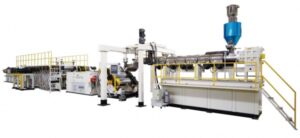
Overview of a Stretch Film Extrusion Machine
A stretch film extrusion machine is not singular, but instead is a series of multiple subsystems that work in succession.
- Common components include:
- The method of raw material feeding and dosing.
- Single-screw or dual-screw extruder
- Melt-based filtering and measuring system
- Film forming mechanism (cast or blow)
- Stretching and orienting units
- Cooling and edge trim systems
- Winding and rolling equipment
Each stage directly affects the molecular composition and ultimate mechanical behavior of the stretch film.
Step 1: Raw Material Selection and Preparation
Polymeric materials are employed in stretchy films.
Many stretch films are made of:
- Linear low-density polyethylene (LLDPE)
- Metallocene-catalyzed polyethylene (mPE)
- mezcles of LDPE and LLDPE
The selection of material is critical:
- Stretchability
- Adherence to performance
- Tear strength
The feeding of material in the extrusion process.
In a stretch film extrusion machine, the raw materials are typically transferred through:
- Those who weigh themselves
- Loss-based dosing systems
These systems guarantee the accurate formulation of chemicals, especially when supplemental ingredients like this:
- Tackifiers
- Slip advisors
- Additives that anti-block
- are combined
Step 2: Melting and Plasticization in the Extruder
The extruder functions in the production of stretch films.
The extruder is the central part of the stretch film extrusion machine. Its purpose is to:
- Transmit solid polymeric pellets
- Freeze them all at the same time
- Homogenize the mixture
Many stretch film producers utilize single-screw extruders that are optimized for:
- Low stress on the sheer
- Constant output
- Temperature consistency
- 온도 프로파일 조절
The barrel is composed of multiple areas that are heated:
- Feeding area
- Compression area
- Metering area
Precise temperature regulation avoids:
- Polymer deterioration
- Gelation
- Melt instabilidade
Step 3: Melt Filtration and Metering
Before movie creation, the molten polymer traverses to:
- Screen adapters
- Melt appliances
The importance of Melt Filtration is documented.
In stretch film extrusion, even small microscopic particles can cause:
- Film failure
- Defects on the surface
- Decreased stretchiness
Melt generators maintain pressure and flow rate, which enables the stretch film extrusion machine to consistently produce films with a uniform thickness across broad production ranges.
Step 4: Film Forming Methods
Stretch film extrusion is typically accomplished using one of two methods.
Cast Film Extrusion
In the extended cast film:
Texit the flat die.
The camera is now traveling at a fast pace over a flat surface.
Advantages include:
- Excellent consistency of thickness
- High definition
- High production volume
Film extrusion that is blowing ( Less common with stretch film )
Some stretch films are manufactured via the extrusion of films that are blown. This process involves:
- Melt is pumped through a circular opening.
- The volume of air increases the thickness of the film.
This approach provides superiority:
Balanced mechanical properties.
However, lower productivity compared to continuous film lines.
Step 5: Stretching and Molecular Orientation
Why It’s Important to Stretch
Stretching typically aligns the polymer chains in the machine direction (MD) and sometimes the transverse direction (TD); this typically improves the fabric.
Shear strength
Volatile recovery
Capacity to hold loads
Stretching units in a stretch film printing machine
Stretching is accomplished with the use of:
- Different speed rollers
- Previously-heated areas
- Tension systems that are controlled
The stretch ratio is one of the most significant parameters in the extrusion process as a whole.
Step 6: Cooling and Thickness Stabilization
After stretching, the film must be:
- Rapidly cooled
- Dimensionally stabilized
Cooling systems include:
- Chill rollers
- Air knives
- Water-cooled rollers
Improper cooling can lead to:
- Shrinkage
- Wrinkling
- Uneven roll profiles
Step 7: Edge Trimming and Recycling
Edges are limited to:
- Subtract the variation in thickness
- Increase the quality of the winding process
Trim waste is typically:
- Reused on the same line
- Returned to the extrusion method
A modern stretch film extrusion machine is built to withstand regrind without negatively impacting the quality of the film.
Step 8: Winding and Roll Formation
Winding systems must maintain:
- Consistent tension
- Smooth roll edges
- Accurate roll length
Poor winding directly affects:
- Downstream converting
- End-user application performance
Key Process Parameters in Stretch Film Extrusion
| 파라미터 | Typical Range | Impact on Film Quality |
| Melt temperature | 180–230°C | Affects clarity and strength |
| 연신률 | 2.5:1 – 5:1 | Determines elasticity |
| Chill roll temperature | 10–25°C | Controls surface finish |
| Line speed | 200–600 m/min | Influences the thickness uniformity |
| Film thickness | 8–35 microns | Defines the application range |
Quality Control in Stretch Film Extrusion
Quality control is of paramount importance in stretch film extrusion because even small changes can have a direct effect on the performance of the film, the cost of production, and customer satisfaction. Effective quality control involves a commitment to raw material management that extends throughout the extrusion process.
- Raw material consistency
Stretching the film’s performance is primarily dependent on the quality of the polymer, typically LLDPE, and its combinations. Variations in the melt flow index (MFI), contamination, or the improper ratio of recycled content can cause inconsistent thickness, poor clarity, and reduced tensile strength. Future material inspection and historical data collection are crucial to maintaining consistency.
- Control of Thickness and Gauge
The uniform thickness of films is one of the most significant quality metrics. Automatic gauging systems that use beta-rays or infrared sensors to detect film thickness across the web. Deviations are rectified in real time by adjusting the bolts or the air ring’s parameters; the purpose of this is to minimize waste while ensuring a consistent mechanical property.
- Mechanical Property Testing
Constant monitoring of the tensile strength, stretchiness, puncture resistance, and clinginess of the film is used to ensure that it meets the requirements of the application. Combining online and offline testing with statistical process control (SPC) facilitates the identification of trends prior to the defect reaching the customer.
- Visual and Functional Review
Clarity, haze, gels, and surface imperfections are assessed visually and with optical technology. Functional tests, such as the load-holding capacity and unwind behavior, demonstrate that the movie is consistently effective in real-world operations that involve pallet wrapping.
Energy Efficiency and Process Optimization
The consumption of energy is one of the largest expenses in stretch film extrusion; as a result, manufacturers are focusing on efficiency in order to reduce costs.
- The extruder and its efficiency in the drive
High-efficiency motors and optimized screws diminish the consumption of energy while maintaining a consistent quality of melt. The design of the screws is matched to the material type and the output needed, which reduces the generation of unnecessary heat and shear.
- Temperature and Temperature-optimizing
Precise temperature regulation across the barrel, the die, and the cooling system that is built in prevents overheating and excessive cooling. Effective air circulation and cooling systems enhance the speed of solidification of the film, which allows for higher line speeds while still maintaining quality.
- Automation of processes and monitoring
Modern advanced control systems have the ability to observe pressure, temperature, and output in real time. Automated adjustments diminish the dependency of the operator, maintain a consistent production, and minimize the energy expenditure caused by process changes or additional rework.
- Productivity-enhancing optimization of the material yield
Reducing the thickness of films while still maintaining their strength—often through the use of optimized stretching ratios or multiple layers of film—lowers the consumption of raw materials and the amount of energy required per finished roll, which improves the overall sustainability of the process.
Common Process Challenges and Solutions
Despite technological improvements, stretch film extrusion has several constant problems. Understanding the causes will facilitate faster resolution of problems and consistent production.
- Inconsistent Film Thickness
Effects: Uneven flow, temperature imbalance, or malfunctioning air ring.
Solution: Constant monitoring of the die, precise temperature regulation, and standardized air passages help to maintain consistent thickness.
- Poor Clarity or Excessive Haze
Effects: Incorrect rate of cooling, impure materials, or excessive shearing.
Solution: Increase the efficiency of the cooling process, improve the quality of the material, and decrease the stress caused by the melting process.
- Gels and Black Specks
Effects: Decayed polymer, malfunctioning extruder components, or reusable material mischief
Solution: Increase the effectiveness of the screen, maintain the cleanliness of the screws and barrels, and regulate the length of time spent in the residence.
- The instability and breakage of the film
Effects: uneven temperature regulation, poor drawing, or flimsy tension control.
Solution: fine-tune the parameters used to stretch, maintain the conditions used to cool down, and ensure consistent tension in the winding.
- Elevated rates of scrap
Effects: Frequent new startups, erratic control of the process, or late detection of defects
Solution: Implement SPCs, improve the startup procedure, and utilize online monitoring to recognize problems before they become serious.
FAQ: Stretch Film Extrusion Process
- What is the purpose of a stretch film extrusion machine?
A stretch film extrusion machine is employed to create elastic polyethylene films that are intended for use in the palletizing process, load support, and industrial packaging.
- What components are typically employed in stretch film extrusion?
LLDPE, metallocene polyethylene, and blends of polymers are typically employed because of their exceptional stretch and regaining capabilities.
- What is the distinction between cast and blown stretch film extrusion?
Cast extrusion has a higher productivity and superior control over thickness, while blown extrusion has a more uniform mechanical composition.
- Why is it important to stretch during the extrusion process?
Stretching causes the alignment of polymer chains, which increases the strength, stretchiness, and capacity to hold loads.
- How does temperature influence the quality of stretch films?
Incorrect temperatures can lead to degradation, poor clarity, and inconsistent mechanical performance.
- Can reusable material be incorporated into stretch film extrusion?
Yes, it is possible to control the volume of regrind incorporated into the multilayer film. This is particularly true of the inner layers of the film.
- What controls the ultimate thickness of stretch film?
The gap, average melt rate, stretch ratio, and line speed all have an effect on the thickness of the film.
결론
The extrusion of stretchy film is a complex industrial procedure that extends beyond the simple melting and creation of plastic. A proper design of a stretch film extrusion machine that takes into account material science, mechanical precision, and thermal control will produce films that have a consistent quality and performance.
By understanding each component of the extrusion process in detail, manufacturers can increase the efficiency of their production, reduce waste, and provide stretch films that are demanded by modern packaging and transportation industries.


 English
  Russian
  Spanish
  Arabic
  German
  French
  Persian
  Turkish
  Bulgarian
  Czech
Czech  Dutch
Dutch  Greek
Greek  Indonesian
  Japanese
  Korean
  Polish
  Portuguese
  Romanian
  Slovenian
  Ukrainian