
A blaasgietmachine belongs to the most essential technologies in modern plastic manufacturing. From simple water bottles to complicated automotive fuel tanks, all hollow plastic parts are accurately and consistently produced through the use of blow molding. It is made possible by the utilization of a very advanced system referred to as a blow molding machine, which transforms raw thermoplastic material into usable lightweight containers and components.
This complete manual about the machine, how it works, where it is used, and the process of choosing the best type according to your production will be described inside. Technical specs, classes, main design factors, and maintenance best practices shall also be discussed for engineers, manufacturers, and industrial buyers who would like to have an expert-level knowledge.
What Is a Blow Molding Machine?
A blow molding machine is an industrial machine that forms hollow plastic parts by blowing air inside a heated plastic tube (parison or preform) within a mold cavity until it assumes the required shape. It operates on the same principle as glass-blowing and uses hot, softened plastic expanded by compressed air against the walls of a mold. When cooled, it solidifies into a light but strong part.
Blow molding machines often find their use in making:
- Bottles and containers (for water, beverages, detergents, oils)
- Industrial drums and jerry cans
- Automotive ducts, tanks, and pipes
- Cosmetic, pharmaceutical, and household packaging
The process is efficient, high-speed, and cost-effective for large-volume production.
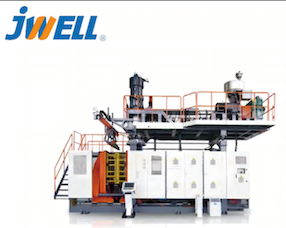
How Does a Blow Molding Machine Work?
The process of blow molding can be divided into four major steps:
-
Plastic Melting & Extrusion / Injection:
The thermoplastic resins (PET, HDPE, and PP) are heated and melted either by an extruder or by the use of an injection system.
-
Parison or Preform Formation:
The molten material is formed either into a parison (tube-like piece) or a preform (pre-shaped part-mostly used in PET processes).
-
Mold Clamping and Air Inflation:
The parison/ preform is closed in a mold cavity. Compressed air is introduced inside it so that the plastic takes the shape of the interior geometry of a mold.
-
Cooling and Ejection:
It is then cooled by means of water channels or by air flow; after cooling, it is ejected and trimmed for finishing. The cycle of a blow molding machine can be very repeatable and hence allows continuous automated production of identical parts.
What Are Blow Molding Machines Used For?
Blow molding machines are used for the production of hollow plastic articles by many industries.
Packaging articles include:
- Packaging Industry: PET bottles, HDPE containers, and cosmetic jars.
- Automotive: Articles from automotive fuel tanks, air ducts, and washer fluid bottles.
- Industrial: Industrial oil cans, chemical drums, jerry cans.
- Medical: Medical sterile containers, lab bottles
- Consumer Products: Some sports bottles, toys, kitchenware, consumer products.
High output with low material waste accounts for the reason why this method remains one of the most economical plastic forming methods.
In Which Fields Are Blow Mold Machines Commonly Used?
The applications of blow molding machines extend into almost every major manufacturing sector:
| Industry | Example Products | Material Used |
| Beverage Packaging | Water bottles, soda containers | PET |
| Chemical / Industrial | Jerry cans, oil drums | HDPE |
| Automotive | Fuel tanks, ducts, reservoirs | HDPE, PA |
| Household | Detergent bottles, shampoo containers | PP, PE |
| Pharmaceutical | IV bottles, pill jars | PP, PETG |
| Landbouw | Pesticide containers | HDPE |
The Purpose of Blow Molding Machines
The blow molding machine can be best defined as a device used to convert molten plastic into sturdy, light hollow shapes by means of regulated air pressure and cooling of the mold. It permits:
- Mass production efficiency
- Low material cost per unit
- Consistent quality
- Customizable shapes and wall thicknesses,
- Integration of threads, handles, or labeling zones.
In the overall packaging and manufacturing economy at a global level, blow molding takes an extremely important place, where it bridges low-cost production with material sustainability.
What Products Can Be Produced by Blow Molding?
Blow molding has made thousands of products across at least a dozen industries. Some of the most common categories are:
- Beverage containers: Water bottles, juice bottles
- Industrial packaging: Chemical drums, lubricant containers
- Automotive parts: Ducts, reservoirs, tanks
- Toys and consumer items: Balls, dolls, squeeze bottles
- Medical items: Sterile bottles, nebulizer containers
- Household products: Detergent and cleaning product bottles
Minimal tooling cost places blow molding at a very favorable competitive position when compared to other forming methods.
Types of Blow Molding Machines and Selection Guide
Choosing the right blow molding machine depends on production needs, resin type, product geometry, and automation level.
-
By Forming Method
| Type | Description | Typische toepassingen |
| Extrusion Blow Molding (EBM) | Molten tube (parison) extruded vertically and blown inside mold. | HDPE bottles, drums, jerry cans |
| Injection Blow Molding (IBM) | Preform injection molded first, then blown. | Pharmaceutical, cosmetic bottles |
| Stretch Blow Molding (SBM) | Preform stretched axially and radially before blowing for clarity and strength. | PET beverage bottles |
| Rotational Blow Molding (Rotomolding) | Heated mold rotates around two axes, forming large hollow parts. | Tanks, playground equipment |
-
By Material Type
PET stretch blow molding: clear, light in weight, strong against impact, HDPE/PP blow molding: resistance to chemicals, stiffness for industrial applications
-
By Equipment Setup
Single mold / Multi-cavity setups
Single screw / Twin screw extruders based on throughput requirements
Fully automatic / Semi-automatic lines by labor cost and scale of production
-
Selection Factors
To select, think about:
Volume
Product size
Plastic type
Mold count
Automatisering
Budget and energy consumption
Key Performance Indicators When Selecting a Blow Molding Machine
Choosing the right system requires evaluating multiple engineering parameters to ensure efficiency, precision, and reliability.
| Indicator | Meaning / Impact |
| Screw Diameter & L/D Ratio | Determines plasticizing capacity and melt uniformity |
| Number of Cavities | Directly affects productivity per cycle |
| Max Bottle / Container Volume | Defines part size limit |
| Positioning Accuracy | Ensures consistent preform centering and thickness |
| Cycle Time | Impacts production throughput |
| Automation Level | Labor efficiency, repeatability |
| Power Consumption (kW) | Operational energy efficiency |
| Material Utilization | Waste reduction ratio |
| Scrap / Reject Rate | Indicator of process stability |
These parameters together determine the machine’s cost-effectiveness and output quality.
Common Problems During Blow Molding Operation
Even advanced systems face operational challenges. Below are frequent issues and their solutions.
| Problem | Root Cause | Recommended Solution |
| Uneven Wall Thickness | Improper parison control, cooling imbalance | Adjust parison programming; recalibrate temperature |
| Shrinkage or Air Bubbles | Inconsistent temperature or moisture in resin | Pre-dry material, balance air pressure |
| Bottle Neck Deformation | Misalignment or improper mold cooling | Maintain uniform cooling flow |
| Mechanical Malfunction | Poor lubrication, sensor failure | Schedule preventive maintenance |
| Electrical/PLC Error | Software or sensor signal fault | Reset PLC, replace sensors if necessary |
Preventive Measures
- Accurate machine selection
- Timely maintenance and lubrication
- Operator training and standard procedures
- Proper mold temperature management
- Routine process audits
Key Manufacturing Technologies in Blow Molding Machine Design
Blow molding machines integrate several critical engineering and automation technologies:
-
Screw and Barrel Design
Geometry stability ensures a stable melt flow and uniform plasticization process. L/D ratios fall between 24:1 to 30:1, depending on the viscosity of the specific polymer being processed.
-
Mold Design and Cooling System
Cool effectively to achieve reduced cycle time and good dimensional accuracy. Multi-zone temperature control and baffle cooling channels are features of modern molds.
-
Positioning and Handling Systems
Advanced machines have preform grippers that are servo-controlled as well as robotic transfer systems used for precision alignment.
-
Control Systems (PLC/HMI/Servo Drive)
PLC guarantees automation and consistency of the process. HMI makes the operation easy. Servo motors increase energy efficiency as well as accuracy.
-
Automatic Mold Change and Scrap Ejection
It is fully automatic, which gives quick mold change, hence reduced downtime. Scrap detection sensors enable auto rejection.
-
Energy-Saving Innovations
More recent designs feature:
Drives with variable-frequency
Systems for heat recovery
Low-pressure pre-blow sequences minimize the energy consumption.
Maintenance and Care Guide for Blow Molding Machines
Routine maintenance is key to long-term reliability and productivity.
-
Daily:
Clean mold surfaces and remove debris from the machine.
Check hydraulic oil levels and air filters.
Inspect heaters and thermocouples.
-
Weekly:
Lubricate guide rails and screw units.
Check the calibration of pressure sensors.
Examine the cooling system for blockage.
-
Monthly:
Test PLC/HMI functionality.
Inspect motor alignment and belts.
Review energy consumption logs.
-
Annual Overhaul:
Replace seals, hoses, and bearings if worn out.
Conduct a full mechanical alignment check.
Update software and safety firmware.
Comparing this to buying new equipment or even having lengthy downtimes, the investment will pay off very fast.
Market and Industrial Trends in Blow Molding Manufacturing
The world market for blow molding machines keeps growing because of:
Higher demand for PET bottles, Lightweight car parts, Green efforts with reusable plastic, and The use of robots and digital controls in making things.
New factories use Internet links, Predictive care, and AI-based checks for quality making smarter, cleaner production lines.
Conclusie
A blow molding machine is a forceful and plastic-flexible system that forms thermoplastic material into useful articles of everyday use. Knowledge of its working principle, applications, and major key performance indicators results in added value for engineers, manufacturers, and procurement professionals.
From extrusion to stretch blow molding from PET bottles to automotive fuel tanks, this is a performing technology precise on sustainability at scale.
When selecting a blow molding machine, always evaluate:
- Type of product and choice of material
- Output requirement and cycle time
- Level of automation and energy-saving capacity
- Maintenance support and supplier support
With good setup using quality material and regular maintenance, blow molding machines can work several decades giving high output performance production—driving innovation across industries from packaging to automotive.



 English
  Russian
  Spanish
  Arabic
  German
  French
  Persian
  Turkish
  Bulgarian
  Czech
Czech  Dutch
Dutch  Greek
Greek  Indonesian
  Japanese
  Korean
  Polish
  Portuguese
  Romanian
  Slovenian
  Ukrainian