
Abstract:
The linia do wytłaczania rur method is a core manufacturing process that is used to create thermoplastic pipes that have a consistent size, mechanical properties, and performance over time.
According to Rosato’s Plastics Handbook, Brydson’s Plastics Materials, and the Plastics Industry Association (PLASTICS) technical reports, pipe extrusion is the most popular production method for PVC, PE,PP, and composite pipes that have multiple layers. This is because of its efficiency, scalability, and precise control over the process.
This article provides a comprehensive, industry-oriented description of the process of extruding pipes, it focuses on the structure and functioning of a typical extrusion line for pipes, the behavior of materials, the parameters of the process, quality control, and emerging technology. Through the incorporation of superior practices that are reflected in the top-ranked resources of the industry, this guide facilitates the understanding and optimization of pipe extrusion systems for manufacturers, engineers, and professionals in procurement.
Introduction: Why Pipe Extrusion Is Fundamental to Modern Infrastructure
Pipes serve as one of the most important components of modern infrastructure, these components enable the supply of water, drainage, distribution of gas, communication, and transport of industrial fluids. Every plastic pipe that’s currently in use has a precise extrusion process that is designed to produce a consistent thickness of wall, mechanical stability, and long life.
From the perspective of a search engine, users who query “What’s the process of extrusion of pipe?” are typically engineers, equipment owners, project managers, or investors who want a more detailed understanding. They’re attempting to understand the mechanism of extrusion of pipes, the equipment involved, the behavior of materials during processing, and the impact of process variables on the quality of the final product. This article is intended to fulfill that goal comprehensively.
What Is the Pipe Extrusion Process?
The pipe extrusion method is a continual manufacturing process that involves melting thermoplastic material through a special design of a die to produce a hollow cylinder. After extrusion, the pipe is chilled, sized, and pulled away from the extruder in a uniform production line.
Unlike the batching process, pipe extrusion is run in a continuous manner, which makes it highly beneficial for mass production. The consistency of the output is dependent on the precise coordination of the entire extrusion line for pipe material, including the feeding of material to the final cut.
Core Components of a Pipe Extrusion Line
A modern extrusion line for pipes is a system that is integrated rather than a single machine. Each component has a specific function that affects, stabilizes, and terminates the pipe.
The extruder is the center of the pipe extrusion chain. It dissociates, homogenizes, and increases the pressure of the polymer’s melt. Single-screw extruders are typically used for the production of pipes, although twin-screw extruders are employed for the production of PVC and other sensitive formulations.
Main functions include temperature regulation and the consistent output of plasticizer.
- The Head and Mandrel System
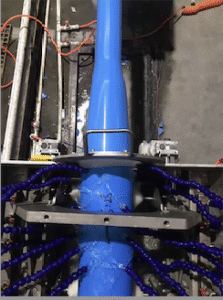
The die’s head forms the molten polymer into a tubular structure. Within the die, a mandrel is responsible for creating the inner diameter, while the body of the die is responsible for creating the outer diameter.
The design is important, as it directly affects the uniformity of the wall’s thickness, the surface quality, and the balance of the melt.
- Vacuum Calibration and Sizing Device
After exiting the die, the hot pipe will travel to a tank that is intended for calibration with a vacuum. This unit maintains the dimensions of the pipe by applying pressure to the pipe via the calibration sleeves while the process of cooling begins.
This stage is crucial to achieving precise outer dimensions and roundness, especially in high-speed extrusion lines that use pipes.
- Cooling System
After the initialization stage, the pipe will travel through water chambers that are sprayed with water or placed in an immersion bath. Controlled cooling is employed to prevent internal tension, warping, and dimensional misbalance.
The length and configuration of the cooling tanks are dependent on the pipe’s diameter, thickness, and speed of extrusion.
- Jednostka ciągnąca
The unit that hauls off the pipe extracts it through the entire line of extrusion at a pre-programmed speed. Hauls or belts are frequently employed to maintain consistent tension without altering the pipe’s shape.
The speed of synchronization between the extruder and the haul-off is essential for maintaining a uniform thickness of walls.
- Systematic Cutting and Stacking
The final stage of the extrusion process involves slicing the pipe into pre-designed lengths. Depending on the type of pipe, the cutting process may involve the use of a planetary saw, a flying knife, or a chipless cutter.
Automated pipetting or stacking systems may be employed for downstream processing.
Materials Commonly Used in Pipe Extrusion
The process of extruding pipes is compatible with a variety of thermoplastic materials. Each material has a unique set of challenges associated with processing and unique performance properties.
Common supplies include:
PVC (plasticized and rigid)
High-Density Polyethylene and Low-Density Polyethylene
PP (PP-R, PP-H)
PEX
Composite structures with multiple layers
The selection of material affects the design of the extruder, the temperature of the profile, and the configuration of the line.
Step-by-Step Overview of the Pipe Extrusion Process
Step 1: The raw materials’ preparation
The procedure starts with choosing and preparing thermoplastic materials like PVC, HDPE, LDPE, PP, or PPR. These components are typically packaged as pellets or powder. Additives like stabilizers, lubricants, colorful patterns, and impact modifiers can be incorporated into the mix to improve performance, durability, or appearance.
Step 2: Consuming and Melting
The prepared substance is transferred into the extruder hopper, which is then inserted into the heated container. Inside the barrel, a reciprocating motion conveys the material forward while melting it at the same time through a combination of temperature, pressure, and shear force. Precise temperature control is employed that ensures the same degree of melting and avoids material deterioration.
Step 3: Dilation and Compaction
As the molten polymer progresses along the screw, it is completely mixed. The extruder produces consistent pressure, which ensures a consistent and direct flow of melt toward the die. This step is essential for maintaining the accuracy of pipe dimensions and the quality of the surface.
Step 4: Form the Pip
The plastic that is molten leaves the extruder through a pipe that extrudes it into a hollow cylinder shape. The design of the die affects the pipe’s outer diameter, thickness of the wall, and degree of concentricity. A mandrel positioned inside the die determines the inner diameter of the pipe.
Step 5: Vacuum Calibration
After exiting the die, the hot pipe will travel to a tank that is intended for calibration with a vacuum. The pressure from the vacuum is used to pull the pipe into position against the calibration sleeves. This ensures the precise measurement of dimensions and a smooth exterior. Additionally, water’s cooling process begins to compact the pipe’s shape.
Step 6: Cooling
The pipe continues through one or more cooling centers, where water is controlled to a degree that further increases the strength of the material. Effective cooling methods prevent distortion, internal stress, and uneven wall thickness, which ensures long-term performance of the pipe.
Step 7: Haul-Off (Dragging)
A unit that takes off, typically equipped with a belt or caterpillar-style grip, will pull the pipe at a consistent speed. The speed of the haul-off must be identical to the extrusion rate to maintain consistent dimensions of the pipe and avoid stretching or compressing it.
Step 8: Trimming or Winding
Once the pipe has reached the desired length, it is cut using an automatic cutter (such as a planetary or flying saw). Smaller diameter pipes can be wound into coil shapes, while larger diameter pipes are lengthened into fixed configurations.
Step 9: Inspection and Quality Control
All finished pipes are subject to quality assessments, which include:
Diameter and thickness of the wall.
Inspection of the surface
Pressure and mechanical stress
Only those pipes that are manufactured according to industry regulations are packaged.
Step 10: Conveying and Storing
The final pipes are gathered, bundled, or coiled and intended for storage or transportation. Effective packaging is employed that safeguards the pipes from distortion, direct sunlight, and mechanical trauma during transportation.
Process Parameters That Affect Pipe Quality
- Temperature of extrusion
Temperature regulation across the barrel regions, including the die, and melting is essential.
Low: Incomplete melting, poor surface quality, weak weld lines
Too high: Decomposition, discoloration, decreased mechanical resistance.
Each material (PVC, HDPE, PP, PPR) has a specific optimal temperature range that must be maintained.
- Screw’s speed
Screw speed has a direct relationship to the output rate and quality of the melt.
High speeds in the screws may increase production, but they may also lead to overheating, melting issues, or air entrapment.
Low speeds of the screws can cause poor uniformity in the melt and inconsistent thickness of the walls.
A consistent speed of the screws ensures consistent pressure and a uniform flow of melt.
- Heat of Melting
Constant pressure melting is crucial to obtaining accurate dimensions.
Pressure fluctuations can lead to variation in diameter, uneven thickness of the wall, and defects on the surface.
Effective pressure control increases the consistency of the pipe and improves the smoothness of the surface.
The pressure that melts the plastic is dependent on the design of the screws, the temperature of the plastic, and the material’s consistency.
- The Design and Temperature
The extrusion die has a direct effect on the pipe.
The poor design of the die can lead to a lack of balance, lines, or otherness.
Incorrect temperatures will affect the uniformity of the melt flow and the quality of the surface.
Effective dies facilitate a smooth melt distribution and precise pipe specifications.
- Vacuum Calibration Point
The pressure in the tank with the vacuum is used to control the outer diameter and roundness of the caliper.
A vaguely low vacuum causes round or other types of failure
Excessive pressure may lead to surface damage or distortion.
Constant and accurate vacuum levels are essential to achieving precise tolerances.
- The Cooling rate and Water temperature
The direct effect of cooling on the pipe’s structure and stress distribution is observed.
Rapid cooling can lead to internal tension and brittleness.
Slow or uneven temperature decrease may lead to deformation and warping.
Controlled, slow cooling is responsible for maintaining the stability of dimensions and long-term performance.
- Haul-Off speed
The unit that hauls off determines the stretching of pipes and the thickness of walls.
Too slow: Reduced thickness of the wall, decreased pipe length
Too slow: Solid walls, large buildups at the conclusion.
The speed of the haul-off should be precisely identical to the extrusion rate.
- The Quality of theaterial and the formulation
The consistency of the raw material has a significant impact on the quality of the pipe.
Variations in resin quality, humidity, or supplements can lead to flaws
Effective drying, blending, and composition of the ingredients ensure consistent results and a repeatable process.
- Conditions in the Environment
The ambient temperature and humidity have an effect on the efficiency of cooling and the behavior of materials, particularly regarding hygroscopic polymers. Constant quality is maintained in environments that are stable.
Typical Applications of Extruded Pipes
Extruded pipes are commonly employed in multiple fields because of their longevity, efficiency, corrosion resistance, and versatility of design. Depending on the material’s choice and the pipe’s specifications, they can serve both structural and fluid-related functions.
- Water Supply and Plumbing Systems
Extruded pipes derived from PVC, CPVC, HDPE, and PPR are frequently employed in:
Residential and commercial water distribution
Hot and cold plumbing systems
The distribution of drinking water.
They have a superior pressure-resisting capability, chemical stability, and a long service life.
- Sewerage and Drainage Systems
In urban and industrial infrastructure, extruded pipes are employed for:
Sewage transportation
Stormwater drainage
Subterranean water systems for wastewater treatment
Their smooth interior walls decrease the resistance of flow and minimize jams.
- Gas Delivery
HDPE pipes that are extruded have a wide popularity in the natural gas distribution industry because of their:
High resistance to impact
The ability to melt without leaking is called leak-free fusion welding.
Constant performance under stress
- Agricultural Irrigation
Plastic pipes that are extruded today support irrigation systems like this:
Drip irrigation
Sprinkler systems
Water transportation pipelines
They are heavyweight, resistant to ultraviolet light, and simple to install over large agricultural regions.
- Conduits for Electrical and Telecommunications
Extruded pipes serve as conduits for protection:
Electrical circuit
Optical fibers and communication lines
They serve as insulation, have moisture resistance, and provide mechanical protection in both subterranean and above-ground installations.
- Industrial Fluid and Chemical Transportation
In factories and chemical plants that utilize extruded pipelines, the handling of materials is accomplished via extruded pipelines.
Perceptible liquids
Industrial process fluids
Slurries and wastewater treatment
Materials likePP, PVDF, and PVC have chemical resistance and are safe during operation.
- Construction and Infrastructure
Extruded pipes are employed by:
Creating a drainage and ventilation system
Stuffed sleeves and encased pipes
Base and subterranean structures
Their ratio of strength to weight makes them ideal for large construction projects of construction.
- HVAC Systems
Plastic pipes that are extruded have applications in multiple areas.
Condensate drainage
Ventilation systems
Below the floor heating systems
They have thermal stability and can be easily incorporated into HVAC systems.
- Mining and Marine Technology
Heavy-duty extruded tubes are employed for:
The movement of soil in mining
Dredging processes
Seawater transfer systems
Their abrasion and corrosion propensity guarantee effective performance in adverse environments.
Comparison of Single-Layer and Multilayer Pipe Extrusion
| Feature | Single-Layer Pipe | Multilayer Pipe |
| Structure | Homogeneous | Co-extruded layers |
| Koszty | Lower | Higher |
| Właściwości eksploatacyjne | Standard | Enhanced (barrier, strength) |
| Sprzęt | Simple pipe extrusion line | Complex co-extrusion line |
| Zastosowania | Water, drainage | Gas, heating, specialty |
FAQ: Pipe Extrusion Line and Process
Q1: What is the definition of a pipe extrusion line?
A pipe extrusion line is a full-scale manufacturing system that is used to produce plastic pipes via continuous extrusion, cooling, and cutting.
Q2: What kinds of materials can be processed on a pipe extrusion line?
Common materials include PVC, HDPE, PP, PEX, and multiple-layer composites.
Q3: How is the diameter of the pipe altered during extrusion?
The diameter of the circle is altered using the design, calibration of the vacuum, and synchronization of the haul-off.
Q4: What is the distinction between pipe extrusion and profile extrusion?
Pipe extrusion produces products that are hollowed out, while profile extrusion produces products that have a solid or complex shape across the length.
Q5: How long do plastic pipes that are extruded last?
Effective manufacturing can lead to pipes that will last for over 50 years, depending on the material and purpose.
User Reviews
User 1: The diameter of the mold, the thickness of the wall, and other attributes can be altered to correspond to different requirements.
User 2: The extrusion line can consistently extrude pipes and employs a system of straightening and cooling that is used to ensure the consistency of dimensions and a high-quality appearance.
User 3: The extrusion line has a high productivity and can operate for a continuous period of 24 hours.
User 4: The pipe’s consistency is high, and the dimensions are accurate.
User 5: The extrusion production line can produce mass quantities of pipe with a high production efficiency, making it a core component of the plastic pipe manufacturing industry.
Wnioski
The process of extruding pipes is one of the fundamental components of modern plastic manufacturing. This enables the production of long-lasting, high-performance pipes that are used around the world. Understanding the function of a pipe extrusion line, from the melting of material to the final cutting of the line, enables manufacturers to improve quality, reduce costs, and remain relevant. As technology becomes more advanced, pipe extrusion will still have a significant impact on the development of sustainable infrastructure.



 English
  Russian
  Spanish
  Arabic
  German
  French
  Persian
  Turkish
  Bulgarian
  Czech
Czech  Dutch
Dutch  Greek
Greek  Indonesian
  Japanese
  Korean
  Polish
  Portuguese
  Romanian
  Slovenian
  Ukrainian