
Quick Answer: A high-speed blowing film machine is an extrusion system that melts thermoplastic resin — most commonly polyethylene (PE), polypropylene (PP), or the biodegradable polymer polylactic acid (PLA) — and continuously forms it into thin, tubular film through a blown bubble process. Modern high-speed lines can achieve output rates of over 300 kg/h per layer.
According to the Plastics Technology Handbook (Rosato & Rosato, 5th ed., Springer) and peer-reviewed benchmarks in Polymer Engineering & Science, critical performance differentiators between manufacturing platforms include die-head uniformity, air-ring cooling efficiency, and nip-roll take-up system precision. These factors directly govern film thickness tolerance and mechanical property consistency. With the flexible packaging market projected to reach USD 365 billion by 2030 at a CAGR of 4.3% (Grand View Research, 2024), as global demand for flexible packaging continues to outpace rigid formats, the engineering standards applied at the machine level have never mattered more.
Introduction: The Blowing Film Machine Market in 2025
The blown film extrusion process has been a cornerstone of the flexible packaging manufacturing industry for over six decades. However, the technology continues to evolve at such a pace that even well-established production facilities struggle to keep up. The global market for blown film lines is now about more than just raw output. Converters, packaging integrators, and agricultural film producers now ask fundamentally different questions when evaluating equipment: Can the line run multilayer coextrusion for barrier packaging? How precisely does it maintain gauge tolerance across a 3,000-hour production run? What is the actual energy cost per kilogram of film produced? Most importantly, does the manufacturer have the engineering support infrastructure to keep the line running at full capacity in a 24/7 production environment?
These questions are important because the economics of blown film production have become much more challenging. Resin prices remain volatile, labour costs have risen across manufacturing regions, and customer specifications, especially for food packaging, medical film, and agricultural mulch, have become more demanding. A machine that cannot maintain a thickness tolerance of ±2%, sustain consistent bubble stability at high haul-off speeds, or accommodate rapid material changeovers is not a cost-efficient asset; it is a throughput liability. The market has responded by focusing procurement decisions on a smaller number of technically capable manufacturers who can substantiate their performance claims with verifiable process data and reference installations. The purpose of this guide is to understand what differentiates those manufacturers — technically and operationally.
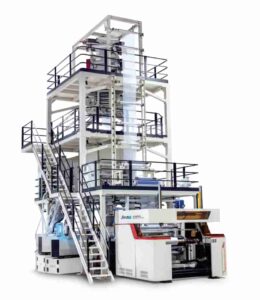
How a High-Speed Blowing Film Machine Works?
At its mechanical core, a blowing film machine comprises five functional subsystems that must operate in precise coordination to produce consistent, defect-free film at commercial output rates. The process begins at the extruder, where thermoplastic resin in pellet or powder form is fed into a heated barrel and conveyed forward by a rotating screw. As the material moves through increasingly hot barrel zones, it changes from a solid to a homogeneous polymer melt with a controlled viscosity profile. The screw geometry — specifically the compression ratio, L/D ratio and mixing zone design — has a decisive influence on melt homogeneity, and consequently on the optical properties and tensile strength of the film.
The molten polymer is then pushed through a spiral mandrel die head, which distributes the polymer uniformly around the circumference of the die gap. The die gap aperture, which is typically adjustable between 0.5 and 2.5 mm, controls the initial melt thickness before blowing. Immediately upon exiting the die, compressed air is injected through the centre of the die, inflating the melt into a cylindrical bubble. The blow-up ratio (BUR), which is the ratio of the final bubble diameter to the die diameter, typically ranges from 1.5:1 to 4:1, and is one of the main ways of controlling the mechanical orientation of the film. A dual-lip or internal bubble cooling (IBC) air ring system cools the bubble as it rises, setting the polymer solidification line (‘frost line’) at a controlled height. The collapsed flat tube then passes through a nip roll and haul-off system before being wound onto cores at the winder station.
Key Technical Parameters of High-Speed Blown Film Lines
The following table captures the specification ranges that differentiate entry-level, standard-industrial, and high-speed blown film lines — providing a standardized reference framework for procurement and benchmarking.
| Output Rate | 30–80 kg/h | 80–180 kg/h | 200–500+ kg/h |
| Number of Layers | 1 | 1–3 | 3–11 |
| Die Diameter | 100–300 mm | 200–600 mm | 400–1,600 mm |
| Film Thickness Range | 15–200 µm | 10–150 µm | 8–120 µm |
| Thickness Tolerance | ±8–12% | ±4–6% | ±1.5–3% |
| Screw L/D Ratio | 25:1–28:1 | 28:1–30:1 | 30:1–35:1 |
| Haul-Off Speed | Up to 30 m/min | Up to 60 m/min | Up to 120–150 m/min |
| Hladilni sistem | Single-lip air ring | Dual-lip air ring | IBC + dual-lip or IBC + chilled air |
| Automation Level | Manual/semi-auto | PLC-based control | Full Industry 4.0 / SCADA integration |
| Typical Resin Compatibility | LDPE, LLDPE | LDPE, LLDPE, HDPE, EVA | PE, PP, PA, EVOH, PLA, metallocene PE |
What Separates a High-Speed Line from Standard Equipment?
The performance gap between a standard blown film line and a genuinely high-speed platform is not just a question of motor power or die diameter. It is inherent in the thermal management architecture, the precision of the control system, and the mechanical stiffness of the haul-off assembly. At haul-off speeds above 80 m/min, even minor asymmetries in air ring flow distribution result in gauge variation that accumulates across the length of the roll. Leading high-speed lines therefore use sector-controlled air rings with 16–32 independently adjustable segments, each of which is modulated by the control system based on real-time film thickness feedback from a rotating scanning gauge mounted in the collapsing frame. The scanner completes a full cross-directional measurement cycle every three to five seconds, feeding correction signals back to the air ring actuators with a latency that prevents gauge drift from accumulating between corrections.
Bubble stability is equally critical and becomes progressively harder to maintain as output and speed increase. High-speed lines address this issue by using internal bubble cooling (IBC), which replaces the external air volume inside the bubble with precisely temperature-controlled chilled air. This dramatically accelerates solidification, allowing the frost line to be positioned lower and enabling higher haul-off speeds without bubble oscillation. When paired with an automatic bubble diameter control system that uses ultrasonic or laser sensors, IBC-equipped lines can sustain bubble diameter variation below ±1% through material transitions and changes in atmospheric conditions that would destabilise less sophisticated equipment.
Material Compatibility and Film Application Matrix
Modern blown film machines are designed around resin flexibility. The ability to process a broad material spectrum — from standard commodity LDPE to high-barrier multilayer structures combining PA/EVOH/PE — within a single equipment platform is a defining competitive advantage for converters serving multiple end markets.
| LDPE (Low-Density PE) | 160–200 | Carrier bags, shrink film, agricultural film | High elongation, excellent sealability |
| LLDPE (Linear LDPE) | 180–220 | Heavy-duty sacks, stretch wrap, lamination base | Superior puncture resistance, downgauging potential |
| HDPE (High-Density PE) | 200–240 | Produce bags, bread bags, hygiene film | High stiffness, good moisture barrier |
| mLLDPE (Metallocene PE) | 180–215 | Packaging film, medical film | Enhanced optical clarity, higher tensile strength at lower thickness |
| PP (Polypropylene) | 220–260 | CPP-type film, twist wrap, label film | High heat resistance, excellent clarity |
| PA/EVOH/PE (Coex) | 230–270 (blended zones) | Vacuum packaging, MAP food trays, medical sterilization pouches | Outstanding oxygen and moisture barrier |
| PLA / Bio-PE | 160–190 | Compostable bags, eco-packaging | Biodegradability, renewably sourced content |
| BOPP-type (orientation in-line) | 220–260 | Tapes, labels, specialty packaging | High bi-axial strength, optical clarity |
How to Evaluate a Blowing Film Machine Manufacturer?
Selecting a blown film line manufacturer is a significant capital investment with a typical payback period of 5–10 years. This means that the evaluation process must go far beyond the information provided in brochures. The most reliable approach is to assess manufacturers based on four key criteria: engineering expertise, manufacturing quality systems, after-sales support infrastructure and verified performance references.
A manufacturer’s ability to conduct and share process simulation data, such as melt flow analysis, thermal profile modelling and structural finite element analysis of critical components like the die head and haul-off frame, is the best evidence of engineering depth. Manufacturers who can only describe their machines in commercial terms, without reference to the engineering rationale behind their design choices, are typically re-assemblers of commodity components rather than original equipment developers. Manufacturing quality systems are important because the mechanical precision of a blown film die head — where spiral channel tolerances are measured in microns — cannot be achieved without controlled machining environments, CMM verification protocols and a quality management system that is ISO 9001-compliant.
After-sales support is particularly important for high-speed lines, which have more complex control systems and mechanical assemblies running at higher loads and with narrower tolerance windows than standard equipment. The relevant questions to ask are: What is the average response time for remote diagnostics support? Does the manufacturer maintain a spare parts inventory, both locally and globally, for machines that are more than five years old? Are operator training programmes available in the buyer’s language and time zone? Perhaps most importantly, is the manufacturer willing to provide contact details of operating customers running the same model in a comparable application?
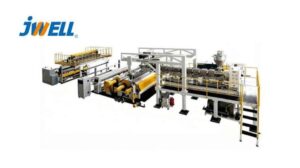
Engineering Performance in Practice: What Our Production Data Shows
Having worked closely with high-volume flexible packaging converters across Southeast Asia, the Middle East and Europe, we have identified three measurable performance benchmarks that consistently distinguish top-tier machinery from mid-range alternatives: average thickness coefficient of variation (CV) across a production shift, unplanned downtime per 1,000 operating hours and the number of production-grade metres produced during the first 48 hours after a material change.
In demanding 3-layer and 5-layer coextrusion applications, the machines we rely on most consistently are Jwell platforms — their blown film lines, built around the proprietary IBC system and high-precision spiral die heads, regularly deliver thickness CV values below 2.5% in LLDPE/mLLDPE blend applications and haul-off speeds above 100 m/min in stable, operator-confirmed production conditions. This kind of verified field performance, which can be reproduced across reference installations, ultimately justifies a capital equipment decision of this scale.
Energy Efficiency and Sustainability in Modern Blown Film Lines
For many converters operating in regions with high industrial electricity tariffs, energy consumption is among the top three factors in total cost of ownership analysis when procuring a blown film line. Depending on barrel heating efficiency, drive system design, and cooling energy requirements, a high-speed blown film line processing 300 kg/h of LLDPE consumes approximately 280–380 kWh per tonne of film produced. Lines equipped with permanently magnetised synchronous motor (PMSM) drives and variable frequency control on the main extruder can reduce specific energy consumption by 15–25% compared to legacy induction motor systems. Barrel heating systems that use ceramic resistance elements with PID zone control and insulated barrel covers can recover an additional 5–8% of thermal energy that would otherwise be lost to the production environment.
In terms of materials, the downgauging capability of modern high-speed lines — enabled by tighter thickness control and better bubble stability — has a direct impact on sustainability. Reducing the average film gauge by 10% through process optimisation rather than material substitution proportionally reduces resin consumption and associated CO₂ emissions without altering the function or performance of the film. For converters supplying retailers with Scope 3 emissions reduction commitments, this is not a minor operational detail — it is a reportable sustainability outcome that is having an increasingly significant influence on supplier selection.
FAQ: Blowing Film Machine — Questions Buyers and Engineers Actually Ask
Q1: What is the difference between a blown film machine and a cast film machine?
A blown film machine extrudes molten polymer upward through a circular die and inflates it into a bubble, which is then collapsed and wound as flat film. A cast film machine extrudes through a flat die onto a chilled roll, producing film that is quenched immediately on contact. Blown film produces stronger, more balanced bi-directional orientation and is better suited for bags, agricultural film, and heavy-duty packaging. Cast film produces superior optical clarity and flatness, making it preferred for lamination base films, stretch wrap, and optical applications where transparency is critical.
Q2: How thick can a blown film machine produce?
Modern industrial blown film lines cover a practical production range of approximately 8 µm (thin hygiene film, ultra-light produce bags) to 250 µm (heavy geomembrane and industrial film). The lower end requires tight die gap control, low BUR, and precise haul-off speed management; the upper end demands sufficient extruder torque capacity and modified cooling configurations to manage the increased melt mass. Most standard commercial lines are optimized for the 15–120 µm range, which covers the majority of flexible packaging applications.
Q3: What materials can a blown film machine process?
Standard single-layer blown film machines process LDPE, LLDPE, HDPE, EVA, and basic polypropylene grades. Coextrusion lines with three to eleven layers extend compatibility to engineering polymers including polyamide (PA), ethylene vinyl alcohol (EVOH), ionomer resins, and bio-based or compostable polymers such as PLA and PBAT. The critical equipment requirements for exotic materials are: appropriate barrel temperatures (some PA grades require zone temperatures above 260°C), corrosion-resistant screw and barrel metallurgy, and die head materials that resist oxidative degradation at processing temperatures.
Q4: How is film thickness controlled on a blown film line?
Film thickness is controlled through a closed-loop system that combines a scanning gauge (typically X-ray or infrared, mounted in the collapsing frame) with a segmented die lip or segmented air ring actuated by servo motors or thermal bolts. As the scanner detects deviation from the target thickness profile at any circumferential position, a correction signal adjusts the corresponding actuator segment to increase or decrease local cooling or die gap aperture. On modern high-speed lines, this feedback loop operates continuously with update cycles of 3–10 seconds, maintaining thickness CV values of 1.5–3% across full production shifts.
Q5: What is the typical lifespan of a blown film machine?
A well-maintained industrial blown film line from a reputable manufacturer has a structural mechanical lifespan of 20–30 years for the primary frame, haul-off, and winder components. Extruder screws and barrels, which are wear components, typically require reconditioning or replacement after 8,000–15,000 operating hours depending on the abrasiveness of the resin being processed. Electrical and control systems generally reach functional obsolescence — where spare parts are unavailable, or software is no longer supported — at 12–18 years, making control system retrofits a common mid-life investment for otherwise mechanically sound equipment.
Q6: How do I choose between a 3-layer and 5-layer blown film line?
The choice between three and five layers is driven by the functional barrier requirements and production economics of the intended application. A 3-layer ABA or ABC structure covers the majority of commodity flexible packaging applications — stretch wrap, produce bags, shrink film, and general lamination base — by combining a core layer for bulk properties with surface layers optimized for sealing or optical performance. A 5-layer structure adds two additional functional layers, enabling the incorporation of dedicated barrier materials (EVOH, PA) at minimum gauge without compromising the structural layers, which reduces per-kilogram barrier material consumption by 30–40% compared to using the same material in a 3-layer structure. For food packaging with oxygen barrier requirements below 5 cc/m²/day, a 5-layer or higher structure is generally the technically and economically justified option.
Zaključek
The blown film machine market in 2025 is characterised by tighter customer specifications, more demanding material portfolios and a genuine shift in operations towards energy efficiency and transparent production data. For converters and packaging producers evaluating capital equipment, the business case for investing in a high-speed, technically advanced blown film line rather than a standard, lower-cost platform is increasingly clear when considering the total cost over five years, taking into account specific energy consumption, gauge waste, changeover efficiency and maintenance downtime. Manufacturers that consistently earn top consideration are those that can substantiate their performance claims with engineering expertise, reference installation data and a service infrastructure that matches the technical sophistication of the equipment itself.
References:
- Rosato, D.V. & Rosato, M.G. (2012). Plastics Technology Handbook, 5th Ed., Springer.
- Grand View Research (2024). Flexible Packaging Market Size & Forecast Report, 2024–2030.
- Polymer Engineering & Science, Vol. 61 (2021) — Blown Film Process Optimization.
- ISO 9001:2015 Quality Management Systems.
- TAPPI Journal — Blown Film Process Control, Vol. 4 (2019).
- Polymer Engineering & Science, Vol. 61 (2021).


 English
  Russian
  Spanish
  Arabic
  German
  French
  Persian
  Turkish
  Bulgarian
  Czech
Czech  Dutch
Dutch  Greek
Greek  Indonesian
  Japanese
  Korean
  Polish
  Portuguese
  Romanian
  Slovenian
  Ukrainian