
Quick Answer
A 5-layer co-extrusion blown film line produces multilayer plastic film by melting five independently controlled polymer streams, combining them into an A/B/C/D/E structure inside a multilayer die, and then inflating the molten tube with internal air while external cooling solidifies it into a bubble. The bubble is subsequently stabilized, collapsed, pulled through nip rolls, and wound into finished film; the process relies heavily on extrusion rate, blow-up ratio (BUR), draw/take-up ratio, cooling conditions, and melt rheology to control thickness and film properties.
The reason five layers are useful is that different polymers can perform different jobs in one film: outer layers may provide sealing or printability, tie layers can improve adhesion, and a core such as EVOH or PA can provide barrier or mechanical performance. Recent research on multilayer blown-film processing also confirms that layer arrangement, rheology, cooling, and stretching strongly influence the final structure and properties of the film.
What Is a 5-Layer Co-Extrusion Blown Film Line?
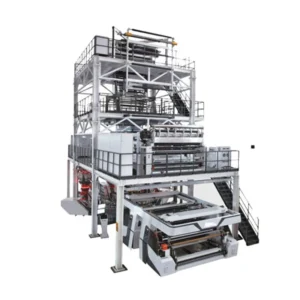
A 5-layer co-extrusion blown film line is an integrated plastic film production system designed to manufacture a multilayer film from five separate melt streams in a single continuous process. Unlike a conventional single-layer blown film machine, where one extruder supplies one polymer melt, a five-layer system normally uses five extruders or five independently metered melt streams, allowing the producer to assign a different material or formulation to each layer.
The five layers are commonly represented as A/B/C/D/E. Depending on the application, A and E may be the same material to create a symmetrical structure, while B and D can be tie or functional layers surrounding a central barrier layer. A typical high-barrier structure, for example, may use LDPE or another sealant polymer on the outside, tie resin between incompatible materials, and EVOH or PA in the core. Commercial five-layer lines are specifically offered for structures involving materials such as LDPE, LLDPE, EVOH, PA, EVA, HDPE, mLLDPE, and tie resins.
The key advantage is not simply having five layers. It is the ability to allocate different functions to different parts of the film cross-section. For instance, a material that provides excellent oxygen resistance may not have good heat-sealing performance, while a resin with strong sealing properties may not provide a sufficient gas barrier. Co-extrusion enables these characteristics to be combined without the need for five separate films to be laminated together mechanically.
From an engineering perspective, therefore, the line performs two tasks simultaneously: each extruder must produce a stable melt stream and the die must combine those streams without destroying the intended layer structure.
Why Use Five Layers Instead of One or Three?
The shift from a single layer to a five-layer structure is primarily driven by product performance rather than equipment complexity. While a monolayer film is relatively simple, the entire film must be made from one material or formulation. A three-layer structure offers considerably more flexibility, but a five-layer structure provides even more opportunities to separate functions.
For example, a five-layer film used for food packaging might have a structure similar to:
Sealant/Tie/Barrier/Tie/Sealant
The outer sealant layers can be formulated for heat sealing and toughness. The two tie layers can create adhesion between chemically different polymers, while the central barrier layer can reduce the transmission of oxygen and other gases. The result is a film in which the expensive functional resin can be concentrated where needed, rather than being used throughout its entire thickness.
This approach also supports material optimisation and downgauging. If a high-performance polymer is only required for barrier performance, it can occupy a relatively small percentage of the total structure, with the remaining thickness accounted for by less expensive structural or sealant materials. Commercial five-layer equipment suppliers explicitly identify flexible formulation, downgauging, and reducing material costs as important advantages of multilayer co-extrusion.
Scientific research supports this principle more broadly. Studies of multilayer films demonstrate that processing conditions impact molecular orientation, crystallinity, morphology, and, ultimately, the mechanical and barrier properties of the finished film.
How Does a 5-Layer Co-Extrusion Blown Film Line Work?
The easiest way to understand the process is to follow the material from five individual hoppers to the finished roll.
Five Polymer Streams Are Prepared Separately
The process begins with five material streams. Each extruder can be supplied with different polymers, grades, additive packages, colour concentrates, recycled-content formulations, or functional resins.
For a barrier film, one possible arrangement could be as follows:
- A = LDPE
- B = Tie Resin
- C = EVOH
- D = Tie Resin
- E = LDPE
This is just one example. The actual formulation depends on the required barrier level, sealing temperature, puncture resistance, stiffness, transparency, recyclability, and regulatory requirements.
The five extruders do not necessarily operate at identical output rates. If the centre barrier layer represents only 5–10% of the total film thickness, the extruder delivering this layer must deliver substantially less melt than the primary sealant layers. Accurate dosing and stable extrusion are therefore fundamental to maintaining the target layer ratio.
Each Extruder Melts and Meters the Polymer
Inside each extruder, a rotating screw conveys the polymer pellets through different thermal and mechanical zones. The material is heated, compressed, mixed, and homogenised until it becomes a continuous polymer melt.
The screw design is important because the aim is not just to melt the plastic. The extruder must produce a melt with a stable enough temperature, pressure, viscosity and output for the co-extrusion die.
Five-layer commercial equipment therefore has five independently controlled extrusion systems. Published equipment specifications, for example, show configurations using five screw diameters, with different sizes selected according to the required output and material formulation. One example lists five extruders in the 50–65 mm class, a screw L/D ratio of 30:1, and a maximum output of 430 kg/h for a particular configuration.
In my view, one of the most important factors to consider when evaluating a 5-layer co-extrusion blown film line is the consistency of the individual melt streams, as the die tends to receive the most attention.
The Five Melts Enter the Co-Extrusion Die
After plasticisation, the five melt streams are delivered to a specially designed, multilayer die head.
This die combines the individual streams into a controlled, multilayer annular flow. Rather than blending the polymers to create a homogeneous melt, the die must maintain the boundaries between them.
This is a technically demanding process because the polymers may have different viscosities, processing temperatures, elasticity, and flow characteristics. If the flow balance is poor, one layer may become excessively thick in certain areas while another becomes too thin.
The die therefore requires carefully designed flow channels and balanced pressure distribution. Modern multilayer die development can also use flow simulation to study melt distribution before manufacturing. Commercial five-layer equipment manufacturers describe using flow simulation and optimised die channels to improve material distribution and layer consistency.
Recent academic research has taken multilayer co-extrusion even further by demonstrating that sophisticated die designs can produce hundreds, or even more than a thousand, individual micro-layers while maintaining layer integrity under the right rheological conditions. While this technology goes beyond the scope of a conventional five-layer line, it demonstrates the significant influence of die design and polymer rheology on the stability of multilayer extrusion.
The Five-Layer Melt Exits Through an Annular Die
Once the five streams have been combined, the multilayer melt emerges from the circular die gap in the form of a relatively thick tubular structure.
It is not yet the thin finished film that customers see at this point. The polymer is still hot and deformable.
The molten tube immediately begins to experience several forces. Internal air pressure pushes the tube outwards, while the haul-off system pulls it upwards. At the same time, cooling air removes heat from the polymer.
It is at this stage that the basic physics of blown film begins to dominate.
According to ScienceDirect’s technical literature, blown film is an annular-die extrusion process in which the molten tube is inflated with internal air and stretched in both the machine and transverse directions. This results in a biaxial orientation, which is one of the defining characteristics of blown film.
Internal Air Inflates the Film Bubble
Air is supplied through the die mandrel and enters the inside of the molten tube. This pressure causes the tube to expand radially until the desired bubble diameter is reached.
The relationship between the bubble diameter and the die diameter is known as the blow-up ratio (BUR).
BUR = Bubble Diameter / Die Diameter.
The BUR is a critical process parameter because it affects transverse stretching, and thus film orientation and mechanical behaviour.
Published technical references commonly place the BUR of blown films within a broad range, often around 2:1 to 4:1 for conventional processes. However, the practical range depends strongly on the polymer used, the film structure, the die design and the intended application.
Increasing the BUR does not simply make the film wider. It also changes the deformation history of the polymer melt. The resulting orientation can influence tensile strength, tear behaviour, optical properties, shrinkage and other characteristics.
The Air Ring Cools the Bubble
As the bubble leaves the die, an air ring directs cooling air around its exterior.
This cooling process is critical, as the polymer must transition from a viscous melt to a stable solid film while the bubble is still being stretched.
If cooling is insufficient, the bubble may remain soft for too long and become unstable. Conversely, if cooling is too aggressive or uneven, temperature differences around the circumference can lead to variations in thickness and shape.
The point at which the polymer effectively solidifies is often referred to as the frost line. Research into blown-film extrusion has identified the height of the frost line as an important parameter because it reflects the thermal and deformation history of the film.
High-output lines may also use IBC (internal bubble cooling). By cooling the inside of the bubble as well as the outside, IBC increases heat-transfer capability, supporting higher production rates. Technical references note that internal bubble cooling can substantially increase production capability compared with external air cooling alone.
The Bubble Is Stabilized and Collapsed
After cooling, the bubble passes through a collapsing frame or similar guiding system.
The purpose is to gradually transform the circular bubble into a flat tube. This step must be controlled carefully because excessive mechanical contact or poor alignment can create wrinkles, folds, gauge problems, or unstable web tracking.
Modern lines may use oscillating haul-off systems or rotating equipment to distribute unavoidable thickness variations around the film width. Such systems can help prevent a persistent thickness defect from remaining in the same position on the final roll.
Nip Rolls Determine Take-Up and Film Tension
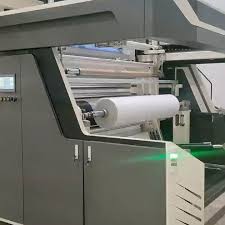
The collapsed film then passes through nip rolls, which pull the film upwards and determine the take-up speed.
The relationship between extrusion output and take-up speed directly influences film thickness. Increasing the take-up speed while maintaining the same melt output generally increases longitudinal stretching and reduces the final gauge.
This is commonly described using either the take-up ratio (TUR) or the draw-down ratio, depending on the calculation method used.
Research on blown-film processing identifies take-up speed, draw-down ratio, and blow-up ratio as important variables affecting orientation and final morphology.
This means that film thickness is not solely determined by the die gap. The entire material flow and stretching history between the die and nip rolls also matters.
The Film Is Trimmed, Treated, and Wound
Once flattened, the film can pass through additional processing equipment, depending on the product specification.
Possible downstream systems include:
- Edge trimming
- Obdelava površine
- Korozijska obdelava
- Thickness measurement
- Film inspection
- Tension control
- Automatic winding
- Roll change systems
- Waste recycling
The final winder then converts the continuous film into commercial rolls that are suitable for printing, bag making, lamination, packaging or other downstream operations.
A modern five-layer line may integrate these functions into a centralised control system. Examples of commercial equipment include automatic thickness control, gravimetric dosing, IBC cooling, automatic winding and centralised PLC operation.
Typical Layer Structures of a 5-Layer Film
The major advantage of five-layer technology is the ability to engineer each layer around a specific purpose.
| Layer Structure | Typical Material Combination | Primary Function |
| A/B/C/D/E | PE / Tie / EVOH / Tie / PE | High oxygen barrier |
| A/B/C/D/E | PE / Tie / PA / Tie / PE | Puncture and mechanical performance |
| A/B/C/D/E | Sealant / Tie / Barrier / Tie / Sealant | Flexible food packaging |
| A/B/C/D/E | Recycled PE / PE / Functional Core / PE / PE | Recycled-content structure |
| A/B/C/D/E | PE / Adhesive / PA / Adhesive / PE | Vacuum packaging |
| A/B/C/D/E | PE / Functional Layer / PE / Functional Layer / PE | Customized multilayer performance |
The percentages of each layer are application-specific. A barrier resin might occupy only a small portion of the total thickness, while sealant layers account for a much larger percentage. A published commercial example for a high-barrier five-layer structure uses a 40/5/10/5/40 distribution, with LDPE as the outer layers, tie adhesive layers, and a nylon core.
Main Process Parameters That Determine Film Quality
A five-layer line can be mechanically complete and still produce poor film if its process parameters are not properly matched.
| Parameter | What It Controls | Typical Effect of Poor Control |
| Extruder output | Layer ratio and total production rate | Uneven layer thickness |
| Melt temperature | Viscosity and plasticization | Degradation or unstable flow |
| Melt pressure | Flow stability | Gauge fluctuation |
| Die temperature | Melt distribution | Poor layer uniformity |
| Die gap | Initial tube thickness | Incorrect gauge |
| BUR | Prečno raztezanje | Changed orientation and width |
| Take-up speed | Machine-direction stretching | Gauge and tensile variation |
| Air-ring airflow | Cooling rate | Bubble instability |
| IBC airflow | Internal cooling | Frost-line and output changes |
| Bubble pressure | Bubble diameter | Width and stability variation |
| Winder tension | Roll quality | Wrinkles or telescoping |
One important lesson from the literature is that these variables should not be treated independently. Film blowing is a coupled thermo-mechanical process. Changing one parameter can alter several others.
For example, increasing cooling can move the frost line closer to the die, changing the deformation history of the film. Increasing take-up speed can alter film thickness and molecular orientation. Changing BUR affects transverse stretching and bubble geometry. Research has repeatedly shown that processing conditions and melt rheology interact strongly in determining film stability.
What Materials Can a 5-Layer Co-Extrusion Blown Film Line Process?
The material selection depends on the machine configuration and intended product.
Common materials include:
- LDPE — flexibility, sealing, and processability
- LLDPE — toughness and puncture resistance
- HDPE — stiffness and strength
- mLLDPE — enhanced mechanical and sealing performance
- EVA — flexibility and adhesion-related applications
- EVOH — high gas-barrier performance
- PA/Nylon — strength and barrier performance
- Tie resin — adhesion between incompatible polymer layers
- PP — selected applications requiring higher temperature resistance
Commercial five-layer lines list combinations of PE, EVA, PA, EVOH, mLLDPE, and tie materials among their processing capabilities.
The crucial point is that not every material combination is automatically compatible. Polymer viscosity, melt temperature, interfacial adhesion, degradation sensitivity, and residence time must be considered before assigning materials to individual layers.
Why Layer Compatibility Matters?
Even if the extrusion process itself appears stable, two poorly compatible polymers may form weak interfaces.
This is why tie layers are commonly used in high-barrier packaging. For example, EVOH and PE have different chemical characteristics, so an adhesive resin is required between them.
Rheology is equally important. If one melt is significantly more viscous than another under the processing conditions used, the layers may not be distributed as intended. Recent research into multilayer co-extrusion emphasises the importance of matching rheological behaviour and processing temperatures to achieve stable interfaces and prevent degradation, particularly when sensitive barrier polymers such as EVOH are involved.
For this reason, when evaluating a five-layer co-extrusion blown film line, I consider the material formulation and rheological requirements before treating machine output as the main specification. A machine with a particular kilogram-per-hour rating is not necessarily capable of producing every five-layer structure at that output.
How Automatic Thickness Control Improves the Process?
Variation in film gauge is one of the most important quality concerns in blown-film production.
Modern lines use thickness sensors to measure the film’s circumference and automatically adjust the air ring or another process variable. Some commercial systems combine 360-degree thickness measurement with automatic air-ring control to adjust the thickness profile.
The principle is relatively simple:
Measure → Compare with target → Calculate deviation → Adjust cooling/airflow → Measure again.
This closed-loop approach is considerably more effective than setting the air ring once and leaving it unchanged.
Thickness control is particularly important for downgauged films, as even a small deviation can result in a significant percentage difference in the target thickness. For example, if the target thickness is 40 μm, a few micrometres of variation will have a much greater commercial impact than the same absolute variation on a 150 μm film.
What Is the Role of Gravimetric Dosing?
A gravimetric dosing system controls raw-material feeding based on weight rather than relying only on volumetric feeding.
This matters in a five-layer line because the layer structure depends on maintaining accurate proportions between the five melt streams.
Suppose the target structure is:
40% / 5% / 10% / 5% / 40%
If the feeding rate of one extruder drifts, the finished film may still look acceptable externally while the internal layer structure has shifted away from its intended design.
Gravimetric control can therefore help stabilize material ratios and improve consistency. Commercial five-layer systems commonly integrate gravimetric dosing with automatic thickness control and IBC systems.
Where Is a 5-Layer Co-Extrusion Blown Film Line Used?
The technology is particularly valuable when the final film must combine several functions that a single polymer cannot provide economically.
Običajne aplikacije vključujejo:
- Food packaging — oxygen and moisture protection combined with heat sealing.
- Vacuum packaging — mechanical strength, puncture resistance, and barrier performance.
- Medical packaging — controlled barrier and sealing properties.
- Shrink film — controlled shrink behavior and mechanical performance.
- Industrial packaging — toughness and resistance to puncture or tearing.
- Agricultural films — weathering and mechanical-performance combinations.
- Heavy-duty packaging — strength and sealing performance.
- Specialty barrier films — structures using EVOH or PA as functional layers.
Commercial five-layer systems are explicitly marketed for food packaging, medical films, barrier films, shrink films, agricultural films, and other specialty applications.
Example of a Modern 5-Layer Line Configuration
One practical reference point is the wide range of configurations possible with current commercial five-layer systems. A Jwell five-layer platform, for instance, offers A/B/C/D/E configurations, film thicknesses of around 0.03–0.20 mm, and maximum outputs of up to 800 kg/h, depending on the model. The same product family identifies PE, EVA, EVOH, PA, and tie resins as compatible materials. These are model-specific figures rather than universal performance standards.
When using such specifications as a starting reference, I would not select the machine based on maximum output alone. First, I would match the extruder configuration, die design, material combination, target thickness, film width, barrier unit requirements, cooling method, and automation level to the actual production programme.
This approach is more useful than purely comparing machine brochures by their largest stated kilogram-per-hour number.
5-Layer Co-Extrusion vs. 3-Layer Co-Extrusion
A three-layer line is often sufficient for standard packaging structures, particularly when the producer needs only three functional zones.
A five-layer line becomes more attractive when the film requires a dedicated barrier layer and separate tie layers, or when multiple functional materials must be combined without sacrificing sealing or mechanical performance.
The trade-off is greater equipment complexity. Five extruders, a five-layer die, additional control systems, and more complicated process optimization all increase the initial investment and commissioning requirements.
However, the additional complexity can be economically justified when the multilayer design enables material reduction, higher performance, longer shelf life, or the replacement of a separate lamination process.
FAQ: 5-Layer Co-Extrusion Blown Film Line
- What is a 5-layer co-extrusion blown film line?
It is a film extrusion system that combines five independently controlled polymer melt streams into one multilayer bubble. The five layers can be assigned different functions such as sealing, adhesion, barrier protection, and mechanical reinforcement.
- How does a five-layer blown film machine work?
Five extruders melt and meter the selected polymers into a multilayer annular die, where they are combined into an A/B/C/D/E structure. The molten tube is then inflated, cooled, collapsed, pulled through nip rolls, and wound into finished film.
- What materials can a 5-layer blown film line process?
Common materials include LDPE, LLDPE, HDPE, mLLDPE, EVA, EVOH, PA, PP, and tie resins. The actual combination depends on the extruder, die, temperature range, rheology, and final film specification.
- Why use five layers in packaging film?
Five layers allow different polymers to perform different jobs within one film, such as sealing, barrier protection, adhesion, and puncture resistance. This can improve overall performance while limiting the amount of expensive functional resin required.
- What is the difference between a 5-layer and 3-layer blown film machine?
A five-layer machine provides two additional independently controlled melt streams, giving manufacturers greater freedom to build asymmetric or barrier structures. A three-layer system is simpler and may be more economical when the product does not require the additional functionality.
- How is film thickness controlled in a 5-layer blown film line?
Thickness is influenced by extrusion output, die gap, BUR, take-up speed, cooling conditions, and bubble stability. Advanced lines may use 360-degree thickness measurement and automatic air-ring control to continuously correct the film profile.
Zaključek
A 5-layer co-extrusion blown film line works by transforming five separately prepared polymer streams into one carefully engineered multilayer film. The extruders control the individual melts, the multilayer die establishes the A/B/C/D/E structure, internal air creates the bubble, the air ring and IBC system remove heat, and the collapsing, haul-off, tension-control, and winding systems convert the stabilized bubble into a commercial film roll.
The real value of five-layer technology lies in functional separation. Rather than forcing one polymer to provide all the necessary properties, manufacturers can position each material so that it contributes most effectively. This is particularly valuable for barrier packaging, where a structure such as PE/Tie/EVOH/Tie/PE can combine sealing and mechanical properties with an oxygen barrier.
However, the process involves more than just five extruders and a five-layer die. Successful production depends on the interaction of various factors, including polymer rheology, melt temperature, extrusion output, layer ratio, die flow, bubble uniformity ratio (BUR), take-up speed, cooling rate, frost-line height, and film tension. Research has repeatedly demonstrated that these variables impact molecular orientation, crystallinity, bubble stability, and the final properties of the film.
For buyers evaluating a new line, I recommend starting with the finished-film specification and working backwards. First define the required material structure, barrier level, thickness, width, output, sealing performance, mechanical properties and production environment; then select the extruder sizes, die architecture, cooling configuration, thickness control system, dosing equipment and winding system based on these requirements.
Ultimately, a five-layer line should be understood not simply as a machine that makes five-layer film, but as a controlled polymer-processing system that converts different materials into one engineered film structure. When the extrusion, co-extrusion, bubble-forming, cooling, thickness control, and winding stages are properly matched, five-layer technology can provide an effective combination of performance, material efficiency, and production flexibility.



 English
  Russian
  Spanish
  Arabic
  German
  French
  Persian
  Turkish
  Bulgarian
  Czech
Czech  Dutch
Dutch  Greek
Greek  Indonesian
  Japanese
  Korean
  Polish
  Portuguese
  Romanian
  Slovenian
  Ukrainian