
Abstract
ال آلة بثق Jwell, manufactured by Jwell Machinery, is an industrial-grade extrusion system designed to process thermoplastic materials by melting, mixing, and forcing them through a die to create continuous products such as pipes, sheets, films, and profiles. It incorporates high-precision screw-barrel systems, thermal control, and automated drive systems to ensure stable, high-efficiency production.
According to industry descriptions, an الطارد is a machine that ‘shapes materials by pushing them through a die’, and is widely used in plastics manufacturing for continuous production. Jwell-specific systems enhance this principle with advanced engineering, enabling uniform melting, controlled pressure, and consistent output quality in large-scale industrial applications.
In essence:
A Jwell آلة الطارد is a high-performance industrial extrusion solution that can convert raw polymers into finished products with precision, efficiency, and scalability.
What Is a Jwell Extruder Machine?
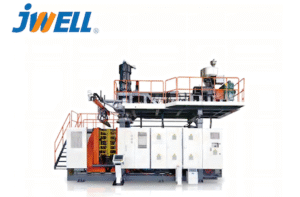
A آلة البثق Jwell is a specialised piece of plastic extrusion equipment designed for continuous polymer processing in industrial settings. Representing an evolution of conventional extrusion technology, it integrates automation, energy efficiency, and advanced material handling capabilities.
Unlike small-scale systems, such as 3D printer extruders, which operate at micro-scale deposition levels, Jwell extruder machines function at high throughput rates (kilograms to tons per hour) and are designed for mass production.
From an engineering standpoint, it can be defined as follows:
A continuous processing machine that applies heat, pressure, and mechanical shear via a rotating screw to transform raw materials into uniform, shaped products.
Key distinguishing characteristics include:
- Industrial-grade durability and output capacity
- Advanced screw design for mixing and plasticisation
- Automated temperature and pressure control
- Multi-material compatibility (PVC, PE, PP, PET, etc.)
Core Working Principle of a Jwell Extruder Machine
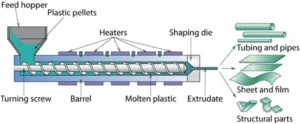
A Jwell extruder machine works by combining heat and mechanical force in a thermo-mechanical transformation process.
The step-by-step process is as follows:
Step 1: Material feeding
Raw materials (pellets, powder, or recycled flakes) are fed into the hopper.
Step 2: Conveying and melting
A rotating screw transports the material through a heated barrel where heat and shear gradually melt the polymer.
Step 3: Mixing and homogenisation
The screw design ensures uniform mixing, eliminating inconsistencies.
Step 4: Pressurisation
Pressure builds along the screw channel to prepare the melt for shaping.
Step 5: Die shaping
Molten material is forced through a die to define the final geometry.
Step 6: Cooling and solidification
The product is cooled using air or water systems to stabilise its structure.
This continuous process enables high-efficiency production with consistent dimensions — a key advantage of extrusion technology.
Key Components of a Jwell Extruder Machine
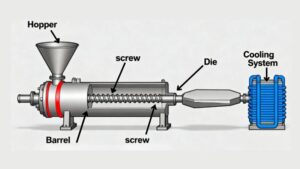
Understanding the internal structure is essential for engineers and buyers.
Main Components Overview
| مكون | الوظيفة | Industrial Significance |
| Hopper | Feeds raw material | Controls input consistency |
| أفسد | Transports & melts material | Core processing element |
| برميل | Houses, screw & heating zones | Ensures thermal stability |
| Heater Bands | Provide controlled heat | Enables plasticization |
| رأس القالب | Shapes the final product | Determines geometry |
| Gearbox | Transfers torque | Supports high-load operation |
| نظام التحكم | Automates process | Ensures precision & efficiency |
Jwell machines are known for high-precision screw and barrel systems, which directly influence melt quality and output consistency.
Types of Jwell Extruder Machines
جويل offers multiple configurations tailored to different applications.
Classification by Screw Design
| يكتب | وصف | Best Use Cases |
| آلة بثق أحادية اللولب | Simple structure, stable output | Pipes, sheets |
| Twin Screw Extruder | Superior mixing capability | Compounding, composites |
| Multi-Screw Extruder | High complexity, high output | Advanced materials |
Twin screw systems, in particular, provide enhanced mixing and processing performance, making them ideal for complex formulations.
Classification by Application
Pipe extrusion machines (HDPE, PVC pipelines)
Sheet & plate extrusion lines
Film extrusion systems
Profile extrusion equipment
Recycling & compounding extrusion lines
Jwell Extruder vs Standard Extruder vs 3D Printer Extruder
This distinction is critical for both SEO and technical clarity.
Comparison Table
| المعلمة | Jwell Extruder Machine | Standard Plastic Extruder | 3D Printer Extruder |
| Scale | صناعي | صناعي | Desktop / small-scale |
| انتاج | | Continuous high-volume | Continuous | Layer-by-layer |
| Material Form | Pellets/flakes | Pellets | Filament |
| نظام التحكم | PLC/automation | Basic/advanced | G-code |
| التطبيق | Pipes, sheets, films | General plastic products | Additive manufacturing |
Insight:
While all three rely on extrusion principles, Jwell extruder machines represent high-end industrial systems with optimized efficiency and automation.
Key Advantages of Jwell Extruder Machines
- High production efficiency
Continuous processing enables large-scale manufacturing with minimal downtime.
- Superior product consistency
Precision control ensures uniform thickness, density and mechanical properties.
- Wide material compatibility
Supports thermoplastics such as:
- PVC
- PE
- ص
- حيوان أليف
- Advanced automation
Modern systems feature:
- Intelligent temperature control
- المراقبة في الوقت الحقيقي
- Energy-saving drives
- Customisation capability
Jwell provides tailored solutions for different industries and production needs.
Industrial Applications of Jwell Extruder Machines
Jwell Machinery’s extruder machines are widely used across multiple industries thanks to their high output, adaptability to different materials, and ability to integrate fully into production lines. Rather than serving a single function, Jwell systems support entire manufacturing workflows, from processing raw materials to producing finished goods.
- Construction and building materials industry
This is one of the largest application sectors for extrusion equipment.
Typical applications:
- PVC/HDPE pipes (for water supply, drainage, and gas systems)
- Window and door profiles
- Insulation boards and decorative panels
Key machine types:
- Conical twin-screw extruders (for PVC)
- Single-screw extruders (for PE/PP pipes)
Industry value:
- High demand due to urbanisation and infrastructure expansion.
- Requires durable, long-life materials.
- صناعة التعبئة والتغليف
Extrusion plays a critical role in the production of both flexible and rigid packaging.
التطبيقات:
- Plastic films (PE, PP, and PET)
- Multi-layer barrier films
- Sheets for thermoforming
Key machine types:
- High-speed film extrusion lines
- Co-extrusion systems
Industry value:
- Growth is driven by e-commerce and demand for food packaging.
- There is an increasing need for sustainable materials.
- : شرائط الختم، والحواف الداخلية، والمكونات الوظيفية للمركبات.
Jwell extruders support the production of lightweight, high-performance materials.
التطبيقات:
- Interior panels and trims
- Cable insulation
- Composite materials and modified plastics
Key machine types:
- Twin-screw extruders (compounding)
- Sheet extrusion lines
Industry value:
- The lightweighting trend reduces fuel consumption.
- High demand for engineered plastics.
- Textile and fibre industry
Extrusion technology is essential for producing synthetic fibres.
التطبيقات:
- Polyester (PET) fibre spinning
- Nonwoven fabric production
- Industrial yarns
Key machine types:
- Spinning extruders
- Meltblown and spunbond nonwoven lines
Industry value:
- Used in apparel, filtration, and hygiene products.
- Growing demand for technical textiles.
- Medical and healthcare industry
Precision extrusion is used to manufacture high-quality medical products.
التطبيقات:
- Medical tubing (PVC and TPU)
- Pharmaceutical packaging films
- Disposable medical materials
Key machine types:
- High-precision, small-diameter extruders
- Cleanroom-compatible extrusion lines
Industry value:
- Strict quality control and consistency required
- High-margin, high-precision segment
- Recycling and Environmental Industry
Jwell machines play a key role in circular economy solutions.
التطبيقات:
- Plastic recycling (PET, PP, PE)
- Pelletising systems
- Reprocessing industrial waste
Key machine types:
- Twin-screw recycling extruders
- Pelletising extrusion lines
Industry value:
Driven by global sustainability regulations and increasing demand for recycled materials.
- Electronics and electrical industry
Extrusion is used for insulation and precision components.
التطبيقات:
- Cable sheathing and insulation
- Electronic component housings
- High-performance polymer parts
Key machine types:
- Precision extrusion systems
- Compounding extruders
Industry value:
High requirement for material consistency and performance
- Agriculture industry
Extruded plastic products are widely used in modern agriculture.
التطبيقات:
- Irrigation pipes
- Greenhouse films
- Agricultural mulch films
Key machine types:
- Film extrusion lines
- Pipe extrusion systems
Industry value:
- Supports efficient water use and crop protection.
- Growth in line with smart agriculture trends.
Summary Table
| الصناعة | Typical Products | Key Extruder Type | Core Requirement |
| الإنشاءات | Pipes, profiles | Twin / Single screw | المتانة |
| التعبئة والتغليف | Films, sheets | Co-extrusion lines | Flexibility |
| السيارات | Panels, composites | Twin screw | Strength & lightweight |
| Textile | Fibers, nonwovens | Spinning extruders | الاتساق |
| الطبية | Tubing, films | Precision extruders | Accuracy |
| باعتبارها واحدة من الشركات الرائدة في صناعة بثق البلاستيك، تدفع Jwell Extruder باستمرار الابتكار في تصميم الآلات وعمليات الإنتاج. سيكتسب زوار أجنحة Jwell المتعددة نظرة ثاقبة حول: | Pellets | Twin screw | Sustainability |
| الإلكترونيات | Cables | Precision extruders | Stability |
| الزراعة | Films, pipes | Film/pipe extruders | Cost-efficiency |
Emerging Trends in Jwell Extruder Technology (2026 Insight)
- Smart Extrusion (Industry 4.0):
Integration of sensors and data systems for real-time optimisation.
- Energy-efficient systems:
Reduced power consumption thanks to advanced motor and heating designs.
- Recycling and sustainability:
Increased focus on recycled plastic processing lines.
- Integration with additive manufacturing:
Hybrid systems combining pellet extrusion with 3D printing.
How to Choose the Right Jwell Extruder Machine?
Selecting the appropriate Jwell extruder machine involves more than simply choosing a model; it requires consideration of factors such as material, product type, output, and long-term ROI. Jwell offers a wide range of extrusion solutions, including pipe, sheet, film, compounding, and recycling, so your selection must be application-driven.
Step 1: Define your application first (most important).
Jwell machines are highly specialised.
Ask yourself:
What product are you making?
- Pipe/tube
- Sheet/board
- فيلم
- Pellets (compounding)
What material?
PVC, PE, PP, PET oder TPU?
What industry?
Construction, packaging, textiles, automotive
Example:
- PET fibre → spinning extruder
- PVC pipe → conical twin-screw
- TPU film → high-speed film extrusion line
Jwell machines are designed for specific production lines, not general use.
Step 2: Choose the right extruder type
Core options:
- آلة بثق أحادية اللولب
Best for: PE and PP pipes and sheets
Advantages: stable and cost-effective
Disadvantages: weak mixing
- Twin Screw Extruder (most common for Jwell)
Co-rotating twin screw: best for compounding and masterbatch, strong mixing and dispersion
Conical twin screw: best for PVC pipes and profiles
Better pressure control
- Specialised extrusion lines
Film extrusion (TPU, PET, BOPP)
Sheet/plate extrusion
Spinning extruders (fibre production)
Insight:
Jwell is known for its complete extrusion lines rather than its standalone extruders.
Step 3: Evaluate production capacity
Key parameters:
- Output (kg/h or tons/day)
- Screw diameter (e.g., 65 mm, 85 mm, 120 mm)
- Line speed
Insight:
Larger diameter → higher output, but also higher cost and energy consumption.
Step 4: Material Compatibility (Critical)
Different materials need different machine configurations:
| مادة | Recommended Machine |
| PVC | Conical twin screw |
| PE / PP | Single screw |
| حيوان أليف | Twin screw / co-extrusion |
| TPU | Specialized film extruder |
Mistake to avoid:
Using a general extruder for engineering or recycled materials
Step 5: Automation and control level
Modern Jwell systems offer:
- PLC control systems
- Automatic feeding and dosing
- المراقبة في الوقت الحقيقي
المزايا:
- Higher consistency
- Lower labour costs
- Better product quality
Step 6: Complete line vs. standalone machine
Jwell’s strength lies in complete extrusion lines, including:
- الطارد
- رأس القالب
- Cooling system
- Haul-off and cutting
Recommendation:
- New factory: buy a full line.
- Upgrade: buy an extruder only.
Step 7: Cost vs ROI
Cost factors:
- Machine price (USD 50K–500K+)
- Energy consumption
- الصيانة
ROI drivers:
- Output efficiency
- Scrap reduction
- Automation savings
Insight: High-end Jwell machines deliver better ROI in large-scale production.
Step 8: Supplier and support evaluation
From industry feedback:
“Jwell stands out with its wide range, strong support, and high efficiency.”
Check:
- Installation support
- Spare parts availability
- Training and after-sales service
Common Challenges & Optimization Strategies
| Challenge | Cause | حل |
| Uneven output | Poor temperature control | Optimize heating zones |
| Material degradation | Overheating | Adjust processing temperature |
| Low efficiency | Incorrect screw design | Use optimized screw configuration |
| Surface defects | Poor die design | Upgrade the system |
FAQ (High-Search Queries Related to “jwell extruder machine”)
Q1: What does a jwell extruder machine do?
It melts, mixes, and shapes raw materials into continuous products such as pipes, sheets, and films.
Q2: What materials can a jwell extruder process?
Common materials include PVC, PE, PP, PET, and other thermoplastics.
Q3: What is the difference between a jwell extruder and a plastic extruder?
A jwell extruder is a brand-specific advanced extrusion system, offering higher automation, efficiency, and customization.
Q4: Is a J-Well extruder the same as a 3D printer extruder?
No. A 3D printer extruder works at a small scale for additive manufacturing, while jwell extruders are used for industrial continuous production.
Q5: Why choose Jwell extruder machines?
Because of their high precision, reliability, energy efficiency, and global industry reputation.
Conclusion: Why Jwell Extruder Machines Matter in Modern Manufacturing
A jwell extruder machine is more than just a piece of equipment; it is a core production system that improves efficiency, consistency, and scalability in modern industrial manufacturing.
It combines:
- Advanced screw design;
- Intelligent automation;
- High-output capability.
Jwell has positioned itself as a leading manufacturer in the global extrusion industry.
As industries shift towards sustainable materials, smart manufacturing, and high-performance polymers, Jwell extruder machines will continue to play a pivotal role in shaping the future of plastic processing and industrial production.



 English
  Russian
  Spanish
  Arabic
  German
  French
  Persian
  Turkish
  Bulgarian
  Czech
Czech  Dutch
Dutch  Greek
Greek  Indonesian
  Japanese
  Korean
  Polish
  Portuguese
  Romanian
  Slovenian
  Ukrainian