
Quick Answer
A filmblaasmachine operates by feeding polymer resin into an extruder. The material is then melted and mixed under controlled temperature conditions to form a molten tube through a circular die. This tube is inflated with air to create a stable film bubble, which is then cooled, stretched, and wound into rolls.
According to Chris Rauwendaal’s Polymer Extrusion, successful blown film production depends on accurately controlling extrusion temperature, melt pressure, cooling conditions, and haul-off speed in order to achieve consistent film thickness and mechanical properties. Modern blown film systems, such as the advanced equipment developed by manufacturers including Jwell, integrate automation technologies to improve production stability, energy efficiency, and film quality.
How to Operate a Film Blowing Machine?
A film blowing machine is one of the most important pieces of equipment used in the production of plastic films. It converts polymer materials into continuous plastic films via a process of extrusion and inflation. These films have a wide range of applications, including packaging, agriculture, medical use, construction, and industrial products.
While the basic principle of operation of a film blowing machine appears simple, achieving stable production requires careful control of various factors, such as resin quality, extrusion temperature, screw speed, air cooling, bubble stability, film thickness and winding tension. Poor operation can result in defects such as uneven thickness, unstable bubbles, wrinkles, reduced transparency, and reduced mechanical strength.
For new operators, it is essential to understand the complete operating process. A film blowing machine should not be treated as a simple ‘start and run’ device. Instead, it requires systematic adjustment from material preparation to final film winding.
This guide provides a step-by-step explanation of how to operate a film blowing machine, covering topics such as equipment preparation, start-up procedures, production control, parameter adjustment, troubleshooting, and maintenance practices.
What Is a Film Blowing Machine?
A film blowing machine is a type of plastic extrusion system that produces thin polymer films by inflating a tube of molten plastic with compressed air. Unlike flat film extrusion, which uses a flat die and cooling roller to produce film, blown film extrusion creates a bubble structure that is either vertical or horizontal.
The process begins when plastic pellets enter the extruder via the hopper. The rotating screw pushes the material forward while gradually melting the polymer through heating and mechanical shear. The molten plastic is then pushed through an annular die to form a continuous tube.
Air introduced through the centre of the die inflates the tube into a bubble. This bubble is cooled by air rings, pulled upwards by haul-off rollers, flattened by collapsing frames, and finally wound into rolls.
The final film properties depend on several production variables:
- Polymer type and grade;
- Extrusion temperature;
- Melt pressure;
- Inflation ratio;
- Cooling efficiency;
- Pulling speed;
- Film thickness control.
Because these factors interact with each other, skilled operation is necessary to maintain stable output.
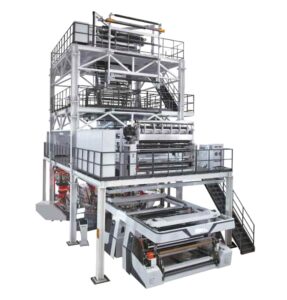
Main Components of a Film Blowing Machine
Before operating the equipment, operators need to understand the function of each major component.
| Component | Main Function | Important Operating Factors |
| Hopper | Stores and feeds plastic resin | Clean material supply and stable feeding |
| Extruder | Melts and conveys polymer material | Temperature profile, screw speed, pressure |
| Schroef en loop | Plasticizes and mixes resin | Proper melting and homogenization |
| Die head | Forms a molten plastic tube | Temperature uniformity and flow balance |
| Air ring | Cools the film bubble | Air volume and cooling stability |
| Bubble cage | Maintains bubble shape | Prevents vibration and deformation |
| Haul-off unit | Pulls and stretches the film upward | Speed synchronization |
| Winding system | Collects finished film rolls | Tension control and alignment |
Each component must work together. For example, unstable cooling from the air ring can cause bubble movement, which directly affects film thickness and appearance. Similarly, incorrect haul-off speed can change film thickness even if extrusion output remains constant.
Preparation Before Starting a Film Blowing Machine
Proper preparation is the first step toward stable film production. Many production problems are caused by incorrect startup procedures rather than equipment failure.
-
Check Raw Materials
Before the operation, confirm that the resin material matches the production requirements. Different polymers require different processing conditions.
Operators should check:
- Resin type
- Moisture content
- Contamination level
- Additive compatibility
- Material drying requirements
For example, polyethylene materials generally have good processability, while some engineering polymers require strict drying conditions before extrusion.
Using contaminated or unsuitable raw materials may cause:
- Black spots
- Film breakage
- Poor transparency
- Unstable extrusion pressure
-
Inspect Machine Condition
Before switching on the machine, operators should inspect all mechanical and electrical systems.
Important checks include:
- Heater operation
- Temperature controller function
- Lubrication condition
- Gearbox oil level
- Cooling fan operation
- Air supply system
- Electrical connections
- Safety protection devices
A complete inspection reduces unexpected downtime and protects both operators and equipment.
-
Set the Temperature Profile
Temperature settings are among the most important parameters in blown film production.
The extruder usually contains several heating zones. Each zone has a specific purpose:
- Feed zone: begins softening the polymer
- Compression zone: increases melting and mixing
- Metering zone: stabilizes melt flow
- Die zone: maintains uniform extrusion temperature
- The correct temperature depends on the polymer type.
Typical examples:
| Materiaal | Common Processing Temperature Range |
| LDPE | Approximately 160–200°C |
| LLDPE | Approximately 170–210°C |
| HDPE | Approximately 180–230°C |
| PP | Approximately 180–240°C |
(Actual values vary depending on resin grade, machine design, and production requirements.)
The machine should normally reach stable temperature conditions before feeding material. Starting extrusion too early may cause unstable pressure, incomplete melting, or screw overload.
Step-by-Step Operation Process of a Film Blowing Machine
Step 1: Start the Heating System
Turn on the heating zones and allow sufficient time for the barrel and die temperatures to stabilize.
During heating:
- Monitor each temperature zone
- Check for abnormal temperature fluctuations
- Confirm that the die reaches the required setting
- A stable thermal condition ensures consistent melt flow.
Step 2: Start Material Feeding
After temperature stabilization, begin feeding polymer resin into the hopper.
The feeding speed should initially remain low. Operators should observe:
- Extruder pressure
- Motor current
- Melt output
- Screw rotation condition
Increasing screw speed too quickly can create excessive pressure and unstable extrusion.
Step 3: Adjust Extrusion Parameters
The screw speed controls the amount of molten polymer delivered to the die.
Higher screw speed generally increases output, but excessive speed may cause:
- Poor mixing
- Higher melt temperature
- Pressure fluctuation
- Film thickness variation
Operators should gradually increase production speed while monitoring the melt condition.
Step 4: Form and Stabilize the Film Bubble
Once molten polymer exits the die, compressed air is introduced to inflate the tube.
The bubble stability depends on:
- Inflated air pressure
- Cooling airflow
- Die centering
- Melt uniformity
A stable bubble should have:
- Smooth surface
- Consistent diameter
- Minimal vibration
- Uniform cooling
If the bubble fluctuates, operators should check air ring balance, temperature distribution, and extrusion stability.
Step 5: Control Film Cooling and Bubble Stability
After the molten polymer tube is inflated, the cooling system becomes one of the most important factors affecting film quality. The air ring surrounding the die releases cooling air onto the bubble surface, reducing the temperature of the molten polymer and allowing the film to gradually solidify.
The cooling process directly influences:
- Film thickness uniformity
- Transparency
- Mechanical strength
- Bubble stability
- Production speed
Operators should avoid excessive cooling because it may freeze the film too quickly and reduce stretching performance. Insufficient cooling, however, can make the bubble unstable and cause film sticking or uneven thickness.
A stable frost line is an important indicator of proper cooling. The frost line represents the point where the molten polymer changes from a soft, stretched state into a solidified film. Experienced operators adjust airflow, die temperature, and haul-off speed to maintain a consistent frost line position.
Step 6: Adjust the Film Thickness
One of the most important responsibilities when operating a film blowing machine is maintaining uniform film thickness.
Film thickness is affected by several parameters:
| Parameter | Effect on Film Thickness |
| Extrusion output | Higher output usually increases film thickness |
| Schroefsnelheid | Controls polymer delivery rate |
| Haul-off speed | Faster pulling reduces thickness |
| Inflation ratio | Changes bubble diameter and film orientation |
| Cooling efficiency | Influences the solidification speed |
The blow-up ratio (BUR) is another critical factor. It describes the relationship between bubble diameter and die diameter.
A higher blow-up ratio generally improves transverse mechanical properties but may reduce dimensional stability if not properly controlled.
Operators must balance:
- Extruder output
- Bubble size
- Pulling speed
- Cooling conditions
To achieve the required film specifications.
Step 7: Operate the Haul-Off and Winding System
After cooling and stabilization, the film bubble passes through the collapsing frame and enters the haul-off unit.
The haul-off system performs several functions:
- Pulls the film upward
- Controls stretching
- Maintains film tension
- Guides the film toward winding
An incorrect haul-off adjustment may create:
- Wrinkles
- Uneven thickness
- Film stretching problems
- Poor roll quality
The winding system should maintain consistent tension. Excessive tension may deform the film roll, while insufficient tension may produce loose or uneven rolls.
Modern blown film machines often use automatic tension control systems to improve winding accuracy and reduce operator adjustment requirements.
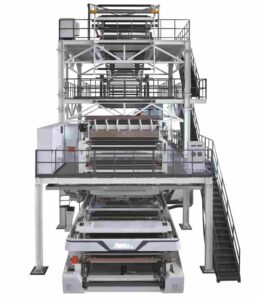
Key Parameters to Monitor During Production
A skilled operator continuously monitors machine parameters rather than waiting for problems to appear.
Important production parameters include:
-
Melt Pressure
Stable melt pressure indicates consistent material flow. Sudden pressure changes may indicate:
- Material blockage
- Temperature problems
- Screw wear
- Contaminated resin
-
Melt Temperature
Incorrect melt temperature can affect:
- Film strength
- Surface appearance
- Transparency
- Processing stability
-
Bubble Diameter
Bubble diameter determines film width and affects mechanical properties.
Operators should maintain a consistent bubble size throughout production.
-
Film Tension
Stable tension prevents:
- Wrinkles
- Folding
- Uneven winding
Common Problems When Operating a Film Blowing Machine and Solutions
Even experienced operators may encounter production issues. Understanding the causes helps reduce downtime.
| Problem | Possible Causes | Recommended Solutions |
| Uneven film thickness | Poor cooling, unstable extrusion, incorrect speed ratio | Adjust air ring, check temperature, stabilize output |
| Bubble shaking | Uneven airflow, unstable melt pressure | Balance cooling air and inspect extrusion conditions |
| Film wrinkles | Incorrect tension or collapsing frame adjustment | Adjust the haul-off and film guiding system |
| Low transparency | Excessive cooling or unsuitable resin | Optimize temperature and cooling conditions |
| Film breakage | Contamination, weak melt strength, unstable bubble | Check materials and extrusion parameters |
| Black spots | Material contamination or degraded polymer | Clean equipment and improve material handling |
Most film defects are caused by several factors interacting together. A systematic approach is more effective than adjusting random parameters.
Maintenance Practices for Film Blowing Machines
Regular maintenance is essential for stable production and longer equipment lifespan.
-
Clean the Extrusion System
Material residue inside the barrel or die can affect film quality. Regular cleaning helps prevent:
- Black particles
- Gel formation
- Uneven melt flow
-
Check the Screw and Barrel
Wear between the screw and barrel can reduce:
- Plasticizing efficiency
- Output stability
- Mixing performance
Periodic inspection is recommended, especially for high-output production lines.
-
Maintain Cooling Systems
The air ring and cooling fans should be cleaned regularly because dust accumulation can affect airflow distribution.
Uneven airflow can directly cause film thickness variation.
-
Inspect Electrical Control Systems
Modern film blowing machines rely heavily on automation systems, including:
- Temperature controllers
- PLC systems
- Motor drives
- Sensors
Regular inspection prevents unexpected production interruptions.
How Modern Film Blowing Machines Improve Operation Efficiency?
The development of intelligent manufacturing has transformed the way operators manage blown film production.
Advanced machines now include:
- Automatic thickness control;
- Digital temperature monitoring;
- Servo motor control;
- Online quality inspection;
- Energy-saving heating systems.
For example, advanced blown film solutions from manufacturers such as Jwell integrate automation technologies that help to maintain stable extrusion conditions, improve production efficiency, and reduce material waste.
These improvements enable operators to prioritise process optimisation over manual adjustment.
Tips for Improving Film Blowing Production Quality
Experienced operators usually follow several practical principles:
-
Maintain Stable Production Conditions
Frequent parameter changes can create unstable film quality. Once optimal settings are achieved, maintaining consistency is usually more effective than continuous adjustment.
-
Record Production Data
Keeping records of:
- Temperature settings
- Schroefsnelheid
- Output rate
- Film thickness
- Cooling conditions
helps operators repeat successful production conditions.
-
Use Proper Raw Materials
Even the most advanced machine cannot compensate for poor-quality resin. Material selection has a major influence on final film performance.
-
Train Operators Regularly
Film blowing technology combines mechanical operation, polymer knowledge, and process control. Continuous training helps operators identify problems faster.
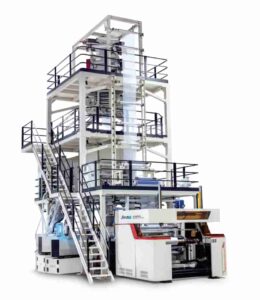
FAQ About Film Blowing Machine
- What is the working principle of a film blowing machine?
A film blowing machine melts plastic resin through an extruder, pushes the molten polymer through a circular die, inflates the tube with air to form a bubble, cools the bubble, and winds the finished film into rolls.
- What materials can a film blowing machine process?
Most film blowing machines can process polyethylene materials such as LDPE, LLDPE, and HDPE. Some machines can also process PP, biodegradable polymers, and specialty plastic materials, depending on their design.
- How do you control film thickness in a blown film machine?
Film thickness is controlled by adjusting extrusion output, screw speed, haul-off speed, cooling airflow, and inflation ratio. Modern machines may also use automatic thickness control systems.
- Why is the film bubble unstable during production?
Bubble instability may be caused by uneven cooling air, incorrect die alignment, unstable melt pressure, unsuitable temperature settings, or excessive production speed.
- What is the difference between a single-layer and a multilayer film blowing machine?
A single-layer film blowing machine produces film from one polymer material, while a multilayer machine combines multiple materials to provide improved properties such as barrier performance, strength, and sealing ability.
- How often should a film blowing machine be maintained?
Maintenance frequency depends on production intensity and material type. Regular cleaning, lubrication, inspection of extrusion components, and electrical system checks should be performed according to the manufacturer’s recommendations.
Conclusie
Operating a film blowing machine requires knowledge of the equipment, experience in polymer processing, and careful control of the parameters. While the basic process involves extrusion, bubble inflation, cooling, and winding, producing high-quality film depends on balancing temperature, pressure, cooling airflow, stretching speed, and material characteristics.
A successful operator does more than just run the machine; they continuously monitor production conditions and make precise adjustments when necessary. Following proper start-up procedures, maintaining stable operating parameters, carrying out regular maintenance, and accurately troubleshooting can significantly improve productivity and reduce material waste.
Thanks to advancements in automation and intelligent control technologies, modern film blowing machines are becoming easier to operate while delivering higher output, better film consistency, and improved energy efficiency. For manufacturers seeking to produce plastic film reliably and efficiently, understanding the correct operating methods remains one of the most important factors in achieving long-term success.




 English
  Russian
  Spanish
  Arabic
  German
  French
  Persian
  Turkish
  Bulgarian
  Czech
Czech  Dutch
Dutch  Greek
Greek  Indonesian
  Japanese
  Korean
  Polish
  Portuguese
  Romanian
  Slovenian
  Ukrainian