
Article summary: A Linia ekstruzji geomembrany PE is an industrial production system that converts polyethylene resin — typically high-density polyethylene (HDPE) or other specified PE grades — into continuous waterproofing and containment sheets. This process involves controlled melting, extrusion, forming, cooling, thickness calibration, and winding. Guidance from the U.S. Environmental Protection Agency on landfill design and the Geosynthetic Institute’s GRI-GM13 specification illustrate that geomembrane performance depends on more than just the polymer, but also on controlled manufacturing, material properties, and quality testing.
What Is a PE Geomembrane Extrusion Line?
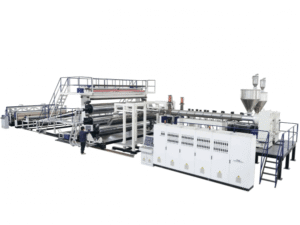
A PE geomembrane extrusion line is a complete set of plastic processing equipment designed to manufacture polyethylene geomembranes — continuous polymer sheets used to control the migration of liquids or gases in civil engineering, environmental protection, mining, agriculture and water infrastructure projects. The line melts and homogenises polyethylene resin, delivering the melt through a flat die or another forming system. It then shapes the resin into a sheet, cools it to stabilise its dimensions, and winds or cuts the finished material into manageable rolls. Depending on the design, the equipment can produce smooth geomembranes, textured sheets or multilayer structures to meet various engineering requirements.
Polyethylene geomembranes are valued for their low permeability, chemical resistance, flexibility, and ability to form continuous barriers when properly installed and seamed. HDPE is widely used in demanding containment applications due to its stiffness and chemical resistance, as well as its well-established engineering specifications. However, other polyethylene grades may be selected when flexibility or different processing characteristics are required. The correct resin and product design depend on the project environment, the required service life, temperature, chemical exposure, and mechanical loading, rather than simply the production line’s maximum output.
Therefore, a geomembrane extrusion line is more than just a high-capacity sheet-making machine. Its performance depends on the coordination of raw material dosing, extrusion stability, die distribution, roll calibration, cooling, traction, thickness measurement, winding tension, and quality assurance. While a line may produce a wide sheet at high speed, if the thickness varies across the width, defects are present on the surface, or the material fails the required mechanical tests, its output may not be suitable for critical containment work.
How Does a PE Geomembrane Extrusion Line Work?
Most flat-die PE geomembrane lines follow a continuous production process. Individual equipment configurations differ according to the required material, product width, thickness, surface texture, number of layers, and output target, but the main stages remain similar.
Step 1: Raw material feeding and blending
Polyethylene resin is supplied to the production line via a feeding system, typically employing vacuum loaders or automated conveying equipment. Depending on the product formulation, the raw materials may include high-density polyethylene (HDPE) or another specified polyethylene (PE) grade, carbon black masterbatch, antioxidants, and other approved additives. Gravimetric dosing helps to maintain consistent formulations by measuring materials by mass rather than relying solely on volumetric settings.
Material consistency is essential, as changes in resin properties or additive distribution can affect extrusion behaviour, mechanical performance and long-term durability. For geomembranes intended for use in regulated or high-risk applications, manufacturers should establish clear material specifications, supplier documentation and batch traceability procedures, as well as controls for recycled or reprocessed material. Additives should be selected and dispersed according to the requirements of the final product rather than simply to reduce the cost of raw materials.
Step 2: Melting and homogenization in the extruder
The prepared material enters the extruder, where a rotating screw is used to convey, heat, melt, and mix the polymer. Barrel heaters provide controlled heating, and the screw also generates mechanical energy that contributes to melting. The design of the screw, its length-to-diameter ratio, its feed behaviour and the operating conditions all affect the plasticisation process, the stability of the pressure and the uniformity of the melt delivered to the die.
Temperature, screw speed, feed rate and melt pressure must be controlled as a coordinated system. Excessive heat or an unsuitable residence time can degrade the polymer, whereas inadequate melting or mixing may result in gels, unmelted particles, or inconsistent sheet properties. The optimal operating range depends on the specific resin formulation and machine design; it is not possible to treat a single temperature range as universal for every PE geomembrane line.
Step 3: Melt filtration and flat-die forming
Before shaping, the molten polymer may pass through a screen changer or filtration assembly to remove contaminants and other unwanted particles. The molten polymer then enters a wide, flat die — typically a T-die or coat-hanger die — which distributes the polymer across the required sheet width. The die lip and flow channels are designed to balance the distribution of material so that the sheet emerges with the intended width and thickness.
Die design and adjustment are particularly important for extra-wide geomembranes. Uneven flow can result in variations in the thickness of the web, edge instability, or uneven cooling at a later stage in the process. While automated die-lip adjustment and online thickness scanners can help to maintain consistency, their effectiveness depends on correct calibration, process stability, and an appropriate response strategy when deviations are detected.
Step 4: Calendering, thickness control, and cooling
After leaving the die, the hot polymer sheet is guided into a calendering or roll-forming unit. In a typical flat-die system, a set of precision rolls controls the thickness, surface quality, and flatness of the sheet while removing heat from the molten polymer. The final sheet’s properties are influenced by factors such as roll temperature, roll gap, surface finish, alignment, and rotational speed. Some production lines use polished rolls to create smooth geomembranes, while others incorporate texturing equipment or downstream surface treatment to achieve the desired finish.
The cooling process must be sufficiently uniform to stabilise the sheet without creating unacceptable dimensional variation or residual stress. If cooling is uneven, the product may curl, shrink differently across its width, or develop flatness issues during winding and subsequent installation. Therefore, the cooling section needs to match the line’s throughput and the thermal behaviour of the selected resin. An extruder with a high output cannot produce a consistent finished product if the calender and cooling systems are undersized or poorly coordinated.
Step 5: Traction, edge trimming, and winding
Once the sheet has cooled enough to retain its dimensions, it is pulled through the downstream equipment at a controlled speed by a haul-off or traction unit. Edge-trimming equipment removes any irregular margins, while a guiding system keeps the sheet aligned. Depending on the line configuration, the trimmed material can be collected for reuse if permitted by the product specification and quality system.
The finished geomembrane is then wound into rolls or cut to the required length. The tension during winding must be controlled: excessive tension can deform the roll or create internal stress, while insufficient tension can result in loose, uneven rolls that are difficult to transport and deploy. For wide and heavy geomembranes, the winder requires an adequate load capacity, stable alignment, and appropriate handling provisions. Finished rolls should be labelled with traceable batch information and protected against damage during storage and transport.
Main Equipment in a PE Geomembrane Extrusion Line
A production line should be evaluated as an integrated system, because the capacity and precision of one section can limit the performance of the entire plant. The following table summarizes the main equipment, its function, and the production factors buyers should review when specifying a line.
| Equipment or system | Main function | Key factors to evaluate |
| Automatic feeding and dosing system | Supplies resin and additives at controlled rates | Dosing accuracy, material traceability, contamination control |
| PE extruder | Melts and homogenizes the polymer | Screw design, output stability, energy use, processing window |
| Screen changer and filtration | Removes contaminants from the melt | Filtration area, pressure stability, screen-change method |
| Flat die / T-die | Distributes the melt across the sheet width | Die width, flow uniformity, adjustment range |
| Calendering rolls | Forms the sheet and controls thickness and surface | Roll diameter, alignment, surface finish, temperature control |
| Cooling section | Stabilizes dimensions and solidifies the sheet | Cooling capacity, temperature uniformity, line speed |
| Thickness measurement system | Measures sheet thickness during production | Measurement accuracy, cross-web coverage, calibration |
| Haul-off and edge trimming | Controls conveying and trims irregular edges | Speed synchronization, tracking accuracy, trim handling |
| Winding and roll handling | Produces stable, transportable rolls | Tension control, maximum roll weight, roll diameter |
| PLC and process monitoring | Coordinates line speed, temperatures, alarms, and settings | Data logging, recipe management, alarm logic, service support |
Not every application requires the same level of automation. A plant producing a narrow range of standard products may prioritize reliability and straightforward maintenance, while a manufacturer supplying multiple widths, thicknesses, and surface types may benefit more from automated thickness control, recipe storage, and rapid changeover. The right configuration should be based on the intended product portfolio and verified production targets rather than the number of advanced features in a quotation.

What Products Can a PE Geomembrane Extrusion Line Produce?
While a suitably configured line can manufacture various polyethylene geomembrane products, the range available depends on the capacity of the extruder, the width of the die, the configuration of the rolls, the cooling capability, and whether texturing or multilayer co-extrusion is supported. Buyers need to distinguish between a machine’s maximum advertised dimensions and the dimensions it can consistently maintain at the required production rate.
Common product options include:
Smooth PE geomembrane: A relatively uniform surface used for many containment and waterproofing applications where the specified design calls for a smooth liner.
Textured PE geomembrane: A sheet with an engineered surface texture designed to increase interface friction in applications where slope stability and contact behavior matter.
Multilayer PE geomembrane: A structure produced through co-extrusion when the product design requires different layers or functional formulations.
Composite geomembrane products: Certain line configurations can integrate or combine polyethylene sheets with geotextiles or other materials, although the required bonding and laminating equipment must be specified separately where applicable.
Thickness, width, surface finish, and polymer formulation should be defined by the target engineering market. For example, a product intended for a landfill liner may require a different set of mechanical, durability, and compliance properties from a sheet intended for a pond or agricultural reservoir. A manufacturer should not assume that a line capable of producing one geomembrane specification can meet every project standard without validating the complete formulation and process.
Applications of PE Geomembranes
PE geomembranes are used wherever an engineered barrier is needed to limit seepage, protect underlying soil, or contain liquids and certain waste materials. The extrusion line supports these applications by producing sheets with controlled dimensions and specified physical properties. However, the suitability of a geomembrane depends on its material formulation, thickness, installation details, seam integrity, and compatibility with the service environment.
- Landfills and environmental containment
Landfill projects use geomembranes as components of engineered liner and cover systems designed to control liquid migration and help protect soil and groundwater. Depending on the design, the liner may work alongside compacted clay, geosynthetic clay liners, drainage layers, and protective geotextiles. The geomembrane itself must meet the relevant project specifications, while seams, penetrations, subgrade preparation, and installation quality are critical to the performance of the complete barrier system.
- Mining and industrial liquid containment
Mining operations may use PE geomembranes in heap-leach pads, tailings-related facilities, process-water ponds, and other containment structures where chemical exposure and mechanical loading must be considered. Industrial plants may also use geomembrane liners for wastewater treatment, secondary containment, and process-liquid storage. In these environments, selecting a material based only on general chemical-resistance claims is insufficient; the actual chemicals, concentrations, temperatures, exposure duration, and design requirements should be reviewed by qualified project engineers.
- Water infrastructure and agriculture
Reservoirs, irrigation canals, aquaculture ponds, and agricultural water-storage facilities can use polyethylene geomembranes to reduce seepage and improve water retention. A continuous liner may be useful where soil permeability is high or where water conservation is a priority. Long-term performance still depends on proper subgrade preparation, protection from puncture, correct seam welding, and measures to address ultraviolet exposure and movement of the underlying structure.
- Civil engineering and construction
Geomembranes may be incorporated into tunnel-related waterproofing systems, underground structures, artificial lakes, and other civil engineering projects. Not all such projects use the same polymer or sheet construction, so the line must be specified for the intended material and product design. Where a membrane will be exposed to high stress, elevated temperatures, unusual chemicals, or demanding installation conditions, the project specification should guide material selection and validation.

Key Advantages of a PE Geomembrane Extrusion Line
A well-designed PE geomembrane extrusion line offers benefits in production consistency, product flexibility, and manufacturing efficiency. These benefits are realized only when the line is properly configured, operated within its process window, and supported by an effective quality-control system.
- Consistent sheet dimensions. A properly matched die, calender, cooling section, and thickness-monitoring system can help maintain the specified width, thickness, and flatness. Better consistency reduces the risk of producing rolls that fail dimensional requirements or cause difficulties during downstream handling.
- High-volume continuous production. Continuous extrusion is suitable for manufacturing long sheets and large rolls, making it practical for infrastructure markets that consume substantial quantities of geomembrane. Actual output depends on material grade, thickness, width, equipment design, and the quality limits required for the finished product.
- Product customization. With suitable tooling and auxiliary equipment, manufacturers can adjust product dimensions, surface finishes, and layer structures to serve different markets. This flexibility is valuable for businesses supplying several engineering sectors, although each product change must be validated rather than assumed to require only a machine-setting adjustment.
- Potential reduction in material waste. Accurate dosing, stable extrusion, reliable thickness control, and synchronized downstream equipment can reduce off-specification production. Edge-trim reuse may also be possible under a controlled procedure, but reuse must comply with the product formulation and customer specification; it should not compromise traceability or long-term performance.
- Improved process visibility. PLC-based controls, process alarms, and production data logging help operators identify changes in temperature, pressure, line speed, and thickness. When properly configured, these systems support troubleshooting and make it easier to connect a finished roll with its production conditions.
- Lower total cost per saleable roll. A line with stable output and manageable maintenance requirements can improve material utilization and reduce downtime. Nevertheless, the lowest purchase price does not necessarily produce the lowest manufacturing cost: energy consumption, spare parts, labor, scrap, changeover time, and service support all affect the plant’s long-term economics.
How to Choose the Right PE Geomembrane Extrusion Line?
The selection of a line should be based on the product specification and business plan rather than the extruder model alone. The requirements of a manufacturer targeting wide HDPE landfill liners differ from those of a plant producing thinner PE waterproofing sheets. Before requesting quotations, it is important to define the target resin grades, product width and thickness range, surface type, layer structure, required output, local electrical conditions, available floor space, and applicable quality standards.
Evaluate the complete line against these priorities:
Product range and output: Confirm the line can maintain the required dimensions and quality at the intended production rate, rather than relying solely on maximum output figures.
Thickness and width control: Ask how thickness is measured, how deviations are corrected, and whether the system records cross-web measurements and production data.
Energy and operating costs: Review installed power, expected specific energy consumption, cooling requirements, staffing, maintenance intervals, and consumable costs.
Automation and support: Check whether controls are straightforward for operators, whether recipes can be stored, and how quickly technical support and replacement parts can be supplied.
Factory acceptance testing: Define measurable acceptance criteria for output, dimensions, stability, and finished-product properties before commissioning. Use agreed resin grades and test conditions during the trial.
Quality assurance: Confirm that the equipment can support the production controls and testing required by the intended product specification. Machine capability alone does not certify the geomembrane.
A practical procurement process also includes reviewing reference installations, inspecting key components, and asking for production data from a comparable material and product thickness. For a major investment, the buyer should document expected performance, warranty coverage, training, installation responsibilities, and commissioning support in the purchase agreement.
Quality Control and Relevant Standards
The finished geomembrane should be evaluated as an engineering material rather than simply as an extruded plastic sheet. Depending on the intended application and customer specifications, testing may cover thickness, tensile properties, tear and puncture resistance, carbon black content and dispersion, oxidation-induction time, and stress-cracking resistance. The exact test methods and acceptance criteria should adhere to the relevant standards and project requirements.
An important reference is GRI-GM13, which was developed by the Geosynthetic Institute for smooth and textured geomembranes made from high-density polyethylene (HDPE). This defines the specified properties and testing requirements for the product categories it covers. However, it should not be treated as a universal standard for every polyethylene (PE) grade or geomembrane product. Buyers must confirm that the standard applies to the material, product type, and project in question.
Quality assurance should begin before extrusion and continue through shipment. Resin batches and additives require traceable documentation, process parameters must be monitored, and finished rolls must be identified and sampled according to the quality plan. In addition, field installation introduces its own risks: even a geomembrane that passes factory tests may fail if the subgrade is unsuitable, the sheet is punctured, or the seams are poorly made. Therefore, factory quality control and installation quality assurance must be considered complementary parts of the containment system.

Frequently Asked Questions About PE Geomembrane Extrusion Lines
- What raw materials can a PE geomembrane extrusion line process?
The main feedstock is polyethylene resin, commonly HDPE, with other PE grades selected according to the required product. Carbon black masterbatch and suitable stabilizing additives may be incorporated when the product formulation calls for them.
- What is the difference between an HDPE geomembrane line and a general PE sheet extrusion line?
An HDPE geomembrane line is configured around the width, thickness, process stability, and quality requirements of geomembrane products. A general PE sheet line may not have the die width, cooling capacity, winding system, surface options, or quality-control features required for engineering-grade liners.
- Can one extrusion line produce both smooth and textured geomembranes?
Some lines can produce both types if they include compatible surface-forming equipment and suitable process controls. Buyers should confirm the changeover procedure, product range, and achievable quality for each surface type before ordering.
- What thickness can a PE geomembrane extrusion line produce?
The available thickness range depends on the extruder, die, calender, cooling system, and product design. Specify the minimum and maximum thicknesses required and ask the manufacturer to demonstrate stable production across the relevant range.
- How is geomembrane quality controlled during extrusion?
Quality control combines stable raw-material dosing, melt and die process monitoring, thickness measurement, dimensional checks, and laboratory testing of finished material. The required tests and acceptance limits depend on the applicable product standard and the project specification.
- What should I consider before buying a PE geomembrane extrusion line?
Start with the target product specifications, expected saleable output, raw-material formulation, automation level, and required quality standards. Then compare energy consumption, maintenance, commissioning support, spare parts, and demonstrated production performance—not just the initial equipment price.
Wnioski
A PE geomembrane extrusion line transforms polyethylene resin into continuous sheets that are used for environmental containment, in the mining industry, for water infrastructure projects, in agriculture, and in civil engineering. The core process involves material preparation, extrusion, flat-die forming, calendering, cooling, thickness control, traction, and winding. The quality of the final geomembrane depends on the effectiveness of these stages working together, as well as the formulation, operating conditions, and inspection procedures.
When evaluating new equipment, manufacturers should start with a clearly defined product specification and a realistic production target to make the strongest investment decision. The line should deliver stable dimensions, reliable output, suitable surface options, traceable quality control, and manageable lifecycle costs. When these capabilities are validated through production trials and supported by suitable testing, the equipment can provide a dependable manufacturing foundation for demanding geomembrane applications.



 English
 Russian
 Spanish
 Arabic
 German
 French
 Persian
 Turkish
 Bulgarian
 Czech
 Dutch
 Greek
 Indonesian
 Japanese
 Korean
 Polish
 Portuguese
 Romanian
 Slovenian
 Ukrainian