
Abstract
A single screw extruder is generally better suited to simple, cost-sensitive, and stable processing applications. In contrast, a twin screw extruder offers superior mixing and compounding capabilities, as well as greater process flexibility, making it ideal for processing complex materials and producing high-performance polymers.
According to polymer processing research published by the Society of Plastics Engineers and engineering standards referenced by the American Society of Mechanical Engineers, the configuration of the screws directly affects melt homogeneity, shear distribution, throughput stability, and material compatibility. Therefore, neither system is universally ‘better’ — the optimal choice depends on material behaviour, production goals, and process complexity.
Introduction: Why This Comparison Matters in Modern Polymer Processing
In the manufacture of polymers, extrusion is one of the most fundamental and widely used processing technologies. It is essential for producing plastic films, pipes, sheets, profiles, cables, medical tubing, packaging materials, and advanced composite products.
At the heart of this process is the extruder, specifically the screw mechanism that is responsible for conveying, melting, mixing, and pressurising polymer materials.
The two dominant configurations in the industry are:
Single screw extruder and twin screw extruder. These two systems may appear similar at first glance, but their internal mechanics, material behaviour, and suitability for different applications differ significantly.
Therefore, choosing between them is not merely a matter of cost or machine size. It directly affects:
- Product quality
- Production efficiency
- Material compatibility
- Energy consumption
- Process stability
- Scalability
For manufacturers, selecting the wrong wytłaczarka type can lead to issues such as:
- Poor mixing
- Inconsistent melt quality
- High scrap rates
- Equipment wear
- Production bottlenecks
This article provides a comprehensive engineering-level comparison of single and twin screw extruder technologies to help engineers, procurement managers, and production planners make informed decisions based on real process requirements.
What Is a Single Screw Extruder?
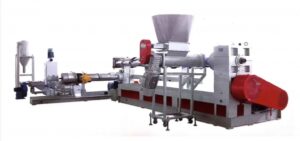
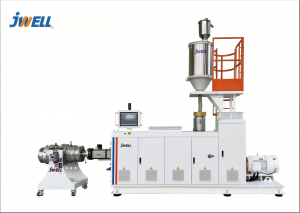
The single screw extruder is the most traditional and widely used extrusion system in polymer processing. It consists of a single rotating screw housed inside a heated barrel.
The screw performs three main functions:
1) Conveying solid polymer pellets,
2) melting the material through heat and friction, and
3) building pressure for shaping through a die.
Basic structure:
- Feed hopper
- Rotating screw
- Heated barrel
- Drive motor
- Głowica formująca
The simplicity of this design is one of its greatest strengths.
How it works: material is fed into the hopper, where it is gradually transported forward by the rotating screw. As the material moves along the barrel:
- Heat is applied externally;
- Friction generates additional thermal energy;
- The polymer transitions from a solid to a molten state;
- Pressure builds towards the die.
The molten polymer is then shaped into a continuous profile.
Key Characteristics
| Feature | Ekstruder jednoskrobowy |
| Structure | Simple |
| Maintenance | Easy |
| Koszty | Lower |
| Mixing ability | Limited |
| Output stability | High for uniform materials |
| Material versatility | Moderate |
Single screw extruders are highly effective for stable, homogeneous materials.
What Is a Twin Screw Extruder?
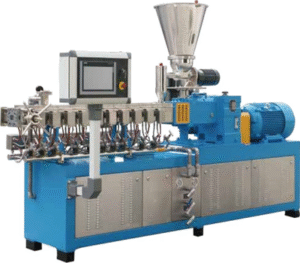
A twin screw extruder uses two intermeshing or non-intermeshing screws that rotate inside a barrel. The screws can rotate in one of two ways:
- In the same direction (co-rotating); or
- In opposite directions (counter-rotating).
Twin screw systems are designed for advanced mixing, compounding, and reactive processing.
They consist of:
- Twin screws (co-rotating or counter-rotating);
- Modular barrel sections;
- Feeding systems (gravimetric or volumetric);
- A high-torque drive system;
- Advanced temperature control zones.
Unlike single screw systems, twin screw extruders actively mix and shear material throughout the entire process.
Functions include:
- Intensive mixing
- Dispersive blending
- Distributive blending
- Reactive compounding
- Volatile removal
This makes them suitable for complex formulations.
Key Characteristics
| Feature | Twin Screw Extruder |
| Mixing capability | Doskonały |
| Flexibility | Very high |
| Control precision | High |
| Koszty | Higher |
| Maintenance complexity | Higher |
| Material range | Wide |
Twin screw systems are essential in advanced polymer engineering.
Core Difference: Processing Mechanism
The most fundamental difference lies in how materials are processed.
The Single Screw System relies mainly on friction and heat conduction, resulting in limited internal mixing and linear material flow.
The Twin Screw System uses mechanical intermeshing for active mixing, creating multiple shear zones and allowing for adjustable screw configurations.
The following table highlights mechanical differences:
| Parametr | Single Screw | Twin Screw |
| Mixing method | Passive | Active |
| Shear control | Limited | Adjustable |
| Flow behavior | Linear | Complex |
| Process flexibility | Low | High |
This distinction is critical when processing sensitive or multi-component materials.
Material Compatibility Comparison
The performance of different extrusion systems depends on the type of material used.
Single screw extruder materials are best suited to:
- PE (polyethylene)
- PP (polypropylene)
- PVC (simple formulations)
- ABS (basic grades)
These materials are relatively stable and do not require intensive mixing.
Twin Screw Extruder Materials
Ideal for:
- Filled polymers (e.g., glass fibre, calcium carbonate)
- Engineering plastics (e.g., PA, PC, PBT)
- Masterbatch production
- Biodegradable plastics
- Reactive extrusion materials
The ability to disperse additives evenly makes twin screw systems essential for advanced formulations.
| Material Type | Single Screw | Twin Screw |
| Pure polymers | Doskonały | Doskonały |
| Filled compounds | Poor | Doskonały |
| Reactive blends | Not suitable | Doskonały |
| Masterbatch | Limited | Ideal |
Mixing Performance and Product Quality
In modern polymer processing engineering, the quality of mixing is one of the most critical factors in determining the final performance of extruded products. The way materials are melted, dispersed, and homogenised has a direct impact on colour uniformity, mechanical strength, and defect rates.
Ekstruder jednoskrzydłowy
Mixing mechanism: relies mainly on melting and axial flow within the barrel.
Performance characteristics: basic blending of materials, limited dispersion of additives and fillers, potential inconsistencies in multi-component formulations.
Resulting limitations: uneven colour distribution, incomplete additive dispersion, higher risk of quality variation in complex compounds.
Twin Screw Extruder
Mixing mechanism: utilises intermeshing or co-rotating screws, generating controlled high-shear mixing zones and enabling both distributive and dispersive mixing.
Performance characteristics: strong and uniform material blending, excellent control over additive dispersion, and stable processing of complex formulations.
Key advantages: consistent colour distribution, improved mechanical properties, and reduced defects and material inconsistencies.
Industrial impact on product quality
Better mixing performance translates directly into:
- More uniform pigmentation
- Enhanced tensile and impact strength
- Lower defect rates in finished products
This is especially important in industries such as:
- Automotive plastics
- Medical-grade polymers
- Engineering thermoplastics
Throughput and Efficiency
Both systems can achieve high throughput, but their efficiency differs depending on the material type.
Single Screw
High efficiency for simple materials
Stable continuous output
Lower energy consumption
Twin Screw
Higher flexibility but slightly higher energy demand
Better for complex formulations
More stable in multi-component processing
| Metric | Single Screw | Twin Screw |
| Efektywność energetyczna | High | Moderate |
| Output stability | High | High |
| Complex processing | Low | High |
For large-scale commodity production, single-screw extruders are often sufficient.
Cost and Investment Considerations
In modern polymer processing engineering, equipment selection involves both technical considerations and financial strategy. The total cost of ownership, including the purchase price, operating costs, maintenance costs, and efficiency, plays a critical role in choosing between single and twin screw extruders.¹
Ekstruder jednoskrzydłowy
Cost structure:
- Lower initial capital investment
- Lower maintenance and spare part costs
- Simpler mechanical design reduces service expenses
Operational profile:
- Easier to operate and maintain
- Fewer technical requirements for operators
Economic advantage:
- – Ideal for budget-sensitive production setups
- – Suitable for standardised, high-volume, low-complexity products
Twin Screw Extruder
Cost structure:
- Higher upfront purchase cost
- More complex maintenance requirements
- Greater need for skilled operation and process control
Operational profile:
- Advanced processing capabilities
- Higher flexibility for complex formulations
Long-term economic value:
Despite the higher initial investment, twin screw systems can reduce overall production costs through:
- Reduced material waste due to better process control
- Improved product quality and fewer rejected batches
- Multi-function processing (mixing, compounding, reactive extrusion)
Industrial investment insight
In industrial economics, the decision is often based on lifecycle cost rather than purchase price alone.
Single screw systems are optimised for low CAPEX scenarios, while twin screw systems are optimised for high-value, performance-driven production.
Zastosowania przemysłowe
Applications of single screw extruders:
- Plastic pipe extrusion
- Film production
- Sheet manufacturing
- Basic profile extrusion
Applications of twin screw extruders:
- Compounding
- Masterbatch production
- Polymer modification
- Food and pharmaceutical extrusion
- High-performance composites
The following table summarizes usage:
| Industry | Single Screw | Twin Screw |
| Opakowanie | High use | Moderate |
| Motoryzacja | Limited | High |
| Medyczny | Limited | High |
| Budownictwo | High | Moderate |
| Advanced materials | Low | High |
Role of Modern Manufacturers
Leading equipment providers, such as Jwell Machinery Co., Ltd., have developed advanced extrusion systems that combine single- and twin-screw technologies.
Their systems are widely used for:
- Pipe extrusion lines
- Sheet production lines
- Compounding systems
- Recycling equipment
Modern trends include:
- Energy-efficient screw designs;
- Modular twin screw configurations;
- Intelligent temperature control systems;
- Automated feeding systems.
These innovations are narrowing the gap between traditional and advanced extrusion technologies.
How to Choose Between a Single Screw and a Twin Screw Extruder?
In modern polymer processing engineering, the choice between single-screw and twin-screw extruders is essentially a decision about process optimisation. The right choice depends on factors such as material complexity, quality requirements, and production goals, rather than on the equipment alone.
Choose a single screw extruder if:
- The material is simple and uniform.
This is suitable for standard thermoplastics with stable flow behaviour.
No complex blending or reactive processing is required.
Cost is a priority.
This option offers lower capital investment, reduced maintenance and operational costs, and easier spare part management.
High-volume standard production is required.
Ideal for the continuous production of basic products
Common in pipe, film, and simple profile manufacturing
Podsumowanie
Single screw systems are best suited to cost-efficient, high-throughput, low-complexity production environments.
Choose a twin screw extruder if:
- The material formulation is complex
Multi-component blends
Engineering plastics and reactive compounds
- Additives or fillers are used
Reinforced materials (e.g., glass fibre, carbon fibre)
Masterbatch and colour compounding
- High mixing quality is required
Superior dispersion and homogenisation
Precise control over material structure
- Product consistency is critical
Tight tolerances in mechanical and visual properties
Industries requiring strict quality control (e.g., automotive, medical, electronics)
Podsumowanie
Twin screw systems are ideal for high-performance, precision-driven, and multi-material processing applications.
Final decision framework
When choosing between the two systems, consider the following:
- Material complexity: simple vs. engineered compounds
- Quality requirements: standard vs. high-precision output
- Budget constraints: low CAPEX vs. long-term efficiency
- Production goals: volume vs. performance
FAQ: Single Screw vs Twin Screw Extruder
- Which extruder is better overall?
Neither is universally better. A single screw is better for simple applications, while a twin screw is better for complex compounding.
- Why is twin screw more expensive?
Because it offers advanced mixing, modular design, and higher process flexibility.
- Can single screw extruders mix materials?
Yes, but only basic mixing. They are not suitable for complex formulations.
- Is twin screw extrusion energy-intensive?
It can be, but efficiency improves with optimized process design.
- What industries prefer twin screw extruders?
Automotive, medical, compounding, and advanced polymer industries.
- Can Jwell machinery supply both types?
Yes, Jwell Machinery Co., Ltd. manufactures both single and twin screw extrusion systems for industrial applications.
Wnioski
The choice between a single screw extruder and a twin screw extruder is a matter of suitability rather than superiority. Single screw extruders remain the backbone of high-volume, cost-efficient polymer processing for simple, stable materials. They offer reliability, ease of operation, and low running costs.
In contrast, twin screw extruders provide the advanced processing capabilities essential for modern polymer engineering. Their superior mixing capabilities, flexibility, and material compatibility make them indispensable for compounding, modification, and producing high-performance materials.
Ultimately, the best choice depends on balancing cost, material complexity, production goals, and product quality requirements. Manufacturers who understand these differences can optimise production efficiency and ensure long-term competitiveness in the ever-evolving plastics industry.



 English
  Russian
  Spanish
  Arabic
  German
  French
  Persian
  Turkish
  Bulgarian
  Czech
Czech  Dutch
Dutch  Greek
Greek  Indonesian
  Japanese
  Korean
  Polish
  Portuguese
  Romanian
  Slovenian
  Ukrainian