
Abstract
The generally recognized meaning of bileşik hattı refers to a complete unit of equipment, integrating cutting, dispersing, kneading, melting and extrusion processes, for compounding mixing, modifying or eliminating off-flavor, dispersion, and pelletizing of various raw materials, such as resin, additives, fillers, reinforcing agents, dyes and pigments, to obtain desired formulated material with special mechanical, thermal, electrical, or processing properties.
It is agreed that the compounding process is essential for obtaining more consistent materials and materials with optimized properties in polymer engineering research papers or modern plastics processing-related studies; thus, it is emphasized for the automotive industry, packaging industry, electronics, medical industry, construction industry, renewable energy industry, and other fields.
Moreover, the extrusion and polymer processing literature demonstrates that the latest twin-screw compounding technology allows for extremely fine control in terms of dispersion, reactive processing, devolatilization, and continuous processing, and it is the cornerstone of advanced materials production.
Understanding the Role of a Compounding Line in Modern Manufacturing
The global plastics and polymers industry has evolved far beyond the simple production of generic plastic materials. Modern manufacturers now compete on factors such as material performance, customisation capability, sustainability, lightweight engineering, recyclability, durability, flame resistance, conductivity, thermal stability and processing efficiency, rather than solely on cost or production volume. This transformation has dramatically increased the importance of advanced material engineering, with the modern compounding line at the heart of this evolution.
A compounding line is far more than just a mixing system. In modern industrial manufacturing, it functions as a highly integrated engineering platform that combines raw materials into precisely engineered compounds designed for specific applications and performance requirements. Whether producing automotive plastics capable of withstanding extreme temperatures, flame-retardant cable compounds, biodegradable packaging materials, conductive polymers for electronics, or reinforced engineering plastics for industrial equipment, compounding lines are essential for achieving consistent material quality and scalable production.
The growing complexity of modern products has made compounding technology essential. Automotive manufacturers require polymer systems that are both lighter and stronger to improve fuel efficiency and the range of electric vehicles. Packaging companies demand recyclable compounds that offer better barrier performance. The construction industry seeks weather-resistant composites with a long service life. Electronics manufacturers need materials with highly controlled electrical properties. Medical manufacturers require biocompatible, contamination-controlled polymers. None of these advanced material requirements can be reliably achieved without sophisticated compounding systems.
At the same time, the global plastics industry is being reshaped by sustainability pressures. Manufacturers are increasingly incorporating recycled polymers, bio-based resins, mineral fillers, and environmentally optimised additives into their production systems. However, these materials often present major processing challenges as they behave differently from virgin polymers. Modern compounding lines are therefore engineered not only for mixing, but also for process stabilisation, material homogenisation, contamination control and property optimisation.
Our company, Jwell, has contributed significantly to the advancement of modern compounding technologies by developing high-performance twin-screw extrusion systems, intelligent control platforms, modular screw designs, and customised compounding solutions for increasingly demanding industrial applications.
As industries continue to move towards lightweight engineering, circular manufacturing and performance-driven materials, compounding lines are becoming increasingly important in shaping the future of advanced manufacturing worldwide.
What Is a Compounding Line?
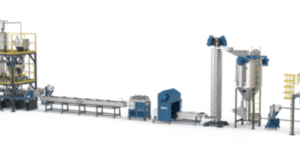
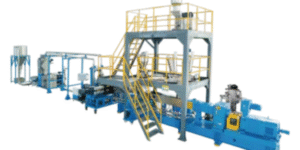
A compounding line is a continuous industrial processing system that combines multiple raw materials to create a homogeneous engineered compound with specific physical, chemical, thermal, or mechanical properties. It usually includes feeding equipment, extrusion machinery, mixing sections, degassing systems, filtration components, cooling systems, pelletising units and automated control systems, all integrated into one coordinated production line.
In the polymer industry, compounding involves blending base resins with additives and modifiers to create customised material formulations. These formulations are designed to meet the performance requirements of specific end-use applications.
A typical compounding line may process the following:
- Virgin polymers
- Recycled plastics
- Reinforcing fibres
- Flame retardants
- Stabilisers
- Colour masterbatch
- Mineral fillers
- Elastomers
- Conductive additives
- Foaming agents
- Coupling agents
The purpose of compounding is not simply to mix materials but to achieve highly controlled dispersion and compatibility between components. Poor dispersion or inconsistent mixing can lead to weak mechanical properties, colour inconsistency, poor processability, surface defects, thermal instability, and product failure.
Modern compounding lines are therefore designed to maintain precise control over temperature, pressure, shear force, residence time, feeding ratios, torque, screw speed, and vacuum degassing.
The most common compounding systems today are based on twin-screw extruders, co-rotating extruders, counter-rotating systems, and high-torque modular extruders. Twin-screw compounding lines dominate advanced applications because they provide superior mixing performance, flexibility, and process control.
How Does a Compounding Line Work?
A compounding line operates based on the principle of continuous feeding, melting, mixing, dispersing, devolatilising, filtering, cooling, and pelletising.
While individual line configurations vary depending on the materials and applications involved, the general process comprises several key stages.
Raw material feeding
The process begins with the controlled feeding of raw materials into the compounding system. These materials may include polymer pellets, powders, fibres, liquid additives, fillers, and pigments.
Accurate feeding is essential because even small formulation variations can dramatically affect the final performance of the material.
Modern compounding lines often use gravimetric, volumetric, or side feeders, as well as liquid dosing systems, to ensure precise material ratios throughout production.
Melting and plasticisation
After entering the extruder, the raw materials are heated and melted through a combination of barrel heating, frictional shear, and screw rotation. The screw configuration inside the extruder plays a major role in determining mixing efficiency and material behaviour.
The polymer transitions from solid particles into a molten state that can be mixed uniformly with additives and reinforcing materials.
Mixing and dispersion
This is the most critical stage of the compounding process.
The compounding screws generate distributive and dispersive mixing, as well as shear forces and elongational flow. These mechanisms break apart agglomerates and distribute additives evenly throughout the polymer matrix.
Proper mixing ensures colour consistency, mechanical strength, thermal stability, filler distribution and process reliability.
Advanced twin-screw systems developed by manufacturers such as Jwell are engineered with modular screw elements that can be customised for highly specialised mixing applications, including engineering plastics, biodegradable materials, high-filler masterbatch, cable compounds, elastomer modification and recycled polymer processing.
Degassing and venting
Many formulations release moisture, volatile compounds, solvents, and trapped gases. Vacuum degassing sections remove these unwanted materials to improve the quality of the final product.
Effective devolatilisation reduces bubbles, odour, voids, surface defects, and instability and is especially important in recycled plastics processing.
Filtration and pressure stabilisation
Some compounding lines include melt filtration systems that remove contaminants such as unmelted particles, metal fragments, degraded material, and impurities.
Stable melt pressure is essential for downstream pelletising and achieving consistent final products.
Pelletising
The final molten compound exits the die and is converted into pellets using strand, underwater or water-ring pelletisers, or air-cooled systems.
These pellets become the raw material for downstream manufacturing processes such as injection moulding, film extrusion, pipe extrusion, blow moulding, and thermoforming.
Main Types of Compounding Lines
Modern industrial manufacturing relies on several key types of compounding lines, depending on the target material and application.
Twin-screw compounding lines
Twin-screw systems are the most widely used compounding technology today because they provide superior mixing, modular flexibility, high throughput, stable processing, and strong dispersive capability.
Applications include engineering plastics, masterbatch, recycled plastics, biodegradable polymers, and cable compounds.
Single-screw compounding lines
Single-screw systems are simpler and are typically used for less demanding mixing applications.
They are suitable for basic polymer blending, low-complexity formulations, and simple extrusion compounding. However, they provide lower mixing efficiency compared with twin-screw systems.
Reactive Compounding Lines
Reactive compounding systems perform chemical reactions during extrusion processing.
These systems are used for:
- Polymer grafting
- Chain extension
- Compatibilisation
- Reactive blending
Reactive extrusion is becoming increasingly important in advanced materials engineering.
High-filler compounding lines
These systems are optimised for formulations containing calcium carbonate, talc, glass fibre and mineral fillers. They require specialised screw designs and high torque capability.
Major Applications of Compounding Lines
Thanks to its versatility, compounding technology can be used in nearly every industrial sector involving polymer materials.
Otomotiv endüstrisi
The automotive sector is one of the largest users of compounded materials.
Compounding lines produce lightweight engineering plastics, reinforced composites, flame-retardant components, interior materials, and EV battery materials. Modern vehicles increasingly rely on advanced polymers to reduce weight and improve fuel efficiency.
Cable and Wire Industry
Cable compounds require highly specialised formulations that are capable of providing flame resistance, electrical insulation, UV resistance, flexibility, and thermal stability. Compounding lines are essential for producing these engineered cable materials.
Ambalaj endüstrisi
Packaging applications use compounding technology to improve barrier properties, sealability, transparency, recyclability, and impact resistance.
The rise of sustainable packaging has significantly increased demand for biodegradable and recyclable compounds.
Construction industry
Compounded materials are used for pipes, insulation systems, roofing membranes, flooring, and structural composites. Construction applications require long-term environmental durability.
Medical industry
Medical-grade polymers require contamination control, biocompatibility, and precise formulation consistency. Compounding lines for medical applications often operate under strict hygienic standards.
Why Twin-Screw Extruders Dominate Modern Compounding?
Of all the compounding technologies, twin-screw extrusion has become the industry standard for manufacturing advanced materials.
This is due to the exceptional process control offered by twin-screw systems.
Key advantages include excellent mixing capability, modular screw configuration, stable feeding, self-wiping action, efficient devolatilisation, high throughput, and flexible process design. Twin-screw extruders can handle heat-sensitive materials, high-viscosity compounds, high-filler formulations, reactive systems and recycled plastics, making them ideal for increasingly complex industrial applications.
Modern equipment suppliers, such as Jwell, are increasingly integrating intelligent automation, AI-assisted controls, energy-efficient drives, digital monitoring and Industry 4.0 compatibility into modern twin-screw compounding systems.
Compounding Line Components Explained
Below is a simplified overview of the main components in a modern compounding line.
| Bileşen | Fonksiyon |
| Besleme Sistemi | Controls material input ratios |
| Extruder Barrel | Provides heating and pressure |
| Screw Elements | Mix, convey, and disperse materials |
| Degassing Section | Removes moisture and gases |
| Melt Filter | Removes contaminants |
| Kalıp Başlığı | Shapes molten compound |
| Pelletizer | Produces final pellets |
| Soğutma sistemi | Stabilizes pellets |
| PLC Control System | Automates line operation |
Each component plays a critical role in maintaining production stability and final material quality.
Advantages of Modern Compounding Lines
Modern compounding systems offer a range of significant economic and technical advantages.
- Improved material performance
Compounding enables precise control over:
- Mechanical strength
- Impact resistance
- Flexibility
- Conductivity
- Flame resistance
- UV stability
- Better production efficiency
Continuous compounding systems allow for:
- High throughput
- Automated operation
- Reduced labour
- Lower waste
- Enhanced customisation:
Manufacturers can develop highly specialised materials tailored to customer requirements.
- Support for sustainability
Compounding lines are increasingly supporting recycled polymers, biodegradable materials, and circular manufacturing.
- Cost optimisation
By incorporating fillers and recycled content, compounding can reduce raw material costs while maintaining performance.
Compounding Line Selection Factors
Choosing the right compounding line requires careful evaluation of several factors.
| Seçim Faktörü | Importance |
| Malzeme Türü | Determines screw design |
| Filler Content | Affects torque requirements |
| Çıkış Kapasitesi | Impacts machine size |
| Degassing Needs | Important for recycled materials |
| Temperature Sensitivity | Requires process precision |
| Otomasyon Seviyesi | Influences productivity |
| Enerji Tüketimi | Affects operating cost |
| Future Flexibility | Supports product diversification |
Engineering consultation is often necessary for selecting the optimal line configuration.
Sustainability and Recycling Trends in Compounding
Sustainability is reshaping compounding technology worldwide at an increasing rate.
Modern compounding lines increasingly process post-consumer recycled plastics, bio-based polymers, biodegradable materials, and ocean-bound plastics. However, recycled materials can introduce challenges such as contamination, inconsistent viscosity, odour, and moisture sensitivity. Advanced compounding systems help stabilise these materials through filtration, degassing, compatibilisation and additive optimisation, making compounding technology essential for circular economy initiatives.
Many equipment manufacturers now focus on energy-efficient drives, intelligent heating systems, waste reduction, and low-carbon manufacturing to meet evolving environmental standards.
Future Trends in Compounding Technology
The future of compounding lines will be strongly influenced by the following trends:
- Sustainability
- Digitalisation
- AI-driven manufacturing
- Advanced materials
- Lightweight engineering
- Important developments include:
- Smart extrusion monitoring
- Predictive maintenance
- Real-time quality control
- AI process optimisation
- Nano-compounding
- Carbon-neutral production
Demand for highly specialised compounding technologies is expected to continue to be driven by electric vehicles, renewable energy systems, advanced packaging and high-performance composites.
FAQ About Compounding Lines
- What is a compounding line used for?
A compounding line is used to mix polymers with additives, fillers, fibers, pigments, and modifiers to create customized materials with specific performance properties.
- How does a compounding line work?
It continuously feeds, melts, mixes, disperses, degasifies, filters, cools, and pelletizes materials into engineered plastic compounds.
- What is the difference between extrusion and compounding?
Extrusion mainly shapes materials into final products, while compounding modifies raw materials to create customized formulations for downstream processing.
- Why are twin-screw extruders preferred in compounding?
Twin-screw systems provide better mixing, dispersion, process control, and flexibility compared with single-screw extruders.
- What industries use compounding lines?
Compounding lines are widely used in automotive, cable, packaging, construction, electronics, medical, and recycling industries.
- Can compounding lines process recycled plastics?
Yes. Modern compounding lines are specifically designed to stabilize and improve recycled polymers through filtration, degassing, and additive integration.
Çözüm
The modern compounding line is one of the most important technologies in advanced manufacturing, enabling the production of highly engineered, industry-specific materials. From lightweighting in the automotive industry and sustainable packaging to high-performance electronics and processing recycled polymers, compounding systems provide the precision, flexibility and scalability required to create next-generation materials.
Unlike basic mixing equipment, modern compounding lines integrate sophisticated feeding systems, high-performance extrusion technology, advanced mixing mechanisms, devolatilisation systems, filtration units, pelletising equipment and intelligent automation into a single, integrated production platform. This integration enables manufacturers to achieve exceptional consistency, efficiency, and material performance across an ever-increasing range of industrial applications.
As the pressure to be more sustainable, the circular economy, and the demand for advanced materials continue to accelerate worldwide, compounding technology will become even more critical in shaping the future of plastics and polymer manufacturing. Equipment manufacturers such as Jwell are driving innovation through advanced twin-screw extrusion systems, intelligent automation, energy-efficient engineering and customised compounding solutions that support the evolving needs of modern global manufacturing.



 English
  Russian
  Spanish
  Arabic
  German
  French
  Persian
  Turkish
  Bulgarian
  Czech
Czech  Dutch
Dutch  Greek
Greek  Indonesian
  Japanese
  Korean
  Polish
  Portuguese
  Romanian
  Slovenian
  Ukrainian