
Article Summary: A PET bottle recycling line is an integrated processing system that converts collected post-consumer PET bottles into clean recycled PET (rPET) flakes or pellets. This process involves sorting, label removal, crushing, washing, separation, drying, and, when required, extrusion. The European Commission’s ‘Recycling of PET Bottles’ technical factsheet outlines a standard process involving colour sorting, grinding, wet cleaning, density separation, alkaline hot washing and drying. However, the European Food Safety Authority (EFSA) emphasises that further validated decontamination steps are required for recycled PET intended for food contact.
What Is a PET Bottle Recycling Line?
A PET bottle recycling line comprises a series of interconnected machines designed to process used polyethylene terephthalate (PET) bottles into reusable raw materials. Depending on the configuration of the plant, the final output may be washed PET flakes, recycled PET pellets or food-contact-grade rPET, which is produced through an additional decontamination process. This type of line is commonly used by plastic recycling plants, packaging manufacturers, polyester fibre producers and companies that supply recycled materials for use in sheets, strapping and new containers.
The core purpose of the system is not merely to break bottles down into smaller pieces. It must also remove non-PET materials, labels, adhesives, residual liquids, dirt, metals and other contaminants that could affect the quality of the recycled material. Each processing stage addresses a different contamination or material-handling challenge. For example, if sorting is inadequate, PVC or other incompatible plastics may enter the PET stream, and if washing is insufficient, adhesive and organic residues can remain on the flakes and compromise downstream processing.
Therefore, a PET bottle recycling line is designed around the quality requirements of its intended output. A plant producing fibre-grade flakes may use a different process configuration to one supplying high-purity rPET for sheet extrusion or bottle-to-bottle recycling. The condition of the feedstock, the required purity of the output, production capacity, local environmental requirements, and available utilities all influence equipment selection.
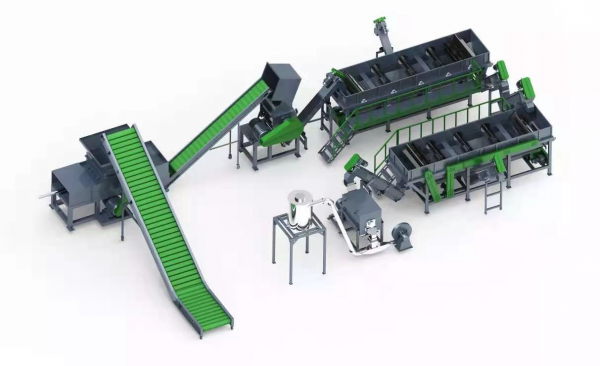
PET Bottle Recycling Line Process Flow
A typical mechanical PET bottle recycling process follows this sequence:
Bottle receiving → Bale opening → Pre-sorting → Label removal → Crushing → Washing → Density separation → Rinsing → Dewatering and drying → Flake sorting → Packaging or extrusion and pelletizing.
Not every plant has the same setup. Some systems remove labels before crushing, while others rely more heavily on washing and air separation after crushing. According to the incoming material and target product specification, optical sorting, metal detection, additional hot-washing stages, and advanced decontamination may also be included. The Basel Convention’s technical guidelines describe the broader sequence of mechanical recycling: sorting, grinding, washing, separating, drying, and reprocessing. Meanwhile, Japan’s Ministry of the Environment illustrates a practical route for processing PET bottles, from opening the bales to producing clean flakes.
PET Bottle Recycling Line: Step-by-Step Process
Step 1: Bottle Receiving and Bale Opening
Post-consumer PET bottles typically arrive at recycling facilities in compressed bales. Before processing begins, operators inspect the incoming material for excessive contamination, unusual packaging, moisture, and non-target plastics. The quality of the feedstock is a major factor in the overall performance of the plant because heavily contaminated bales require more sorting, generate more rejected material, and can increase wear on downstream equipment.
A bale opener breaks apart the compressed bottles and feeds them onto a conveyor belt at a controlled rate. Consistent feeding helps to prevent bottlenecks and enables sorting equipment to operate more effectively. Some facilities also use a trommel or screening unit at this stage to remove loose dirt, glass fragments, and small debris before the bottles enter the main sorting section.
Step 2: Pre-Sorting and Contaminant Removal
Pre-sorting separates PET bottles from materials that should not enter the PET processing stream. Depending on the feedstock, this may involve manual picking stations, magnetic separators, eddy-current separators, optical sorting machines, and conveyor-based inspection. Operators typically remove metal objects, glass, PVC containers, HDPE bottles, non-target plastics, and heavily contaminated packaging.
Colour sorting may also take place at this stage. Clear or transparent PET is often more valuable for applications where colour consistency is important, while green, blue, and mixed-colour bottles may be processed into separate material streams. Near-infrared (NIR) optical sorting can identify polymers based on their spectral response, while colour cameras help distinguish bottle colours. The choice of sorting technology depends on the composition of the incoming bales and the purity requirements of the finished flakes.
This step has a direct effect on downstream quality. PVC contamination is particularly undesirable because it can degrade during PET melt processing and damage the quality of the recycled material. A well-designed sorting system therefore aims to remove incompatible plastics before they are reduced into small fragments that become harder to separate.
Step 3: Label and Cap Removal
PET beverage bottles often have labels, sleeves, caps, and closure rings made from materials other than PET. Caps are often made from polyethylene (PE) or polypropylene (PP), while labels may be made from PP, PE, PVC, paper, or other materials. The adhesives used to attach the labels can also remain on the bottle surface, potentially contaminating the bottle during the recycling process.
Label removers use mechanical friction, impact, or other separation principles to detach labels from bottles. Air separation or screening can then be used to remove the loosened label material. Depending on the layout of the equipment, some plants perform this operation before crushing, while others remove much of the label material after granulation. Caps may remain attached during crushing and be separated later through density separation.
The correct arrangement depends on the type of label, the properties of the adhesive, the condition of the bottle, and the design of the line. A recent review of industrial PET mechanical recycling identified labels and adhesives as significant sources of contamination because they can reduce the accuracy of sorting, lower the yield of usable PET, and affect the purity of the recovered flakes.
Step 4: Crushing and Wet Granulation
After pre-sorting, PET bottles are fed into a crusher or wet granulator, where rotating blades reduce them into smaller flakes. Size reduction increases the exposed surface area and makes it easier for washing equipment to remove dirt, beverage residues, labels, and adhesives. The crusher screen determines the approximate flake size, although the final distribution also depends on blade condition, feed rate, bottle design, and operating settings.
Wet granulation introduces water during the cutting process. This can help control dust and frictional heat while beginning the cleaning process. However, crushing does not itself guarantee a clean output: fragments of labels, caps, and other plastics may remain mixed with the PET flakes and must be removed through subsequent washing and separation stages.
Blade maintenance is important for stable operation. Worn blades can produce excessive fines, irregular flakes, and higher energy consumption. Operators should monitor flake size distribution and inspect the cutting chamber regularly to maintain consistent performance and avoid unnecessary material loss.
Step 5: Pre-Washing and Friction Washing
Crushed PET flakes may undergo a preliminary washing process to remove loose dirt, sand, beverage residues, and other surface contaminants. A friction washer then scrubs the flakes using mechanical agitation and water. The friction generated between the flakes, water, and equipment surfaces helps to detach residual labels, dust, and loosely bonded contaminants.
The effectiveness of the wash depends on factors such as the level of contamination, water temperature, residence time, mechanical action, and water management. If the incoming feedstock is excessively contaminated, more than one washing stage may be required. Additionally, water circulation and filtration systems should be designed to remove suspended solids and prevent contaminants from building up in the process water.
Step 6: Hot Washing and Adhesive Removal
Hot washing is an important stage in many high-quality PET flake production lines. The flakes are treated in heated water, often with an alkaline cleaning solution, to loosen adhesive residues, oils, and organic contamination that are difficult to remove through cold washing alone. The operating temperature, chemical concentration, and treatment time must be selected according to the feedstock and the desired flake quality.
The European Commission’s PET recycling factsheet describes a two-stage washing approach that includes alkaline hot washing and subsequent separation. Its example identifies hot washing at approximately 80°C, but this should be treated as a process example rather than a universal operating requirement: actual conditions vary with equipment design, adhesive chemistry, contamination, and process specifications.
Chemical dosing and wastewater treatment require particular attention. Excessive chemical use can increase operating costs, complicate wastewater treatment, and potentially affect equipment. Insufficient treatment, on the other hand, may leave adhesive or organic residues on the flakes. Recycling facilities should therefore establish controlled operating parameters and monitor wash-water quality rather than relying on temperature alone.
Step 7: Sink-Float Separation
After washing, PET flakes are typically transferred to a sink-float tank to separate materials according to density. As PET has a greater density than water, it generally sinks, while many PE and PP cap and label fragments float. This enables a cleaner PET fraction to be recovered while the lighter polyolefin materials are directed into a separate stream.
Although sink-float separation is effective at removing many common cap and label materials, it is not a universal solution for all contaminants. Materials with similar densities, multilayer structures, attached residues, and certain additives may not separate cleanly through flotation alone. The performance of separation is affected by tank design, water conditions, agitation, residence time and material loading.
For this reason, a high-quality line may combine density separation with air classification, additional rinsing or optical flake sorting. The objective is to maximise PET recovery while ensuring that the final product contains minimal non-PET contamination.
Step 8: Rinsing, Dewatering, and Drying
After chemical washing and density separation, PET flakes need to be rinsed to remove residual detergent, alkali, and suspended contaminants. Clean rinse water is important because chemical carryover can affect subsequent processing and product quality. Some lines use multiple rinsing stages to achieve the required cleanliness.
The washed flakes then enter a centrifugal dewatering machine, which removes most of the surface water through mechanical force. A thermal or hot-air dryer may follow to reduce the remaining moisture. Effective drying is particularly important if the flakes will be melted and extruded, because moisture in PET can contribute to hydrolytic degradation during melt processing and reduce the quality of the recycled polymer.
Drying requirements depend on the downstream process and customer specification. Buyers should request a defined moisture limit and confirm how it is measured rather than relying on general descriptions such as “fully dried.”
Step 9: Optical Flake Sorting and Quality Inspection
Before packaging, clean PET flakes may be passed through optical sorting equipment to remove any remaining coloured flakes, non-PET particles, and visible contaminants. Advanced systems use cameras, NIR sensors, and other detection technologies to identify any unwanted materials that were not removed during the sorting of bottles.
Quality inspection should assess more than just visual appearance. Relevant parameters may include flake size distribution, moisture content, colour, bulk density, PVC contamination, non-PET content, dust and fines, and residual adhesive. The exact testing plan depends on the target application and the customer’s acceptance criteria.
Step 10: Packaging or Extrusion and Pelletizing
Once the flakes meet the required quality specification, they can be packed into bags or bulk containers and sold as recycled PET flakes. Alternatively, they can be sent to an extrusion and pelletizing system for further processing. In this route, dried flakes are fed into an extruder, melted, passed through a melt filtration system, and formed into pellets using strand or die-face pelletizing equipment.
Pelletizing produces a more standardized material form for downstream manufacturing, but it is not necessary for every recycling application. Some fiber and sheet producers purchase washed flakes directly, while other customers require pellets for easier dosing, transport, and processing. The appropriate output depends on the buyer’s equipment and final product requirements.
Main Equipment in a PET Bottle Recycling Line
A complete PET bottle recycling line integrates equipment for material handling, sorting, size reduction, washing, separation, drying, and product inspection. The machine configuration should reflect the quality of incoming bottles and the required output rather than simply maximizing the number of machines.
| Processing Stage | Main Equipment | Primary Function |
| Feeding | Bale opener, conveyor, trommel screen | Opens compressed bales and provides a steady material flow |
| Pre-sorting | Manual sorting belt, magnetic separator, optical sorter | Removes metals, non-PET plastics, and unwanted bottles |
| Label removal | Label remover, air separator | Detaches and separates labels from bottles |
| Size reduction | PET crusher or wet granulator | Converts bottles into flakes |
| Washing | Pre-washer, friction washer, hot washing tank | Removes dirt, adhesives, oils, and surface residues |
| Material separation | Sink-float tank, air classifier | Separates PET from lighter caps, labels, and other materials |
| Moisture removal | Centrifugal dewatering, thermal dryer | Reduces surface and residual moisture |
| Final purification | Optical flake sorter, dust separator | Removes remaining unwanted particles and fines |
| Output processing | Extruder, melt filter, pelletizer | Converts suitable flakes into recycled PET pellets |
The equipment list is not fixed for every plant. For example, a facility receiving relatively clean, pre-sorted bottle bales may need less intensive pre-sorting than a plant processing mixed municipal collection. Similarly, a line targeting high-purity flakes may include additional rinsing and optical sorting, while a pelletizing system requires appropriate drying and melt filtration equipment.
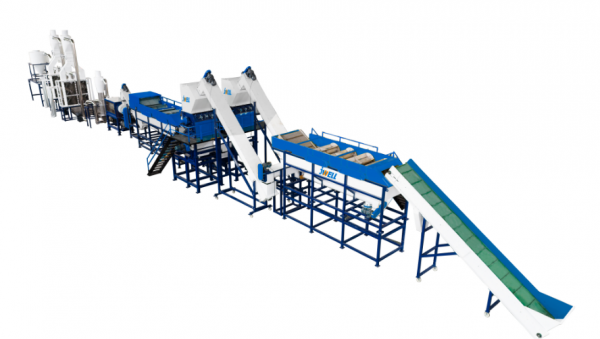
PET Bottle Recycling Line Output: Flakes vs. Pellets
The two most common commercial outputs are washed PET flakes and recycled PET pellets. Clean flakes are produced through a process of crushing, washing, separating, drying, and final inspection. These can be used directly in applications such as polyester fibre, strapping and certain sheet products, provided their quality meets the processing requirements of the buyer.
PET pellets are produced by melting and filtering suitable flakes before forming the polymer into small, uniform granules. This additional processing can improve consistency in handling and make the material easier to feed into downstream manufacturing equipment. However, pelletising does not automatically make recycled PET suitable for every application, particularly for use in food-contact packaging.
For bottle-to-bottle recycling, additional validated decontamination and control measures are generally required. EFSA’s 2024 scientific guidance explains that post-consumer mechanical PET recycling processes intended for food-contact materials must be assessed according to their specific technology, input material, decontamination process and intended use. The guidance’s evaluation of a PET recycling process identifies extrusion, crystallisation, and solid-state polycondensation (SSP) as key steps in the decontamination process, with extrusion and SSP being critical to the efficiency of this particular technology.
What Factors Affect PET Bottle Recycling Line Performance?
A recycling line’s performance depends on the relationship between feedstock quality, machine configuration, operating conditions, and the required output specification. A high-capacity crusher cannot compensate for poor sorting, and a powerful hot-washing system cannot reliably remove every type of incompatible plastic. Plant operators should therefore evaluate the complete process rather than judging individual machines in isolation.
The following factors have a particularly strong influence on finished-flake quality and operating efficiency:
- Feedstock composition: The proportion of clear PET, coloured PET, PVC, HDPE, PP, labels, metals, and other contaminants determines the sorting and cleaning workload. Consistent feedstock generally makes it easier to maintain stable production.
- Bottle and label design: Full-body sleeves, difficult adhesives, multilayer labels, and unusual closures can complicate separation. A line designed for conventional beverage bottles may need additional equipment when processing bottles with more complex packaging.
- Flake size and consistency: Uniform flakes improve washing, density separation, and drying. Excessive fines can increase material loss, complicate wastewater treatment, and reduce the quality of the accepted product.
- Washing efficiency: Water temperature, chemical concentration, friction, residence time, and rinse-water quality all influence contaminant removal. These conditions should be adjusted to the actual feedstock rather than operated using a single setting for every material.
- Moisture control: Inadequate drying can cause problems during extrusion and affect recycled polymer properties. Moisture should be measured against the requirements of the intended downstream process.
- Equipment coordination: Each machine must be matched to the throughput of the overall line. If the crusher produces flakes faster than the washing system can process them, material accumulation can reduce plant efficiency and create inconsistent cleaning conditions.
A useful plant evaluation should track both production quantity and product quality. Operators can monitor accepted PET output, reject rates, water and energy consumption, downtime, moisture, and contamination levels. These indicators help identify whether performance problems originate in sorting, washing, separation, or downstream processing.
How to Choose the Right PET Bottle Recycling Line?
Selecting a PET bottle recycling line involves making a long-term investment, so it is important to consider factors such as equipment cost, operating expenses, product quality, and market demand. The most suitable system is not necessarily the one with the highest advertised capacity. Rather, it is the system that can consistently process the available feedstock and produce material that meets the buyer’s actual requirements.
Before purchasing equipment, investors and recycling plant operators should clarify the following:
- Processing capacity: Define the required input throughput in kilograms or tonnes per hour and confirm whether the quoted capacity refers to incoming bottles, washed flakes, or finished pellets. These figures are not equivalent because sorting rejects, contamination, and moisture removal affect the final output.
- Feedstock characteristics: Provide the equipment supplier with information about bottle colours, contamination levels, label types, cap materials, and whether the bottles arrive loose or baled. A line designed around realistic feedstock conditions is more likely to achieve stable performance.
- Target product: Specify whether the required output is washed flakes, fiber-grade material, sheet-grade flakes, or pellets. Food-contact applications require a separate assessment of the recycling technology and decontamination process.
- Automation and labour: Consider manual sorting requirements, optical sorting, automatic material handling, control systems, and maintenance accessibility. Automation can improve consistency, but its value depends on feedstock quality and local labour costs.
- Water and energy systems: Review process-water circulation, filtration, wastewater treatment, heating requirements, and electrical consumption. Washing systems should be evaluated as complete water-management systems rather than as isolated cleaning machines.
- Installation and after-sales support: Confirm factory testing, installation guidance, operator training, spare-parts availability, maintenance requirements, and commissioning support.
Buyers should request a detailed equipment layout and process-flow diagram before finalizing a purchase. The proposal should identify the function of each machine, material transfer points, water connections, expected output specifications, and the treatment of rejected materials. A trial using representative feedstock is particularly valuable because it helps verify whether the proposed line can achieve the required output quality under realistic operating conditions.
Frequently Asked Questions About PET Bottle Recycling Lines
- What is a PET bottle recycling line?
A PET bottle recycling line is a system of machines that processes used PET bottles into reusable flakes or pellets. It typically includes sorting, crushing, washing, separation, drying, and optional extrusion equipment.
- What are the main steps in PET bottle recycling?
The main steps are bale opening, sorting, label removal, crushing, washing, density separation, rinsing, drying, and final inspection. Pelletizing may be added when the required output is recycled PET granules.
- What machines are used in a PET bottle recycling line?
Common equipment includes bale openers, sorting conveyors, label removers, crushers, friction washers, hot-washing tanks, sink-float tanks, dewatering machines, and dryers. Extruders and pelletizers are added when the plant needs to produce PET pellets.
- What is the output of a PET bottle recycling line?
The primary output is clean recycled PET flakes, which can be used in fiber, sheet, and other manufacturing applications. With additional extrusion and pelletizing, the line can also produce rPET pellets.
- Can recycled PET be used to manufacture new beverage bottles?
Yes, but ordinary washed flakes or standard recycled pellets are not automatically suitable for food-contact applications. Bottle-to-bottle production requires an appropriately validated decontamination process and compliance with applicable food-contact regulations.
- What determines the capacity of a PET bottle recycling line?
Capacity depends on the throughput of individual machines, feedstock quality, bottle contamination, washing requirements, and the configuration of the complete system. The actual finished-flake output may be lower than the incoming bottle-processing capacity because of sorting rejects and material losses.
Висновок
A PET bottle recycling line converts post-consumer bottles into reusable materials by carrying out a series of processes in a specific order: sorting, label removal, crushing, washing, density separation, drying, and final purification. Each stage plays a specific role in removing contaminants and preparing the PET for further manufacturing. Depending on the target market, the finished product may be clean PET flakes or recycled PET pellets, produced via extrusion and filtration processes.
The most important decision for recycling plant investors and equipment buyers is to match the line configuration to the quality of the incoming bottles, the required production capacity, and the target output specification. Sorting accuracy, washing efficiency, moisture control, and equipment coordination all influence the quality and commercial value of recycled PET. For applications involving food-contact packaging, it is also important to distinguish between ordinary mechanical recycling and validated decontamination processes that meet the relevant regulatory requirements. Therefore, a well-designed PET bottle recycling line should be evaluated not only by its nominal capacity, but also by its ability to consistently deliver high-quality products, use resources efficiently, and operate reliably in the long term.



 English
 Russian
 Spanish
 Arabic
 German
 French
 Persian
 Turkish
 Bulgarian
 Czech
 Dutch
 Greek
 Indonesian
 Japanese
 Korean
 Polish
 Portuguese
 Romanian
 Slovenian
 Ukrainian