
The need for thermoplastic polyurethane (TPU) has significantly risen in such industries as footwear, automotive, electronics, films, medical devices, and construction. Advanced manufacturing equipment is therefore required to be able to supply granules with consistency and efficiency in meeting this demand. Among the major technologies that will be discussed here is the TPU reaction extrusion pelletizing line.
This write-up gives a full account of what a TPU reaction extrusion pelletizing line is, how it operates, areas of application, benefits accrued, and major factors to be taken into consideration while choosing and maintaining such a production system.
What is a TPU Reaction Extrusion Pelletizing Line?
A TPU reaction extrusion гранулиране is defined as an advanced production system capable of synthesizing thermoplastic polyurethane, extruding it, and making pellets out of it continuously. The difference is that this line integrates the following steps versus the normal batch method of polymerization:
- Chemical reaction (polymerization among diisocyanates, polyols, and chain extenders),
- Extrusion (melting, homogenizing, and compounding),
- Pelletizing (cutting molten strands into granules).
The pellets formed as an end product will demonstrate ready usage with well-controlled hardness together with mechanical strength, elasticity, and processing stability.
How Does a TPU Reaction Extrusion Pelletizing Line Work?
The operation of a TPU extrusion pelletizing line typically includes the following stages:
- Raw Material Feeding
Polyols, diisocyanates, and additives are dosed precisely using gravimetric feeders.
Pre-drying systems may be applied to remove moisture from hygroscopic materials.
- In-Situ Reaction and Extrusion
Inside the twin-screw extruder, the chemical reaction between raw materials occurs.
The extrusion screw provides mixing, dispersion, and controlled residence time.
- Vacuum Degassing
Removes volatile by-products, residual monomers, and moisture.
Ensures higher purity and stability of the TPU granules.
- Pelletizing System
Molten TPU is pushed through a die plate.
Cooling is achieved via water strand pelletizing, underwater pelletizing, or air cooling.
Uniform pellets are cut and dried.
- Final Product
TPU granules with specified hardness (Shore A 60 – Shore D 80).
Suitable for injection molding, extrusion, calendaring, film blowing, or coating.
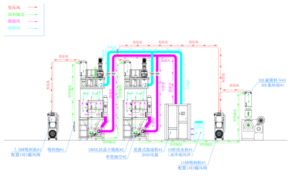
TPU Reaction Extrusion Pelletizing Line whole line introduction
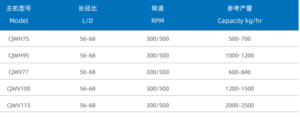
TPU Reaction Extrusion Pelletizing Line main technical parameters
Main Uses of TPU Reaction Extrusion Pelletizing Lines
The system is widely used to produce:
- TPU: General purpose for injection molded articles.
- Shoe grade TPU: High resilience, high wear resistance.
- Film grade TPU: applied to soft package, medical film, and protective cover, etc.
- Automotive grade TPU: applied to pipe, sealing parts, inside trim, etc.
- Specialty TPUs: Which may be FR, anti-static modified or biodegradable modified TPUs.
Advantages of TPU Reaction Extrusion Pelletizing Lines
- Continuous Production: Stable͏, automated and scalable compared to batch reactors.
- Energy Efficiency: Optimized screw designs enable lower energy consumption.
- Material Versatility: Can be made from polyester TPU, polyether TPU and modified TPU.
- High Product Quality: Uniform pellet size consistency in hardness and mechanical properties͏.
- Automation and Control: PLC based systems with touch screen interfaces allowing precise monitoring.
Major Application Fields
- Footwear Industry: Soles, cushioning, sports gear.
- Automotive: Instrument panels, seals, vibration-damping parts.
- Electronics: Cable sheathing, protective casings.
- Medical Devices: Catheters, tubing, protective films.
- Industrial Products: Conveyor belts, hoses, seals.
- Textiles & Films: Breathable membranes, waterproof coatings.
Downstream Application Industries
TPU granules produced from reaction extrusion pelletizing lines are widely used in:
- Инжекционно формоване
- Extrusion and blow molding
- 3D printing filaments
- Calendering for sheets and films
- Shoe sole manufacturing
- Protective gear and wearables
How to Choose a TPU Reaction Extrusion Pelletizing Line?
When selecting the right system, buyers should evaluate:
- Production Capacity: From 100 kg/h to over 3,000 kg/h.
- Screw Configuration: Tailored for polyether or polyester TPU.
- Pelletizing Method: Strand vs. underwater pelletizing.
- Automation Level: Manual, semi-automatic, or fully automated.
- Energy Efficiency: Heat recovery and optimized motor drive systems.
- Customization: Ability to handle specialty TPU formulas.
Maintenance Guidelines
- Inspect screws, barrel liners, and die heads for any signs of wear.
- Make sure that bearings and gearboxes are properly lubricated.
- Clean vacuum systems by ensuring there is no blockage in degassing units.
- Maintain cooling systems by regularly cleaning water circulation systems.
- Spare parts management includes having cutting knives and sealing rings in stock as critical components.
- A preventive maintenance schedule should include shutdowns for major servicing.
Common FAQs About TPU Reaction Extrusion Pelletizing Lines
Q1: What hardness range of TPU granules can be produced?
A1: Typically Shore A 60 to Shore D 80, covering soft elastomers to rigid plastics.
Q2: Are the pellets suitable for injection molding, extrusion, films, and shoe materials?
A2: Yes, TPU pellets are versatile and widely applicable across these processes.
Q3: What is the typical production capacity of a line?
A3: From 100–500 kg/h for lab-scale and medium lines, up to 10,000 t/year for industrial lines.
Q4: Can the system support continuous, automated production?
A4: Yes, modern lines integrate PLC control, sensors, and data logging for full automation.
Q5: Do raw materials need pre-drying?
A5: Yes, especially hygroscopic polyols and TPU resins; vacuum degassing further improves quality.
Q6: What about energy consumption?
A6: Advanced extruders reduce energy use by 15–25% with optimized heating and cooling systems.
Q7: Can it process polyester TPU, polyether TPU, and modified TPU?
A7: Yes, screw configurations can be adjusted for different chemistries.
Q8: How long do key components last?
A8: With proper maintenance, screws and barrels may last 2–5 years depending on throughput and formulation.
Comparative Table of TPU Reaction Extrusion Pelletizing Line Features
| Характеристика | Standard Lines | Advanced Lines (Smart/Automated) |
| Производствен капацитет | 100–800 kg/h | 1,000–3,000 kg/h |
| Pelletizing Method | Strand pelletizing | Underwater or air-cooling |
| Ниво на автоматизация | Semi-automatic | Full PLC & IoT integration |
| Compatible TPU Types | General TPU (polyester/ether) | Specialty TPU (FR, anti-static) |
| Energy Consumption | Higher baseline | Optimized, 15–25% energy saving |
| Degassing | Single-stage | Multi-stage with vacuum |
| Maintenance Requirement | More frequent | Predictive maintenance enabled |
| Downstream Application | Footwear, films, cables | Automotive, medical, high-tech |
Заключение
A TPU reaction extrusion pelletizing line is a state-of-the-art system that transforms raw chemical feedstocks into versatile, high-quality TPU granules. It combines polymerization, extrusion, and pelletizing in a single continuous process, ensuring stable product quality, energy efficiency, and broad applicability.
Whether used in footwear, automotive, electronics, or medical industries, these lines play a critical role in advancing the performance and sustainability of TPU-based materials. For manufacturers, choosing the right system involves balancing capacity, automation, energy efficiency, and compatibility with various TPU grades. With proper operation and maintenance, a TPU reaction extrusion pelletizing line delivers long-term reliability and profitability.




 English
  Russian
  Spanish
  Arabic
  German
  French
  Persian
  Turkish
  Bulgarian
  Czech
Czech  Dutch
Dutch  Greek
Greek  Indonesian
  Japanese
  Korean
  Polish
  Portuguese
  Romanian
  Slovenian
  Ukrainian