
Quick Answer
A přesná nátěrová jednotka is an advanced industrial system designed to apply ultra-uniform, controllable, thin-film coatings to substrates such as films, foils, glass, semiconductors, and medical materials with micron- or even nanometre-level accuracy. According to the ASM International Handbook of Thin Film Deposition Processes (2023) and the Elsevier Materials Science and Engineering Reports (2022), precision coating systems are essential in industries where surface functionalisation, optical performance, adhesion control, or barrier properties must be strictly controlled. They typically integrate multi-zone coating heads, controlled viscosity delivery systems, and real-time thickness monitoring to ensure consistent, defect-free coating quality.
In modern manufacturing environments such as lithium battery production, optical film production, the production of medical device coatings, and the production of flexible electronics, precision coating units are considered critical infrastructure rather than optional equipment. Their importance is growing as industrial demand shifts towards high-performance functional materials that require nanometre-level coating consistency.
Introduction: Why Precision Coating Units Are Becoming Industrial Core Technology
In advanced manufacturing, surface engineering has become one of the most important factors affecting product performance. The functional behaviour of products such as lithium-ion battery separators, photovoltaic films, and medical-grade catheters is largely defined by how uniformly and precisely a coating is applied.
A precision coating unit is the industrial solution to this requirement. Unlike conventional coating machines, which prioritise throughput or basic surface coverage, precision coating systems are engineered for repeatability, micron-level thickness control, and defect minimisation.
In industries such as flexible electronics and energy storage, even a deviation of 1–2 microns in coating thickness can significantly affect conductivity, adhesion strength, or optical clarity. This is why precision coating technology has become central to modern production lines.
Supplier ecosystems such as Jwell (mentioned here as a representative industrial equipment provider) are contributing to this field by developing stable extrusion and coating systems for use in film processing and functional material manufacturing.
Definition of a Precision Coating Unit
A precision coating unit is an integrated system that applies a controlled layer of liquid, semi-liquid, or molten material to a substrate with exceptional uniformity and accuracy.
It typically consists of the following components:
- A coating head or die system;
- A substrate transport mechanism;
- A viscosity and flow control system;
- A drying or curing system;
- Real-time monitoring sensors.
The goal is to ensure that coating thickness variation remains within tight tolerances, often below ±2–5%.
The core engineering objective is not simply to “coat a surface”, but to:
- Control film thickness at the micron/nanometre scale;
- Maintain uniform distribution across width and length;
- Eliminate defects such as streaks, bubbles, or pinholes;
- Ensure repeatable industrial-scale production.
This distinguishes it from general coating equipment used in packaging or decorative applications.
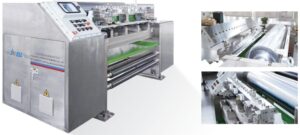
How a Precision Coating Unit Works?
Precision coating systems operate through a controlled fluid dynamics process combined with high-precision mechanical motion systems.
The coating material is first prepared in a controlled viscosity state, then delivered through a precision die or slot coating head. The substrate moves at a constant speed while the coating layer is applied in a continuous film.
Key controlling factors include:
- Flow rate stability
- Die gap precision
- Substrate tension control
- Temperature uniformity
- Surface energy compatibility
Coating Process Flow
Material preparation (mixing, filtration, degassing)
Viscosity stabilization
Precision metering pump delivery
Coating head application
Leveling and spreading phase
Drying or curing stage
Each stage affects final coating uniformity.
Table: Precision Coating Unit Process Parameters
| Parametr | Popis | Impact on Quality |
| Viscosity | Fluid resistance | Determines coating thickness stability |
| Line Speed | Substrate movement speed | Affects film uniformity |
| Die Gap | Coating head opening | Controls layer thickness |
| Temperature | Thermal stability | Influences on curing behavior |
| Pressure Stability | Flow consistency | Prevents streak defects |
Types of Precision Coating Technologies
Slot Die Coating
Slot die coating is one of the most precise methods, widely used in battery electrodes and optical films. It provides:
- Excellent thickness uniformity
- Closed system material delivery
- Minimal waste
Gravure Coating
Uses engraved rollers to transfer coating material. Suitable for:
- High-speed production
- Packaging films
- Decorative coatings
Blade Coating
Uses a controlled blade to spread material. Common in:
- Ceramic films
- Battery slurry coating
Spray Coating
Used for complex geometries but less precise than die-based systems.
Table: Comparison of Coating Technologies
| Method | Precision | Rychlost | Náklady | Aplikace |
| Slot Die | Very High | Střední | High | Batteries, optics |
| Gravure | Střední | Very High | Střední | Balení |
| Blade | High | Střední | Low–Medium | Energy materials |
| Spray | Low–Medium | High | Low | Irregular surfaces |
Aplikace přesných nátěrových jednotek
Precision coating units are essential in modern manufacturing processes where micron-level accuracy, uniform film thickness, and surface consistency directly determine product performance. These systems are widely used across energy storage, electronics, medical devices, and advanced industrial materials.
Výroba lithiových-iontových baterií
Precision coating plays a central role in battery electrode production, where even minor variations can significantly affect electrochemical performance.
Klíčové aplikace:
- Cathode coating
- Anode coating
- Separator surface modification
Why precision matters:
- Ensures uniform active material distribution
- Improves energy density and cycle life
- Reduces internal resistance inconsistencies
Impact:
Even slight coating defects can lead to capacity loss, overheating risks, and reduced battery lifespan, making precision coating critical for EV and energy storage systems.
Optical Films and Display Industry
In optical applications, coating uniformity directly affects visual quality and device performance.
Klíčové aplikace:
- LCD polarizer films
- OLED functional layers
- Anti-reflective coatings
- Optical diffusion films
Why precision matters:
- Maintains consistent light transmission
- Prevents color distortion
- Ensures high-definition display performance
Impact:
Uniform coating thickness is essential for achieving accurate color reproduction and crystal-clear image quality in modern display technologies.
Medical and Biomedical Applications
Precision coating is critical in medical devices where surface properties influence both biocompatibility and drug delivery performance.
Klíčové aplikace:
- Drug-eluting stents
- Catheters
- Diagnostic membranes
- Biosensors
Why precision matters:
- Ensures controlled drug release rates
- Improves tissue compatibility
- Reduces risk of adverse biological reactions
Impact:
Coating consistency directly affects patient safety and therapeutic effectiveness.
Flexibilní elektronika
Flexible and printed electronics rely heavily on precise coating techniques for functional layer formation.
Klíčové aplikace:
- Flexible circuit films
- Conductive polymer layers
- Wearable sensors
- Printed electronics substrates
Why precision matters:
- Maintains electrical conductivity consistency
- Prevents signal loss or distortion
- Supports mechanical flexibility without cracking
Impact:
Enables the development of next-generation wearable and foldable electronic devices.
Industrial Protective Coatings
Precision coating is widely used to enhance durability and resistance in harsh environments.
Klíčové aplikace:
- Anti-corrosion coatings
- Thermal barrier coatings
- Chemical-resistant surface layers
- Wear-resistant industrial surfaces
Why precision matters:
- Ensures uniform protective coverage
- Prevents weak points in coating layers
- Extends the service life of industrial components
Impact:
Improves equipment longevity, safety, and operational stability in demanding environments.
Engineering Challenges in Precision Coating
Precision coating systems are designed to deliver uniform, high-accuracy thin films, but achieving this level of control in real-world manufacturing environments presents several engineering challenges. These challenges arise from the interaction between fluid dynamics, material properties, mechanical precision, and drying behavior.
Fluid Instability at High Speeds
At high production speeds, coating fluids can become unstable due to changes in flow behavior.
Causes:
- High shear forces during coating application
- Viscosity fluctuations in coating materials
- Inconsistent pump or slot-die flow rates
Effects:
- Ripple patterns on the coated surface
- Thickness variation across the substrate
- Reduced coating uniformity
Engineering response:
- Precision flow control systems
- Stable rheology formulation
- Optimized coating head design
Edge Bead Formation
Edge bead refers to excess material accumulation at the edges of the substrate.
Causes:
- Surface tension effects
- Lateral flow imbalance
- Inadequate edge control mechanisms
Effects:
- Uneven coating thickness
- Material waste during trimming
- Reduced usable surface area
Engineering response:
- Edge bead removal systems (EBR)
- Controlled coating width design
- Optimized viscosity and surface tension balance
Air Bubble Entrapment
Air bubbles trapped within the coating layer can severely affect product quality.
Causes:
- Improper mixing of coating slurry
- Turbulent flow during application
- Inadequate degassing before coating
Effects:
- Surface defects
- Electrical or optical performance degradation
- Mechanical weak points in coating layers
Engineering response:
- Vacuum degassing systems
- Laminar flow control
- Improved mixing and filtration systems
Drying Non-Uniformity
Uneven drying leads to internal stress and coating defects.
Causes:
- Temperature gradients in drying zones
- Uneven airflow distribution
- Variable solvent evaporation rates
Effects:
- Warping or cracking
- Thickness inconsistencies
- Reduced adhesion strength
Engineering response:
- Multi-zone drying control
- Uniform airflow design
- Real-time thermal monitoring systems
Substrate Deformation
Thin or flexible substrates may deform during coating and drying processes.
Causes:
- Mechanical tension imbalance
- Thermal expansion differences
- Coating-induced stress
Effects:
- Dimensional distortion
- Registration errors in multilayer processes
- Reduced product precision
Engineering response:
- Tension control systems
- Temperature stabilization
- Reinforced substrate handling mechanisms
Table: Common Defects and Causes
| Defect | Kořenová příčina | Řešení |
| Streaking | Flow instability | Improve pump control |
| Bubbles | Air entrapment | Degassing system |
| Uneven thickness | Die misalignment | Precision calibration |
| Edge thickening | Surface tension imbalance | Edge control system |
Role of Precision Coating Consumables and Materials
In precision coating systems, consumables and material properties are just as important as the coating equipment itself. They directly influence coating stability, film uniformity, process repeatability, and long-term production efficiency.
Key Precision Coating Consumables
Consumables are the replaceable or wear-prone components that ensure continuous, stable coating performance. Even small variations in their condition can significantly affect coating quality.
-
Coating Dies
Coating dies are the core component that determines the shape, width, and thickness distribution of the coating layer.
Funkce:
- Control uniform fluid distribution
- Define coating width and edge quality
- Ensure consistent film thickness across the substrate
Importance:
Directly impacts coating uniformity
Wear, or contamination leads to defects such as streaks or thickness variation
-
Metering Pumps
Metering pumps control the precise flow rate of coating materials.
Funkce:
- Deliver stable and adjustable fluid volume
- Maintain consistent coating thickness
- Support high-speed continuous operation
Importance:
- Flow instability leads to uneven coating
- Critical for multi-layer and high-precision applications
-
Filters
Filters remove unwanted particles and impurities from coating fluids.
Funkce:
- Eliminate contaminants and agglomerates
- Protect coating die and nozzle systems
- Improve surface smoothness
Importance:
- Prevents defects such as pinholes and scratches
- Essential for optical, medical, and battery coatings
-
Mixing Elements
Mixing systems ensure uniform dispersion of materials in the coating slurry.
Funkce:
- Maintain homogeneous particle distribution
- Prevent sedimentation or phase separation
- Stabilize viscosity throughout processing
Importance:
- Directly affects coating consistency
- Critical for multi-component formulations (e.g., battery slurries)
-
Nozzle Systems
Nozzles control the final application of coating onto the substrate.
Funkce:
- Regulate spray or slot application patterns
- Ensure even deposition across surfaces
- Adapt to different substrate widths and speeds
Importance:
- Affects edge quality and surface uniformity
- Sensitive to clogging and wear
Key Material Properties in Precision Coating
Beyond equipment, the physical and chemical properties of coating materials strongly influence process stability and final product quality.
-
Viscosity
Definition:
Resistance of the fluid to flow.
Impact on coating:
- Determines flow stability through dies and nozzles
- Affects layer thickness and uniformity
Key insight:
- Too high → uneven flow
- Too low → poor film formation
-
Surface Tension
Definition:
Molecular force at the liquid surface.
Impact on coating:
- Controls wetting behavior on substrates
- Influences edge bead formation and leveling
Key insight:
Balanced surface tension is essential for smooth, defect-free coating layers.
-
Solid Content
Definition:
Percentage of solid particles in the coating mixture.
Impact on coating:
- Determines final film density and thickness
- Affects drying time and adhesion strength
Key insight:
Higher solid content improves efficiency but increases flow complexity.
-
Drying Rate
Definition:
The speed at which the solvent evaporates after coating.
Impact on coating:
- Influences film structure formation
- Affects internal stress and surface quality
Key insight:
- Too fast → cracks and defects
- Too slow → productivity reduction
Industrial Equipment Ecosystem (Including jwell)
In industrial film and coating production systems, manufacturers such as Jwell provide extrusion-based and coating-related equipment widely used in polymer film production lines.
In many production environments, coating units are integrated with extrusion systems to form continuous manufacturing lines for:
- Plastic films
- Obalové materiály
- Functional polymer sheets
This integration improves production efficiency and reduces material waste.
Precision Coating Unit vs Traditional Coating Systems
Precision coating units differ significantly from traditional systems:
- Traditional systems focus on coverage
- Precision systems focus on uniformity and repeatability
Table: System-Level Comparison
| Funkce | Přesná nátěrová jednotka | Traditional Coating Machine |
| Accuracy | Micron-level | Millimeter-level |
| Waste | Low | High |
| Řídící systém | Advanced feedback loops | Basic mechanical control |
| Aplikace | High-tech industries | General industrial use |
| Náklady | Higher | Lower |
Future Trends in Precision Coating Technology
Future developments include:
- AI-controlled coating thickness adjustment
- Real-time optical thickness monitoring
- Nano-scale functional coatings
- Multi-layer simultaneous coating systems
- Smart adaptive viscosity control
These innovations will push precision coating toward nanomanufacturing standards.
FAQ: Precision Coating Unit
- What is a precision coating unit used for?
It is used to apply ultra-uniform thin films on materials in industries like batteries, electronics, and medical devices.
- What industries use precision coating units?
Lithium batteries, flexible electronics, optical films, and the biomedical industries.
- What is the difference between coating and precision coating?
Coating applies material generally, while precision coating ensures micron-level thickness control.
- What is a slot die coating system?
It is a high-precision method that delivers coating material through a controlled die for uniform film formation.
- Why is precision coating important in batteries?
Because uneven coating reduces energy density, cycle life, and safety performance.
- What materials are used in precision coating?
Slurries, polymers, conductive materials, adhesives, and functional chemical coatings.
Závěr
A precision coating unit is much more than just a coating machine; it is a high-precision material engineering system that determines the performance of advanced industrial products.
It plays a central role in:
- Energy storage systems;
- Electronics manufacturing;
- Medical device production;
- Optical material engineering.





 English
  Russian
  Spanish
  Arabic
  German
  French
  Persian
  Turkish
  Bulgarian
  Czech
Czech  Dutch
Dutch  Greek
Greek  Indonesian
  Japanese
  Korean
  Polish
  Portuguese
  Romanian
  Slovenian
  Ukrainian