
Quick Answer
A high-output, thin-mesin tiup film is designed to manufacture lightweight plastic films at high production speeds while maintaining precise thickness control, stable bubble formation and excellent mechanical properties. It also improves energy efficiency. According to Chris Rauwendaal’s Polymer Extrusion and the Film Extrusion Manual published by TAPPI Press, the performance of blown film production depends on extrusion stability, die technology, cooling efficiency and process control accuracy. Modern, high-output film blowing systems, such as those developed by experienced manufacturers like Jwell, integrate advanced extrusion technology and intelligent automation to reliably produce film on a large scale.
Features of a High-Output Thin Film Blowing Machine
Global demand for high-performance plastic films is increasing rapidly due to growth in flexible packaging, agriculture, medical products, electronics and industrial protection applications. To meet this demand, manufacturers are investing in high-output thin film blowing machines that can produce thinner films more efficiently while maintaining strict quality standards.
A thin film blowing machine is an extrusion-based production system that converts polymer materials into continuous plastic films by melting, extruding, inflating the bubble, cooling, stretching and winding. Unlike traditional blown film equipment, high-output models are designed to deliver higher throughput, greater film uniformity, reduced energy consumption and enhanced production stability.
By 2026, advanced film blowing technology will have moved towards intelligent manufacturing, multi-layer structures, sustainable material processing and automated quality control. These developments enable manufacturers to produce films with enhanced strength-to-weight ratios, improved barrier performance and reduced production costs.
What Is a Thin Film Blowing Machine?
A thin film blowing machine is a type of plastic extrusion equipment used to manufacture thin polymer films. It does this by forming an inflated tubular bubble from molten plastic material.
The basic working process includes the following steps:
- Feeding the plastic resin;
- Melting and plasticising the material;
- Extruding it through a circular die;
- Forming and inflating the bubble;
- Cooling and stabilising it;
- Stretching and pulling the film;
- Treating and winding the film surface.
During production, multiple parameters must be carefully controlled, including:
- Melt temperature
- Extrusion pressure
- Air cooling volume
- Bubble diameter
- Film thickness
- Take-up speed
The final film quality depends heavily on the stability and precision of each processing stage.
Thin film blowing machines are widely used for producing:
- Packaging films
- Agricultural films
- Food wrapping films
- Medical packaging films
- Shrink films
- Protective industrial films
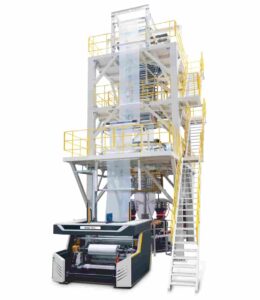
Main Features of High-Output Thin Film Blowing Machines
-
Higher Production Output
The primary advantage of a high-output film blowing machine is its ability to increase production capacity without compromising film quality.
Higher output is achieved through optimized equipment design, including:
- High-performance extrusion systems
- Larger screw diameter options
- Improved motor efficiency
- Advanced cooling technology
- Automated process monitoring
Compared with conventional machines, high-output systems can process more polymer material within the same operating time.
This provides manufacturers with several advantages:
- Lower production cost per unit
- Higher factory productivity
- Reduced labor requirements
- Improved market competitiveness
For large-scale film manufacturers, production efficiency directly affects profitability. Therefore, output capability is one of the most important factors when selecting a film blowing system.
-
Advanced Extrusion Technology
The extrusion unit is the core component of any film blowing machine because it determines the quality and stability of molten polymer processing.
A high-output system usually incorporates:
- Optimized screw geometry
- High-efficiency heating zones
- Accurate temperature control
- Stable feeding mechanisms
The extrusion process must achieve uniform melting and mixing before the polymer reaches the die.
An advanced extrusion system helps improve:
- Melt homogeneity
- Output stability
- Efisiensi energi merupakan faktor penting yang harus dipertimbangkan saat memilih lini peletisasi. Efisiensi energi lini peletisasi daur ulang plastik bergantung pada sejumlah faktor, termasuk desain mesin, jenis motor yang digunakan, dan sistem kontrol. Memilih lini peletisasi yang efisien energi penting karena membantu mengurangi biaya operasional dan meminimalkan dampak terhadap lingkungan. Lini peletisasi yang efisien energi mengonsumsi lebih sedikit energi dan menghasilkan lebih sedikit panas, yang mengurangi jejak karbon dari operasi daur ulang. Saat memilih lini peletisasi, penting untuk mempertimbangkan penghematan energi dalam jangka panjang.
- Film appearance
Poor extrusion performance may result in:
- Thickness variation
- Film surface defects
- Weak mechanical properties
- Production interruptions
Modern high-output machines use specially designed screws to improve plasticization efficiency and support a wider range of polymer materials.
-
Precision Film Thickness Control
For thin films, thickness accuracy is one of the most critical quality indicators.
A high-output thin film blowing machine uses advanced control technologies to maintain consistent film thickness throughout continuous production.
Important technologies include:
- Automatic thickness measurement
- Intelligent die adjustment
- Online quality monitoring systems
These systems can detect thickness deviations and automatically adjust operating parameters.
Benefits include:
- Reduced raw material waste
- Improved product consistency
- Better downstream processing
- Lower production costs
Thickness control is especially important for applications such as:
- Kemasan makanan
- Medical films
- High-barrier packaging
- Precision industrial films
where small variations can influence product performance.
-
High-Efficiency Cooling System
Cooling performance has a direct impact on film quality and production speed.
After molten polymer exits the die, the bubble must be cooled quickly and evenly to achieve stable film formation.
A high-performance cooling system improves:
- Bubble stability
- Film transparency
- Mechanical strength
- Line speed capability
Common advanced cooling technologies include:
- High-performance air rings
- Dual-lip cooling systems
- Internal bubble cooling systems
Compared with conventional cooling designs, these systems provide more uniform airflow around the bubble, allowing higher production speeds while maintaining stable film properties.
-
Stable Bubble Control
Bubble stability is essential for producing high-quality thin films.
During blown film production, the inflated bubble must maintain a consistent diameter and shape. Any instability can cause:
- Uneven thickness
- Film wrinkles
- Edge defects
- Reduced mechanical performance
High-output machines use automatic bubble control technologies to regulate:
- Internal air pressure
- Cooling airflow
- Bubble diameter
- Haul-off speed
Stable bubble control enables continuous production with fewer interruptions and improved product consistency.
Comparison Between Standard and High-Output Thin Film Blowing Machines
| Feature | Standard Film Blowing Machine | High-Output Thin Film Blowing Machine |
| Production Speed | Medium production rate | High-speed continuous production |
| Kapasitas Output | Suitable for general applications | Designed for large-scale manufacturing |
| Kontrol Ketebalan | Manual or basic adjustment | Automatic precision control |
| Sistem Pendinginan | Conventional air cooling | Advanced cooling technology |
| Automation Level | Limited monitoring | Intelligent process control |
| Efisiensi Energi | Average efficiency | Optimized power consumption |
-
Multi-Layer Film Production Capability
One of the major developments in modern thin film blowing technology is multi-layer film production.
High-output machines often support:
- 3-layer film structures
- 5-layer film structures
- 7-layer film structures
Multi-layer technology allows manufacturers to combine different material advantages into a single film.
For example:
| Film Layer | Main Function |
| Outer layer | Printing performance and protection |
| Barrier layer | Prevents oxygen, moisture, or gas penetration |
| Adhesive layer | Improves layer bonding |
| Inner layer | Provides sealing performance |
This technology is widely used in:
- Kemasan makanan
- Pharmaceutical packaging
- Agricultural films
- Industrial barrier films
-
Intelligent Automation and Process Control
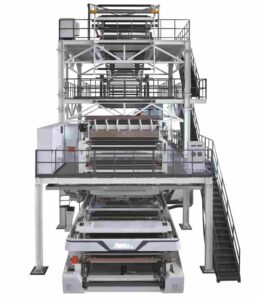
One of the most important developments in high-output film blowing machines is the integration of intelligent automation systems. As film manufacturers face increasing demands for higher productivity and consistent quality, manual operation alone is no longer sufficient for modern production requirements.
Advanced control systems allow operators to monitor and adjust critical parameters in real time, including:
- Extrusion temperature
- Melt pressure
- Kecepatan sekrup
- Cooling airflow
- Bubble diameter
- Film thickness
- Winding tension
Through PLC control systems, touchscreen interfaces, and data monitoring technologies, manufacturers can reduce human errors and improve production repeatability.
Intelligent automation provides several benefits:
- Faster troubleshooting
- More stable production processes
- Mengurangi limbah material
- Easier operation management
- Improved production data analysis
For large-scale film production facilities, these intelligent functions help maintain stable output even during long continuous operation periods.
-
Energy-Saving Design and Sustainable Production
Energy efficiency has become a key consideration in plastic processing industries. A high-output thin film blowing machine must not only increase production capacity but also reduce energy consumption per kilogram of film produced.
Modern energy-saving designs include:
- High-Efficiency Extrusion Motors
Advanced motors provide better power utilization and reduce unnecessary electricity consumption during operation.
- Optimized Heating Systems
Traditional heating methods may lose energy through heat dissipation. Modern systems use improved insulation designs and precise temperature control to minimize energy waste.
- Efficient Cooling Technology
Cooling systems with optimized airflow improve heat exchange efficiency while reducing blower energy consumption.
The combination of these technologies helps manufacturers achieve:
- Lower operating costs
- Reduced carbon footprint
- Higher production efficiency
- Better compliance with environmental requirements
As sustainability becomes increasingly important in the plastics industry, energy-efficient film blowing equipment will continue to gain market attention.
-
Compatibility with Various Polymer Materials
A high-quality thin film blowing machine should be capable of processing different types of polymer materials to meet changing market demands.
Common materials include:
- Polietilena (PE)
- Linear low-density polyethylene (LLDPE)
- Low-density polyethylene (LDPE)
- High-density polyethylene (HDPE)
- Polipropilena (PP)
- Biodegradable polymers
Different materials require different processing conditions.
For example:
LDPE is commonly used for flexible packaging films because of its excellent flexibility.
LLDPE provides improved tensile strength and puncture resistance.
HDPE offers higher stiffness and barrier properties.
Biodegradable materials require precise temperature control to avoid degradation.
A flexible machine design allows manufacturers to expand product categories and respond quickly to market changes.
-
Improved Film Quality and Mechanical Performance
The purpose of a high-output film blowing machine is not only to increase production speed but also to improve final film performance.
Advanced equipment helps produce films with:
- Uniform thickness
- Higher tensile strength
- Better transparency
- Improved sealing performance
- Enhanced barrier properties
Film quality depends on the interaction between:
- Extrusion stability
- Cooling efficiency
- Stretching ratio
- Die design
- Winding accuracy
A well-designed machine ensures that these factors remain balanced throughout the production process.
Major Applications of High-Output Thin Film Blowing Machines
-
Flexible Packaging Industry
Flexible packaging is one of the largest application areas for blown film technology.
High-output film blowing machines are used to produce:
- Food packaging films
- Shopping bags
- Packaging liners
- Protective wrapping films
The packaging industry requires films with:
- Good mechanical strength
- Excellent sealing properties
- High transparency
- Reliable barrier performance
Multi-layer blown film technology has further expanded packaging applications by combining multiple functional properties into one film structure.
-
Agricultural Film Production
Agriculture requires specialized films for improving crop production efficiency.
Applications include:
- Greenhouse films
- Mulching films
- Silage films
Agricultural films must provide:
- UV resistance
- Weather durability
- Mechanical strength
- Umur pakai yang panjang
High-output machines enable manufacturers to produce large volumes of agricultural films with stable quality.
-
Medical and Hygiene Products
The medical industry requires strict quality control for plastic films.
Applications include:
- Medical packaging films
- Disposable product packaging
- Protective barrier films
These applications require:
- Clean production processes
- Stable film thickness
- Reliable material performance
Advanced film blowing machines help manufacturers meet these demanding requirements.
-
Industrial Protective Films
Industrial sectors use thin films for surface protection and transportation safety.
Examples include:
- Electronic product protection films
- Construction material wrapping
- Automotive protective films
These films require:
- Good flexibility
- Scratch resistance
- Strong adhesion control
High-output production lines provide the efficiency needed for large industrial markets.
How to Choose a High-Output Thin Film Blowing Machine?
Selecting the right machine requires evaluating several technical factors.
-
Production Requirements
Manufacturers should consider:
- Required output capacity
- Lebar film
- Rentang ketebalan film
- Production schedule
A machine designed for high-volume packaging film production may differ significantly from equipment used for specialty films.
-
Material Requirements
The machine should match the polymer materials being processed.
Important considerations include:
- Resin characteristics
- Melting temperature
- Processing stability
- Required film properties
A machine with flexible material compatibility provides greater production opportunities.
-
Extrusion and Cooling Performance
The extrusion system and cooling structure directly influence production efficiency.
Key factors include:
- Screw design
- Die quality
- Cooling airflow
- Bubble stability control
These components determine whether the machine can maintain high output without sacrificing quality.
-
Automation Level
For modern manufacturing environments, automation capability is increasingly important.
Recommended features include:
- Automatic thickness control
- Digital monitoring systems
- Remote diagnostics
- Production data recording
Higher automation reduces dependence on operator experience and improves consistency.
Maintenance Tips for Film Blowing Machines
Proper maintenance is essential for maintaining long-term performance.
-
Regular Extruder Inspection
Operators should check:
- Screw wear
- Heater condition
- Temperature sensors
- Motor performance
Stable extrusion is critical for consistent film quality.
-
Maintain Cooling Systems
Cooling components should be regularly cleaned and inspected.
Blocked airflow or unstable cooling may lead to:
- Bubble fluctuations
- Thickness variation
- Reduced production speed
-
Check Die and Winding Systems
The die and winding unit directly affect final film appearance.
Regular inspection helps prevent:
- Film wrinkles
- Uneven winding
- Surface defects
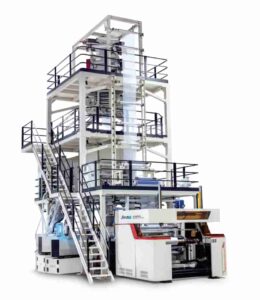
Frequently Asked Questions About Film Blowing Machines
- What is a high-output film blowing machine?
A high-output film blowing machine is an advanced extrusion system designed to produce plastic films at higher speeds while maintaining stable thickness, quality, and production efficiency.
- What factors affect film blowing machine output?
Main factors include:
- Extruder capacity
- Screw design
- Die structure
- Cooling efficiency
- Film thickness requirements
- Material type
Optimizing these factors helps achieve higher production rates.
- What materials can a thin film blowing machine process?
Most machines can process materials such as PE, PP, LLDPE, HDPE, LDPE, and some biodegradable polymers depending on machine configuration.
- Why is cooling important in film blowing?
Cooling determines bubble stability, film thickness uniformity, transparency, and mechanical properties. Efficient cooling allows higher production speeds with better film quality.
- How can a film blowing machine reduce production costs?
A high-output machine reduces costs through:
- Higher production capacity
- Lower energy consumption
- Mengurangi limbah material
- Improved automation
- How long can a film blowing machine operate?
With proper maintenance and correct operation, industrial film blowing machines can provide many years of reliable production. Service life depends on machine quality, operating conditions, and maintenance practices.
Kesimpulan
The features of a high-output thin film blowing machine determine its ability to deliver efficient, stable and cost-effective film production. Compared with conventional equipment, advanced systems offer a higher output capacity, improved thickness control, enhanced cooling performance, intelligent automation and greater compatibility with modern polymer materials.
As the plastic film industry moves towards lightweight products, sustainable materials and smart manufacturing, high-performance film blowing machines will become increasingly important for manufacturers seeking to increase productivity and improve product quality.
The ideal machine is not simply the one with the highest production speed. A truly high-output system must balance output capacity, energy efficiency, film quality, reliability and operational flexibility. Selecting suitable extrusion technology, cooling systems, automation features and maintenance strategies enables manufacturers to achieve long-term production advantages in an increasingly competitive global market.



 English
  Russian
  Spanish
  Arabic
  German
  French
  Persian
  Turkish
  Bulgarian
  Czech
Czech  Dutch
Dutch  Greek
Greek  Indonesian
  Japanese
  Korean
  Polish
  Portuguese
  Romanian
  Slovenian
  Ukrainian