
Article Summary
The differentiation between ekstrusi pelat ekstruder, commonly confused terms, is paramount to production – extrusion being the process of shaping material by forcing it through a die to create continuous shapes, and extruder being the machine that carries out said process.
Extrusion is identified as one of the key continuous forming technologies for plastic, metal, food, rubber, and advanced composites in the field of polymer processing and industrial production, among which the extruder is the core equipment of conveying, melting, mixing, pressurizing, and forming material.
Understanding Extrusion and Extruder in Modern Manufacturing
In industrial manufacturing, the terms ‘extrusion’ and ‘extruder’ are often used interchangeably, particularly among those new to plastics processing, polymer engineering, cable manufacturing, pipe production, or industrial machinery. However, despite their close relationship, the two terms refer to entirely different concepts. Engineers, purchasing managers, factory operators, production planners, and manufacturers involved in modern processing industries need to understand the distinction.
The term ‘extrusion’ describes the manufacturing process itself. This continuous shaping method involves pushing raw material — typically plastic pellets, powder, rubber compounds, metal billets, food paste or composite material — through a specifically designed die opening under controlled heat and pressure. The result is a continuous product with a fixed cross-sectional profile. Common examples include plastic pipes, sheets, profiles, wires, films, tubes, window frames, medical tubing, food snacks, and aluminium structural components.
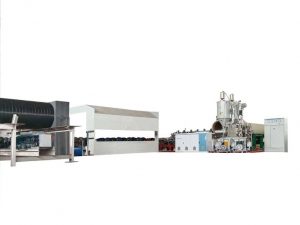
An extruder is the machine used to carry out the extrusion process. This industrial equipment melts, transports, compresses, mixes, and pushes the material through the die. It usually contains key mechanical systems such as screws, barrels, heaters, cooling units, hoppers, drive motors, gearboxes, and control systems. Without an extruder, the extrusion manufacturing process cannot occur.
A useful analogy is this:
Extrusion is the manufacturing activity or process, while an extruder is the machine that performs this activity.
This distinction may seem basic, but confusing the two can lead to communication issues during equipment procurement, technical discussions, production optimisation and engineering documentation in industrial practice.
The global manufacturing sector is becoming increasingly reliant on extrusion technologies because they enable high-speed, continuous production with excellent material efficiency. Research into polymer processing and industrial forming technologies consistently identifies extrusion as one of the world’s most economically important continuous manufacturing methods.
Today, extrusion systems are used across a range of industries, including:
- Plastic processing
- Wire and cable manufacturing
- Food processing
- Pharmaceutical production
- Rubber manufacturing
- Aluminium and metal forming
- 3D printing
- Composite materials
- Chemical engineering
- Recycling systems
Industrial equipment manufacturers such as Jwell have played an important role in advancing high-performance extrusion technologies for pipes, sheets, profiles, films, and recycling systems used worldwide.
What Is Extrusion? Complete Explanation of the Process
Extrusion is a continuous manufacturing process designed to produce products with a uniform cross-sectional shape. During the process, the raw material enters a processing chamber where it is heated and softened or melted. It is then mechanically conveyed and pressurised before being forced through a die that determines the final shape of the product.
The process itself can vary depending on the material involved. In plastics manufacturing, for example, thermoplastic pellets are typically fed into a heated barrel, where rotating screws generate the friction and heat necessary to melt the polymer. The molten plastic is then pushed through a die to shape the material into pipes, sheets, tubing, or profiles. After exiting the die, the product is cooled and solidified.
Metal extrusion operates differently because metal billets undergo extreme pressure and deformation, often without fully melting. In aluminium extrusion, for instance, heated aluminium billets are compressed and forced through hardened dies to create profiles used in construction, transportation, and industrial systems.
The extrusion process has several defining characteristics:
| Extrusion Characteristic | Deskripsi | Industrial Benefit |
| Continuous Production | Material flows continuously through the die | High production efficiency |
| Fixed Cross Section | Final shape remains consistent לאורך the product | Excellent dimensional consistency |
| High Throughput | Large volumes can be processed rapidly | Lower manufacturing cost |
| Kemampuan Serbaguna Bahan | Works with plastics, metals, food, rubber, and composites | Broad industrial applications |
| Scalable Production | Supports both small and large-scale manufacturing | Flexible factory integration |
One reason why extrusion has become so prevalent in industrial production is its efficiency. Unlike injection moulding, which is a cyclic batch process, extrusion operates continuously. This enables factories to produce kilometres of pipe, film, cable insulation or profiles without interruption. Engineers often describe extrusion as a ‘continuous flow manufacturing technology’.
The process can also incorporate additives, fillers, colourants, stabilisers and reinforcements during production. Advanced twin-screw extrusion systems are particularly well-suited to compounding applications requiring homogeneous material mixing.
Modern extrusion systems are increasingly incorporating automation, AI-driven process optimisation, IoT monitoring, predictive maintenance systems and Industry 4.0 data analytics. Manufacturing research is even exploring semantic machine models and intelligent extrusion systems for smart factories.
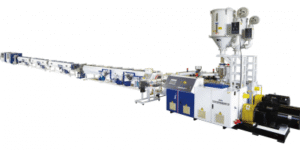
What Is an Extruder and How Does It Work?
Extrusion is the process; the extruder is the machine that performs it. Modern industrial extruders are highly sophisticated systems that integrate mechanical engineering, thermal control, materials science, and automation technologies.
At its core, an extruder performs five essential functions:
1) feeding raw material;
2) conveying material forward;
3) melting or plasticising the material;
4) mixing and homogenising the melt;
5) Pressurising and shaping the material through a die.
These functions occur simultaneously inside the machine.
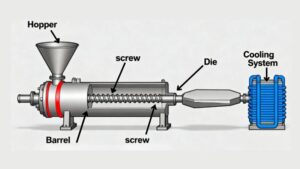
A standard plastic extruder typically contains the following components:
| Extruder Component | Fungsi | Importance |
| Hopper | Feeds raw material into the machine | Continuous material supply |
| Laras | Houses the screw and heating zones | Processing chamber |
| Sekrup | Moves, melts, and mixes material | Core mechanical element |
| Heater Bands | Provide thermal energy | Polymer melting |
| Sistem Pendinginan | Controls temperature stability | Prevents overheating |
| Kepala Cetakan | Shapes the final product | Determines profile geometry |
| Motor & Gearbox | Powers screw rotation | Controls throughput |
| Sistem Kontrol | Monitors operating parameters | Process precision |
The screw is often considered the heart of the extruder. As it rotates inside the heated barrel, it pushes material forwards while generating the shear forces needed to melt and homogenise the polymer.
Different extruder designs depend on processing requirements:
These include:
- Single-screw extruders
- Twin-screw extruders
- Counter-rotating extruders
- Co-rotating extruders
- Ram extruders
- Planetary extruders
- Multi-screw systems
Single-screw extruders are commonly used for straightforward applications, such as pipe and film production. Twin-screw systems, on the other hand, are preferred for complex compounding and high-performance material processing.
Manufacturers such as Jwell have developed advanced extrusion lines capable of processing engineering plastics, biodegradable materials, medical polymers, recycled plastics, and multilayer composite systems.
Extruder technology has evolved significantly over the past decade. Modern systems now incorporate:
- Intelligent temperature control
- Servo-driven precision motors
- Energy-saving heating systems
- Automated feeding systems
- Real-time monitoring software
- AI-assisted process optimisation
- Smart factory integration
These developments improve product consistency, reduce energy consumption, and minimise material waste.
Key Differences Between Extrusion and Extruder
Although the two terms are closely related, the distinction becomes clearer when viewed from a manufacturing systems perspective.
| Factor | Ekstrusi | Pengekstrusi |
| Definisi | Manufacturing process | Industrial machine |
| Role | Forms material into continuous shapes | Performs the forming process |
| Category | Production technology | Mechanical equipment |
| Fungsi | Material shaping method | Material processing system |
| Example | Plastic pipe extrusion | Twin-screw plastic extruder |
| Industrial Meaning | Operation or process | Equipment or machinery |
| Usage in Factories | Production activity | Production asset |
The confusion between the terms often arises because industrial professionals use the word ‘extrusion’ casually when discussing both the process and the equipment. However, in technical engineering, it is important to make this distinction.
For example:
- ‘The factory uses extrusion for PVC pipe production.’
- ‘The plant installed a new twin-screw extruder.’
- These two sentences refer to different aspects of the manufacturing process.
The relationship between the two can be summarised very simply:
- Extrusion is the process.
- The extruder is the machine that performs it.
This distinction also appears in scientific literature and industrial engineering documentation. Research papers discussing polymer extrusion tend to focus on flow behaviour, rheology, die pressure, thermal transfer and process optimisation, whereas studies centred on equipment analyse extruder design, screw geometry, motor systems and machine efficiency.
In Industry 4.0 manufacturing systems, this distinction is even more important because digital factory systems classify processes and equipment differently. Extrusion belongs to the process layer, while extruders belong to the machinery and asset layer.
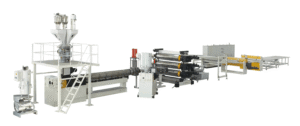
Types of Extrusion Processes and Extruders
Extrusion technology has expanded far beyond the traditional plastics manufacturing industry. Today, there are numerous extrusion methods and extruder configurations, depending on the materials used, the product’s geometry, and the industrial requirements.
Common extrusion processes include:
Plastic extrusion
Digunakan untuk memproduksi:
- Pipes
- Sheets
- Profiles
- Films
- Bahan kemasan
- Cable insulation
Metal extrusion
Used for:
- Aluminium profiles
- Structural components
- Automotive parts
- Aerospace materials
Food extrusion
Banyak diterapkan dalam:
- Breakfast cereals
- Snack foods
- Pet food
- Pasta products
Rubber extrusion
Used for:
- Seals
- Gaskets
- Automotive rubber parts
3D printing material extrusion
Modern additive manufacturing systems use miniature extrusion systems to deposit molten material layer by layer.
Common Extruder Types
| Jenis Pengekstrusi | Main Feature | Aplikasi Khas |
| Single-Screw Extruder | Simple and economical | Pipe, sheet, film |
| Twin-Screw Extruder | Superior mixing capability | Compounding, engineering plastics |
| Co-Rotating Extruder | High shear and dispersion | Polymer blending |
| Counter-Rotating Extruder | Gentle processing | PVC profiles |
| Ram Extruder | High-pressure batch feed | PTFE processing |
| Planetary Extruder | Excellent thermal control | Specialty materials |
Twin-screw systems continue growing in popularity because they provide superior mixing, devolatilization, compounding, and process flexibility. Companies such as our Jwell increasingly focus on advanced twin-screw technologies for high-end industrial applications, including biodegradable plastics, recycled materials, and smart manufacturing systems.
Why is Extrusion Technology so Important in Industry?
Extrusion has become one of the most important manufacturing technologies in modern industrial production thanks to its combination of efficiency, scalability, material flexibility, and continuous operation.
There are several reasons for its widespread adoption:
- High production efficiency: continuous production dramatically increases throughput compared with batch manufacturing methods.
- Excellent material utilisation: extrusion minimises scrap and waste because material flows continuously through the system.
- Broad material compatibility: the process supports thermoplastics, thermosets, elastomers, metals, composites and food materials.
- Automation compatibility: Extrusion systems integrate well with modern automation, robotics and smart factory systems.
- Cost efficiency: long production runs reduce manufacturing costs per unit.
Dimensional consistency
Continuous processing improves product uniformity and repeatability.
Extrusion also plays a critical role in recycling systems. Modern recycling lines often use extrusion equipment to reprocess plastic waste into reusable pellets or new products.
According to discussions in the engineering community, extrusion is often described as ‘continuous shaping’, while injection moulding is described as ‘batch cavity filling’. Reddit engineering users often summarise the difference by comparing extrusion to squeezing toothpaste continuously through an opening.
The growing global demand for sustainable materials, recyclable polymers, lightweight composites, and energy-efficient manufacturing processes is driving further innovation in extrusion systems worldwide.
FAQ About Extrusion and Extruder
- What is the main difference between extrusion and an extruder?
Extrusion is the manufacturing process of forcing material through a die to create continuous shapes, while an extruder is the machine that performs this process.
- Is extrusion a machine or a process?
Extrusion is a process, not a machine. The machine used in extrusion is called an extruder.
- What products are made using extrusion?
Extrusion produces pipes, sheets, films, profiles, wires, tubing, cable insulation, food products, aluminum profiles, and many other continuous products.
- What are the main types of extruders?
The main types include single-screw extruders, twin-screw extruders, ram extruders, planetary extruders, and co-rotating or counter-rotating systems.
- Why is extrusion widely used in plastics manufacturing?
Extrusion offers continuous production, high efficiency, low waste, dimensional consistency, and compatibility with a wide range of polymer materials.
- What industries use extrusion technology?
Extrusion is widely used in plastics, food processing, pharmaceuticals, automotive manufacturing, construction, packaging, wire and cable production, and additive manufacturing.
Kesimpulan
Knowing the difference between extrusion and extruder is fundamentally important in industrial manufacturing and polymer processing. Although these terms are closely related, they mean different things within the production process.
Extrusion refers to the manufacturing process itself, whereby material is continuously shaped by being forced through a die under controlled pressure and temperature. Meanwhile, the extruder is the machine that carries out this process through mechanical conveying, melting, mixing, pressurisation, and shaping operations.
This distinction is becoming increasingly important as manufacturing systems evolve towards automation, Industry 4.0 integration, the processing of sustainable materials, and intelligent production control. Modern extrusion technology supports a wide range of applications, from traditional plastic pipe manufacturing to advanced composite materials, food engineering, pharmaceutical production, recycling systems, and additive manufacturing.
As the global industrial demand for greater efficiency, reduced waste, smarter automation, and more sustainable production methods grows, the critical role of extrusion technology across manufacturing industries will continue to increase. Suppliers of equipment such as Jwell remain important contributors to the advancement of high-performance extrusion systems for modern industrial applications.



 English
  Russian
  Spanish
  Arabic
  German
  French
  Persian
  Turkish
  Bulgarian
  Czech
Czech  Dutch
Dutch  Greek
Greek  Indonesian
  Japanese
  Korean
  Polish
  Portuguese
  Romanian
  Slovenian
  Ukrainian