
Quick Answer
PPR and PEX pipes are made of different materials and are not the same type of piping system. PPR (polypropylene random copolymer) is a thermoplastic polypropylene commonly used for hot and cold water distribution. PEX (crosslinked polyethylene) is a different polymer structure designed to provide greater flexibility and specific thermal and pressure performance. ISO 15874 covers polypropylene piping systems, while ISO 15875:2025 covers crosslinked polyethylene systems separately, confirming that they belong to distinct material standards.
References used: ISO 15874-1:2013 and ISO 15874-2:2013 for polypropylene piping systems and ISO 15875-1:2025 for PEX systems. These standards are particularly useful because they address the polymers themselves, as well as their intended applications, operating conditions, dimensions, and system requirements.
PPR Pipe vs. PEX Pipe: What Is the Main Difference?
The most significant distinction between PPR and PEX lies in the polymers and molecular structures from which each pipe is crafted. PPR is a polypropylene-based thermoplastic, whereas PEX starts out as polyethylene and then undergoes a crosslinking process that alters the polymer’s structure. While both materials can be used in hot and cold water systems, they should not be considered interchangeable simply because they perform similar functions within a building.
ISO 15874 describes polypropylene piping systems for hot and cold water installations and heating systems under specified pressure and temperature conditions within buildings. ISO 15875:2025, on the other hand, addresses crosslinked polyethylene piping systems for comparable hot and cold water and heating applications. The existence of separate international standards for these products reflects a fundamental engineering distinction rather than merely a difference in commercial naming.
For manufacturers, this difference begins before the pipe reaches the installation site. A PPR-pijpextrusielijn processes polypropylene material into a continuous pipe through melting, homogenization, die forming, calibration, cooling, sizing, hauling, and cutting or coiling as appropriate. PEX production also involves extrusion, but the crosslinking technology is an essential part of the final material structure, meaning that a PEX production process cannot simply be considered a PPR extrusion process with a different resin.
| Property | PPR Pipe | PEX Pipe |
| Full name | Polypropylene Random Copolymer | Crosslinked Polyethylene |
| Base polymer | Polypropylene | Polyethylene |
| Molecular structure | Thermoplastic | Crosslinked polymer |
| Flexibility | Relatively rigid | Highly flexible |
| Common supply form | Straight pipe lengths | Straight lengths or coils |
| Typical joining approach | Heat fusion | Mechanical or specialized PEX fittings |
| Common uses | Hot/cold water, plumbing, heating | Plumbing, radiant heating, hot/cold water |
| Production principle | Thermoplastic pipe extrusion | Extrusion combined with crosslinking technology |
| Main international standard | ISO 15874 series | ISO 15875 series |
The practical consequence is straightforward: PPR and PEX may compete in some of the same markets, but they are different piping technologies. The decision between them should therefore consider installation method, required flexibility, operating conditions, connection technology, local standards, and the specifications of the complete piping system.

What Is PPR Pipe and How Is It Made?
PPR pipe is a pressure pipe made from polypropylene random copolymer, more commonly known as PP-R. It has become a popular material for building water distribution systems due to its combination of low density, resistance to chemicals, and suitability for hot and cold water systems when correctly designed and specified.
The manufacturing process begins with polypropylene resin, which is usually supplied in the form of pellets or a prepared compound. Inside the extruder, the material is conveyed, heated, melted, mixed, and homogenised before being pushed through a pipe die. The die determines the initial tubular geometry. The hot pipe then passes through calibration and cooling equipment to establish its final outside diameter, wall thickness, roundness, and dimensional stability.
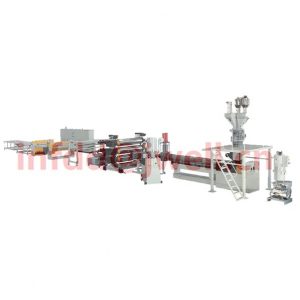
Therefore, designing a PPR pipe extrusion production line involves more than simply selecting an extruder with sufficient output. The die head, calibration sleeve, vacuum or sizing system, cooling tank, haul-off, cutting or coiling equipment, and control system all influence whether the finished pipe will maintain stable dimensions at production speed.
ISO 15874-2 specifies the requirements for polypropylene pipes used in hot and cold water installations and heating systems. These requirements include service conditions, design pressures, pipe dimensions, and associated testing. The standard also covers PP pipes with or without barrier layers, demonstrating that PPR production can involve more than one structural configuration.
For manufacturers, process stability is especially important because excessive variation in melt temperature, extrusion output, cooling conditions, or haul-off speed can affect wall thickness and dimensional consistency. Therefore, a production line needs coordinated control rather than treating extrusion, calibration, and cooling as independent operations.
What Is PEX Pipe and Why Is It More Flexible?
PEX stands for crosslinked polyethylene. Unlike PPR, which remains a thermoplastic material after processing, PEX contains crosslinks between polymer chains, giving the finished material a unique combination of flexibility, thermal behaviour, and dimensional characteristics.
The term PEX covers several manufacturing processes. PEX-A is typically produced using a peroxide or Engel process; PEX-B uses a silane or moisture-cure approach; and PEX-C uses an irradiation-based crosslinking process. While the resulting materials are all classified as crosslinked polyethylene when they meet the applicable requirements, these routes do not produce identical manufacturing conditions.
The flexibility of PEX is one of its most notable characteristics. Compared with the relatively rigid PPR pipe, PEX can be routed around corners and through building structures with fewer rigid directional fittings in suitable installations. It is also commonly supplied in coils, which reduces the number of connections required for long runs.
ISO 15875:2025 specifically addresses PEX piping systems for hot and cold water installations and heating systems. The standard covers systems intended for water conveyance within buildings and establishes the framework for performance under specified design temperatures and pressures.
However, flexibility should not automatically be interpreted as superior performance in every installation. PPR’s rigidity can be useful where the piping system requires straight runs and stable positioning, while the flexibility of PEX can be advantageous when the routing is complex. The most suitable material depends on the engineering requirements rather than flexibility alone.

PPR Pipe vs. PEX Pipe: How Do Their Joining Methods Differ?
One of the most obvious practical differences between PPR and PEX lies in the way the pipes are connected to the fittings. PPR systems typically employ heat fusion, whereby the surfaces of the pipe and fitting are heated and pressed together, causing the compatible thermoplastic materials to form a fused joint upon cooling.
This joining principle is closely related to PPR’s characteristics as a thermoplastic. When the appropriate surfaces are heated under controlled conditions, the polymer softens and forms a continuous joint with the fitting. Therefore, proper preparation, heating, alignment, insertion depth, cooling, and equipment settings are important for ensuring good joint quality.
PEX systems generally rely on specialised mechanical joining technologies rather than the heat-fusion process used for PPR. Depending on the PEX system and applicable standard, common approaches include expansion-type and compression or clamp-style fitting systems. The exact fitting technology must match the pipe type and the system requirements of the manufacturer.
This difference affects installation planning. PPR installation requires equipment and procedures for controlled fusion, whereas PEX installation relies more heavily on compatible fittings and appropriate insertion, expansion, compression, or clamping techniques. A contractor familiar with one system cannot automatically assume that its joining procedure can be transferred to the other.
This distinction is also relevant to manufacturers because pipe and fitting production must be considered together. Dimensional consistency is particularly important for PPR pipes, which must interface correctly with fusion fittings. PEX manufacturers, on the other hand, must maintain the dimensional and material characteristics required by their specified fitting system.
Which Is More Flexible: PPR or PEX?
PEX is generally much more flexible than PPR pipe. This difference comes primarily from the characteristics of crosslinked polyethylene and the way PEX tubing is designed and manufactured.
PPR is comparatively rigid and is normally installed as straight pipe sections connected through fittings. This characteristic can be useful for exposed plumbing, plant-room installations, vertical risers, and systems where the pipe route is relatively predictable. Supports and expansion provisions can be incorporated into the system design to accommodate thermal movement.
PEX, by contrast, can be bent into curved routes and is often supplied in long coils. This can be valuable in residential plumbing, radiant-floor heating, and other applications where pipes need to navigate around structural elements or cover relatively long distances without numerous intermediate joints.
| Installation consideration | PPR | PEX |
| Flexibility | Lower | Higher |
| Typical installation style | Rigid pipe routes | Flexible routing |
| Long continuous runs | Requires fittings/support planning | Often well suited to coil installation |
| Direction changes | Generally require fittings | Can often be formed into bends |
| Joint technology | Heat fusion | System-specific mechanical fittings |
| Visual straightness | Naturally rigid | Requires appropriate supports/clips |
| Typical manufacturing form | Cut lengths | Straight lengths or coils |
Nevertheless, flexibility should be evaluated together with the installation environment. A rigid PPR system may be preferable where straightness, visible routing, and heat-fused joints are important, whereas PEX can be attractive when reducing fittings and simplifying complex routing are major priorities.
Are PPR and PEX Used for the Same Applications?
The application areas of PPR and PEX significantly overlap. Both can be used in hot and cold water plumbing and heating systems, provided the selected product is designed, certified, and installed for the relevant service conditions.
PPR is particularly common in building water supply networks, hot water distribution systems, plumbing installations, and certain industrial fluid handling applications. ISO 15874 specifically identifies hot and cold water installations in buildings and heating systems as intended applications.
PEX is widely used in residential plumbing, radiant floor heating, hydronic heating, and applications where flexible routing is important. Its ability to be supplied in coils makes it practical for installations requiring long, continuous runs.
This overlap can create the mistaken impression that PPR and PEX are simply different versions of the same pipe. However, they are better understood as two material platforms that can address some of the same engineering requirements through their different physical properties and installation technologies.
Therefore, when selecting a project, the relevant questions are not simply “Which pipe is stronger?” or “Which pipe is better?” Instead, engineers should consider design temperature, pressure, pipe dimensions, thermal expansion, joint technology, routing requirements, local building codes, drinking water requirements where applicable, and the manufacturer’s installation instructions.

How Does a PPR Pipe Extrusion Production Line Work?
A modern PPR pipe extrusion production line normally converts polymer feedstock into a dimensionally controlled continuous pipe through several coordinated stages. The basic sequence is material feeding, extrusion and plasticization, die forming, calibration, cooling, haul-off, marking, cutting or coiling, and final inspection.
The extruder is responsible for melting and homogenizing the polymer. The screw geometry, barrel temperature profile, feed stability, residence time, and output rate all influence the quality of the melt entering the die. For PPR, stable plasticization is particularly important because fluctuations in melt flow can translate into variations in wall thickness and outside diameter.
After the die forms the tube, calibration and cooling establish the pipe’s final dimensions. Cooling needs to remove sufficient heat without creating excessive dimensional distortion, while the haul-off must maintain a controlled relationship with extrusion output. If the haul-off moves too quickly or too slowly relative to the melt output, wall thickness and dimensional accuracy can change.
Our Jwell company currently has PPR/PERT/PEX production lines. The PPR production line configuration includes single-screw and twin-screw systems as well as JWS series single-screw extruders. The actual output depends on the material, pipe design, process parameters, and equipment configuration, and can meet various production needs.
For manufacturers evaluating equipment, this distinction is important. A production line should be selected from the required pipe diameter range, wall thickness, material grade, target output, number of strands, cooling capacity, dimensional tolerances, automation requirements, and downstream configuration rather than from an advertised maximum output alone.
What Should Manufacturers Consider When Choosing a PPR Pipe Extrusion Production Line?
The product range should be the first consideration, not the extruder model. A production line intended for the high-speed manufacture of small-diameter PPR plumbing pipes has different requirements from a system designed for larger-diameter or specialised multilayer pipes.
Manufacturers should define the target outside diameters, wall thicknesses, pressure classes, pipe standards, production speed and annual output, as well as whether single- or dual-strand production is required. These parameters determine the appropriate extruder capacity, die configuration, calibration equipment, cooling length, haul-off design, and cutting system.
The material formulation also matters. Different PP-R grades and compounds can have different processing characteristics, so process conditions should be established through material-specific trials rather than being copied directly from another polypropylene product. The extrusion system must be able to plasticise the material sufficiently while avoiding unnecessary thermal exposure or unstable residence times.
Automation is another area worth examining. Modern lines can integrate extrusion, temperature regulation, vacuum or calibration control, cooling-water management, haul-off speed, cutting, marking and production monitoring into a coordinated control architecture. The objective is not automation for its own sake, but rather to reduce process variation and facilitate repeatable production.
Finally, quality control should extend beyond the extrusion machine. Finished PPR pipes require dimensional checks and the appropriate mechanical, pressure, and system performance testing in accordance with the relevant standards and market requirements. ISO 15874-7 provides guidance on the conformity assessment of PP compounds, products, and assemblies within a manufacturer’s quality plan.
Which Should You Choose: PPR or PEX?
There is no universal answer because PPR and PEX solve different installation problems. PPR is often attractive when a rigid thermoplastic piping system with heat-fused joints is desired, while PEX is particularly useful where flexibility and long continuous runs are important.
PPR can make sense for projects with clearly defined pipe routes, extensive straight runs, and established fusion-welding practices. Its rigid structure can also make the finished installation easier to organize visually, particularly in exposed mechanical rooms and utility areas.
PEX can be advantageous in projects where pipes must navigate complicated routes, where minimizing intermediate joints is desirable, or where radiant heating requires flexible tubing. Its installation characteristics can reduce the need for numerous directional fittings, although the appropriate fitting system and installation method remain essential.
For manufacturers, the decision is different because the question becomes one of production economics and product positioning. A company specializing in PPR needs a stable PPR pipe extrusion production line matched to its diameter range and target market, while a company producing PEX must account for the particular crosslinking technology and downstream requirements associated with its chosen PEX type.
The most reliable approach is therefore to start with the finished pipe specification and work backward to the material, process, equipment, testing regime, and applicable standard. That method avoids the common mistake of choosing equipment first and attempting to adapt the product specification afterward.

FAQ About PPR Pipe Extrusion Production Line
- Is PPR-pijp hetzelfde als PEX-pijp?
No. PPR is a polypropylene random copolymer, while PEX is crosslinked polyethylene, so their material structures and processing characteristics are different.
- Which is more flexible, PPR or PEX?
PEX is generally more flexible than PPR because its crosslinked polyethylene structure allows it to be bent and supplied in coils. PPR is comparatively rigid and is commonly installed in straight sections.
- Can PPR and PEX be used for hot water?
Yes, both can be designed for hot-water applications when the specific pipe system meets the required temperature, pressure, dimensional, and installation requirements. ISO 15874 covers PP systems, while ISO 15875 covers PE-X systems.
- What is a PPR pipe extrusion production line?
A PPR pipe extrusion production line is a complete manufacturing system that melts and forms polypropylene into continuous pipe and then calibrates, cools, hauls, cuts, or coils the finished product. The line normally integrates an extruder, die, calibration equipment, cooling system, haul-off, and downstream cutting or winding equipment.
- Can one extrusion line produce PPR and PEX pipe?
Some equipment platforms are marketed for multiple polyolefin pipe materials, but PPR and PEX should not be assumed to require identical processing configurations. PEX production may require additional or different crosslinking technology depending on whether PEX-A, PEX-B, or PEX-C is being manufactured.
- What should I check before buying a PPR pipe extrusion line?
Start with the required pipe diameter, wall thickness, material grade, target output, applicable standard, number of production strands, and downstream configuration. The extruder and auxiliary equipment should then be matched to those requirements rather than selected solely according to maximum advertised capacity.
Conclusie
PPR and PEX pipes are not the same. PPR is a polypropylene thermoplastic generally used for rigid pipe sections and heat-fused joints, whereas PEX is crosslinked polyethylene characterised by substantially greater flexibility and system-specific mechanical joining methods. The fact that their applications overlap should not obscure the fundamental difference in polymer structure and manufacturing technology.
For pipe manufacturers, this distinction is even more important. A high-quality PPR pipe extrusion production line must be designed around the behaviour of PPR material, target pipe dimensions, extrusion stability, calibration, cooling, haul-off accuracy, and the relevant product standard. ISO 15874 provides an international framework for polypropylene (PP) piping systems, while ISO 15875:2025 provides a separate framework for cross-linked polyethylene (PEX) systems.
Ultimately, PPR and PEX should be evaluated as different engineering solutions rather than interchangeable plastic pipes. Recognising this distinction helps installers select the right system, enables buyers to specify the correct product, and assists manufacturers in designing an extrusion line that meets the actual performance requirements of the finished pipe.



 English
 Russian
 Spanish
 Arabic
 German
 French
 Persian
 Turkish
 Bulgarian
 Czech
 Dutch
 Greek
 Indonesian
 Japanese
 Korean
 Polish
 Portuguese
 Romanian
 Slovenian
 Ukrainian