
Korte antwoord
A Extrusielijn voor PE-buizen is een industriële productiesysteem dat wordt gebruikt om polyethyleenbuizen en -pijpen continu te produceren met een gecontroleerde diameter, wanddikte, lengte en oppervlaktekwaliteit. Volgens ISO 4427 worden polyethyleenleidingsystemen veel gebruikt voor watervoorziening en aanverwante toepassingen. Ondertussen breiden industriële extrusiesystemen de productie van PE-buizen uit naar gasdistributie, irrigatie, drainage, industriële vloeistofbehandeling, maritieme pijpleidingen en beschermende of geïsoleerde leidingen. Het extrusieproces omvat over het algemeen het invoeren, smelten en plastificeren van het materiaal, het vormen in een matrijs, het dimensioneren, het koelen, het trekken, het snijden of opwinden en het uitvoeren van online kwaliteitscontrole.
In de praktische productie ligt de waarde van een extrusielijn voor PE-buizen niet alleen in haar vermogen om kunststofbuizen te produceren, maar ook in haar capaciteit om PE-hars om te zetten in continu gedimensioneerde buizen die zijn ontworpen voor specifieke toepassingen en prestatie-eisen. Afhankelijk van factoren zoals de harsgraad, buisdiameter, wanddikte, drukklasse, productiesnelheid en eindgebruik kan de lijn worden geconfigureerd om flexibele buizen met kleine diameter, standaard HDPE-waterleidingen, gasleidingen, irrigatiebuizen, infrastructuurpijpen met grote diameter of gespecialiseerde PE-beschermingspijpen te produceren.
Wat is een extrusielijn voor PE-buizen?
Een extrusielijn voor PE-buizen is een continu productiesysteem dat is ontworpen om polyethyleenharss tot afgewerkte buizen of pijpen te transformeren. In tegenstelling tot batch-gietprocessen produceert extrusie een continue holle profiel door polymeerkorrels te smelten, het gesmolten materiaal door een ringvormige matrijs te persen, de hete buis te vormen met kalibratie- en koelapparatuur en vervolgens de gestabiliseerde buis door downstreammachines te trekken.
De term ‘PE-buis extrusielijn‘ bestrijkt een breed scala aan apparatuur, omdat polyethyleenproducten in vele verschillende diameters en configuraties worden vervaardigd. PE-buizen met kleine diameter kunnen direct in rollen worden gewikkeld, terwijl HDPE-buizen met grote diameter meestal als rechte lengtes worden geproduceerd en meerdere trekbanen, grote vacuümtanks, zwaarlastige snijapparatuur en geautomatiseerde stapeling vereisen. Daarom moet de apparatuurconfiguratie worden afgestemd op de beoogde buispecificatie in plaats van alleen te worden gekozen op basis van de naam van het polymeer.
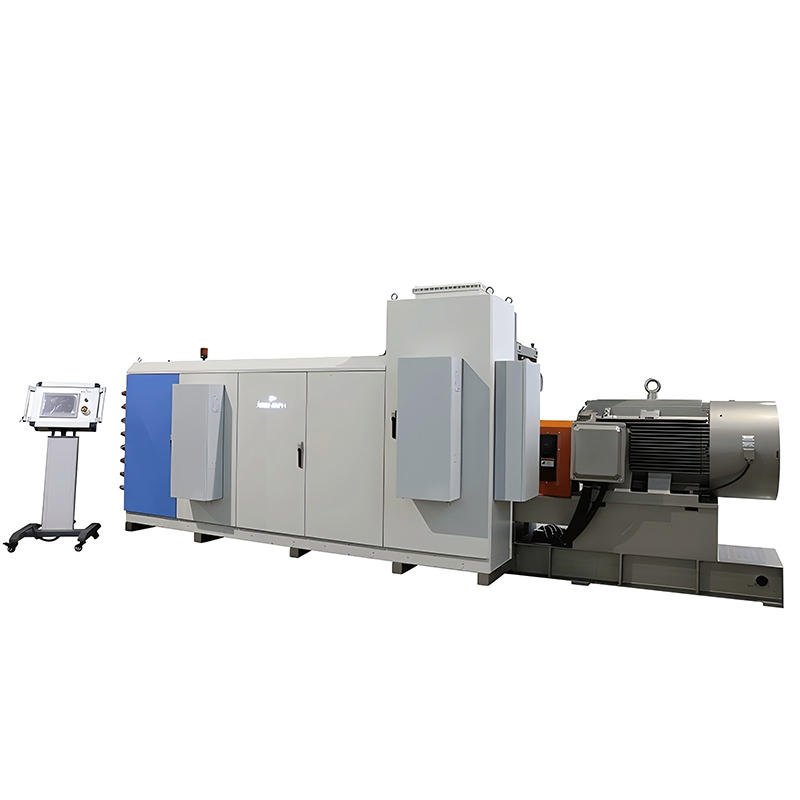
Een typisch productiesysteem bevat een materiaalinvoereenheid, een hopper of een gravimetrisch doseersysteem, een enkelvoudige schroefextruder, een extrusiematrijs, een vacuümkalibratietank, een koelsectie, een trekunit, een snijder of een winder en buishandlingsapparatuur. Moderne systemen kunnen ook laserdiameterverschijning, online wanddiktemonitoring, metergewichtcontrole, automatische markering en gecentraliseerde PLC/HMI-besturing bevatten. Deze componenten werken samen als één procesketen, omdat de dimensionale nauwkeurigheid afhangt van de synchronisatie van smeltoutput, matrijsdruk, koeling, tractiesnelheid en downstream-behandeling.
Welke materialen kan een PE-buisextrusielijn verwerken?
Polyethyleen is geen enkele materiaalgraad. De fabricage van PE-buizen kan hoogdichtheidpolyethyleen (HDPE), middendichtheidpolyethyleen (MDPE) en andere polyethyleenformuleringen omvatten, die worden geselecteerd op basis van factoren zoals drukvereisten, flexibiliteit, omgevingsomstandigheden, chemische blootstelling, temperatuur en de relevante buistandaard. HDPE is vooral belangrijk in de infrastructuur omdat het hoge sterkte combineert met flexibiliteit, corrosieweerstand en goede fusie-eigenschappen.
De harsgraad beïnvloedt direct het ontwerp en de bedrijfsomstandigheden van de extrusielijn. Zo kan een materiaal dat bestemd is voor een drukpijp met grote diameter een andere schroefconfiguratie, outputcapaciteit, koelstrategie en trekopstelling vereisen dan een irrigatiebuis met kleine diameter. Materiaalvoorbereiding is even belangrijk, want consistente toevoer en een stabiele smelttemperatuur helpen om dimensionale schommelingen, oppervlaktedefecten en variaties in wanddikte te voorkomen.
Sommige moderne pijpleidingen kunnen ook worden geconfigureerd voor meerlagige productie. Extra extruders kunnen worden geïntegreerd om twee- of drielagige PE-buizen te maken, waardoor verschillende materiaalformuleringen of functionele lagen in dezelfde buisstructuur kunnen worden opgenomen. Deze flexibiliteit is handig wanneer fabrikanten prestaties, kleuridentificatie, gehalte aan gerecycled materiaal en toepassingsspecifieke oppervlaktekenmerken in één product moeten combineren.
Hoe werkt een PE-buisextrusielijn?
Het productieproces begint met het invoeren van de PE-hars in de extruder. In de cilinder wordt het polymeer voortbewogen door roterende schroefvleugels, terwijl warmte en mechanische afschuiving het materiaal geleidelijk smelten en homogeniseren. Het schroef- en cilindersysteem moet zo zijn ontworpen dat het een stabiele smelt met constante temperatuur en druk levert, omdat schommelingen in deze fase uiteindelijk kunnen leiden tot variaties in wanddikte, oppervlaktedefecten of onstabiele buisdimensies.
De homogene polymeersmelting komt vervolgens in de matrijskop, waar ze rond een centrale mandrel wordt verdeeld om een continue buisvormig profiel te creëren. Het materiaal is op dit punt nog heet en relatief zacht, dus er is gecontroleerde dimensionering en koeling nodig om de uiteindelijke afmetingen te behouden. De buis passeert daarom een kalibratiesysteem met vacuümdimensionering om de gewenste buisgeometrie te bereiken, gevolgd door waterkoeling om warmte te verwijderen en het polymeer te stabiliseren.
Zodra de buis voldoende dimensionele stabiliteit heeft bereikt, trekt een trekunit hem continu door de lijn. De relatie tussen extrusie-output en trek-snelheid is cruciaal: als de lijn te snel trekt ten opzichte van de snelheid waarmee het materiaal wordt uitgevoerd, kunnen de wanden van de buis te dun worden; als de tractie te traag is, kan de buis te groot of te dik worden. Moderne extrusiesystemen maken daarom steeds meer gebruik van gesynchroniseerde regeling om stabiele productieomstandigheden te behouden. Jwell’s PE- en HDPE-buisystemen integreren bijvoorbeeld extrusie, vacuümdimensionering, koeling, een servo-aangedreven trekunit, een snijeenheid en gecentraliseerde besturing, met de mogelijkheid om online meetsystemen toe te voegen voor productiecontrole.
Wat zijn de belangrijkste toepassingen van PE-buizen?
De grootste toepassingsgebieden voor polyethyleen (PE)-buizen omvatten waterlevering, gasdistributie, irrigatie, drainage, industriële vloeistoftransport, mijnbouw, maritieme infrastructuur en beschermende leidingen. PE wordt op grote schaal gebruikt in deze gebieden dankzij zijn corrosieweerstand, flexibiliteit, relatief lage gewicht en het feit dat buizen in geschikte toepassingen kunnen worden verbonden door warmtefusietechnieken.
In waterinfrastructuur kunnen PE-buizen drinkwater en andere waterbronnen transporteren wanneer het materiaal, de buisconstructie en certificering voldoen aan de toepasselijke eisen. Geschikt gespecificeerde polyethyleenbuizen worden veel gebruikt voor gasdistributie omdat PE niet corrodeert op dezelfde manier als conventionele metalen buizen en gemakkelijker grondverplaatsingen kan opvangen dan rigide materialen onder vele installatieomstandigheden.
Landbouwirrigatie is een andere belangrijke markt voor kleinere PE-buizen en -pijpen. Deze producten kunnen in continue lengtes worden gefabriceerd en in rollen worden gewikkeld, wat transport en installatie in het veld vereenvoudigt. Afhankelijk van het ontwerp kunnen PE-extrusielijnen ook buizen produceren voor drainage, landbouwwaterlevering, kabelbescherming en andere laag- tot middendruktoepassingen.
Large-diameter PE extrusion expands the range of applications into municipal infrastructure, industrial water systems, dredging and marine pipelines. Therefore, equipment manufacturers offer substantially different line architectures for small tubes and large pipes. Published Jwell equipment information, for example, includes large-diameter HDPE systems covering pipe ranges extending into the metre scale. This demonstrates how extrusion line configuration changes substantially as diameter and throughput increase.
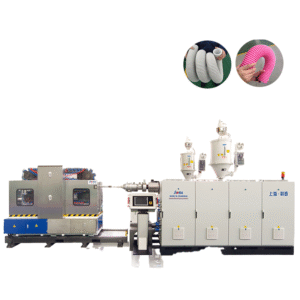
PE Pipe Applications and Corresponding Production Requirements
The relationship between application and machine configuration is important for anyone purchasing a PE pipe extrusion line. A manufacturer should not specify the line only from a desired output number because pipe diameter, wall thickness, resin grade, pressure class, cooling requirements, and product handling can all influence the equipment configuration.
| PE Pipe Application | Typical Product Characteristics | Important Extrusion-Line Requirements |
| Water supply | Pressure-rated PE pipe, multiple diameters | Stable melt output, precise sizing, controlled cooling |
| Gas distribution | Pressure-rated PE pipe with controlled dimensions | Consistent wall thickness, reliable process control, marking |
| Agricultural irrigation | Small or medium diameter pipe/tube, often coiled | High-speed extrusion, efficient cooling, winder capability |
| Drainage | Solid-wall or specialized drainage pipe | Appropriate die and sizing system, dimensional stability |
| Industrial fluid transport | Application-specific diameter and pressure class | Material compatibility, robust extrusion and cooling |
| Marine pipelines | Large-diameter HDPE pipe | High extrusion capacity, heavy-duty haul-off and handling |
| Cable or pipe protection | Tubes and protective conduits | Surface quality, dimensional control, flexible production |
| Pre-insulated piping | HDPE outer protective jacket | Accurate diameter, roundness, and stable surface quality |
| Mining applications | Heavy-duty PE pipe | High throughput, thick-wall capability, reliable cooling |
| Multilayer pipe | Two- or three-layer construction | Multiple extruders and synchronized layer distribution |
The table illustrates why “PE pipe extrusion machine” and “PE pipe production line” are not necessarily interchangeable specifications. A small-diameter irrigation tube and a 1,000 mm infrastructure pipe may both be PE products, but their extrusion capacity, die dimensions, cooling system, haul-off configuration, and handling requirements are fundamentally different.
What Equipment Does a PE Pipe Tube Extrusion Line Include?
Although the extruder is the core of the system, it is just one component of a complete production line. A modern line can be better understood as a coordinated manufacturing system, where the quality of the final pipe is affected by every downstream unit.
The first stage is material handling. Resin is delivered to the extruder by automatic feeders or vacuum conveying systems, while gravimetric dosing improves control of material throughput and formulation. The extruder then melts, mixes, and conveys the polymer; barrel temperature zones and screw geometry control the processing conditions in this stage.
The die head determines the distribution of the molten polymer into the tubular shape. After leaving the die, calibration and cooling equipment control the external dimensions and roundness. Vacuum calibration is particularly important for maintaining stable geometry, while multi-stage water cooling enables heat to be removed gradually rather than suddenly.
The haul-off provides controlled traction. For large-diameter pipes, several crawler tracks may be required to distribute the pulling force evenly and prevent damage to the pipe surface. Depending on the product, the line may use a chipless or saw cutter, an automatic stacker or a winder. Optional additional equipment can include laser marking systems, laser diameter measurement systems, gravimetric control systems, wall-thickness monitoring systems, belling machines and mixers.
What Determines PE Pipe Extrusion Line Output?
The output of an extruder is determined by much more than just the power of its motor. The effective production rate depends on the following factors: screw diameter and design; screw speed; polymer grade; melt temperature; die design; pipe diameter; wall thickness; cooling capacity; haul-off speed; and the stability of the entire process.
For small-diameter products, a dual-strand configuration can increase productivity by producing two pipes simultaneously, rather than doubling the number of production lines. Jwell’s small-diameter PE/PPR/PE-RT/PA line, for instance, features dual-pipe configurations for products measuring 16–75 mm and includes servo-controlled haul-off and optional winding or cutting equipment.
At the other end of the scale, large-diameter HDPE pipe requires much higher material throughput and more substantial downstream equipment. Published specifications for one Jwell HDPE pipe system show models ranging from 400–800 mm to 2,000–3,000 mm, with increasing listed outputs as the line configuration becomes larger and more powerful. However, these figures are supplier-specific reference values rather than universal industry standards, so production capacity should always be confirmed through a material trial using the buyer’s actual resin and pipe specification.
What Quality Factors Should Manufacturers Control?
The most important quality variables in PE pipe extrusion are outside diameter, wall thickness, roundness, weight per metre, surface condition, material uniformity, and dimensional stability. As these parameters are interconnected, correcting one process variable without understanding the effect on the rest of the line can create another problem.
Melt temperature and pressure must be kept stable to prevent inconsistent polymer flow, which can result in uneven wall thickness or surface fluctuations. The pipe must then be cooled uniformly by the calibration and cooling processes so that it retains its required dimensions after leaving the sizing section. Haul-off speed must be synchronised with extrusion output, as even a stable die cannot compensate indefinitely for an unstable traction ratio.
Online monitoring can significantly reduce the time between a process deviation being detected and corrective action being taken. Laser diameter measurement can continuously monitor the external diameter, while meter-weight control can help identify changes in material output. For high-value or pressure-rated pipes, manufacturers should also maintain documented laboratory testing procedures that cover the relevant mechanical and hydrostatic performance requirements of the applicable standard.
For buyers, this means that evaluation of the production line should focus on process stability rather than maximum theoretical output. A machine capable of producing 1,000 kg/h would not necessarily be more useful than a lower-output system if the application required tight dimensional tolerances and consistent production over long operating periods.
How to Choose the Right PE Pipe Tube Extrusion Line?
Rather than starting with the machine, the first step is to define the finished pipe. The buyer should specify the material grade, pipe diameter range, wall thickness or SDR requirements, applicable pressure class, required output, production length, coiling or cutting method, colour, multilayer requirements, target market and standard.
The second step is to determine the production range. A line optimised for pipes with a diameter of 20–110 mm is fundamentally different from one intended for pipes with a diameter of 630–1,600 mm. Small-diameter lines can prioritise high line speed, compact cooling systems and winding, whereas large-diameter lines require high melt throughput, powerful haul-off systems, extended cooling capacity and heavy-duty handling equipment.
The third step is to evaluate automation and quality control. PLC/HMI systems, automatic temperature control, servo haul-off, online diameter measurement, and meter-weight control can reduce manual intervention and improve repeatability. However, automation should be selected according to actual production requirements rather than being treated as a collection of marketing features.
When evaluating a PE pipeline from a supplier such as our Jwell, it is important to look beyond the headline output and examine the complete process configuration, including the extruder design, die structure, vacuum sizing, cooling capacity, haul-off arrangement, cutting or winding system, control architecture, and optional online inspection. Jwell’s published PE/HDPE systems illustrate configurations ranging from small-diameter, single- or dual-pipe production to large-diameter HDPE lines. Therefore, the exact model and technical configuration should be matched to the intended product, rather than being selected from a generic capacity table.
FAQ About PE Pipe Tube Extrusion Lines
- Waarvoor wordt een extrusielijn voor PE-buizen gebruikt?
A PE pipe tube extrusion line is used to continuously manufacture polyethylene pipes and tubes with controlled dimensions and wall thickness. Common applications include water supply, gas distribution, irrigation, drainage, industrial fluid transport, and protective piping.
- What materials can a PE pipe extrusion line process?
PE extrusion lines can be configured for polyethylene materials such as HDPE and MDPE, depending on the product specification and machine design. Some systems can also be adapted for related polyolefin materials or multilayer structures.
- How does a PE pipe extrusion line work?
The line melts PE resin in an extruder and pushes the homogeneous melt through an annular die to form a tube. Vacuum sizing, cooling, haul-off, and cutting or winding then stabilize and finish the pipe.
- What pipes can be produced by a PE extrusion machine?
A suitable PE extrusion machine can produce small-diameter tubes, irrigation pipes, water pipes, gas pipes, industrial pipes, and large-diameter HDPE pipelines. The actual diameter and wall-thickness range depend on the extruder, die, calibration system, and downstream equipment.
- What determines the output of a PE pipe extrusion line?
Output depends on screw design, extruder size, polymer grade, pipe diameter, wall thickness, screw speed, die design, and cooling capacity. A stable production rate should be confirmed through testing with the actual PE resin and finished-pipe specification.
- How do I choose a PE pipe tube extrusion line?
Start with the finished pipe specification, including material, diameter, wall thickness, application, output, and applicable standard. Then select the extruder, die, sizing, cooling, haul-off, cutting or winding, and automation systems that can reliably meet those requirements.
Conclusie
A PE pipe tube extrusion line is essentially a continuous polymer processing system designed to turn polyethylene resin into dimensional pipes for use in infrastructure, utilities, agriculture, industry, and specialised applications. The extruder establishes melt quality, the die creates the tubular geometry, and the haul-off controls production speed. Calibration and cooling then establish dimensions, and cutting, winding, and inspection equipment convert the stabilised pipe into a usable commercial product.
Therefore, the most important consideration when selecting such a line is not simply maximum output. The right system must match the PE material grade, pipe diameter, wall thickness, application, production capacity, quality standard, and downstream handling method, while providing sufficient process control to ensure consistent dimensions during continuous production. When comparing extrusion equipment, manufacturers should evaluate the entire process chain and validate the line using the actual resin and pipe specifications, rather than comparing extruder power or advertised capacity alone.




 English
 Russian
 Spanish
 Arabic
 German
 French
 Persian
 Turkish
 Bulgarian
 Czech
 Dutch
 Greek
 Indonesian
 Japanese
 Korean
 Polish
 Portuguese
 Romanian
 Slovenian
 Ukrainian