Article Summary:
A PVC extruder machine is a specialized machine designed to continuously form profiles, pipes, sheets, and other products from Polyvinyl chloride (PVC).
It operates by melting plastic pellets or powder and forcing it through a shaped channel, producing consistent, superior products.
According to the Handbook of Plastics Technology (Chanda & Roy, 2020) and Modern Extrusion Technology (Rosato et al., 2021), the efficacy, precision, and quality of PVC products are primarily derived from the extruder’s design, type, and processing parameters.
This article discusses the various types of extruder machines used in the process of PVC, including the stages of operation, the considerations that must be taken into account, and the practical applications that are available.
Introduction: The Significance of PVC Extruder Machines
PVC continues to be one of the most popular thermoplastics in manufacturing industries because of its:
- Durabilidade
- Chemical resistance
- Cost-effectiveness
- Easy to process
To transform raw PVC resin into consumable products, manufacturers rely on extruder machines that offer constant production, high consistency, and precise control over shape and size. Understanding the extruder machine and its procedure is crucial to manufacturers, engineers, and production managers who want to have efficiency and quality in their PVC products.
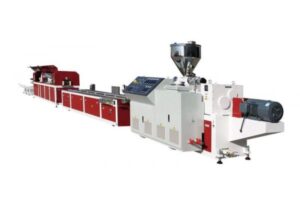
What is a PVC Extruder Machine?
A PVC extruder is an industrial device that possesses multiple functions:
Feed raw PVC material (powder or granules) into a hopper.
Heats and melts the substance in the extruder barrel.
Press the molten plastic PVC through a die to create consistent shapes.
Stops the flow of the extrudate and stabilizes it for later use in cutting or further processing.
Key Components:
| Componente | Função |
| Hopper | Feeds PVC granules into the barrel |
| Barril | Heated cylinder where PVC is melted |
| Screw(s) | Moves and compresses PVC, mixing it evenly |
| Matriz | Shapes the molten PVC into the desired profile |
| Cooling system | Solidifies and stabilizes the extrudate |
| Puller | Maintains consistent speed and tension |
| Cortador | Cuts the extrudate into required lengths |
Types of PVC Extruder Machines
PVC extruder machines are categorized by design, the type of screw, and the intended use of the product. wide varieties include:
-
Single-Screw Exuder
The most common style of general-purpose PVC manufacturing.
Has a single reciprocating motion inside a heated chamber.
Benefits: Simple design, easy maintenance, appropriate for pipes, sheets, and profiles.
Limitations: Less effective in combining than twin-screw extruders.
-
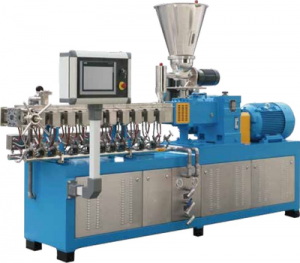
Twin Screw Exuder
Two screws move in the same or opposite directions.
Provides a superior combination, integration, and degassing.
Ideal for use with compounds that are PVC-based, such as color masterbatches or stretchy-flex blends.
Benefits: High accuracy, superior heat management, and reduced material wear.
-
Co-rotating and counter-rotating plants are both viable options for floriculture
Co-rotating: Screws move in the same direction; this is beneficial for high-viscosity compounds of PVC.
Counter-rotating: Screws move in opposite directions; this improves the pressure and output control.
-
Unique Extruders
Micro-extruders: For small-scale or prototype products made of PVC.
Profile extruders: They’re built for specific configurations like window frames or cable sheaths.
Pipe extruders: Designed to efficiently produce round profiles with a consistent thickness.
The PVC Extrusion Process: Step by Step
The procedure of converting PVC resin into finished products involves multiple important steps:
-
Feedback
The resin from PVC, as well as stabilizers, plasticizers, and supplements, is incorporated into the feed before being fed.
Effective feeding promotes uniform melting and decreases imperfections.
Considerations:
The hopper design prevents the aggregation of granules.
Pre-blending with colorants or supplements increases uniformity.
-
Melting and Combining
The extruder barrel’s temperature is increased over time.
The screws(s) facilitate uniform melting and composition.
Temperature zones are specifically marked out to avoid overheating, which can lead to the degradation of the PVC.
Temperature optimal ranges: 160-210°C, depending on the type of plastic or vinyl.
-
Attempting the Die
Molten polyethylene plastic is forced through the die and into the desired shape.
The design of the product’s exterior and interior is crucial to the final design and surface quality of the product.
The varieties include:
Circle for the pipes
Square for sheets
Customized profiles for windows or skirting boards.
-
Cooling and Maintenance
Extrudates can pass through water baths, air conditioning, or a combination of both.
The process of cooling solidifies the plastic while also maintaining its dimensional properties.
Factors that are important:
Water temperature and flow rate
Puller speed
Avoiding warping or roundness in flows.
-
Pulling and Cutting
Puller ensures a consistent rate and tension to avoid stretching.
The cutter will snicker the extrudate to a precise length that is used for packaging or additional processing.
Factors Affecting PVC Extrusion Quality
PVC extrusion is commonly employed for pipes, profiles, and sheets, but the quality of the final product is dependent on multiple critical factors:
-
The Quality of theaterial
PVC Resin class: Different classes (rigid, flexible, and impact-modified) have different effects on flow and strength.
Additives and Stabilizers: The proper amounts of plasticizers, UV stabilizers, and lubricants are incorporated into the plastic and prevent it from degrading.
-
Extrauder Settings
Temperature Profile: Incorrect temperatures in the barrel or die can lead to surface flaws, bubbles, or warping.
Screw speed and design affect the mixture, the consistency of melting, and the volume of throughput.
Back Pressure: This pressure affects the compaction of the material and the flow of the die.
-
The Dead and the Living
The Design: Must ensure that the flow is uniform, the minimal turbulences are minimal, and the cross-section is consistent.
Maintenance of tools: Worn dies cause dimensional misconceptions and surface imperfections.
-
Resfriamento e Calibração
Cooling RATE: Rapid or uneven temperature decrease can lead to warping, shrinkage, or residual stress.
Calibration tools: Effective methods of sizing and precise vacuuming are responsible for maintaining dimensional accuracy.
-
Environmental Factors
Temperature and humidity: They have an effect on the behavior of PVC and the stability of its extrusion.
Pollution: Dust or other particles in the feedstock that are foreign can lead to surface imperfections.
Key Takeaway: The optimization of material, machinery, tools, and cooling is responsible for ensuring high-quality extrusions of PVC that are consistent in size, have a smooth surface, and have structural integrity.
Common Applications of PVC Extruder Machines
| Produto | Aplicação | Key Benefits |
| PVC Pipes | Water supply, drainage, cable conduits | Corrosion resistance, durability |
| Window Profiles | Residential and commercial windows | High-dimensional accuracy |
| Sheets & Panels | Construction, signage | Lightweight, customizable |
| Cable Sheaths | Electrical and telecommunication | Flexible, fire-retardant options |
| Flooring Profiles | Industrial and home flooring | Easy installation, long lifespan |
PVC extruder machines are essential in construction, electrical, automotive, and consumer goods industries.
Advantages of Using PVC Extruder Machines
PVC extruder machines are crucial to the efficient processing of PVC. They have multiple advantages:
-
High productivity and consistent production
Allow the continuous extrusion of long profiles, pipes, and sheets.
Lower the frequency of downtime compared to batch processing.
-
Accuracy and consistency
Provide a single melt and flow rate that is consistent with the desired dimensions and smooth surface.
Modern screws and dies have exacting tolerances.
-
Versatility
Manage different types of PVC, including those that are rigid, flexible, and modified by impact.
Adept at handling a variety of product types, from small tubes to large panels.
-
Eficiência de Custos
Lower costs of production due to the high volume and minimal waste generated.
Reduced labor requirements and automated processes further enhance efficiency.
-
Increased Product Quality
Precise temperature control, pressure, and die design result in a strong, flawless extrusion.
Increased tensile strength and improved surface quality are crucial to pipes and profiles used in buildings, cars, and power supplies.
Key Takeaway:
PVC extruder machines have a combination of efficiency, precision, versatility, and cost savings; they are essential for producing high-quality products at a large scale.
Challenges in PVC Extrusion
PVC extrusion is commonly utilized for pipes, profiles, and sheets, but it has specific issues that manufacturers must deal with in order to maintain quality and efficiency.
-
Resource depletion
Overheating can adversely affect PVC, causing color changes, reduced tensile strength, or burning.
Incorrect additive concentrations can have an effect on the flow properties and the ultimate product’s durability.
-
Subsurface Defects
Bubbles, rough areas, or streaks are likely to appear as a result of trapped air, contamination, or inhomogeneous flow.
Poor design or poor use can cause uneven thickness or distortion of the wall.
-
Scale Inaccuracy
Variations in temperature, rotation speed, or cooling can cause shrinking, warping, or misaligned profile dimensions.
Incorrectly or inconsistently fastening the line affects the tolerances.
-
Processing Instability
PVC’s narrow processing window makes it susceptible to temperature changes, screw wear, or uneven feeding.
Inconsistent supplies or moisture levels can lead to extrusion failure or product errors.
-
Wear and tear on the equipment
The PVC extrusion process is harsh and can lead to the wear of the screws, barrels, and dies over time.
Incorrect lubrication or lack of preventative care promotes equipment failure.
Key Takeaway: Understanding the characteristics of PVC processing and having careful control of the temperature, quality of the material, the speed of the screws, and the design of the die is crucial to surmounting the extrusion issues.
Maintenance Tips for PVC Extruders
Effective maintenance promotes consistent performance, long machine life, and superior extrusion quality.
-
Constant Cleaning
Remove the remaining plastic from the screws, barrels, and dies following every use.
Employ mechanical or chemical cleaning methods that are recommended by the manufacturer.
Avoid material buildup to avoid contamination or defects in extrusion.
-
Inspection of the Screw and the Barrel
Constantly assess wear, corrosion, or damage.
Substitute old screws or barrels with new ones to maintain the same quality of melt and volume.
-
Wear and Cooling
Use the appropriate type of lubricant on the moving parts and bearings.
Check the cooling system for impediments that would result in a uniform temperature regulation.
-
The Maintenance
Examine the openings for damage or malformations.
Polish or remachine the dies as necessary to maintain the accuracy of dimensional measurements and the surface quality.
-
Calibration and Alignment
Ensure the screws, barrels, and dies are all positioned correctly.
Maintain the vacuum’s calibration and measurement tools in order to consistently have a consistent profile.
-
Electrical and Control System Examinations
Regularly inspect heaters, sensors, and control boards.
Ensure the temperature controllers and safety thresholds are functioning as intended.
Key Takeaway:
The routine maintenance of extruders that are made of PVC is necessary to maintain the production of quality products and to extend the life of the machine.
Future Trends in PVC Extrusion Technology
The extrusion of PVC continues to be a fundamental part of the production of pipes, sheets, and films. With increasing popularity for efficiency, sustainability, and product quality, the technology is evolving at a rapid rate. Manufacturers must stay aware of emerging trends to remain competitive.
-
Innovative Designs for the Advanced Extruder
Twin-Screw and Co-rotating Extruders: The addition of a second mechanism for stirring and a uniform temperature increase in the melt leads to a better consistency of the product.
High-Output Machines: Modern extruders have a higher productivity without sacrificing quality, reducing the energy cost per unit.
Modular extruder systems: They’re able to reconfigure easily for different types of material or profile.
-
Automation and Industry 4.0 Combination
Smart sensors: Temperature, pressure, and torque are all monitored in real time to maximize the extrusion process.
Predictive Maintenance: Data-driven alerts facilitate the prevention of machine shutdowns.
Software that optimizes processes: Automates the adjustment of different batch sizes, which results in consistent quality products.
-
Energy Efficiency and Sustainability
Low-energy extruders: Screw designs that are optimized, and the insulation of the barrels reduces the consumption of power.
Recycled PVC Integration: Post-consumer or industrial recycled PVC is increasingly being handled by extrusion lines, which diminishes the environmental impact of the material.
Eco-Friendly Addition: The utilization of non-toxic stabilizers and plasticizers concords with environmental sustainability principles.
-
Accuracy and Product Quality enhancements
Enhanced Die Technology: The increased thickness of the die’s geometry leads to a uniform wall thickness and final surface.
Vacuum Calibration and Cooling: More advanced systems are involved in reducing warping and shrinking of intricate profiles.
Real-Time Quality Tracking: Inline sensors immediately recognize flaws, which diminishes the amount of wasted material.
-
Specialized extrusion applications of polycarbonate
Multi-Layer and Co-Extrusion Tracks: Allow for the combination of PVC with other polymers or supplements in order to create enhanced products with function.
Micro-Profile and Thin-Wall Extrusions: The increasing popularity of lightweight, high-precision components in the construction, automotive, and medical industries.
Customizable Profile: Personalized solutions for industry-specific requirements, including window frames and water reservoirs.
-
Combination with Digitized Supply Chains
IoT-connected production lines: Allow for the tracking of outputs, quality concerns, and maintenance log information.
remote monitoring and control: manufacturers can alter the settings and have troubleshooting done from faraway locations.
Data-Driven Process Improvement: It promotes continuous improvement and reduces downtime.
FAQ: PVC Extruder Machines
- What is the purpose of a PVC extruder?
A PVC extruder machine is an industrial apparatus that converts resin from PVC into pipes, sheets, or custom shapes.
- Can extruders made of polycarbonate material produce both flexible and solid products?
Yes, with the appropriate design of screws, temperature regulation, and composition, both sturdy and malleable PVC can be converted.
- What is the distinction between single and twin-screw extruders?
Single-screw extruders are simpler and appropriate for use with standard profiles, while twin-screw extruders have a better combination of properties, including uniformity and flexibility, that makes them ideal for complex formulations.
- How is quality guaranteed in the extrusion of PVC?
Through precise temperature regulation, the design, cooling systems, and consistent feeding rates.
- What industries are dependent on extrusion machines for their operations?
Construction (pipes, panels), electrical (cable sheaths), automotive (profiles), and consumer goods (flooring, furniture components).
Conclusão
A PVC extruder is a fundamental component of modern PVC processing. This machine enables continuous, high-quality, and specific production.
Understanding the different types, processes, and practical considerations is crucial to manufacturers who want to maximize efficiency, reduce waste, and maintain consistent quality.
From the raw materials’ feeding to the shaping, cooling, and cutting stages, every stage affects the final product. With the increasing prevalence of technological advances in automation, the design of the product, and the sustainable nature of the material, PVC extrusion is still evolving, which offers manufacturers greater versatility and control than ever before.


 English
  Russian
  Spanish
  Arabic
  German
  French
  Persian
  Turkish
  Bulgarian
  Czech
Czech  Dutch
Dutch  Greek
Greek  Indonesian
  Japanese
  Korean
  Polish
  Portuguese
  Romanian
  Slovenian
  Ukrainian