
Quick Answer
A compound machine combines two or more simple machines, such as levers, pulleys, wheels and axles, wedges, screws, or inclined planes, to perform work more efficiently. According to Simple Machines and Their Applications by the National Science Teachers Association (NSTA), and the engineering principles outlined in Engineering Mechanics, compound machines reduce human effort by multiplying force, changing the direction of force, or increasing mechanical advantage through the interaction of multiple simple machine elements. Statics by R. C. Hibbeler, compound machines reduce human effort by multiplying force, changing its direction, or increasing mechanical advantage through the interaction of multiple simple machine elements.
In modern manufacturing, the concept of a compound machine extends beyond classical mechanics into industrial systems, such as compounding lines, where multiple mechanical, thermal, and processing units work together to transform raw materials into engineered compounds. Understanding traditional compound machines and modern industrial compounding systems is essential for engineers, manufacturers, and students of mechanical and materials engineering.
Вступ
For thousands of years, machines have shaped human civilisation. From ancient construction tools to modern automated production lines, they have helped people to perform tasks more quickly, safely, and efficiently. While many people are familiar with simple machines, such as levers and pulleys, most real-world equipment actually falls into the category of compound machines.
A compound machine combines two or more simple machines to form a system that can perform complex tasks. This principle can be seen everywhere, from bicycles and cranes to industrial extruders and automated manufacturing systems. In today’s advanced manufacturing environment, this concept has evolved even further. Modern compounding line systems used in plastics, polymer engineering, recycling, and composite manufacturing can be viewed as sophisticated compound machines that integrate multiple processing stages into a continuous production process.
This article provides a comprehensive explanation of the definitions and operating principles of compound machines, their industrial relevance and practical applications, and the growing importance of compounding line technology in modern manufacturing.
What Is a Compound Machine?
A compound machine is a mechanical device made up of two or more simple machines that work together to perform a task.
Simple machines are generally categorised into six classical types:
- Lever
- Pulley
- Wheel and axle
- Inclined plane
- Wedge
- Гвинт.
When these simple machines are combined into a single mechanism, they create a compound machine.
Unlike simple machines, which perform relatively basic functions, compound machines can accomplish more complex operations by combining multiple force-modifying mechanisms.
For example, a wheelbarrow contains:
- A lever
- A wheel and axle
Because these two simple machines work together, the wheelbarrow is classified as a compound machine.
The primary purpose of a compound machine is to improve efficiency by reducing the amount of force required to perform work.
Why Compound Machines Matter?
The significance of compound machines extends far beyond science lessons in schools.
Virtually every industrial machine in use today is based on the principles of compound machines.
Examples include:
- Forklifts
- Conveyor systems
- Printing presses
- Plastic extrusion systems
- CNC machining centres
- Automated packaging lines
- Robotics systems
By combining multiple simple machine mechanisms, engineers can achieve the following:
- Greater mechanical advantage
- Improved productivity
- Enhanced safety
- Reduced labour requirements
- Higher energy efficiency
Without compound machine design principles, modern manufacturing would be impossible.
Understanding Mechanical Advantage in Compound Machines
Mechanical advantage is one of the most important concepts in machine design.
Mechanical advantage refers to the ratio between output force and input force.
A simple machine may multiply force by a certain factor. When multiple simple machines are combined, the overall mechanical advantage can increase significantly.
For example:
- A pulley system provides a mechanical advantage of 2.
- A lever provides a mechanical advantage of 3.
If these systems work together within a compound machine, the total mechanical advantage may become:
2 × 3 = 6
This means the operator can move a load six times heavier than would otherwise be possible with the same effort.
This principle explains why compound machines are so effective in industrial applications.
Components Commonly Found in Compound Machines
Most compound machines utilize several core mechanical elements.
| Simple Machine Component | Primary Function | Common Industrial Use |
| Lever | Amplifies force | Presses, clamps |
| Pulley | Changes force direction | Cranes, hoists |
| Wheel and Axle | Reduces friction | Conveyors |
| Inclined Plane | Reduces lifting effort | Material handling |
| Wedge | Splits or cuts material | Cutting equipment |
| Гвинт. | Converts rotation to linear force | Extruders, presses |
Engineers strategically combine these elements to achieve specific operational goals.
How Does a Compound Machine Work?
A compound machine operates by transferring energy through multiple interconnected mechanisms.
The process generally follows these steps:
Step 1: Input force
Initial energy is provided by an operator, motor, hydraulic system or pneumatic system.
Step 2: Force transmission
The force moves through various machine components.
Step 3: Mechanical transformation
Simple machine elements modify the force, speed or direction.
Step 4: Output work
The machine produces the desired result.
For example, in a bicycle:
- The pedals function as levers.
- The gears act as wheel-and-axle systems.
- The chain transfers motion.
Together, these mechanisms enable efficient transportation with reduced human effort.
The same principle applies to industrial machinery, albeit on a much larger scale.
Common Examples of Compound Machines
Understanding everyday examples can help to clarify the concept.
A bicycle is one of the most frequently cited examples of a compound machine.
It contains:
- Levers
- Wheels and axles
- Pulley-like chain systems
- Gear mechanisms
The interaction of these components enables riders to travel long distances efficiently.
Wheelbarrow
The wheelbarrow combines:
- Levers
- Wheels and axles
This design enables heavy loads to be transported with relatively little effort.
Can opener
A can opener combines:
- Lever
- Wheel and axle
- Wedge
Each mechanism contributes to the cutting process.
Scissors
Scissors integrate:
Two levers and wedges, resulting in efficient cutting force.
Crane
A crane combines:
- Pulleys
- Levers
- Hydraulic systems
These mechanisms work together to lift extremely heavy loads.
Compound Machines in Industrial Manufacturing
While educational examples are useful, compound machines are far more sophisticated in industrial environments.
Manufacturing equipment often combines mechanical, electrical, hydraulic, and thermal systems with automation technologies. Examples include:
- Injection moulding machines
- Extrusion lines
- Recycling systems
- Printing presses
- Packaging machines
Each of these systems can be viewed as a highly advanced compound machine.
What Is a Compounding Line?
The term ‘compounding line’ is particularly important in the manufacture of polymers and plastics.
It is an integrated production system designed to mix, disperse, melt, homogenise and pelletise raw materials into engineered compounds.
Typical inputs include:
- Base polymers
- Fillers
- Additives
- Reinforcing fibres
- Colourants
- Flame retardants
The finished compound possesses properties that are specifically tailored for downstream manufacturing processes.
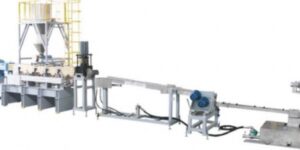
A compounding line is a modern industrial interpretation of the compound machine concept, as multiple machines work together as one integrated system.
Main Components of a Modern Compounding Line
A typical compounding line contains several interconnected subsystems.
| Обладнання | Функція |
| Система подачі | Supplies raw materials |
| Екструдер | Melts and mixes materials |
| Vacuum Degassing Unit | Removes volatiles |
| Filtration System | Eliminates contaminants |
| Гранулятор | Produces uniform pellets |
| Система охолодження | Stabilizes product quality |
| Control System | Automates operations |
Each component performs a specialized task while contributing to the overall production process.
How a Compounding Line Works?
The operation of a compounding line involves multiple stages.
Подача матеріалу
Raw materials enter through gravimetric or volumetric feeders.
Melting
The extruder heats and melts polymer materials.
Mixing and Dispersion
Screws generate shear forces that distribute additives uniformly.
Degassing
Moisture and volatile compounds are removed.
Filtration
Contaminants are filtered from the melt.
Гранулювання
The material is converted into uniform pellets.
Cooling and Packaging
Pellets are cooled, dried, and packaged.
This integrated workflow transforms raw materials into high-performance engineering compounds suitable for numerous applications.
Types of Compounding Lines
Different industries require different compounding technologies.
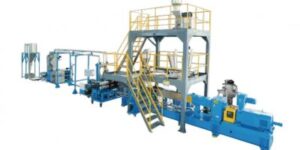
Twin-screw compounding line: the most common solution
Advantages include:
- Excellent mixing
- High output
- Superior additive dispersion
Applications include:
- Engineering plastics
- Masterbatch
- Recycled polymers
Reactive Compounding Line
This supports chemical reactions during processing. Reactive Compounding Line
This line supports chemical reactions during processing.
Applications include:
- Polymer modification
- Compatibilization
- Specialty materials
Recycling Compounding Line
Designed for post-consumer and post-industrial plastics. Recycling Compounding Line
Designed for post-consumer and post-industrial plastics.
Features include:
- Degassing
- Melt filtration
- Contaminant removal
Fiber-Reinforced Compounding Line
Used to manufacture: Fibre-reinforced compounding line
Used to manufacture:
- Glass fibre compounds
- Carbon fibre compounds
- Long-fibre thermoplastics
These materials are increasingly used in the automotive and aerospace sectors.
Compound Machines vs Compounding Lines
Although related conceptually, these terms differ significantly.
| Feature | Складний механізм | Лінія компаундування |
| Визначення | A combination of simple machines | Industrial material processing system |
| Purpose | Increase mechanical advantage | Produce engineered compounds |
| Scale | Small to large | Industrial scale |
| Energy Source | Human or mechanical | Electrical and industrial |
| Example | Bicycle | Polymer compounding line |
A compounding line can actually be viewed as an advanced compound machine because it integrates numerous mechanical subsystems into a unified process.
Applications of Modern Compounding Lines
Compounding technology supports a wide range of industries.
- Автомобільна промисловість
Used to produce:
- Lightweight composites
- Reinforced plastics
- High-performance polymers
- Електрика та електроніка
Used to manufacture compounds with:
- Flame retardancy
- Electrical insulation
- Conductivity
- Пакування
Produces:
- Barrier materials
- Flexible packaging compounds
- Будівництво
Creates:
- Pipe compounds
- Profile compounds
- Waterproofing materials
- Медичні
Manufactures specialised compounds that meet strict quality requirements.
Industry Trends Driving Compounding Line Development
Several trends are transforming compounding technology.
- Sustainability
Manufacturers increasingly process recycled and bio-based polymers.
- Smart Manufacturing
Industry 4.0 systems provide:
- Моніторинг у реальному часі
- Predictive maintenance
- Data analytics
- Енергоефективність
Modern lines consume significantly less energy.
- Advanced Materials
Growing demand for engineered compounds continues to drive innovation.
- Circular Economy
Compounding lines play a critical role in plastic recycling initiatives worldwide.
Choosing the Right Compounding Line
Selecting the right compounding line requires consideration of:
- Material type
- Production volume
- Product specifications
- Future scalability
- Energy consumption
- Рівень автоматизації
Many global equipment suppliers, including Джейвел., provide customized compounding solutions designed for engineering plastics, recycling applications, and specialty polymer manufacturing.
Frequently Asked Questions (FAQ)
- What is a compound machine?
A compound machine is a device that combines two or more simple machines to perform work more efficiently.
- What are the most common examples of compound machines?
Common examples include bicycles, wheelbarrows, scissors, cranes, and can openers.
- How does a compound machine reduce effort?
By increasing mechanical advantage through the interaction of multiple simple machine components.
- What is a compounding line?
A compounding line is an industrial production system that mixes and processes polymers, additives, and fillers into engineered compounds.
- Why are twin-screw extruders widely used in compounding lines?
They provide superior mixing, dispersion, and process flexibility compared with single-screw systems.
- What industries use compounding lines?
Automotive, packaging, construction, electronics, medical, consumer goods, and recycling industries all rely heavily on compounding technology.
Висновок
The concept of the compound machine is fundamental to countless technologies used in everyday life and industrial manufacturing. By combining multiple simple machines into a single system, compound machines increase mechanical advantage, improve efficiency and enable complex tasks that would otherwise require far greater effort.
In modern industry, this principle is most evident in compounding lines, where feeding systems, extruders, filtration units, pelletisers and automation technologies work together as an integrated manufacturing platform. As the focus on sustainability, advanced materials and intelligent manufacturing continues to transform global production, compound machine principles and compounding line technologies will remain at the heart of engineering innovation and industrial progress.



 English
  Russian
  Spanish
  Arabic
  German
  French
  Persian
  Turkish
  Bulgarian
  Czech
Czech  Dutch
Dutch  Greek
Greek  Indonesian
  Japanese
  Korean
  Polish
  Portuguese
  Romanian
  Slovenian
  Ukrainian