
Quick Answer: A PVC WPC door board extrusion line is a continuous plastic extrusion system that converts prepared PVC or wood-plastic composite formulations into rigid door boards or hollow door panels. This process involves controlled compounding, twin-screw extrusion, die forming, vacuum calibration, cooling, haul-off, cutting, and stacking. In practice, the line is designed according to the width, thickness, density, internal structure, formulation, and surface finish of the boards, as well as the required output. Current industrial configurations commonly use conical twin-screw extrusion, followed by equipment dedicated to forming and calibrating door panels.
This is consistent with the broader literature on WPC processing: extrusion is one of the main methods of forming wood-plastic composites, and recent research emphasises that WPC performance depends strongly on polymer/fibre compatibility, component ratios and processing conditions. ASTM D3678-26 is a current reference for rigid PVC interior profile extrusions. ASTM D7032-21 demonstrates that WPC performance must be evaluated according to the intended application, rather than being assumed to behave like conventional wood.
What Is a PVC/WPC Door Board Extrusion Line?
A PVC door board extrusion line is an integrated manufacturing system that produces rigid PVC door panels continuously, rather than fabricating each panel individually by cutting and assembling the components. A WPC door board extrusion line performs a similar function, but processes a wood-plastic formulation. This normally involves combining a thermoplastic matrix with wood flour or another lignocellulosic component, as well as stabilisers, lubricants, processing aids, pigments, and other additives selected for the target product. This distinction is important because the formulation determines the behaviour of the material when it melts, how sensitive it is to moisture, the torque demand, the foaming characteristics, and the dimensional shrinkage. Ultimately, it also determines the design of the extrusion system.
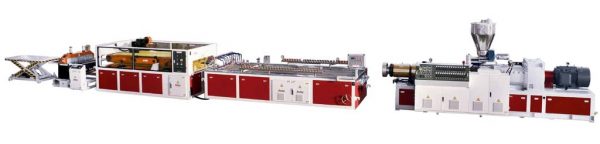
For door-board production, the extruder is only one part of the process. A complete line typically incorporates raw material feeding, a conical twin-screw extruder, a dedicated door-board die, and equipment for calibration, cooling, haul-off, cutting, and stacking. Laminating, embossing, UV coating, transfer printing, and other finishing systems can be added if the final door surface requires a decorative appearance. Current commercial configurations demonstrate that door panel widths can be designed across a relatively broad range. For instance, ДЖВЕЛЛ offers a PVC WPC door panel line with widths ranging from approximately 600 to 1250 mm, and the final configuration is customisable based on the customer’s panel geometry and production requirements.
How Does PVC WPC Door Board Extrusion Work?
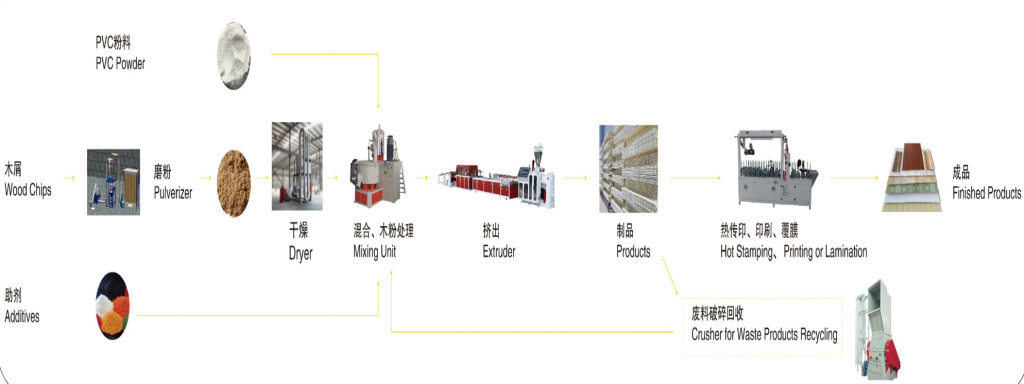
The production process begins with formulation and material preparation. PVC-based systems generally use PVC resin together with stabilizers, lubricants, fillers, pigments, and processing aids, while WPC formulations additionally introduce wood flour or other lignocellulosic material. Moisture control becomes particularly important for WPC because wood-based fillers can carry moisture into the extrusion process, affecting dispersion, surface appearance, dimensional stability, and the consistency of the finished panel.
After mixing, the prepared compound enters the conical twin-screw extruder, where conveying, melting, mixing, homogenization, and controlled degassing occur progressively. The material is then pushed through a specially designed door-board die, which determines the basic panel geometry. The freshly extruded panel is still thermally unstable at this stage, so it enters the calibration section where vacuum, mechanical sizing, and cooling stabilize width, thickness, cavity geometry, and surface quality. The haul-off then pulls the continuously formed panel at a controlled speed before the cutting unit produces predetermined lengths. Finally, a stacker or unloading system receives the boards for inspection, finishing and packaging. This sequence is consistent with current commercial line configurations and with established descriptions of extrusion as a principal WPC forming technology.
| Production stage | Main function | Key variables affecting quality |
| Material preparation | Homogenizes PVC WPC formulation | Moisture, mixing temperature, filler ratio, additive dispersion |
| Conical twin-screw extrusion | Melts, mixes, and conveys material | Screw speed, temperature profile, torque, pressure |
| Die forming | Creates door-board geometry | Die gap, melt distribution, pressure, temperature |
| Vacuum calibration | Controls dimensions and surface | Vacuum level, calibration temperature, cooling rate |
| Haul-off | Maintains continuous movement | Traction force, line speed, synchronization |
| Різання | Produces specified panel length | Cutting accuracy, synchronization, blade condition |
| Складання | Collects finished boards | Panel alignment, handling speed, surface protection |
| Finishing | Adds decorative or protective surface | Lamination, embossing, printing, coating |
Why Is a Conical Twin-Screw Extruder Commonly Used?
The conical екструдера з подвійним шнуром is particularly well-suited to rigid PVC and PVC-based WPC, as these materials require controlled melting and mixing rather than high-temperature plasticisation alone. The twin-screw configuration provides substantial conveying and mixing capability, and the conical geometry offers an effective combination of torque transmission, control of material residence time, and processing stability for rigid PVC formulations. Although commercial PVC WPC door-board lines commonly specify conical twin-screw extruders such as SJZ80/156 or SJZ92/188, the correct model should be selected based on the required output and product specifications rather than being treated as a universal standard.
The situation is more demanding for WPC production because wood flour changes the melt’s rheology and can increase sensitivity to moisture, filler dispersion, and thermal history. Recent WPC research likewise identifies the relationship between the polymer matrix, lignocellulosic reinforcement, and processing conditions as a key factor in determining the final mechanical and durability performance. In other words, even a powerful extruder cannot compensate for an unsuitable formulation or poor material preparation. The screw design, temperature profile, feeding system, and downstream calibration must all be considered together.
PVC Door Board vs. WPC Door Board: What Is the Difference?
PVC and WPC door boards share much of the same extrusion architecture, but they are not identical products. PVC door boards rely primarily on a PVC-based formulation and can be engineered for low weight, dimensional stability, moisture resistance, and relatively easy machining. WPC door boards introduce wood-based filler into the polymer matrix, giving the finished material a different appearance, texture, stiffness profile, and processing behavior.
The choice therefore depends on the door application rather than on the assumption that one material is universally better. Interior doors, cabinet-related panels, partitions and decorative applications may prioritize surface finish, machinability and dimensional consistency, whereas other applications may place greater emphasis on wood-like appearance, rigidity or the ability to reproduce a particular decorative texture. ASTM’s WPC guidance is useful here because it explicitly recognizes that WPCs are manufactured with broad combinations of resin and fiber and should not automatically be assumed to have the same physical or structural behavior as wood.
| Factor | PVC Door Board | WPC Door Board |
| Main matrix | PVC resin | PVC or another thermoplastic matrix with wood-based filler |
| Зовнішній вигляд | Uniform plastic-based surface | Can provide a more wood-like appearance |
| Moisture sensitivity during processing | Generally lower | Higher because wood filler can retain moisture |
| Processing challenge | PVC thermal stability and fusion | Moisture, dispersion, compatibility and thermal control |
| Machining | Sawing, drilling and routing are possible | Can also be machined with suitable tooling |
| Типові сфери застосування | Interior doors, partitions, decorative panels | Doors, decorative panels, furniture and architectural products |
| Surface finishing | Lamination, printing, coating, embossing | Lamination, printing, coating, embossing |
| Formulation priority | PVC stabilization and lubrication | Matrix/fiber compatibility and moisture control |
What Are the Main Components of the Extrusion Line?
A production-ready PVC WPC door board extrusion line should be viewed as a coordinated process, rather than as a collection of independent machines. The feeding system must deliver a stable material flow, the extruder must provide sufficient plasticisation and mixing, the die must distribute the melt uniformly across the full width of the panel, and the calibration section must remove enough heat to freeze the geometry before the introduction of mechanical stress by traction and cutting.
The calibration system is particularly important for door boards, as even minor dimensional deviations become visible when the panels are assembled into a door structure. Vacuum calibration helps to maintain the designed section, while cooling reduces thermal movement. The haul-off must also pull the board smoothly without creating distortion, surface marks, or thickness variation. Current commercial lines typically comprise a die, a vacuum calibration table, a haul-off, a cutter, and a stacker, and optional downstream equipment is selected according to the final decorative process.
How Are Door Boards Formed and Calibrated?
Die design is one of the most underestimated parts of the system. The extruder can provide stable melt pressure, but if the die channel does not distribute the material uniformly, the panel may leave the die with variations in thickness, density, or internal cavity geometry. For hollow WPC/PVC door panels, the die must also maintain the intended internal structure while preventing excessive pressure differences across the width.
Calibration begins immediately after the die and determines whether the theoretical dimensions become usable commercial dimensions. The calibration tooling establishes the board width, thickness, and surface geometry while controlled cooling progressively locks the structure into place. JWELL’s current door-panel configuration, for example, combines the conical twin-screw extruder with a dedicated door-panel die, vacuum calibration, haul-off and cutting system, illustrating why the die and calibration equipment should be engineered together rather than purchased as unrelated components.
What Parameters Should Buyers Specify Before Purchasing a Line?
Before discussing the machine model, a buyer should define the product. The technical brief should at least include the following: finished width, thickness and length; target density; solid or hollow structure; number and geometry of internal cavities; PVC WPC formulation; wood-fibre percentage, if applicable; surface treatment; required output per hour; and expected dimensional tolerances.
Current industrial references, for example, show door-panel systems with widths ranging from approximately 600 to 1250 mm, while other PVC WPC foam-board systems are configured around widths of 1220 mm with different thicknesses. These figures should be treated as equipment references rather than universal specifications, as output can vary significantly depending on factors such as board thickness, density, formulation, cooling capacity, and surface quality requirements.
When evaluating a PVC or WPC door board extrusion line for a specific project, I would start from the finished door board and work backwards towards the extrusion system. This approach prevents the common mistake of selecting an extruder based solely on the nominal kg/h output, while overlooking whether the die, calibration section, cooling system, and downstream equipment can actually maintain the required panel geometry at that output.
What Determines the Quality of a PVC WPC Door Board?
Finished-board quality is controlled by the interaction of formulation, extrusion, forming, and cooling. Typical defects such as surface waviness, uneven thickness, poor cavity definition, warping, discoloration, voids, or unstable density should not automatically be attributed to a single machine because the same defect can originate from material moisture, insufficient mixing, incorrect temperature distribution, excessive haul-off speed, poor die balance, or inadequate calibration.
For WPC products, the quality of the wood-plastic interface is especially important. Research literature emphasizes that component proportions, compatibility, and processing conditions influence the physical and mechanical behavior of WPCs, while ASTM D7031 provides a framework for evaluating relevant mechanical and physical properties rather than treating all WPC products as equivalent. For this reason, factory acceptance testing should ideally use the customer’s actual formulation and target door-board dimensions instead of relying only on an empty-machine demonstration.
Surface Finishing and Downstream Processing
Although extrusion creates the structural panel, many commercial door products require a second stage to achieve the desired appearance. Depending on the design of the product, manufacturers may add PVC film lamination, hot stamping, transfer printing, UV curing, embossing, sanding, spraying, or vacuum membrane pressing. The necessary equipment varies according to whether the customer wants a flat decorative surface, a wood-grain texture, a high-gloss finish, or a three-dimensional engraved pattern.
This is also why the required surface treatment must be defined before the extrusion line is finalised. For example, a panel intended for lamination may require different surface characteristics to one designed for direct printing or engraving. Downstream equipment can also influence the required flatness, surface energy, cooling conditions, and dimensional tolerance. Current WPC door panel line references explicitly identify lamination, transfer printing with UV curing, vacuum membrane pressing, and spraying as possible downstream options.
What Are the Main Advantages of Continuous Door Board Extrusion?
Continuous extrusion offers a major manufacturing advantage: once the formulation, extrusion conditions, and calibration system are stable, long lengths of consistent board can be produced with comparatively little manual intervention. This supports repeatable dimensions, automated cutting, centralized process control, and easier integration with surface-finishing equipment. For manufacturers supplying standardized door panels, the continuous process is generally more scalable than batch fabrication.
The second advantage is flexibility. By changing the die and calibration tooling, and where necessary adjusting the formulation or extrusion configuration, the same basic production concept can support different widths, thicknesses, surface structures, and panel designs. Current PVC WPC production systems also support options such as co-extrusion, allowing a denser or differently formulated surface layer to be combined with a foamed or lower-density core when the product economics and performance requirements justify the additional equipment.
How Should Manufacturers Choose a PVC WPC Door Board Extrusion Line?
The best line is not necessarily the one with the highest advertised capacity. A more useful approach to making a purchasing decision is to compare the complete production system against five measurable requirements: product geometry, material formulation, target output, surface quality, and automation level. Suppliers should be able to explain how the screw configuration, die, calibration tooling, cooling capacity, and haul-off speed interact at the buyer’s actual operating point.
A reliable technical evaluation should also include sample production, dimensional inspection, density measurement where applicable, surface inspection, long-run stability, and confirmation of utility consumption. While ASTM standards can provide useful testing frameworks for relevant PVC or WPC products, the exact compliance requirements depend on the intended market and application. For example, ASTM D3678-26 addresses rigid PVC interior-profile extrusions, while ASTM D7032-21 focuses specifically on performance-rating procedures for WPC products used in deck boards, stair treads, guards, and handrails. Therefore, neither standard should be presented as a universal ‘door-board standard’.
PVC WPC Door Board Extrusion Line FAQs
- What is a PVC Door Board Extrusion Line?
A PVC Door Board Extrusion Line continuously converts PVC compound into rigid door boards through extrusion, die forming, calibration, cooling, hauling, and cutting. It can be configured for different panel widths, thicknesses, densities, and surface-finishing requirements.
- What is a WPC Door Board Extrusion Line?
A WPC Door Board Extrusion Line produces door boards from a wood-plastic composite formulation using continuous extrusion technology. It normally combines material feeding, conical twin-screw extrusion, die forming, vacuum calibration, cooling, haul-off, and cutting.
- What extruder is used for PVC WPC door boards?
Conical twin-screw extruders are widely used because they provide the mixing, plasticization, and torque characteristics required by rigid PVC-based formulations. Common commercial configurations include SJZ80/156 and SJZ92/188, although the correct model depends on product dimensions, formulation, and required output.
- What materials are used to make WPC door boards?
WPC door boards generally combine a thermoplastic polymer with wood flour or another lignocellulosic filler and a package of stabilizers, lubricants, processing aids, and other additives. The exact formulation must be developed around the desired density, mechanical properties, surface finish, and processing behavior.
- Can PVC WPC door boards be laminated?
Yes, extrusion lines can be integrated with downstream lamination equipment to apply decorative PVC films or other surface layers. Other options include embossing, transfer printing, UV curing, spraying, and vacuum membrane pressing, depending on the final design.
- How do I choose the capacity of a PVC WPC door board extrusion line?
Capacity should be calculated from the target board width, thickness, density, line speed, and formulation rather than from the extruder model alone. A proper equipment proposal should validate the required output using the customer’s actual product specification and material recipe.
Висновок
A PVC WPC door board extrusion line is an integrated production system, not just a plastic extrusion machine. It comprises several processes, including material preparation, twin-screw extrusion, die design, vacuum calibration, cooling, haul-off, cutting, and surface finishing, all of which must work together to produce dimensionally stable and commercially consistent door boards. Therefore, the key to selecting the right PVC or WPC door board extrusion line is to start with the finished product — its width, thickness, density, structure, formulation, surface appearance and required output — and then match each part of the line to these requirements. With the right formulation control, tooling design and process optimisation, continuous extrusion provides a scalable approach to manufacturing durable, consistent PVC and WPC door panels for interior doors, decorative panels, partitions and other architectural applications.




 English
 Russian
 Spanish
 Arabic
 German
 French
 Persian
 Turkish
 Bulgarian
 Czech
 Dutch
 Greek
 Indonesian
 Japanese
 Korean
 Polish
 Portuguese
 Romanian
 Slovenian
 Ukrainian