
Quick Answer
The price of a new 3-layer FFS blown film line can vary widely. Current public listings range from approximately USD 48,000–100,000 for some China-made configurations, to around USD 205,000–210,000 for higher-specification 3-layer co-extrusion systems. However, for serious industrial budgeting, a more useful working range is approximately USD 80,000–150,000 for standard, heavy-duty configurations. High-output, advanced cooling, automatic gauge control, integrated printing, and premium European systems can cost considerably more. The difference between otherwise similar 3-layer lines can be determined by output, film width, cooling technology, automation, and application requirements.
What Is a 3-Layer FFS Blown Film Line?
A 3-layer FFS blown film line is a polyethylene film extrusion system designed primarily for producing tubular film for use in form-fill-seal (FFS) bags. Three separate extruders melt different polymer streams and feed them into a multilayer die, where they are combined into an A/B/C film structure. This structure is then cooled, collapsed, pulled, and wound into finished film rolls.
The ‘FFS’ designation is important because an FFS film line is designed around the requirements of automated bag forming, filling and sealing, rather than simply producing generic blown film. Heavy-duty FFS film is widely used for fertiliser, resin, agricultural products, grain, chemicals, pet food and other bulk materials, where the finished sack requires a combination of tensile strength, puncture resistance, impact performance, reliable sealing and consistent dimensions.
The 3-layer structure also provides an important economic advantage. Different layers can perform different functions, enabling the producer to optimise the formulation rather than using the same resin throughout the film. For instance, the outer layers can be designed for sealing, surface properties, or printability, while the core can contribute to mechanical strength and cost-efficiency of the material. The ability to distribute functions across layers explains why multilayer FFS extrusion remains important in high-volume industrial packaging.
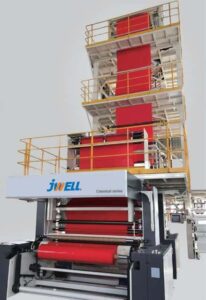
What Is the Current Price of a 3-Layer FFS Blown Film Machine?
There is no universal price because “3-layer FFS blown film machine” describes a machine category rather than one fixed specification. Current public listings illustrate the spread: one supplier lists a 3-layer FFS heavy-duty line around USD 48,000–57,200, while other 3-layer blown-film equipment is listed around USD 88,400–100,000 or USD 96,000–106,000.
| 3-Layer FFS Line Level | Approximate Planning Price | Typical Positioning | Main Variables |
| Basic / entry industrial | USD 50,000–80,000 | Cost-sensitive production | Standard extrusion, cooling and winding |
| Standard heavy-duty FFS | USD 80,000–150,000 | General industrial packaging | Better cooling, dosing, automation and process stability |
| Advanced high-output | USD 150,000–220,000+ | High-volume FFS production | Advanced cooling, gauge control, automation and premium components |
| Premium European-class system | Often above USD 200,000 | High-performance plants | High output, sophisticated process control and integrated automation |
| Used/refurbished | Highly variable | Lower initial CAPEX | Machine age, condition, retrofit level and spare parts |
These ranges should be treated as budgetary references rather than quotations. Public marketplace prices can exclude freight, installation, commissioning, taxes, auxiliary equipment, spare parts, or customized options, and some listings cover a base machine rather than a complete production package.
Special Note: The price range for 3-layer FFS blown film production lines varies depending on the manufacturer and configuration. The price range mentioned in this article is for reference only. Please consult the specific supplier for a specific quote.
Why Does the Price Vary So Much?
The biggest mistake when purchasing is to compare machines according to layer count alone. For example, two machines may both be described as ‘3-layer FFS blown film lines’, but they could have completely different extruder sizes, output capabilities, cooling systems, die configurations, film widths, automation levels, and downstream equipment.
Output capacity is one of the most important factors affecting price. For example, a line designed for 200–300 kg/h does not require the same extrusion, cooling, drive, and winding capacity as a system designed for 500–600 kg/h.
Cooling technology is another major factor. As output increases, more heat must be removed from the polymer bubble without compromising bubble stability or film quality. Advanced internal or external cooling systems, automatic air-ring control, and bubble stabilisation technology can therefore increase both the cost of the equipment and its productive capacity. This is why a higher-priced line may be more cost-effective if the additional investment results in higher sustained output and lower scrap.
Automation can also significantly impact the quotation. Gravimetric dosing, automatic thickness control, recipe management, automatic winding, online monitoring, remote diagnostics, and integrated process control all incur additional hardware and software costs, but can reduce operator dependence and improve consistency in continuous production.
What Output Can a 3-Layer FFS Blown Film Line Achieve?
There is no single output figure that applies to every 3-layer FFS blown film line. Production capacity depends on factors such as resin formulation, film thickness, layflat width, die design, screw configuration, cooling efficiency, bubble stability, winding speed, and the production conditions used by the manufacturer when quoting maximum output.
For buyers, sustained saleable output is more important than maximum output quoted in brochures. A machine that is advertised as producing 350 kg/h, but which operates at 270 kg/h when using the buyer’s resin, thickness, width, and formulation, may have a lower economic value than a machine that consistently delivers 300 kg/h with stable film quality.
Before purchasing, ask the supplier to specify the output under an agreed production recipe. The test conditions should specify the resin grades, film thickness, layflat width, layer ratio, winding specification, and whether the quoted figure represents maximum theoretical output or demonstrated continuous production.
What Materials Can a 3-Layer FFS Film Machine Process?
3-layer FFS blown film lines are typically designed for polyethylene-based materials, such as LDPE, LLDPE, mLLDPE, HDPE, and certain blends and additives. Depending on the specific machine design and application, some equipment listings also identify materials such as EVA and other polymers. Material compatibility should not be evaluated simply by asking whether the extruder can melt a polymer. The important question is whether the entire extrusion system can process the intended formulation at the required output, maintaining stable melt pressure, bubble control, layer distribution, cooling, and film properties throughout.
For heavy-duty FFS sacks, resin selection is usually connected to the final mechanical requirements. A formulation may combine different polyethylene grades to balance factors such as tensile strength, impact resistance, sealability, stiffness, puncture resistance, processability, and cost. The 3-layer architecture gives film producers greater freedom to allocate these properties to different layers.
This is why a machine should only be purchased once the film recipe and target application have been defined. Obtaining a generic machine quotation before the resin and product specifications are known can easily result in an inappropriate extruder configuration or cooling system.
How Does Film Width Affect Machine Price?
Film width is another major factor in the cost of a 3-layer FFS blown film line because wider film generally requires a larger die, greater cooling capacity, suitable traction and collapsing equipment, and a winding system designed for the corresponding roll dimensions.
For example, Our JWELL‘s current three-to-five-layer classical blown-film range, for example, is positioned for high-performance flexible packaging and lists maximum layflat widths from approximately 1,400 to 2,600 mm depending on the model.
From our perspective, when specifying a multilayer film line, width and output should always be defined together rather than separately. A buyer requesting a “high-output 3-layer line” without stating the required layflat width and film thickness is leaving two of the most important engineering variables undefined.
Which Features Are Worth Paying More For?
Not every premium option provides an equal return. The right question is whether an additional feature improves a measurable production parameter such as throughput, gauge uniformity, material utilization, labor efficiency, changeover time, or machine uptime.
- Gravimetric dosing
Gravimetric feeding becomes increasingly valuable when resin costs represent a significant proportion of production cost. Accurate dosing helps maintain layer ratios and can reduce formulation variation, while more precise material control can also help prevent unnecessary use of expensive resin.
- Automatic thickness control
Film gauge consistency is particularly important for FFS sacks because excessive variation can influence mechanical performance and downstream sealing. Automatic thickness-control systems can help reduce deviations and support downgauging strategies where the producer wants to reduce film weight without sacrificing performance.
- Advanced cooling
Cooling capacity directly influences the ability of the line to increase output while maintaining bubble stability and film quality. Modern high-output FFS systems increasingly use sophisticated cooling technologies for precisely this reason, rather than treating the air ring as a simple auxiliary component.
- Automatic winding and process control
Automatic winding can reduce manual intervention and improve roll consistency, particularly in continuous production. Advanced PLC/HMI systems, recipe management, alarm monitoring, and production data collection become increasingly valuable when the line operates multiple formulations or needs consistent output across several shifts.
What Applications Use 3-Layer FFS Film?
A 3-layer FFS blown film line is best suited to heavy-duty industrial packaging applications. Typical products include fertiliser sacks, resin bags, grain and agricultural packaging, chemical bags and pet food packaging, as well as other sacks for bulk materials that require reliable automated filling and sealing.
FFS technology is particularly valuable because the film can be produced in a tubular shape and then converted into bags using an automated form-fill-seal process. The objective is not merely to produce attractive film; it must also run reliably through high-speed bag-making and filling equipment.
Therefore, the film specification needs to consider the entire packaging chain. For example, a film that performs well during extrusion but has unstable sealing behaviour, an excessive coefficient of friction, poor puncture resistance, or inconsistent thickness may cause problems later in the converting or filling process.
For this reason, equipment selection and film formulation should be developed together. The extrusion line forms part of a production system rather than being an isolated machine.
What Is the Total Investment Beyond the Machine Price?
The advertised price of the equipment is only the starting point for a new production project. Buyers should also factor in shipping, import duties, installation, commissioning, electrical infrastructure, cooling water, compressed air, material handling, factory modifications, spare parts, training, and initial production materials.
Installation requirements are particularly important for blown-film lines, as the equipment may require considerable vertical clearance and floor space. The factory must also provide the necessary power capacity and access for maintenance, loading resin, handling rolls, and replacing major components.
Commissioning should not be overlooked. A new line may require experienced technicians to set screw temperatures, extrusion rates, layer ratios, die conditions, air-ring settings, bubble stability, winding tension, and film gauge. A low purchase price can lose its advantage if the machine takes too long to reach stable commercial production.
Therefore, the correct financial metric is total cost of ownership, not simply the machine’s FOB or EXW price.
New or Used: Which 3-Layer FFS Line Is Better?
A used 3-layer FFS line can reduce initial capital expenditure, but the purchasing process requires considerably more technical due diligence. The buyer should inspect extruder screws and barrels, gearboxes, motors, die heads, air rings, cooling systems, winding units, electrical cabinets, PLC components, sensors, bearings, heaters, and the availability of replacement parts.
Production history is particularly useful. A machine that has produced heavy-duty film continuously for many years may have experienced considerably more wear than a machine with the same nominal age but lighter operating conditions.
Refurbished equipment can make sense where the supplier can document replacement parts, testing, electrical upgrades, process validation, and commissioning support. For high-volume packaging operations, however, the cheapest used machine is rarely the safest investment if downtime or obsolete controls create production interruptions.
How Should Buyers Compare 3-Layer FFS Blown Film Line Quotations?
A professional RFQ should force suppliers to quote against the same technical specification. Otherwise, a low quotation may simply exclude components that another supplier has already included.
| Quotation Item | What to Specify | Why It Matters |
| Структура на слоевете | A/B/C ratio and target formulation | Determines functional distribution between layers |
| Extruders | Diameter, L/D ratio, motor power | Determines plasticizing and output capability |
| Резина | LDPE, LLDPE, mLLDPE, HDPE and blend ratios | Directly affects processing conditions |
| Матрична глава | Die diameter and layer configuration | Influences film distribution and output |
| Ширина на филма | Layflat range | Determines target bag dimensions |
| Film thickness | Minimum, nominal and maximum | Determines application and material consumption |
| Производителност | Sustained kg/h under agreed recipe | Allows realistic capacity comparison |
| Охлаждане | Air ring, IBC or advanced cooling | Affects output and bubble stability |
| Dosing | Gravimetric or volumetric | Influences formulation accuracy |
| Gauge control | Manual or automatic | Affects thickness consistency |
| Намотка | Manual or automatic | Influences labor and roll quality |
| Printing | Offline or inline | Changes equipment scope and investment |
| Автоматизация | PLC/HMI, recipes, monitoring | Affects process control and labor |
| Installation | Included or excluded | Can materially change project cost |
| Commissioning | Technician days and training | Affects time to production |
| Warranty | Coverage and duration | Helps quantify supplier risk |
| Spare parts | Initial and recommended inventory | Reduces future downtime |
When comparing quotations, buyers should also ask suppliers to state exactly what is excluded. A quotation becomes much more useful when it clearly separates the base machine, optional equipment, auxiliary systems, commissioning, freight, and installation.
How Much Should You Budget?
For a preliminary feasibility study, USD 80,000–150,000 is a reasonable working budget for many standard new 3-layer FFS blown film lines, while the broader public market extends below and above that range. Lower-cost configurations can be found below USD 80,000, whereas advanced high-output systems and premium European equipment can move beyond USD 200,000. Current public listings support the broad nature of this market rather than a single universal price.
The more important calculation is the relationship between CAPEX and usable production capacity. If a factory requires 250 kg/h but purchases a machine designed for 500 kg/h, the additional capital may not produce sufficient utilization; if demand is 450 kg/h and the buyer purchases a 250 kg/h line to save money, the factory may quickly encounter a capacity constraint.
A sensible investment model should therefore calculate expected annual production, operating hours, utilization, scrap, resin consumption, labor, electricity, maintenance, and selling price per kilogram. Only after these variables are known can the buyer determine whether a USD 100,000, USD 150,000, or USD 200,000 machine is actually economical.
Често задавани въпроси
- What is the price of a 3-layer FFS blown film machine?
A new 3-layer FFS blown film line can range from roughly USD 50,000 to more than USD 200,000, depending on output, film width, cooling, automation, and configuration. For many standard industrial systems, a preliminary budget of about USD 80,000–150,000 is a useful starting point.
- How much does a 3-layer FFS blown film line produce?
Industrial examples commonly fall around 300–350 kg/h, while advanced systems can achieve substantially higher output under suitable film formulations and operating conditions. The actual sustained output should always be confirmed using the buyer’s resin, thickness, width, and layer ratio.
- What materials can a 3-layer FFS blown film line process?
Most heavy-duty FFS blown-film lines are designed for polyethylene-based materials such as LDPE, LLDPE, mLLDPE, and HDPE. Some configurations can process additional polymers or blends, but material compatibility should be confirmed against the specific extruder, screw, and die design.
- Is a 3-layer FFS blown film line suitable for fertilizer bags?
Yes, 3-layer FFS technology is widely associated with heavy-duty sacks used for fertilizer and other bulk materials. The multilayer structure allows manufacturers to balance strength, sealing, puncture resistance, and material cost for automated bag production.
- What makes a 3-layer FFS blown film machine expensive?
Output capacity, extruder size, die-head configuration, cooling technology, gravimetric dosing, automatic gauge control, winding automation, and integrated printing are major cost drivers. Installation, commissioning, premium components, and after-sales support can also materially affect the final project cost.
- Is a 3-layer or 5-layer FFS blown film line better?
A 3-layer line is often sufficient when the film specification can be achieved with three functional layers and cost efficiency is important. A 5-layer system becomes more attractive when the producer needs greater formulation flexibility, more sophisticated downgauging, or more complex distribution of barrier, sealing, and mechanical properties.
Заключение
The price of a 3-layer FFS blown film line is best understood as a range rather than a fixed market figure. Current public offers demonstrate that the price of the equipment can range from around USD 50,000–100,000 for some configurations, to USD 150,000–220,000 or more for more advanced 3-layer systems. The price of premium equipment can be considerably higher depending on performance and automation requirements. For most buyers, the price of the machine itself should not be the final purchasing criterion. A more meaningful question is how much it costs to produce one kilogram of saleable FFS film of the required quality and output. Factors such as cooling efficiency, gauge stability, resin utilisation, uptime, automation, maintenance and technical support can all have a greater long-term effect on profitability than the initial difference between two quotations.
Before requesting a final quotation, it is important to define the film structure, resin formulation, layflat width, thickness range, sustained output, cooling technology, dosing system, thickness control, winding requirements, automation level, auxiliary equipment, and commissioning scope. Once these parameters have been standardised, suppliers can provide comparable quotations, and the investment decision becomes a production engineering calculation rather than a simple comparison of machine prices.



 English
 Russian
 Spanish
 Arabic
 German
 French
 Persian
 Turkish
 Bulgarian
 Czech
 Dutch
 Greek
 Indonesian
 Japanese
 Korean
 Polish
 Portuguese
 Romanian
 Slovenian
 Ukrainian