
Quick Answer
A 二軸押出機 processes polymers or formulations by continuously feeding, conveying, melting, mixing, pressurising, and shaping the material via two closely interacting screws within a heated barrel. Compared with a single-screw machine, it provides much greater control over distributive and dispersive mixing, devolatilisation, filler incorporation, and residence-time management. This is why it is widely used for compounding, masterbatch production, reactive extrusion, PVC processing, and engineered polymer blends. Research and industrial references consistently describe twin screw extrusion as a modular, continuous process, where the joint determination of output quality and process stability is the result of screw geometry, barrel zoning, feed strategy, and venting configuration.
In simple terms, a twin screw extruder moves material through a sequence of process zones. Raw material enters through a feeder; the screws then convey it forward, softening it through heat and shear. Dedicated kneading or mixing elements, then disperse additives and homogenise the melt. Vacuum or vent sections, then remove moisture and volatiles. Finally, the metering zone builds pressure before the melt exits through a die. The exact behaviour depends heavily on whether the machine is co-rotating or counter-rotating, how the screw elements are configured, and whether the process is designed for compounding, pelletising, sheet extrusion, or profile production.
はじめに
The twin screw extruder occupies a special position among polymer-processing machines because it does far more than simply melt plastic and push it through a die. In modern manufacturing, extrusion lines are often required to perform multiple tasks simultaneously: dispersing fillers, blending polymers, removing moisture, introducing heat-sensitive additives at specific points, carrying out reactive extrusion and stabilising residence time, while still delivering a consistent melt to downstream pelletising or forming equipment. While a single-screw extruder can perform some of these functions adequately, particularly when the formulation is straightforward and the process window is flexible, it is the twin-screw extruder that truly excels in such demanding conditions. However, when the material system becomes more demanding, such as with high filler loading, recycled feedstock variability, compounding of engineering plastics, PVC profile production, or the devolatilisation of moisture-sensitive materials, the limitations of a simpler conveying machine become apparent.
This is where the twin screw extruder becomes valuable. Its two screws create a much more controllable flow field, and the machine can be built as a modular processing platform rather than a single-purpose melter. The screw elements can be arranged to emphasise conveying, pressure generation, kneading, distributive mixing, dispersive mixing, venting, or melt sealing. Barrel sections can be assigned to feeding, side feeding, liquid injection, vacuum degassing, or cooling. In other words, the twin screw extruder is not just a machine, but a configurable process system.
This article answers the question ‘How does a twin screw extruder work?’ from a practical industrial perspective. Rather than providing a mere textbook definition, it describes what happens to the material as it moves through the machine, the importance of different screw zones, how co-rotating and counter-rotating designs affect the process, and the factors that determine the efficiency of a twin screw line in real production.
What Is a Twin Screw Extruder?
A twin screw extruder is an extrusion machine containing two rotating screws inside a barrel, as opposed to a single screw. Depending on the application, these screws may rotate in the same direction (co-rotating) or in opposite directions (counter-rotating), and they may be intermeshing or non-intermeshing. The dominant configuration in most modern polymer compounding lines is the intermeshing co-rotating twin screw extruder because it offers strong mixing, a modular screw design, and flexible feeding and venting arrangements. However, counter-rotating machines remain important, particularly for certain PVC and profile extrusion applications, where gentler shear and strong positive conveying are beneficial.
The presence of a second screw is not the only feature that distinguishes a twin screw extruder from a single-screw machine. The real difference lies in the interaction between the two screws and the resulting control over material transport and mixing. In an intermeshing system, material is repeatedly transferred between the screws and the barrel, creating more opportunities for controlled shear, distributive mixing, pressure development, and self-wiping action. This is particularly important in compounding, where the aim is to melt the resin, disperse the pigments, wet the fillers, distribute the additives, and homogenise the melt without causing excessive thermal damage.
Twin screw extruders are therefore used in a wide range of processes, including polymer compounding, colour masterbatch, filled and reinforced plastics, reactive extrusion, biodegradable polymer processing, pharmaceutical hot-melt extrusion, food extrusion, PVC pipe and profile production, cable compounds, and recycling-based reprocessing systems. The machine’s flexibility stems from the fact that its processing behaviour can be engineered through screw design and barrel configuration rather than just motor speed or barrel temperature.
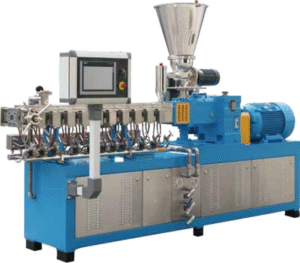
How Does a Twin Screw Extruder Work?
At a process level, a twin screw extruder continuously moves material through a series of functional zones, each performing a specific task. Rather than melting and mixing the material in one event, the machine stages the process. Instead, it stages the process, which involves the following steps: feeding, conveying, melting, mixing/dispersing, venting/devolatilisation, pressurising, and die shaping. Understanding these stages is key to understanding how twin screw extrusion works in practice.
-
Feeding: Controlled introduction of resin and additives
The process begins in the feed section, where the base polymer, powders, pellets, regrind, fillers, and additives enter the barrel. In many co-rotating twin screw systems, the 押出業者 is starve-fed, meaning the feed rate is set by external gravimetric or volumetric feeders rather than by the screws ‘pulling material in at maximum capacity. This provides much greater control over throughput, formulation accuracy, residence time, and melt temperature. It also enables processors to install additional side feeders further down the line for materials such as glass fibre, minerals, flame retardants, and other ingredients that should not be exposed to the full thermal or shear history from the outset of the process.
This is one of the most significant practical differences between a twin screw compounding line and a basic extrusion setup. Material introduction is not treated as a passive step. It is part of the process design. For instance, polymer pellets may be fed into the main hopper, mineral filler introduced at a side feeder after the polymer has partially melted, and liquid additives injected downstream where mixing has already occurred but thermal exposure is lower. In a well-designed line, the feed strategy is matched to the formulation, not the other way around.
-
Conveying: Moving Material Forward Through the Barrel
Once the material enters the barrel, the screw flights begin to convey it forward. Conveying elements are designed to transport solids or melt from one section to the next while controlling fill level and residence time. In a co-rotating intermeshing machine, the material is transferred repeatedly between the two screws in a figure-eight-like flow pattern, which improves the renewal of material at the screw surface and helps prevent stagnant zones. This self-wiping action is one reason co-rotating machines are so effective in compounding and reactive extrusion.
However, conveying in a twin screw extruder is not just about pushing material forward. The screw geometry determines how much drag flow is created, how much back-pressure can develop, and how full the channel becomes in each zone. Some conveying sections are designed to move solids efficiently with minimal shear; others intentionally compress or meter the melt before it reaches a kneading zone. The machine, therefore, behaves less like a simple pump and more like a sequence of engineered transport environments.
-
Melting: Converting Solid Feed into a Uniform Melt
As material advances, it encounters heated barrel zones and increasing mechanical energy input. Melting occurs through a combination of external heat from the barrel heaters and viscous dissipation generated by shear between the screws, barrel wall, and polymer mass. In many practical extrusion lines, barrel heat alone does not “do the job.” The screw configuration and throughput determine how much of the melting load is carried by mechanical work versus external heating.
This matters because the quality of melting directly affects downstream mixing and pressure stability. If the polymer is only partially melted before it enters an intensive kneading section, the process may become unstable, or the filler may not wet out correctly. On the other hand, if the material is overheated too early, thermal degradation, color shift, or viscosity loss may occur. A well-designed twin screw extruder balances screw speed, temperature profile, and element arrangement so that melting occurs at the right location and at the right rate for the formulation being processed.
-
Mixing: Distributive and Dispersive Work in the Screw Elements
Once the polymer has softened or melted sufficiently, the process enters the most important zone for many twin screw applications: mixing. This is where kneading blocks, mixing elements, reverse elements, or specialized screw geometries perform the work that gives twin screw extrusion its reputation. In practice, there are two related but different goals:
Distributive mixing: spreading ingredients uniformly throughout the melt without necessarily breaking them down
Dispersive mixing: breaking agglomerates, wetting pigments or fillers, and applying enough stress to disperse difficult additives into the polymer matrix
A compounding line for glass-fiber-reinforced polypropylene, for example, may require careful distributive mixing to spread the fiber evenly while limiting fiber breakage. A color masterbatch line may need strong dispersive mixing to break pigment agglomerates. A flame-retardant compound may require both. The screw configuration is therefore selected not just to “mix,” but to generate the right type of mixing at the right stage of melt development. Research on twin screw processing consistently shows that screw-element geometry strongly influences residence-time distribution, stress history, and mixing efficiency, which is why modular screw design is central to extrusion optimization.
-
Venting and Devolatilization: Removing Moisture, Air, and Volatiles
Many formulations contain moisture, entrained air, residual monomer, solvents, or reaction by-products that must be removed before the melt reaches the die. A twin screw extruder can include atmospheric vents or vacuum vent sections positioned after the melt has formed a stable seal upstream. In these sections, volatile components escape because the local barrel pressure is intentionally reduced and the screw design exposes a large melt surface area. This is one of the reasons twin screw extruders are widely used for devolatilization, reactive extrusion, recycled polymer processing, and hygroscopic material handling.
Venting is not a minor accessory function. In many industrial lines, it is the difference between a stable product and a defective one. Poor devolatilization can cause bubbles, porosity, odor, inconsistent density, hydrolytic degradation, or downstream die instability. Effective venting requires not only a vacuum system but also a screw layout that creates the correct fill pattern before and after the vent so material does not flood the opening or carry unremoved volatiles into the final metering zone.
Main Process Stages in a Twin Screw Extruder
| Process Stage | What Happens in the Extruder | Why It Matters |
| Feeding | Resin, regrind, fillers, additives, or liquids are introduced through the main feeder or side feeders. | Determines formulation accuracy, throughput stability, and residence-time control |
| Conveying | Screw elements transport solids and melt through the barrel while controlling fill level | Creates stable forward movement and prepares material for melting and mixing |
| Melting | Polymer softens and melts through barrel heating plus mechanical shear energy. | Establishes a homogeneous melt state for downstream compounding and die stability |
| Mixing / Kneading | Kneading blocks and mixing elements distribute additives and disperse agglomerates. | Controls compound quality, filler wet-out, color uniformity, and final material performance |
| Venting / Devolatilization | Moisture, trapped air, solvent, or reaction volatiles are removed through vent or vacuum zones. | Reduces bubbles, odor, porosity, hydrolysis, and melt defects |
| Metering / Pressurizing | Final screw sections stabilize the flow and build pressure toward the die | Ensures steady output, dimensional consistency, and smooth downstream operation |
| Die Forming / Pelletizing Feed | Melt exits through a die for pelletizing, sheet, profile, strand, or other shaping operations. | Converts the processed melt into a usable intermediate or final product |
Why the Screw Configuration Matters So Much?
One of the most important concepts in twin screw extrusion is that the screws are not merely rotating shafts, but rather the entire process architecture. A twin screw extruder can be configured with various elements, such as conveying blocks, kneading sections, reverse elements, mixing zones, side-feeder intake areas, venting sections, and pressure-building segments. The sequence of these elements can significantly impact melt temperature, pressure profile, mixing intensity, residence time, fibre breakage, devolatilisation efficiency, and product colour consistency.
This is why processors rarely ask only, ‘What size extruder do I need?’ The more important question is often ‘What screw design do I need for this formulation and output target?’ For example, a machine processing filled engineering plastics may require a very different screw layout from one processing rigid PVC dry blend or a devolatilising recycling line. Even with the same barrel diameter and motor power, the outcome of the process can change dramatically depending on the design of the screw.
Pressure Build-Up and Die Discharge
Once mixing and venting are complete, the melt enters the final metering and pressure-building section. At this point, the extruder’s role shifts from developing the formulation to stabilising the output. The screw geometry creates a controlled increase in pressure, enabling the melt to be pushed through a die at a stable rate. This final zone is essential because any fluctuation in pressure or melt homogeneity will immediately result in dimensional inconsistency, surging, or poor pellet quality, whether the die feeds a strand pelletizer, an underwater pelletizing system, a sheet die, a profile die, or a pipe die.
In other words, a twin screw extruder operates as a continuous chain of coordinated processes. It does not simply transport material from the hopper to the die. Rather, it manages the material’s thermal and stress histories, composition uniformity, volatile removal, and final pressure profile in one integrated machine.
Co-Rotating vs. Counter-Rotating Twin Screw Extruders
Not all twin screw extruders work in the same way, because the direction of screw rotation has a major effect on conveying behavior, shear generation, mixing intensity, pressure development, and material residence history. In industrial practice, the two main categories are co-rotating twin screw extruders and counter-rotating twin screw extruders, and understanding the distinction is essential when selecting equipment for compounding, PVC processing, devolatilization, or profile extrusion.
A co-rotating twin screw extruder has both screws turning in the same direction. In intermeshing co-rotating machines, the material is transferred repeatedly from one screw to the other as it moves forward. This repeated transfer produces strong mixing action, high surface renewal, and effective self-wiping behavior. For that reason, co-rotating designs dominate in polymer compounding, color masterbatch, filled plastics, glass-fiber-reinforced compounds, reactive extrusion, recycling, and engineering thermoplastics. They are especially useful when the process requires modular screw design, multiple feeding points, vacuum venting, and a controlled balance of distributive and dispersive mixing.
A counter-rotating twin screw extruder, by contrast, uses screws that rotate in opposite directions. These machines can also be intermeshing, but their conveying and pressure-generation characteristics are different. Counter-rotating systems are often associated with PVC pipe, profile, sheet, and pelletizing applications, where positive conveying, controlled shear, and stable melt delivery are highly valued. In rigid PVC processing, for example, the material is heat-sensitive and must be fused and homogenized without excessive shear heating or degradation. Counter-rotating twin screw designs can be advantageous because they generate pressure efficiently while keeping the melt history relatively controlled.
The “better” design, therefore, depends on the process goal. If the line is intended for high-performance compounding and flexible formulation work, co-rotating systems are usually preferred. If the line is focused on PVC extrusion or specific profile applications requiring strong pumping and moderate shear, counter-rotating configurations may be more suitable. The important point is that a twin screw extruder is not a single universal machine category; it is a family of process platforms whose behavior depends heavily on screw interaction and application context.
Why Twin Screw Extruders Are Widely Used in Compounding?
The industrial importance of the twin screw extruder comes from its ability to combine several processing functions in one continuous system. Instead of melting resin in one machine, mixing additives in another, and removing volatiles in a separate step, a well-designed twin screw line can perform these tasks in a controlled sequence. This is why it has become a central technology in modern polymer compounding.
-
Stronger Mixing Control Than Single-Screw Extrusion
The first major advantage is mixing control. A single-screw extruder can homogenize an already simple material reasonably well, but it is not ideal for aggressive compounding tasks that involve high filler loading, pigment dispersion, polymer blending, or staged additive incorporation. A twin screw extruder gives processors far more control over how and where mixing happens because the screw elements can be arranged to create conveying, kneading, back-mixing, melt sealing, or dispersive work at specific points in the barrel.
This matters because compounding is rarely just “melt and push.” A calcium carbonate-filled polyolefin compound, a flame-retardant engineering plastic, and a biodegradable resin blend each require a different stress history. Too little mixing leaves agglomerates and poor filler distribution; too much mixing can damage fibers, overheat the resin, or degrade sensitive additives. Twin screw extrusion is valuable precisely because it allows processors to tune that balance.
-
Better Handling of Fillers, Fibers, and Additives
Another reason twin screw systems are widely used is their ability to process complex formulations. Fillers such as talc, calcium carbonate, barium sulfate, or carbon black often need to be introduced in high percentages and dispersed thoroughly. Reinforcements such as glass fiber must be incorporated without excessive breakage. Liquid additives may need to be injected at a point where the polymer is already molten but not yet fully pressurized. A twin screw extruder can accommodate these requirements through side feeding, liquid injection ports, vent zones, and modular screw layouts that match the formulation rather than forcing the formulation to adapt to the machine.
-
More Effective Devolatilization and Moisture Removal
A third advantage is devolatilization. Moisture, residual solvent, monomer, low-molecular-weight by-products, and entrained air can all create problems in extrusion and pelletizing. Because twin screw machines can be configured with vent and vacuum sections after proper melt sealing has been established, they are well-suited to applications where gas removal matters. This is particularly useful in recycled plastics, reactive extrusion, hygroscopic engineering resins, and some specialty compounds where volatile control directly affects appearance, odor, mechanical properties, and downstream processing stability.
-
Greater Process Flexibility
Finally, twin screw extruders are attractive because they are modular and scalable. Screw elements can be changed, feeder arrangements can be modified, and venting or downstream equipment can be adapted as product lines evolve. For manufacturers producing multiple grades or custom compounds, this flexibility can be commercially as important as the raw processing performance.
How to Choose a Twin Screw Extruder?
Selecting a twin screw extruder should start with the material and the process objective, not with barrel diameter alone. Two extruders of similar size can behave very differently depending on screw design, L/D ratio, torque level, feeding layout, venting arrangement, and downstream requirements. A useful selection process, therefore, asks a series of technical questions before comparing machine brands or quoted output.
-
Define the Real Processing Goal
The first question is simple but decisive: what exactly must the extruder do? A compounding line for color masterbatch is not the same as a line for rigid PVC profile material, recycled PE reprocessing, wood-plastic composite, or glass-fiber-filled engineering resin. Some processes prioritize dispersive mixing; others prioritize low-shear fusion, devolatilization, or stable metering to a profile die. The answer determines whether the machine should be co-rotating or counter-rotating, how the screw should be configured, and whether side feeding or vacuum degassing is essential.
-
Evaluate Screw Diameter, L/D Ratio, and Torque Together
A common mistake is to compare machines only by output per hour. In reality, screw diameter, L/D ratio, and specific torque strongly affect what the line can do. A longer L/D may provide more room for staged feeding, melting, venting, and mixing. Higher torque can be critical for heavily filled compounds or high-throughput engineering plastics. But more length or more torque is not automatically better; both must match the formulation and the thermal sensitivity of the polymer. For example, a heat-sensitive PVC compound may need a different process balance from a mineral-filled polypropylene masterbatch.
-
Match Feeding and Venting to the Formulation
If the formulation includes powder fillers, chopped glass fiber, liquid additives, or recycled flakes with moisture variability, the feeding strategy becomes central to extruder selection. A good line should support the right combination of gravimetric feeding, side feeding, liquid injection, and vacuum venting. These are not optional accessories in advanced compounding—they are part of the process architecture. Choosing an extruder without thinking through feeder positions and vent requirements often leads to unstable throughput, poor additive distribution, or inadequate devolatilization later.
-
Look Beyond Machine Size to Process Support
For many buyers, especially in B2B manufacturing, the most practical question is not only whether the machine can run the material, but whether the supplier can support screw design, commissioning, process tuning, and future product adaptation. A technically strong extruder supplier should be able to discuss barrel zoning, screw-element arrangement, downstream pelletizing or die requirements, and likely output windows for the target formulation. In that context, manufacturers such as ジュエル are often evaluated not just as equipment vendors, but as line suppliers capable of supporting broader extrusion and compounding system integration when the project requires more than a standard machine frame.
Twin Screw Extruder Selection Guide
| Selection Factor | What to Evaluate | Why It Matters |
| Processing goal | Compounding, PVC extrusion, devolatilization, reactive extrusion, recycling, sheet/profile feedstock | Determines whether a co-rotating or counter-rotating design is more suitable |
| Material type | Polyolefin, engineering plastic, PVC, biodegradable resin, recycled material, filled compound | Influences shear sensitivity, melting behavior, venting needs, and screw design |
| Screw configuration | Conveying elements, kneading blocks, reverse elements, mixing sections | Controls melting, mixing intensity, residence time, and pressure profile |
| L/D ratio | Available barrel length for feeding, melting, venting, and mixing stages | Affects process flexibility and the ability to stage multiple operations |
| Torque/motor capacity | Specific torque, power density, heavy-load compounding capability | Critical for high filler loading, high throughput, and viscous formulations |
| Feeding system | Main feeder, side feeder, liquid injection, gravimetric control | Essential for accurate formulation handling and stable production |
| Venting/devolatilization | Atmospheric vent, vacuum vent, vent location | Determines moisture removal, odor control, bubble reduction, and melt quality |
| Downstream system | Strand pelletizing, underwater pelletizing, sheet die, pipe/profile die | The extruder must match the downstream pressure and melt-quality requirements |
FAQ: Twin Screw Extruder
- What is a twin screw extruder used for?
A twin screw extruder is used for polymer compounding, masterbatch production, filled and reinforced plastics, PVC processing, reactive extrusion, devolatilization, and recycling-related extrusion. It is especially valuable when the process requires controlled mixing and additive incorporation.
- What is the difference between a single-screw and a twin-screw extruder?
A single-screw extruder is generally better for simpler melt-conveying applications, while a twin-screw extruder provides stronger control over mixing, filler dispersion, devolatilization, and formulation flexibility.
- Which is better: a co-rotating or a counter-rotating twin screw extruder?
Neither is universally better. Co-rotating twin screw extruders are usually preferred for compounding and masterbatch applications, while counter-rotating twin screw extruders are often selected for PVC pipe, profile, and some low-shear processing tasks.
- Why is venting important in a twin screw extruder?
Venting removes moisture, air, residual solvent, monomer, and other volatiles from the melt. Good devolatilization improves pellet quality, reduces bubbles and odor, and helps stabilize downstream processing.
- Can a twin screw extruder process recycled plastics?
Yes. Twin screw systems are widely used in recycling and re-compounding because they can handle additive incorporation, filtration-compatible melt preparation, moisture removal, and property modification more effectively than simpler extrusion systems.
- What factors matter most when choosing a twin screw extruder?
Key factors include material type, formulation complexity, co-rotating vs counter-rotating design, screw configuration, L/D ratio, torque, feeding system, venting setup, and downstream shaping or pelletizing requirements.
結論
So, how does a twin screw extruder work? Material is moved through a series of controlled processing stages inside a barrel containing two interacting screws. These stages include feeding, conveying, melting, mixing, devolatilising, pressurising, and discharging through a die. The machine’s power lies not only in its two screws, but also in the fact that they can be configured to manage material transport, thermal history, mixing intensity, additive incorporation, and volatile removal far more precisely than a basic extrusion system.
This is why the twin screw extruder has become a core platform in polymer compounding, PVC processing, recycling, reactive extrusion, and high-value formulation work. When the process requires more than simple melting, such as filler dispersion, fibre incorporation, devolatilisation, residence-time control, or formulation flexibility, the twin screw design provides a level of process engineering control that single-screw systems often cannot match. However, the best results come not from choosing the biggest machine, but from matching the design of the screws, feeding strategy, venting layout, and supplier support to the actual material and product target.




 English
  Russian
  Spanish
  Arabic
  German
  French
  Persian
  Turkish
  Bulgarian
  Czech
Czech  Dutch
Dutch  Greek
Greek  Indonesian
  Japanese
  Korean
  Polish
  Portuguese
  Romanian
  Slovenian
  Ukrainian