
Introduction: Why Understanding the Extruder Matters in Modern Manufacturing
Today, the term “押出業者” is typically used casually, but behind it is a fundamental component of equipment in plastics, rubber, food, and metal processing. An extruder is not simply a machine: it’s the center of operations that converts raw materials into various shapes, profiles, or pellets. This delivers precision, consistency, and efficiency. Whether you’re dealing with a plastic pipe plant, a cable insulation line, a food line, or a station that composes things, understanding what an extruder is and how it functions benefits you in the optimization of processes, maintenance, quality, and cost.
In this article, we’ll discuss: what an extruder is, its components and mechanisms, how it functions in-step, the different types of extruders, the materials that are processed, the applications that are available, the design of the extruder, and the future trends that are anticipated. By the end, you’ll have a solid understanding of extruder systems, you will choose one, you will troubleshoot the performance of your extruder, and you will align the maintenance of your extruder to the real world.
Defining the Extruder: Fundamental Concepts
At its most basic, an extruder is a mechanical apparatus that presses or conveys raw material—such as granules, powdered substances, pellets, or slurries—through a rectangular opening or die and applies heat and combines as necessary. This results in the production of a continuous product with a constant cross-section.
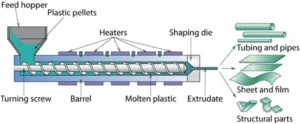
In the extrusion of plastic, the raw resin is transferred from a hopper to a heated cylindrical container that contains a rotating blade (or blades). The screw moves forward, causing the material to flow forward; this generates heat and friction. The heated barrel increases the temperature of the material, the material is melted, and the molten polymer is then passed through a die, into its intended shape, which is then cooled and solidified.
The outcome: a consistent profile like tubing, sheet, pipe, film, or strands, all of which are dependent on the die. This ongoing procedure is different from the continuous process of extrusion, which is used to create bulk products like injection-molded plastic.
As a result, the term “extruder” covers the machine’s key components plus its supplementary components that are upstream or downstream: feed systems, hoppers, barrels, screws, drive motors, dies, supplementary equipment, and control system. The extruder is the “engineer” of raw material that is converted into a form.
Understanding the extruder is crucial because of its configuration: the geometry of the screws, the areas of barrel heating, the shape of the die, the cooling line, and the scrap rate.
Main Components of an Extruder
To understand how an extruder functions, we must understand its essential parts. While different designs are employed by different industries (plastic, food, rubber, and metal), the fundamental components are still employed.
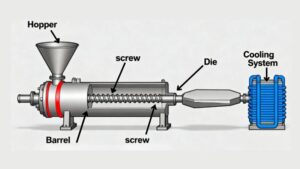
- Hopper / Flusher
The raw material is often presented in a pellet, granule, or powder form, and is introduced via the hopper at the rear of the machine. The feed’s throat is connected to the hopper’s. Many problems with quality are attributed to feed issues (variable amounts of feed, moisture, or size).
- Barrel (Cylinder)
The barrels are heated cylinders that contain the screws. It’s typically divided into zones that heat up, each with its own temperature controller. Its climate is ideal for melting, pressing, and transferring the substance. Many barrels are equipped with a hardened or nitrided surface, depending on the condition of wear.
- screws
The screw (or dual screws) is the center of the extruder. It spins inside the container, transferring material towards the front while compressing, melting, combining, and pressuring. The configuration of the screws (the flight depth, pitch, and compression ratio) is crucial.
- Die / Mold or Exposure
At the front of the extruder, the die converts the molten material into the desired continuous shape (pipe, sheet, film, strands). The die must be accurately crafted and correspond to the product.
- Drive System
The motor, gearbox, coupler, and train of wheels provide the motion of the screw(s). Control of speed is typically via variable frequency drives (VFDs) that alter the frequency of the screws and the volume of production.
- Heating and Cooling Mechanisms
The barrel contains heaters (band heaters or induction) as well as fans or cooling devices to control the temperature gradient. Downstream cooling (water baths, cooling rolls, or vacuum sizing) is essential to solidify the extrudate.
- Control System and Other Auxiliary Items
Modern extruders have sensors, computers, drives, motors, and feed systems. upstream and downstream supplementary equipment (material dryer, feeder, vent) and downstream equipment (hauling, cutters, coilers) complete the extrusion line.
How an Extruder Works: Step-by-Step Mechanism
Disaggregating the process into steps facilitates the understanding of the extruder’s functionality:
Step 1:Feeding/Conveying
The raw material is transferred into the hopper and then fed into the barrel via a gravity or other system. The screw is now beginning to move the solid material forward. At this point, the substance is still compacted and at the ambient temperature.
Step 2:Melting / Plasticizing
As the substance moves down the barrel, the friction between the screw and the barrel, plus external heat, causes the substance to melt and become plastic. The design of the channel’s geometry promotes the compacting of the material, which results in a decrease in channel depth, increased pressure, and a uniform melt.
Step 3:Homogenization & Combination
In the melting zone, elements that shear and mix (primarily found in twin-screw machines) are responsible for the dispersal of additive, the uniform distribution of color, and the release of volatiles. Twin-screw extruders have a special propensity for thoroughness.
Step 4:Measuring and Generating Pressure
The section that measures the pressure is responsible for creating the pressure needed to pass the molten substance through the die. The final flights of the screw have a consistent pressure and flow that is intended to ensure the stability of the extrudate’s dimensions.
Step 5:Transforming via Die
The molten substance is transported to the die where it is forced through a pre-designed opening that defines its section (e.g., a pipe’s bore, a film’s slit, or a profile channel). The shape of the die affects the final shape of the product.
Step 6:Cooling / Solidification
After the die, the extrudate must be chilled to maintain its shape and properties. Cooling methods include water baths, air conditioning, sizing by vacuums, or rolling. Effective cooling is timely and prevents distortion or failure.
Step 7:Haul-off, Disposal, or Cooking
Once the extrudate is firm, it is pulled by a hauling device or caterpillar that maintains a consistent speed and tension. The device either cuts the extrudate into length, coils it, or is used for further processing.
Step 8:Downstream processing/packaging
After the extrusion process, the material may be subjected to printing, embossing, trimming, or packaging based on the industry. The extruder is thus the central component of a manufacturing line.
Types of Extruders and Material Variants
Extruders have a significant variety in their capabilities depending on the material and application. Below are the primary types employed in different industries:
- Single-Screw Extruders
These have a single circular motionless blade in a stationary bottle. They’re the most popular for standard plastic extrusion (strips, sheets, films). They’re simpler, less expensive, and appropriate for many thermoplastic substances.
- Twin-Screw Extruders
With two pairs of intermeshing screws that rotate in different directions (co-rotating or counter-rotating), twin-screw extruders have a better combination of properties, a higher production volume, and a greater flexibility. They’re favored for combination, recycling, filling, and more intricate formulations.
- Ram or Plunger Extruders (for metals, rubber, or ceramic)
For materials that are not thermoplastic (e.g., metal extrusion, rubber profiles), extruders that are ram or plunger-based apply direct pressure to the material instead of using screws to rotate it. The general extrusion theory is still relevant: material is forced through a die in a pressure-resistant manner.
- Unique Extruders
Food extruders: they process cereals, snacks, and pet food, all of which require different types of screws and zones of the barrel.
Micro-extruders or 3D printing nozzles (for the 3D printing) feed the filament through the hot end and a nozzle.
Sheet, movie, or profile extrusion that is dedicated to the continuous production of rectangular parts.
Single-Screw vs. Twin-Screw: What’s the Difference?
While both types of extruders shape material through a die, their internal mechanics and ideal use cases are quite different. This table breaks down the key distinctions:
|
Feature
|
Single-Screw Extruder
|
|
|
Number of Screws
|
One
|
Two (intermeshing)
|
|
Primary Function
|
Conveying and melting a single material
|
Superior mixing, compounding, and reacting
|
|
Best For
|
Complex tasks like mixing polymers with additives, creating custom blends, processing heat-sensitive materials, and devolatilization.
|
|
|
Mixing Capability
|
Good for homogenous, pre-compounded materials.
|
Excellent; provides intense and thorough mixing of multiple components.
|
|
Cost & Complexity
|
Lower cost, simpler design, easier to operate and maintain.
|
Higher initial cost, more complex mechanics, and requires more skilled operation.
|
|
Industry Role
|
The “workhorse” for straightforward extrusion.
|
The “specialist” for compounding and customized material development.
|
Applications Across Industries
The variety of extruders is wide, and each sector relies on the fundamental process of extrusion, but with different materials, shapes, and downstream results.
- Plastics Industry
Perhaps the most popular user of extruders. Pipes, tubes, window shapes, sheets, films, wire and cable insulation, and profiles are all produced via extruders. The consistent nature allows for high volume and a constant cross-section.
- Rubber and Elastomer Extraction
Extruders utilize dies that push compounds of rubber through holes for fastening, irrigation, gaskets, and profiles. The principle is identical, though the conditions involved (temperature, pressure, and curing) are different.
- Food Preparation
Extruders utilize heat, pressure, and expansion to cook, shape, and expand food products, including snacks, cereals, pasta, and pet food. The extruder is dual-purpose; it combines cooking and shaping as well as mixing.
- Metal and ceramic extrusion
Metals like aluminum, copper, and steel are pulled through dies to produce rodents, bars, or intricate configurations. Similarly, ceramic can be extruded and then sintered.
- Reuse and Addition
Extruders have a crucial role in the disposal of plastic waste. Twin-screw extruders have a successful reputation for combining recycled plastic with other components, supplements, and uniformizing the melt for subsequent processing.
Key Process Parameters and How They Affect Performance
When selecting an extruder or optimizing it, certain factors are important:
- Screw speed (RPM) and total volume
Higher RPMs lead to increased productivity, but they may also cause shear-induced heat and a decrease in quality. Corresponding the speed of the screws to the material and the die is essential.
- Temperature Profile
Barrel regions must be dedicated to providing quality melt and avoiding degradation. An incorrect profile causes poor melt consistency, partial melting, or flash.
- Melt Pressure and Die Velocity
The pressure accrued by the screw compensates for the die’s resistance; a stable pressure and consistent velocity lead to consistent product dimensions.
- Residence Time
The amount of time the material has spent in the barrel has an effect on the process of mixture, homogenization, and thermal history. Too long may lead to a decline in quality; too short may leave unmelted fragments.
- Cooling and Haul-off Timing
After the exit, the process of cooling and pulling must correspond to the throughput to avoid distortion or failure of the extrudate.
- Wear, friction, and material compatibility
When dealing with compacted or abrasive materials, the wear of the screws and barrels is significant; the selection of the right materials (nitrided barrels, hardened screws) is crucial.
Extruder Design Considerations: Engineering the Machine for Optimal Performance
Designing or selecting an extruder is concerned with balancing the number of transactions, material properties, product dimensions, and operational flexibility. From the perspective of process engineers and plant managers, the following factors have a long-term effect and are responsible for cost-efficiency and performance.
- Combining Screw Theory and Compression Ratio
The screw describes the extruder’s nature. Its geometry, including pitch, flight depth, and the ratio of compression, controls how the polymer or mixture is transported, melted, and combined.
The frequency of the feed and the metering zones is typically 2:1 to 4:1. A higher ratio leads to better melting and uniformity, but it also increases the stress and energy needed to melt.
The combination of Elements (such as the combination of blocks in a twin-screw extruder) increases the dispersity of addenda, pigments, and fillers. This is important for the compounding and recycling applications.
Effective design of the screws ensures consistent flow, low temperature variations in melt, and minimal degradation— this is especially important for high-performance polymers or sensitive food materials.
- The configuration of the barrel and the temperature zones inside it.
An extruder barrel is typically composed of multiple temperature-regulated zones that feed, compress, and measure. Each zone must have specific requirements:
The zone of feed must prevent slackening or early melting.
The zone of compression creates pressure and melts the plastic.
The area surrounding the metering zone has a stabilizing effect on the melt’s viscosity and pressure before the die.
In machines with dual-screws, vent ports and side feeders can be incorporated to remove or add something to the machine. Modular barrels that can be replaced with different liners offer flexibility and control over wear.
- Drive and Power Systems
Modern extruders utilize AC vector motors or servos that are associated with precise gearboxes. The concern with energy efficiency is increasing, variable frequency drives (VFDs) minimize the consumption of power by taking the appropriate amount of torque to match the demand of the process.
Drive stability directly affects the consistency of the melt; therefore, controlling the torque and reducing mechanical vibrations are crucial in high-duty industrial applications.
- The Design and Distribution of Flows
The die converts pressure and flow into the desired product configuration. Internal channels must have a uniform velocity and temperature distribution. Today, computational fluid dynamics (CFD) tools facilitate the optimization of flow paths and the minimization of dead zones that lead to degradation or uneven thickness of the wall.
For extrusion of profiles, variable calibrators and vacuum systems that are adjustable maintain precise tolerances. For extrusion of films or sheets, a spiral mandrel or coat-hanger die is employed that provides a symmetrical flow. In pelletizing systems, the design of the die plate directly affects the shape, uniformity, and cutting capabilities of the pellets.
- The materials used in the construction of the shoe and its resistant capabilities are listed below.
High wear and corrosion are both common issues in extrusion, particularly when dealing with compounds that are filled or have a corroding nature, like PVC.
Common materials include:
| コンポーネント | Common Material | Properties & Use |
| バレル | Nitrided steel / Bimetallic | Hardness and corrosion resistance |
| スクリュー | 4140 steel / Tungsten carbide coating | Wear resistance for abrasive fillers |
| 金型 | Tool steel / Stainless steel | Dimensional stability and polish |
| Heater bands | Inconel / Ceramic | High-temperature durability |
Selecting the right combination ensures longevity, stability, and reduced maintenance downtime.
Comparing Extruder Types: Single-Screw vs Twin-Screw vs Specialty
Choosing the right extruder type depends on process requirements. Each has unique advantages and challenges.
| タイプ | Structure | Advantages | Limitations | Typical Uses |
| Single-Screw | One rotating screw in barrel | Simple, low cost, good for homogeneous polymers | Limited mixing ability, sensitive to feed consistency | Film, pipe, sheet, profile |
| Co-Rotating Twin-Screw | Two screws turning in same direction | Excellent mixing, self-cleaning, high output | Higher cost, more complex design | Compounding, recycling, masterbatch |
| Counter-Rotating Twin-Screw | Screws turn opposite directions | Gentle shearing, high pressure generation | Lower mixing intensity | PVC pipe, profile extrusion |
| Ram / Plunger | Direct mechanical push, no screw | Handles viscous or non-melt materials | Intermittent, slow | Metal or ceramic extrusion |
| Food Extruder | Twin-shaft or single-shaft cooking screw | Mixing + cooking + shaping | Requires specific temperature control | Snacks, cereals, pet food |
Understanding this comparison allows process engineers to specify an extruder that aligns with throughput, product complexity, and maintenance tolerance.
Operational Control: Key Parameters for Stable Extrusion
- Temperature Profile Regulation
A temperature profile that is uneven results in poor melting or excessive shearing. PID controllers direct the heater’s bands and cooling fans to maintain consistent thermal averages. Advanced systems utilize melt thermocouples that provide real-time information.
- Pressure Monitoring and Melt Quality
Melt pressure sensors near the die have a crucial role in determining the stability. Pressure fluctuations are indicative of screw wear, feed misbalance, or blockage. Constant pressure helps to maintain the consistency of dimensions and improve the surface quality of products.
- Feedrate and Torque Reduction
Gravimetric feeders make sure that the flow of material is synchronous with the rotation of the screw in order to avoid starvation or overfeeding. Torque sensors facilitate the monitoring of mechanical pressure, which prevents overloading of the gear or motor.
- Vacuum ventilation and degasification
In twin-screw extruders that have vacuoles, the air, moisture, and volatiles are removed. Effective venting prevents bubbles, burns, or deterioration in the ultimate product – especially in reusable materials or hydroscopic polymers.
- Cooling and Haul-Off Timing
The intensity of the cooling process and the speed of the puller have a direct relationship to the accuracy of the dimensions. If the cooling process is not sufficient, deformation or shrinking occurs. Conversely, excessive puller stress results in thinning or weakening.
- Quality Control Combination
Modern extrusion lines have in-line measurement tools that are laser-based, such as ultrasonic thickness sensors and color scanners. These facilitate long-term quality assessment and log data for the ISO standard.
Maintenance and Troubleshooting of Extruders
Similar to other industrial processes, extruders have a demand for proficient preventive care. Adequate care increases the lifespan, decreases downtime, and maintains the quality of the product.
- Routine Exams
Check whether the screws and barrels are wearing out using visual or numerical methods.
Watch for heaters, thermocouples, and fans that are cooling weekly.
Ensure the bolts and adaptors have a torqueless design.
Clean the hopper and prevent the transmission of disease.
- Common Problems and Solutions
| Symptom | Possible Cause | Recommended Action |
| Irregular melt pressure | Screw wear / inconsistent feed | Inspect screw, check feeder calibration |
| Overheating of motor | Excessive torque load | Adjust feed rate, verify gearbox lubrication |
| Uneven product dimensions | Die temperature imbalance | Balance heating zones, verify haul-off alignment |
| Discoloration or burn marks | Overheating / residence time too long | Lower temperature profile, purge system |
| Bubbles in extrudate | Moisture / poor venting | Pre-dry material, check vent vacuum |
| Reduced output | Screw or barrel wear | Rebuild or replace worn parts |
- Cleaning and purging
At the grade or color transition, effective purging is crucial. Employ compounds that purged the material or high-melting polymers to eliminate remaining debris. Avoid interior metal tools in the barrel, as these tools accelerate the wear process.
- Oil and Direction
Gearboxes need to be sampled periodically to recognize corrosion. Joints and bearings must be perpendicular to prevent noise and vibrations.
- Predictive Maintenance
Industry 4.0 approaches facilitate the detection of vibrations prior to their occurrence. Using SCADA systems, operators can observe the health of equipment in real time.
Extruder Selection and Procurement Guide
For buyers and engineers planning to invest in an extruder line, the following checklist ensures proper specification and supplier comparison:
| Evaluation Aspect | Key Question | Target Specification |
| Material Type | What resins or compounds will be processed? | PVC, PE, PP, ABS, PET, TPE, etc. |
| 生産能力 | What throughput (kg/hr) is required? | 50–2000 kg/hr typical |
| Product Type | What cross-section or form? | Pipe, sheet, film, pellet, profile |
| Screw Diameter / L:D Ratio | What geometry suits your material? | 25–150 mm; L:D = 24:1–40:1 |
| Drive Power | What motor size meets torque requirement? | 15–450 kW |
| Temperature Zones | How many heating zones are needed? | 4–8 for plastics; more for food |
| Automation Level | Manual, semi-automatic, or PLC control? | Smart/IoT integration preferred |
| Supplier Support | Does supplier offer local service, training, and spare parts? | Essential for uptime |
When comparing suppliers, look beyond price. Evaluate mechanical robustness, documentation quality, and after-sales service. You can learn more about ジュエル‘s extruders; they are professional, efficient, and can provide various solutions.
Innovations and Future Trends in Extruder Technology
As sustainability and digitalization influence the global manufacturing industry, extruder design is now evolving towards knowledge, efficiency, and environmental responsibility.
- Smart Extrusion Systems ( Industry 4.0)
Today, extruders that are modernized extruders include sensors that are connected to the Internet of Things, digital dashboards, and computers that are intelligent. These systems are based on the process’s data to automatically increase or decrease the speed of the screws, temperature, or pressure, to maintain the consistent quality of the product.
- Energy-Efficient Motors and Heat Recoveries
High-efficiency motors, regenerative drives, and heat-retaining systems decrease the power consumption by as much as 20-30%. Insulated containers and exact temperature regulators increase the efficiency of energy management.
- Modular and rapid-iteration design
Extruders are now evolving towards modular screws and barrels that can be quickly switched to different materials or products; this minimizes the amount of downtime in multiple facility productions.
- Innovative materials and coatings
Barrels and screws now utilize nano-coatings, bimetallic liners, and ceramic composites that have a triple life span in the presence of abrasive materials. This is of special importance in the recycling of material extrusion, as wear is accelerated by contaminants.
- Sustainable and Reusable Processing
Systems that extrude plastic have a significant role in the circular economy. Twin-screw extruders that are designed to recycle plastic can deal with mixed, polluted waste streams and reconfigure them into high-value pellets – this will help to support global sustainability goals.
Conclusion: Why Extruders Remain the Backbone of Modern Production
Jwellエクストルーダー is more than just a mechanical apparatus – it’s a system that converts raw material into a variety of consistent, value-added products with high efficiency and reproducibility. From its core principle of forcing material through a die to the latest AI-operated extrusion lines, the technology has continued to evolve, which has led to an increase in manufacturing innovation in plastics, food, and metals.
For those involved with plant engineering, understanding the functioning of an extruder is not simply academic. It conveys information regarding equipment choice, process optimization, troubleshooting, and energy management. For investors and procurement teams, it provides the platform from which to assess suppliers based on their technical proficiency, lifetime cost, and after-sales expertise.
In the future, as industries want to produce more exact products, have a higher degree of recyclability, and have greater productivity, the extruder will still be the central part of continuous manufacturing; it will be adaptive, intelligent, and essential.




 English
  Russian
  Spanish
  Arabic
  German
  French
  Persian
  Turkish
  Bulgarian
  Czech
Czech  Dutch
Dutch  Greek
Greek  Indonesian
  Japanese
  Korean
  Polish
  Portuguese
  Romanian
  Slovenian
  Ukrainian