
Quick Answer
A simple machine is a basic mechanical device that uses a single mechanical principle to change the magnitude or direction of a force, whereas a compound machine combines two or more simple machines to perform more complex tasks with greater efficiency and functionality. According to The Simple Machines by the National Institute of Standards and Technology (NIST) and the Engineering Mechanics textbook, Statics by Russell C. Hibbeler, compound machines achieve higher operational efficiency by integrating multiple force-transmitting mechanisms into one coordinated system.
In industrial manufacturing, the concept of a compound machine goes beyond classroom examples such as scissors or wheelbarrows. Modern production equipment, including extrusion systems, automated assembly lines, and コンパウンドライン solutions used in plastics processing, represents advanced compound machines designed to maximise productivity, precision, and process control.
はじめに
Machines have transformed human civilisation by enabling people to perform tasks that would otherwise require enormous physical effort or be impossible to accomplish manually. Virtually every industrial process, from lifting heavy construction materials to manufacturing high-performance engineering plastics, depends on machines that manipulate force, motion, and energy.
While most people recognise everyday tools such as hammers, pulleys, or bicycles, fewer understand the engineering distinction between a simple and a compound machine. This distinction is fundamental because it illustrates how increasingly sophisticated equipment evolves from basic mechanical principles.
For students, engineers, equipment buyers, and manufacturing professionals, understanding compound machines offers more than just theoretical knowledge. It reveals why modern industrial systems deliver higher productivity, greater automation, lower labour costs, and improved operational consistency.
This guide explains:
- What defines a simple machine?
- What makes a compound machine different?
- How compound machines generate mechanical advantage?
- Why compound machine design dominates modern manufacturing?
- How industrial compounding line systems represent practical applications of compound machine engineering?
Rather than viewing compound machines as merely ‘multiple simple machines connected’, this article explores the engineering principles that enable them to achieve precision, scalability, and continuous industrial production.
What Is a Simple Machine?
A simple machine is the most basic mechanical device, capable of changing the direction or magnitude of an applied force, which does not require an external power source. They reduce human effort by providing mechanical advantage, enabling users to accomplish work more efficiently.
According to the law of conservation of energy, mechanical advantage does not reduce the total amount of work required. Instead, it changes the relationship between force and distance. For example, a smaller input force applied over a longer distance can generate a larger output force over a shorter distance.
Engineers traditionally classify six fundamental simple machines:
| Simple Machine | Primary Function | Typical Example | Industrial Application |
| Lever | Multiplies force | Crowbar | Mechanical presses |
| Wheel and Axle | Reduces rotational effort | Hand wheel | Valves and steering systems |
| Pulley | Changes force direction | Crane pulley | Hoisting equipment |
| Inclined Plane | Reduces lifting force | Loading ramp | Material handling |
| Wedge | Converts force into separation | Chisel | Metal cutting |
| スクリュー | Converts rotation into linear force | Bolt | Clamping and fastening |
Although these mechanisms may appear simple, they are indispensable components of modern machinery. Even highly automated production systems rely on these basic principles to transmit motion, distribute loads, and maintain mechanical stability.
For instance, screw mechanisms generate precise axial movement in extrusion equipment, while lever systems control clamping actions in industrial moulds. Pulleys and wheel-and-axle arrangements facilitate the transport of materials across manufacturing facilities.
Thus, simple machines represent the fundamental ‘building blocks’ from which virtually all mechanical equipment is constructed.
What Is a Compound Machine?
A compound machine combines two or more simple machines to form an integrated mechanical system that can perform tasks that would be impossible, or significantly less efficient, for any individual simple machine alone.
Unlike simple machines, which perform a single mechanical function, compound machines coordinate multiple force transformations simultaneously. Each component plays a specific role while working together as part of a unified system.
Consider, for example, a pair of scissors.
Although they appear to be a single tool, they combine several simple machines:
- Two first-class levers generate the cutting force.
- Two wedges form the sharpened blades.
- A screw joins the two halves together and acts as the rotational pivot.
These mechanisms work together to produce a smooth, controlled cutting motion that none of the simple machines could achieve independently.
The same principle applies to more sophisticated equipment.
For example, a bicycle incorporates wheels and axles, levers, gears, screws, and chain-drive mechanisms. An automobile incorporates hundreds of interacting mechanical systems. Likewise, industrial packaging equipment, robotic assembly stations, and polymer extrusion systems integrate numerous simple machines into synchronised operations.
Therefore, the defining characteristic of a compound machine is mechanical integration, rather than the number of components.
Why Compound Machines Are More Efficient?
Compound machines deliver superior performance because they optimise the transfer of mechanical energy across multiple stages rather than relying on a single force transformation.
Their widespread adoption across industrial sectors is explained by several engineering advantages.
Higher mechanical advantage
Multiple mechanical elements can multiply force sequentially.
Rather than depending on a single lever or pulley, engineers design systems in which gears, screws, cams, bearings, and levers work together to amplify output while minimising operator effort.
Multiple functions in one system
Simple machines generally perform one task.
Compound machines can perform several tasks simultaneously, such as transmitting power, guiding motion, controlling speed, regulating pressure, positioning materials, improving safety, and automating repetitive operations.
This multifunctionality significantly improves productivity.
Greater precision
Modern manufacturing demands repeatability measured in fractions of a millimetre.
Compound machines incorporate precision bearings, servo drives, linear guides, and synchronised actuators that maintain accurate positioning throughout continuous operation.
Improved automation
Automation depends on coordinated mechanical movement.
As compound machines integrate multiple motion systems, they provide the mechanical foundation required for programmable logic controllers (PLCs), sensors, robotics, and closed-loop process control.
Consequently, nearly every automated production line in use today is essentially a sophisticated compound machine.
Simple Machine vs. Compound Machine
Although both categories rely on identical physical laws, their engineering objectives differ considerably.
| Feature | Simple Machine | 複合機械 |
| Number of mechanisms | One | Two or more integrated mechanisms |
| Complexity | Low | Moderate to very high |
| Mechanical advantage | Single-stage | Multi-stage |
| Primary purpose | Perform one basic task | Perform multiple coordinated tasks |
| Power source | Usually manual | Manual, electric, hydraulic, or pneumatic |
| Maintenance | Minimal | Requires systematic maintenance |
| Typical examples | Lever, pulley, wedge | Bicycle, sewing machine, forklift, extrusion system |
| Industrial role | Basic mechanical component | Complete manufacturing equipment |
Rather than replacing simple machines, compound machines build upon them. Every sophisticated mechanical system—from a robotic arm to a packaging line—contains numerous simple machines working together in carefully engineered relationships.
This layered design philosophy enables engineers to create machines capable of delivering higher productivity, greater reliability, and increased operational flexibility across diverse industries.
How Compound Machines Work?
The effectiveness of a compound machine lies in its ability to coordinate several simple mechanical principles into a continuous chain of energy conversion. Rather than relying on a single movement, a compound machine receives an input force and transfers it through its interconnected components. This force is then modified in terms of direction, speed, or magnitude before finally producing a controlled output suited to a specific task.
- A typical workflow includes:
- Power input from a human operator, electric motor, hydraulic system, or pneumatic actuator;
- Force transmission through shafts, gears, belts, screws, or linkages.
- Motion conversion, such as transforming rotational motion into linear movement or adjusting speed and torque; and
- Output execution, where the machine performs work such as cutting, lifting, compressing, mixing, or conveying materials.
- The machine then performs work such as cutting, lifting, compressing, mixing, or conveying materials.
The greater the integration of these stages, the more efficient, precise, and reliable the machine. This systems-based approach illustrates why compound machines form the basis of modern industrial equipment, where multiple mechanical functions must operate continuously and in synchronisation.
Compound Machines in Modern Manufacturing
Although simple machines remain essential building blocks, modern manufacturing depends almost entirely on compound machines. Every production line incorporates multiple mechanical components to ensure continuous, consistent, and highly efficient operation. Electric motors provide the necessary power, while gearboxes adjust the speed and torque. Conveyors transport materials, sensors monitor performance, and control systems synchronise every stage of the production process. Together, these components form a single compound machine capable of delivering consistent quality on an industrial scale.
In manufacturing environments, the objective extends beyond merely reducing human effort. Compound machines must also improve productivity, minimise material waste, ensure operator safety, and maintain tight dimensional tolerances over long production cycles. For this reason, engineers design machines as interconnected systems rather than isolated mechanisms. Mechanical components, electrical controls, hydraulic or pneumatic actuators, and software are increasingly integrated to optimise overall performance.
Examples of industrial compound machines include:
- Plastic extrusion systems
- Injection moulding machines
- CNC machining centres
- Automated packaging lines
- Robotic assembly cells
- Textile production equipment
- Food processing systems
- Metal rolling and forming lines
Although these machines vary significantly in function, they all share the same engineering principle: multiple simple machines cooperate to complete complex manufacturing tasks that no single mechanism could accomplish independently.
The Relationship Between a Compound Machine and a Compounding Line
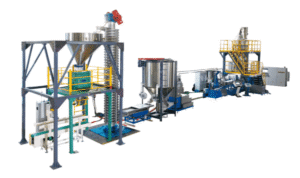
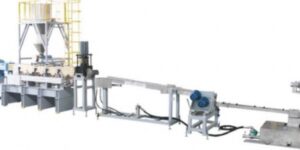
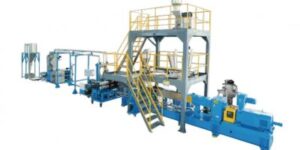
One of the best examples of an industrial compound machine is a compounding line, which is used in the manufacture of polymers and plastics.
Rather than being a single piece of equipment, a compounding line is an integrated production system that combines numerous mechanical, thermal, and control processes to produce engineered plastic compounds with consistent properties. Raw materials, including polymer resins, fillers, reinforcing fibres, pigments, and additives, are blended, melted, mixed, devolatilised, filtered, cooled, and pelletised in one continuous process.
From an engineering perspective, a compounding line is a prime example of a compound machine because it comprises several subsystems, including:
- Feeding systems
- Gravimetric dosing units
- Twin-screw or single-screw extruders
- Gear transmission systems
- Heating and cooling modules
- Vacuum degassing systems
- Melt filtration equipment
- Strand or underwater pelletizers
- Conveying equipment
- PLC-based automation and monitoring systems
Each subsystem performs a specialised function while remaining synchronised with every other stage. If one component operates outside its specified parameters, the performance of the entire production line may be affected. This high level of integration distinguishes industrial compound machines from simpler mechanical assemblies.
The benefits of modern compounding lines include:
- Uniform material dispersion
- Stable product quality
- Higher production efficiency
- Reduced energy consumption
- Lower material waste
- Improved process automation
- Greater flexibility for different formulations
These advantages explain why compounding lines are widely used to manufacture engineering plastics for industries such as automotive, electrical and electronics, medical devices, construction, consumer goods, and renewable energy.
Compound Machine Design Principles in Industrial Equipment
Designing a successful compound machine requires far more than simply combining several individual machines. To achieve reliable long-term performance, engineers must optimise the interaction between mechanical structures, power transmission systems, thermal management, automation, and material flow.
Several design principles are particularly important.
Efficient power transmission
Energy losses reduce production efficiency and increase operating costs. Engineers therefore select gear ratios, bearings, shafts, and drive systems that maximise torque transmission while minimising friction and vibration.
Modular architecture
Modern industrial machines are increasingly designed with modular components. Individual modules can be upgraded, replaced, or maintained without the need to redesign the entire system. Modular design also enables manufacturers to customise equipment for different production requirements.
Process stability
Industrial production often operates continuously for many hours or even days. Compound machines must therefore maintain stable temperatures, pressures, rotational speeds, and material flow rates throughout extended operating cycles. Stable processes improve product consistency while reducing equipment wear and tear.
Automation and data integration
Today’s compound machines incorporate programmable logic controllers (PLCs), human-machine interfaces (HMIs), industrial sensors, and real-time monitoring systems. These technologies enable operators to track production parameters, identify potential issues early on, and optimise process performance through data-driven decision-making.
Example: Compound Machines in Plastic Compounding
The process of plastic compounding demonstrates how multiple engineering disciplines converge within a single compound machine.
Consider, for example, the production of glass-fibre-reinforced polypropylene.
Polymer pellets are metered into the feeding system with precision.
Reinforcing fibres and additives are introduced at designated feeding ports.
この 押出業者 then melts and mixes the materials at a controlled temperature and pressure.
Vacuum degassing then removes any moisture or volatile substances.
The molten material then passes through a filtration system to remove any remaining contaminants.
The extrudate is then cooled and pelletised into uniform granules.
The finished pellets are then conveyed for packaging and quality inspection.
Each stage depends on the successful operation of the previous stage, which demonstrates why the entire production line functions as one integrated machine rather than a collection of independent devices.
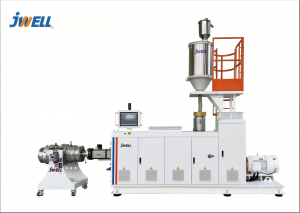
Manufacturers seeking high-capacity polymer processing solutions can turn to suppliers such as ジュエル, which provide advanced compounding line systems designed for engineering plastics, recycled materials, masterbatch production, and biodegradable polymers. Modern configurations emphasise high throughput, energy efficiency, intelligent control, and flexible process customisation for diverse industrial applications.
Simple Machines vs. Industrial Compound Machines
| Evaluation Factor | Simple Machine | Industrial Compound Machine |
| Primary objective | Assist with a single mechanical task | Complete an integrated manufacturing process |
| Number of components | One mechanical element | Multiple interconnected mechanical and control systems |
| Level of automation | Manual or limited | Fully or semi-automated |
| 生産能力 | Low | High-volume continuous production |
| Precision | Basic | High precision with closed-loop control |
| Maintenance | Simple | Preventive and predictive maintenance required |
| Scalability | Limited | Easily adapted for industrial expansion |
| Typical industries | Education, household tools | Plastics, automotive, electronics, food, medical, packaging |
Future Trends in Compound Machine Development
As digital manufacturing and Industry 4.0 advance, compound machines continue to evolve. Future systems will perform mechanical tasks, collect operational data, communicate with other equipment, and optimise performance automatically.
Several trends are shaping the next generation of compound machines.
Smart sensors that can monitor vibration, temperature, pressure, and energy consumption in real time.
Artificial intelligence that can predict equipment wear and recommend maintenance before failures occur.
Digital twins will simulate machine performance, enabling engineers to virtually test process changes before implementing them on the factory floor.
Energy-efficient drive systems will reduce electricity consumption while maintaining production capacity.
Remote monitoring via industrial IoT platforms allows manufacturers to supervise multiple production lines from centralised control centres.
Flexible manufacturing systems can switch rapidly between different products with minimal downtime.
These innovations are transforming compound machines from purely mechanical systems into intelligent production platforms that combine mechanical engineering, automation, software, and data analytics.
Frequently Asked Questions (FAQ)
- What is the main difference between a simple machine and a compound machine?
A simple machine performs a single mechanical function using one basic mechanism, while a compound machine combines two or more simple machines to complete more complex tasks with improved efficiency and control.
- Is a bicycle a compound machine?
Yes. A bicycle is a classic example of a compound machine because it integrates wheels and axles, levers, gears, chains, screws, and braking mechanisms into one coordinated system.
- What is a compounding line used for?
A compounding line is used to manufacture customized plastic compounds by blending polymers with fillers, additives, pigments, reinforcing fibers, and other materials through a continuous extrusion process.
- Why are compound machines important in manufacturing?
Compound machines improve productivity, precision, automation, and process consistency. They enable continuous industrial production while reducing labor requirements, material waste, and operating costs.
- What industries commonly use compounding lines?
Compounding lines are widely used in the plastics industry to produce materials for automotive components, electrical and electronic products, construction materials, medical devices, packaging, consumer goods, and recycled plastics.
- Can every industrial machine be considered a compound machine?
Most modern industrial machines qualify as compound machines because they integrate multiple simple machines with electrical, hydraulic, pneumatic, and computerized control systems to perform coordinated manufacturing operations.
結論
The difference between a simple and a compound machine lies in their complexity, functionality, and application. While a simple machine performs one fundamental mechanical function by altering the direction or magnitude of force, a compound machine integrates two or more simple machines to accomplish sophisticated tasks with greater efficiency, precision, and versatility.
This distinction is particularly important in modern manufacturing. Compounding line systems, for example, demonstrate how compound machine principles can enable continuous production, precise material processing, and advanced automation. By coordinating multiple mechanical and control subsystems, these machines deliver consistent quality, higher productivity, and lower operating costs across a wide range of industries.
As the manufacturing sector continues to embrace intelligent automation, data connectivity, and sustainable production, compound machines will remain at the heart of industrial innovation. Understanding their principles provides valuable insight into both engineering fundamentals and the technologies driving today’s most advanced production systems.


 English
  Russian
  Spanish
  Arabic
  German
  French
  Persian
  Turkish
  Bulgarian
  Czech
Czech  Dutch
Dutch  Greek
Greek  Indonesian
  Japanese
  Korean
  Polish
  Portuguese
  Romanian
  Slovenian
  Ukrainian