
Quick Answer
A blow film machine, or more precisely a blown film extrusion line, is a plastic processing system that melts polymer resin, extrudes it through a circular die, inflates the molten plastic into a tubular bubble, cools it, and then winds it onto film rolls. This process is known as blown film extrusion in polymer-processing literature. It is valued because the film is stretched in both the machine direction (MD) and the transverse direction (TD). This helps to create balanced mechanical properties, such as tensile strength, puncture resistance, and tear performance. Standard references, including Principles of Polymer Processing by Z. Tadmor & C.G. Gogos and Polymer Extrusion by Chris Rauwendaal, describe blown film as one of the core manufacturing processes for polyethylene packaging film, agricultural film, liners, and multilayer barrier structures.
In practical manufacturing terms, a blow film machine is much more than just a machine that ‘makes plastic film’. It is a coordinated thermal, rheological, and air control system that determines the thickness, width, orientation, clarity, output, sealing behaviour, and final converting performance of the film. This is why buyers evaluating a blown film line need to understand the equipment layout and the physics of the process.
What Is a Blow Film Machine?
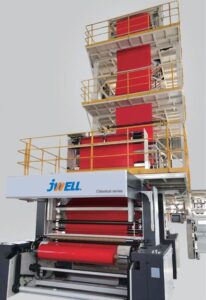
A blow film machine is an extrusion line used to produce continuous plastic film. It does this by forming a molten polymer tube and inflating it into a bubble. The process begins with resin pellets — most commonly LDPE, LLDPE, or HDPE, and in more advanced structures, EVA, PA, EVOH, metallocene PE, or biodegradable blends such as PBAT/PLA — being fed into an extrusora. The extruder then melts and pressurises the polymer before pushing it through an annular die. Air is introduced through the centre of the die, inflating the molten polymer into a bubble. As the bubble rises, it is cooled, stabilised, flattened, and wound into rolls for use in making bags, laminating, printing, or packaging conversion processes.
While this process may sound simple, the industrial value of a blow film machine lies in its ability to produce both single-layer commodity film and high-performance coextruded barrier film with multiple functional layers. Therefore, the same process can serve very different markets, such as shopping bags, food packaging, shrink film, silage film, heavy-duty liners, express bag film, hygiene packaging, and speciality protective film.
Why Blown Film Matters in Packaging and Industrial Film Production?
Blown film remains one of the most important plastic film processes due to its versatility, tubing capability, biaxial orientation, and multilayer adaptability, which flat cast systems often struggle to match. During the process, the film is stretched circumferentially by internal air pressure and axially by the haul-off speed. This dual stretching provides the film with greater balanced strength than a process involving a single direction of draw. It also enables manufacturers to produce centre-fold film, lay-flat tubing, gusseted film, and bag stock directly from the production line.
This matters to converters and packaging buyers because the performance of the end product often depends on how the film behaves in both directions. For example, a shopping bag, pallet cover, or heavy-duty liner that tears too easily in the transverse direction may be due to a process-orientation issue as well as a material issue. This is why, rather than asking “What is a blow film machine?”, the question should be “What kind of film structure and performance can this line consistently deliver?”
How Does a Blow Film Machine Work?
At a high level, a blow film machine works by converting solid resin into a controlled molten tube, then using air pressure, cooling, and line tension to transform that tube into finished film. The process is continuous and typically consists of seven linked stages.
1) Resin feeding and melt preparation
The process starts at the hopper, where resin pellets or blends are fed into the extruder. Depending on the film recipe, additives such as slip, antiblock, UV stabilizer, antiblooming agents, pigments, processing aids, or reprocessed material may also be dosed into the system. Inside the extruder barrel, the screw conveys, compresses, melts, mixes, and pressurizes the polymer. The goal is not only to melt the resin, but to create a uniform melt with stable temperature, viscosity, and pressure before it reaches the die.
This stage has a huge effect on the final film quality. If the melt is not homogeneous, the line can suffer from gels, fish-eyes, die lines, thickness variation, or bubble instability. In practice, melt quality depends on screw design, L/D ratio, screen changer condition, resin dryness, where relevant, and the stability of barrel-zone temperature control.
2) Extrusion through the annular die
Once the polymer melt is fully prepared, it enters the die head, which distributes the melt around a circular path and forces it through a narrow annular gap. This forms a hot tubular sleeve of plastic. Die design is critical here. Poor melt distribution around the circumference leads to non-uniform gauge before the bubble even starts to rise. References on blown film processing consistently emphasize that die geometry, mandrel centering, and flow balance are central to thickness control.
For commodity film, a single-layer die may be sufficient. For higher-value applications, coextrusion dies combine several melt streams into a multilayer tube, allowing one line to build a structure in which each layer performs a specific job—sealability, stiffness, toughness, oxygen barrier, moisture barrier, puncture resistance, or print surface quality.
3) Bubble formation by internal air pressure
As the molten tube exits the die, air is introduced through the die center. This inflates the tube into a bubble. The ratio between the final bubble diameter and the die diameter is known as the blow-up ratio (BUR). BUR is one of the most important variables in blown film because it affects film width, transverse orientation, mechanical balance, and sometimes optics.
This is the point where the line starts behaving less like a simple extruder and more like a dynamic process system. The bubble must remain stable even though it is thin, hot, continuously moving, and sensitive to changes in pressure, cooling, melt strength, and haul-off speed. If the bubble oscillates or “breathes,” the line can produce wrinkles, gauge bands, poor layflat, and inconsistent roll quality.
4) Cooling and frost-line formation
The newly formed bubble is cooled externally by an air ring positioned around the die. On higher-performance lines, internal bubble cooling (IBC) may also be used to cool the bubble from the inside. Cooling is not just about making the polymer solid; it determines the frost line height, output rate, optical properties, orientation balance, and gauge stability. Published work on air-ring performance shows that air-ring selection influences bubble stability, output, gauge uniformity, and the balance of physical versus optical film properties.
The frost line is the point on the bubble where the polymer transitions from molten/soft to visibly solidified film. A stable frost line is a sign of stable process conditions. If the frost line moves excessively, the operator may see thickness fluctuations and poorer consistency. In modern high-output systems, air-ring design and IBC control are major differentiators between ordinary lines and high-performance lines.
5) Bubble stabilization and upward haul-off
As the bubble rises, it is guided by stabilizing cages or collapsing-frame elements and pulled upward by the haul-off section. The speed at which the bubble is pulled relative to the extrusion output affects the draw-down ratio and, therefore, film thickness and orientation in the machine direction. If the haul-off speed increases while output stays constant, the film generally becomes thinner. If output increases without sufficient haul-off adjustment, thickness rises.
This is one of the reasons the blown film operation is best understood as a balancing act among output, BUR, haul-off, cooling, and melt temperature. A machine can produce acceptable film at low speed but struggles at high output if one of these variables moves outside the stable processing window.
6) Collapsing the bubble into lay-flat film
Near the top of the tower, the bubble is collapsed between frames and nip rollers into a flat double-layer web, often called layflat film. The geometry of this stage matters more than many buyers realize. Poor collapsing-frame design or unstable bubble shape can create wrinkles, uneven tension, gusset defects, or roll telescoping later in winding.
7) Winding and roll formation
Finally, the flattened film is wound onto rolls under controlled tension. At this point, the film may already be ready for shipment, or it may move on to printing, lamination, slitting, bag making, sealing, or pouch conversion. Winding quality affects how well the film runs downstream; a film roll with inconsistent tension or poor edge alignment can create major problems in converting, even if the film gauge itself is acceptable.
Main Components of a Blow Film Machine
To understand line performance, it helps to look at the blow film machine as a system of interacting modules rather than a single machine. Each module controls a different part of the film’s formation history.
Main Components of a Blow Film Machine and What They Control
| Componente | Main Function | What It Influences Most |
| Hopper/dosing system | Feeds virgin resin, masterbatch, and additives into the line | Blend consistency, additive accuracy, repeatability |
| Extruder screw and barrel | Melts, mixes, conveys, and pressurizes the polymer | Melt homogeneity, output stability, gel risk, energy use |
| Screen changer/filtration | Removes contaminants and unmelted particles | Surface quality, fish-eye reduction, die pressure stability |
| Annular die head | Shapes melt into a tubular flow and distribute it circumferentially | Gauge uniformity, layer distribution, bubble symmetry |
| Air ring | Cools the bubble externally and helps stabilize it | Frost line height, clarity, output, and thickness consistency |
| IBC system | Cool’s bubble internally on advanced lines | Output increase, gauge stability, bubble control |
| Bubble cage/stabilizer | Guides and stabilizes the bubble during ascent | Bubble flutter, layflat stability, wrinkle reduction |
| Nip / haul-off unit | Pulls the bubble upward and collapses it | Thickness, MD orientation, line speed |
| Oscillating haul-off or rotating die | Distributes circumferential gauge variation around the roll | Thickness profile averaging, downstream converting stability |
| Enrolador | Forms finished rolls under controlled tension | Roll build quality, slitting/printing performance |
What Types of Blow Film Machines Are Available?
Not every blow film machine is built for the same market. One of the biggest mistakes buyers make is evaluating all blown film lines as if they were interchangeable. In reality, machine architecture should be matched to film structure, resin family, output target, and downstream application.
-
Single-layer blow film machine
A single-layer line is the classic entry-level or commodity configuration. It is commonly used for shopping bags, garbage bags, simple liners, protective covers, and agricultural commodity film. The structure is simple, the investment cost is lower, and the operation is easier to learn. But it also limits how precisely you can engineer film properties, because the entire film is made from one material system rather than a layered combination.
-
ABA or ABC coextrusion blow film machine
Coextrusion lines allow multiple polymer streams to be combined into one film. An ABA line may use virgin material on the outer layers and controlled recycled or lower-cost content in the center. An ABC line can separate functions more clearly—for example, one layer for sealing, one for strength, and one for appearance or printability. This makes coextrusion one of the most commercially important upgrades from basic film production.
-
5-layer, 7-layer, 9-layer, and high-barrier blown film lines
These are used when the film needs barrier performance, downgauging potential, toughness, puncture resistance, or specific food-packaging functionality. A multilayer line can incorporate PA, EVOH, metallocene PE, tie layers, or specialty sealant layers in one structure. This is where blown film moves from “bag film production” into engineered packaging film manufacturing.
For example, Jwell’s published blown film line range includes 3–11 layer coextrusion blown film systems for higher-performance packaging and industrial applications, with configurations that integrate automatic air rings, online thickness measurement, and IBC on suitable models. Those features matter because they directly address the two things buyers care about most at scale: output and thickness uniformity.
Which Materials Can a Blow Film Machine Process?
The answer depends on the screw and die designs, cooling capacity, and target application, but the most common materials include:
- LDPE for softness, sealability, and general flexible packaging
- LLDPE for toughness, puncture resistance, and stretch performance
- HDPE for stiffness, yield strength, and thin, grocery-bag-style film
- EVA for softness and seal performance in speciality films
- MPE/metallocene PE for high toughness and downgauging strategies
- PA (nylon) for puncture resistance and barrier functions in multilayer packaging
- EVOH for an oxygen barrier in food packaging structures
- BAT/PLA blends for selected biodegradable or compostable film applications
Material selection is not just a question of resin; it is also a question of machine compatibility. For example, a line optimised for commodity HDPE shopping bag film may not automatically perform well on a high-barrier PA/EVOH coextruded structure without different screws, temperature windows, and a different cooling strategy.
Key Process Parameters That Determine Film Quality
One reason why top-ranking articles on blown film often feel incomplete is that they describe the process without explaining which variables actually control film quality. In real production, the success or failure of a blown film machine depends on parameter control.
-
Blow-up ratio (BUR)
The BUR affects film width, TD orientation, and mechanical balance. While a higher BUR generally increases transverse orientation, the ‘right’ BUR depends on resin type, die diameter, output, and target properties.
-
Frost line height (FLH)
The frost line is one of the most visible indicators of line behaviour. An unstable or high frost line can indicate insufficient cooling, excessive output, or an imbalance between the melt temperature and the air-ring capacity.
-
Draw-down ratio/take-up ratio
These determine how much the film is stretched in the machine direction. Too much draw can thin the film excessively or cause instability, while too little can reduce orientation and productivity.
-
Melt temperature and viscosity stability
If the melt is too hot, it may lose bubble stability and melt strength. If it is too cold, it may result in a poor surface finish, high die pressure, or incomplete mixing. Stable viscosity is especially important in multilayer structures, as one layer must not dominate the flow distribution.
-
Die gap and gauge control
The die gap determines the initial wall thickness prior to inflation and drawing. Modern production lines may also use automatic thickness control (ATC) and oscillation systems to reduce gauge bands and improve roll uniformity.
-
Filtration quality
Contaminants, gels, and degraded polymer can produce visible defects in the finished film. In blown film production, filtration issues are not merely cosmetic; they can also cause pressure and bubble behaviour to become unstable. Recent engineering guidance on blown film filtration emphasises that inadequate melt filtration is a major cause of defects such as fish-eyes and gauge inconsistency.
Common Blow Film Defects and What Usually Causes Them
A strong article should not stop at “how it works.” Buyers and operators also need to understand what goes wrong in real production. Below is a practical troubleshooting map that makes the article more useful for both Google and AI citation.
Common Blow Film Problems, Likely Causes, and First Checks
| Problem | Typical Symptoms | Likely Causes | First Things to Check |
| Bubble instability/oscillation | Bubble wobbles, breathes, or collapses intermittently | Uneven cooling, unstable internal pressure, poor melt homogeneity, and mechanical misalignment | Air ring balance, IBC settings, die pressure stability, bubble cage alignment |
| Thickness variation/gauge banding | Heavy/light bands around roll, poor uniformity | Uneven die flow, unstable frost line, poor air-ring distribution, lack of oscillation | Die centering, screen pack condition, air ring settings, ATC calibration |
| Fish-eyes / gels | Small raised defects or transparent specks | Contamination, degraded resin, poor filtration, unmelted polymer | Screen changer condition, resin cleanliness, temperature profile |
| Wrinkles in lay-flat film | Fold marks, uneven winding, poor converting | Bubble asymmetry, collapsing-frame issues, tension imbalance | Frame geometry, nip alignment, bubble symmetry |
| Melt fracture / rough surface | Sharkskin, rough die exit surface | Excessive shear, wrong temperature profile, resin mismatch | Melt temperature, die pressure, output rate, resin grade |
| Poor seal performance | Weak bag seals, seal contamination, inconsistent hot tack | Wrong layer design, additive imbalance, film contamination, insufficient sealant layer control | Structure design, resin selection, additive dosing, seal layer gauge |
Blow Film vs Cast Film: Which Process Is Better?
This is one of the most frequently searched-for questions, and it deserves a direct answer. Neither process is universally ‘better’. The right choice depends on the end-use requirements of the film.
Blown film is often preferred when balanced mechanical properties in MD and TD are required, or when tubing or layflat film is needed directly from the line. It is also preferred for tougher bag film and industrial film, as well as for multilayer barrier structures with broad process flexibility, thicker gauges, or robust packaging film.
Cast film is often preferred when higher optical clarity and gloss are required, or when tighter gauge control is needed at very high speed. It is also preferred for flatter film geometry in certain converting processes, stretch film, and selected hygiene or lamination applications.
A buyer choosing a blown film machine should therefore evaluate not just price and output, but also whether the intended product family actually benefits from blown-film orientation and tubing capability.
Where Blow Film Machines Are Used?
A modern blow film machine has many more uses than just producing commodity bags. Typical end uses include:
- Food packaging film: bread bags, frozen food bags, multilayer barrier pouches, and produce packaging
- Industrial packaging: pallet covers, heavy-duty liners, protective overwrap, and FFS film
- Agricultural film: mulch film, greenhouse film, and silage film
- Retail and e-commerce packaging: shopping bags, courier bags, and mailer film
- Construction and protective film: dust sheets, surface protection film, and temporary moisture barriers
- Medical and hygiene packaging: sterile packaging webs and hygiene film structures, depending on the resin system and line specification
The line specification changes with the market. For example, a greenhouse film line prioritises width, output, and weathering additives, while a food-packaging barrier line prioritises layer precision, contamination control, and seal/barrier balance.
How to Choose the Right Blow Film Machine?
If you are writing for commercial intent and want the article to outperform generic competitors, this section is essential. Buyers rarely ask only “what is a blow film machine?” They are usually also asking “which machine should I buy or specify?”
-
Start with the film, not the machine
Define the film application first: bag film, barrier food film, silage film, courier bag film, heavy-duty liner, shrink film, or lamination substrate. The target film determines the needed layers, width, output, resin family, and quality-control systems.
-
Match output to cooling capacity, not just extruder size
A machine’s nameplate capacity means little if the cooling system cannot support stable bubble formation at that rate. High-output blown film is often limited by air-ring efficiency, IBC effectiveness, and bubble stability, not by motor power alone.
-
Check whether the thickness control is manual or automatic
For commodity film, manual adjustment may be acceptable. For tighter-tolerance packaging film, automatic air ring control, online thickness measurement, and profile correction are much more valuable.
-
Evaluate future product flexibility
If the business may move from commodity bags into higher-margin multilayer packaging, an ABA or ABC platform may be a better investment than a basic single-layer line. The lowest capital cost is not always the lowest long-term cost.
-
Ask about the actual process window, not just the brochure specs
Good suppliers can discuss BUR range, die options, IBC availability, resin compatibility, typical thickness range, and gauge uniformity expectations under real operating conditions—not just list output numbers.
FAQ: Blow Film Machine
1) What is a blow film machine used for?
A blow film machine is used to manufacture plastic film rolls for applications such as shopping bags, garbage bags, food packaging, agricultural film, industrial liners, courier bags, and multilayer barrier packaging.
2) How does a blow film machine work?
It melts polymer resin in an extruder, pushes the melt through a circular die to form a tube, inflates that tube with air into a bubble, cools it with an air ring (and sometimes IBC), collapses it into layflat film, and winds it into rolls.
3) What is the difference between a blow film machine and a cast film machine?
A blow film machine forms film as an inflated bubble and typically provides better-balanced MD/TD properties and tubing capability. A cast film machine extrudes film through a flat die onto a chill roll and is often preferred for high clarity and tight gauge control.
4) Which materials can be processed on a blow film machine?
Common materials include LDPE, LLDPE, HDPE, EVA, metallocene PE, and, in multilayer structures, PA, EVOH, tie resins, and selected biodegradable compounds depending on the machine design.
5) What controls film thickness in blown film extrusion?
Film thickness is mainly influenced by extruder output, haul-off speed, blow-up ratio, die gap, melt temperature, cooling stability, and thickness-control systems.
6) Why is bubble stability so important in a blow film machine?
Bubble stability affects gauge uniformity, wrinkle formation, layflat quality, roll build, and overall output consistency. An unstable bubble can quickly cause scrap, downtime, and downstream converting problems.
Conclusão
A blow film machine is best understood as a film engineering system rather than merely an extrusion machine. It converts polymer pellets into finished film by combining melt preparation, annular die extrusion, bubble inflation, cooling, stabilisation, collapse, and winding into one continuous process. Its value lies not only in its ability to produce film, but also in its capacity to adjust orientation, strength, width, thickness, sealing behaviour, and multilayer functionality for a wide range of packaging and industrial applications.
The most important takeaway for manufacturers and buyers is that machine selection should be based on end-use film requirements rather than generic output numbers. While a commodity HDPE bag line, an ABA courier bag line, and a seven-layer barrier packaging line may all be ‘blow film machines’, they solve very different production problems. To achieve stable output, tight gauge control, scalable product development, and better downstream converting performance, it is far more useful to understand the mechanics of the bubble, the cooling system, the die, and the multilayer structure than to simply compare horsepower or width. This is also why the most advanced blown film production lines on the market are increasingly competing on factors such as automation, cooling efficiency, thickness control, and structural flexibility, rather than just capacity.



 English
  Russian
  Spanish
  Arabic
  German
  French
  Persian
  Turkish
  Bulgarian
  Czech
Czech  Dutch
Dutch  Greek
Greek  Indonesian
  Japanese
  Korean
  Polish
  Portuguese
  Romanian
  Slovenian
  Ukrainian