Suzhou Jwell Machinery Co., Ltd. is a large-scale plastic extrusion machinery manufacturer in China. The company produces more than 2,000 advanced extrusion production lines each year. Its products are exported to all over the world, including Germany, the United States, Japan, Spain and other developed countries. Today, we will introduce Suzhou Jwell Machinery’s extruder products in detail. If you are interested, let’s learn about it together!
Kaj je ekstruder?
An extruder is a mechanical device that continuously transports, melts and extrudes raw materials (such as plastics, metals, foods, etc.) from a mold by heating, pressurizing, shearing and pushing. It is widely used in plastic processing, rubber molding, food manufacturing, metal molding, cable coating and other fields.
In the plastics industry, extruders are key equipment for the production of sheets, films, pipes, profiles, hollow products, granular materials and other products. Due to its advantages of high degree of automation, large output, strong continuity and strong customizability, it has become an indispensable core equipment in modern manufacturing.
Jwell Extruder Introduction
1、Linija za iztiskanje pihane folije
Linija za ekstrudiranje pihane folije je proizvodna oprema, posebej zasnovana za izdelavo plastičnih folij. Postopek uporabe stroja za pihanje folije za izdelavo plastičnih folij vključuje tajanje granulatov plastične smole in njihovo ekstrudiranje skozi krožno matrico v raztopljeni plastični cev. Ta cev se napihne, pri čemer se napihne kot balon do določene velikosti in debeline. Ko se ohladi, se splošči in zavije v rolko. Ta postopek se imenuje ekstrudiranje pihane folije in se uporablja za izdelavo plastičnih folij enakomerne debeline in kakovosti.
Linija za ekstrudiranje pihane folije igra ključno vlogo pri proizvodnji plastičnih folij, saj skrbi za celoten proces od taljenja plastične smole do zvijanja končnega izdelka v role. Ta stroj ima več ključnih komponent, vključno z ekstruderjem, matrico, plinskim obročem, pritiskalnim valjčkom in navijalnikom. Vsaka komponenta je zasnovana tako, da opravlja določeno funkcijo, na primer ogrevanje in taljenje plastične smole, oblikovanje in hlajenje raztopljene plastike v cev ter zvijanje končne plastične folije v role.
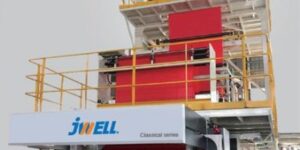
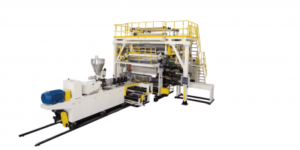
Linija za ekstrudiranje plošč Jwell je kompaktna v zgradbi in vrhunska po zmogljivosti. Vijačni mehanizem in cilinder sta optimizirana v zasnovi in profesionalno obdelana s visoko zmogljivo legirano jeklo, tako da ima celotna proizvodna linija prednosti enakomernega plastificiranja, stabilnega ekstrudiranja in dolge življenjske dobe.
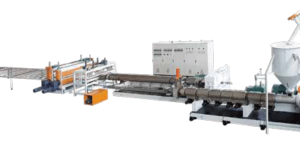
Linija za ekstrudiranje folij je proizvodni proces, ki izdeluje plastične folije z uporabo ekstruderja. Proces se začne s peletiranjem plastične surovine, ki se nato vloži v ekstruder. Material se nato stopi, filtrira in potisne skozi matrico, da nastane neprekinjena folija. Folijo nato ohladijo, sploščijo in zvijejo na kolute za nadaljnjo obdelavo ali pakiranje. Linija za ekstrudiranje folij se uporablja za izdelavo različnih plastičnih folij, kot so LDPE, HDPE, PVC, PP folija itd., ki se široko uporabljajo v embalaži, kmetijstvu, gradbeništvu in drugih panogah.
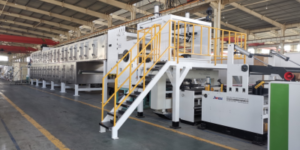
Linija za ekstrudiranje tal je priljubljen izdelek strojne opreme jwell; uporablja ekstruderje za proizvodnjo neprekinjenih in enakomernih plošč iz plastike, PVC-ja ali drugih materialov, ki se nato oblikujejo v različne vrste talnih izdelkov, kot so ploščice, deske ali zvitki. Postopek vključuje tališče surovin v ekstruderju in njihovo potiskanje skozi matrico, ki določa končno obliko in velikost izdelka. Nastale plošče se nato ohladijo, obrežejo in razrežejo na dolžino preden se pakirajo in odpošljejo strankam.
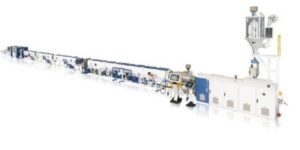
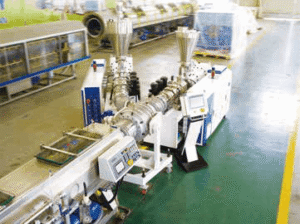
Stroj za iztiskanje cevi PP PPR PE PVC je lahko enovijačni ekstruder ali dvovijačni ekstruder.
Ekstruder z enim vijakom prenaša materiale s trenjem, njegov učinek taljenja in plastificiranja pa ni tako dober kot pri ekstruderju z dvema vijakoma, vendar so stroški zelo nizki.
Trenutno se polietilenske in polipropilenske pelete običajno oblikuje z enosukovnimi ekstruderji. Večina vijakov ni običajnih tridelnih vijakov s polnim navojem, temveč so vijaku dodani mešalni elementi, da se poveča učinek mešanja in plastificiranja.
Surovina polivinilklorida je v obliki prahu. Če se proizvaja z enovijačnim ekstruderjem, ga je treba predhodno zmešati in granulirati, kar podaljša proizvodni proces.
Zato se pri sedanji proizvodnji PVC v prahu za mešanje in oblikovanje neposredno uporablja konusni dvovijačni ekstruder. Pri načrtovanju ali izbiri vijaka za stroj za iztiskanje PVC cevi je treba pri njegovi strukturi in parametrih upoštevati toplotno občutljivost PVC (zlasti togega PVC).
Jwell Pipe Extrusion Line is able be easily controlled. With stable performance, pipelines can keep high efficient output capacity. Further, that PP PPR PE PVC pipe extruder machine’s long service life is also the reason that you can trust Jwell.
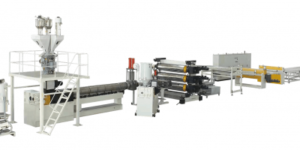
Linija za ekstrudiranje plošč vključuje dovodnik, ekstruder, kalup, kalibrator s tremi valji, nosilno ogrodje za hlajenje, napravo za obrezovanje, traktor, laminacijsko napravo, napravo za viseče folije, rezalni stroj, transportni pas, manipulator in regulator temperature valja.
Izdelki od ekstruzijskega formiranja do obdelave končnih izdelkov in zbiranja se avtomatsko zaključijo v eni liniji, z visoko proizvodno učinkovitostjo, zelo malo ročnega dela ter hitrim in stabilnim oblikovanjem plošč.
7、Linija za iztiskanje profilov
Linija za ekstrudiranje profilov Jwell uporablja surovino za izdelavo visokokakovostnih ekstrudiranih izdelkov, ki se uporabljajo za podporo gradbeništvu, talnim oblogam ali igralni industriji.
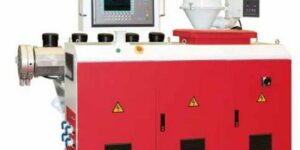
Linija za ekstrudiranje palic JWELL je učinkovita, prilagodljiva in energetsko varčna napredna oprema, ki uporablja postopek ekstruzije za izdelavo različnih vrst plastičnih izdelkov, vključno s cevmi, ploščami in profili. Njene značilnosti vključujejo visoko hitrost proizvodnje, raznoliko prilagodljivost izdelkov, natančne krmilne sisteme ter energetsko varčne in okolju prijazne funkcije. Široko se uporablja na področju proizvodnje plastičnih izdelkov, kar strankam prinaša velike gospodarske koristi in je idealna izbira proizvodne opreme.
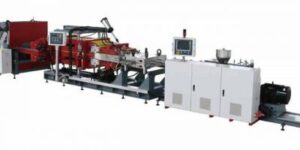
9、Linija za iztiskanje pločevine
A sheet extrusion line includes an extruder (double or single screw), outfitted with a screen changer plus a gear pump, followed closely with a static mixer (occasionally feeding a coextrusion feed block that’s preceded by one or more added extruders sets as explained previously ), feeding a level sheet expire.
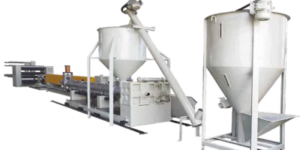
How does an extruder work?
The working process of an extruder mainly includes feeding, plasticizing, melting, compression, metering, molding and other links, which are usually completed by the following core components:
Hopper: The raw materials enter the equipment from here;
Vijak: Rotates under the drive of the motor, pushes the material forward and melts it under heat;
Sodček: Provides wrapping space for the screw and is equipped with a heating system;
Heating zone and cooling system: Control the temperature in sections to ensure stable processing of materials;
Die: Determines the shape of the product;
Traction device, cooling device: Assists in product shaping and output.
The principle of extrusion is to heat and melt the thermoplastic material under pressure, and continuously extrude and mold it, which can achieve efficient and large-scale production.
Extruder process flow
The following table shows the standard process flow of general plastic extrusion processing:
Raw material preparation: material drying, premixing, and impurity removal
Feeding: Put the raw materials into the hopper
Screw feeding and heating: Push and gradually heat to the set temperature through the screw
Melting and mixing: The material is fully melted and mixed evenly at high temperature
Metering and compression: Control the output to ensure product consistency
Mold forming: Press out the product shape through the mold, such as film, pipe, granules, etc.
Cooling and traction: Use air cooling, water cooling or vacuum cooling system for rapid shaping
Cutting and winding: The product is cut or wound according to specifications
The entire process is highly automated and suitable for manufacturing scenarios with strong continuity.
What does the extruder do?
The core functions of the extruder are as follows:
Material melting and plasticization: With the help of screw shearing and electric heating functions, solid materials are transformed into processable melts;
Material transportation and homogenization: High-efficiency continuous advancement, while mixing different components of raw materials;
Pressure construction: Increasing pressure through the metering section allows the melt to pass through the mold smoothly;
Continuous molding: Different mold structures determine the final shape of the product, such as diaphragms, pipes, sheets, etc.;
Control stability: The consistency of product quality can be controlled by parameter settings (temperature, pressure, speed).
In short, the extruder is the “core processing engine” that converts raw materials into functional end products.
How to remove consumables from the extruder?
When replacing consumables or maintenance, residual materials need to be removed from the extruder. The following are the general steps:
Stop feeding: turn off the hopper feed;
Empty the raw materials: continue to run the screw to push out the remaining raw materials in the barrel;
Add purging compound: special purging compound helps dissolve the residue;
Run idly for a few minutes: let the purging compound fully contact the entire screw and barrel;
Remove the die head (if necessary) :for physical cleaning;
Wait for cooling: After the temperature drops to a safe range, clean the residue manually.
Precautions:
Wear protective gloves and goggles during operation;
Avoid disassembling the mold when the screw is not stopped;
Some high-temperature materials such as PVC and PBT need to be cleaned by professionals to prevent poisoning or corrosion.
Main application areas of extruders
Extruders are widely used in the molding and processing of various raw materials. The following are the main areas:
Plastic processing: continuous products such as pipes, profiles, plates, films, cable sheaths, etc.
Packaging material manufacturing: multi-layer co-extruded films, shrink films, foam materials, heat-sealed films, etc.
Prehrambena industrija: noodles, puffed food, pet feed, energy bars, etc.
Rubber and seal manufacturing: automotive rubber strips, O-rings, shock-absorbing pads
Medical materials and consumables: medical hoses, catheters, infusion tubes, experimental consumables
Metal extrusion: aluminum profiles, copper tubes, alloy plates
3D printing consumables: preparation of wires such as PLA/ABS/TPU
Environmentally friendly materials: biodegradable films, EVA solar films, recycled plastic granulation
Comparative analysis of different types of extruders
| Production Line Type | Main Material | Final Product | Glavne lastnosti | Tipične aplikacije | Die Structure |
| Linija za iztiskanje pihane folije | LDPE, LLDPE, HDPE, EVA | Plastic films | Film is blown vertically by air ring; high transparency possible | Packaging, agricultural film, bags | Circular blown die |
| Linija za iztiskanje pločevine | PP, PS, PET, ABS | Sheets (1–10mm thickness) | Uniform thickness, wide format possible | Packaging trays, folders, signage | Flat T-die |
| Cast Film Extrusion Line | PP, PE, CPP, BOPP | Thin plastic films | Fast cooling, high gloss and clarity | Food packaging, stretch film, protective film | Flat die + chill roll |
| Flooring Extrusion Line | PVC, SPC, WPC, PP | Flooring panels (multi-layer) | Rigid, multilayer co-extrusion | Vinyl flooring, laminate floors, click floors | Complex die + calender rollers |
| Linija za iztiskanje cevi | PVC, PE, PPR, PEX | Pipes/tubes (Ø5–1000mm) | Stable pressure, sizing sleeve cooling | Water pipes, gas pipes, conduit systems | Pipe die + vacuum tank |
| Linija za iztiskanje profilov | PVC, ABS, ASA, WPC | Complex cross-section profiles | Customizable mold shapes, continuous profile | Window frames, cable ducts, wall panels | Profile die |
| Linija za iztiskanje palic | Nylon, PTFE, PP, POM | Solid plastic rods | Compact structure, used in CNC machining | Industrial parts, gears, sealing rods | Circular or annular die |
| Linija za iztiskanje plošč | HDPE, UHMWPE, PP | Thick plates (10–60mm) | High rigidity, used in heavy industries | Chemical tanks, cutting boards, liners | Wide flat die + 3-roll stack |
| Sheet (Thin) Extrusion Line | PETG, PVC, PS | Thin sheets (0.2–2mm) | Fast production, ideal for thermoforming | Display covers, blister packaging | Flat die + cooling rolls |
Zaključek
As a key equipment for continuous, efficient and automated material forming in modern industry, extruder has been widely used in many industries. It is not only the main equipment in the plastics industry, but also plays an important role in food, medical, rubber, metal and even environmental protection.
When choosing an extruder, enterprises should consider the selection based on factors such as raw material type, target product form, output demand, budget range, etc. At the same time, in order to ensure efficient operation of the equipment and extend its service life, it is necessary to combine scientific operating procedures and regular maintenance strategies.
With the development of new materials and the upgrading of intelligent manufacturing, extrusion technology in the future will tend to be highly intelligent, highly integrated, energy-saving and environmentally friendly, and multi-functional, which will further promote the evolution of the industry.



 English
  Russian
  Spanish
  Arabic
  German
  French
  Persian
  Turkish
  Bulgarian
  Czech
Czech  Dutch
Dutch  Greek
Greek  Indonesian
  Japanese
  Korean
  Polish
  Portuguese
  Romanian
  Slovenian
  Ukrainian