
Suzhou Jwell Machinery Co., Ltd. is a large-scale plastic extrusion machinery manufacturer in China. The company produces more than 2,000 advanced extrusion production lines each year. Its products are exported to all over the world, including Germany, the United States, Japan, Spain and other developed countries. Today, we will introduce Suzhou Jwell Machinery’s extruder products in detail. If you are interested, let’s learn about it together!
O que é uma extrusora?
An extruder is a mechanical device that continuously transports, melts and extrudes raw materials (such as plastics, metals, foods, etc.) from a mold by heating, pressurizing, shearing and pushing. It is widely used in plastic processing, rubber molding, food manufacturing, metal molding, cable coating and other fields.
In the plastics industry, extruders are key equipment for the production of sheets, films, pipes, profiles, hollow products, granular materials and other products. Due to its advantages of high degree of automation, large output, strong continuity and strong customizability, it has become an indispensable core equipment in modern manufacturing.
Jwell Extruder Introduction
1、Linha de extrusão de película soprada
A Linha de Extrusão de Filme Sopro é um equipamento de fabricação especialmente projetado para produzir filmes plásticos. O processo de utilização de uma máquina de filme sopro para fabricar filmes plásticos envolve derreter pelotas de resina plástica e extrudi-las através de uma matriz circular, formando um tubo de plástico fundido. Esse tubo é inflado, expandindo-se como um balão até atingir um tamanho e espessura específicos. Quando esfria, é achatado e enrolado em rolos. Esse processo é chamado de extrusão de filme sopro e é utilizado para produzir filmes plásticos de espessura e qualidade consistentes.
A Linha de Extrusão de Filme Sopro desempenha um papel fundamental na produção de filmes plásticos, cuidando de todo o processo, desde a fusão da resina plástica até o enrolamento do produto acabado em rolos. Esta máquina possui vários componentes-chave, incluindo a extrusora, a matriz, o anel de gás, o rolo de pressão e o bobinador. Cada componente é projetado para desempenhar uma função específica, como aquecer e fundir a resina plástica, moldar e resfriar o plástico fundido em um tubo e enrolar o filme plástico acabado em rolos.
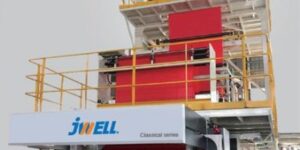
A linha de extrusão de placas Jwell possui uma estrutura compacta e desempenho superior. O parafuso e o cilindro são otimizados em design e processados profissionalmente com aço-liga de alto desempenho, garantindo que toda a linha de produção apresente as vantagens de plastificação uniforme, extrusão estável e longa vida útil.
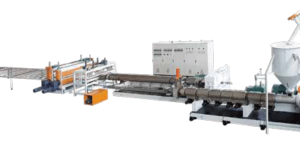
3、Linha de extrusão de película
Uma linha de extrusão de filmes é um processo de fabricação que produz filmes plásticos utilizando uma extrusora. O processo começa com a peletização da matéria-prima plástica, que é então alimentada em uma extrusora. O material é posteriormente fundido, filtrado e forçado através de uma matriz para formar um filme contínuo. Em seguida, o filme é resfriado, alisado e enrolado em rolos para posterior processamento ou embalagem. A linha de extrusão de filmes é utilizada para produzir diversos tipos de filmes plásticos, como LDPE, HDPE, PVC, filme de PP, entre outros, amplamente empregados em embalagens, agricultura, construção civil e outras indústrias.
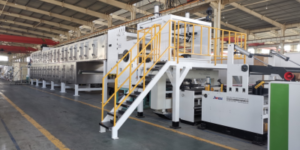
4、Linha de extrusão de pavimentos
A linha de extrusão para pisos é um produto popular da maquinaria jwell; ela utiliza extrusoras para produzir folhas contínuas e uniformes de plástico, PVC ou outros materiais, que são posteriormente moldadas em diversos tipos de produtos para pisos, como ladrilhos, tábuas ou rolos. O processo envolve derreter a matéria-prima numa extrusora e empurrá-la através de uma matriz que determina a forma e o tamanho finais do produto. As placas resultantes são então resfriadas, aparadas e cortadas no comprimento adequado antes de serem embaladas e enviadas aos clientes.
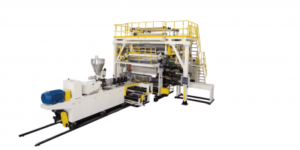
A máquina extrusora de tubos PP PPR PE PVC pode ser uma extrusora de parafuso único ou uma extrusora de parafuso duplo.
A extrusora de parafuso único transporta os materiais por fricção, e o seu efeito de fusão e plastificação não é tão bom como o da extrusora de parafuso duplo, mas o custo é muito baixo.
Atualmente, os granulados de polietileno e de polipropileno são geralmente formados por extrusoras de parafuso único. A maioria dos parafusos não são parafusos convencionais de três secções de rosca completa, mas são adicionados elementos de mistura ao parafuso para melhorar o efeito de mistura e plastificação.
A matéria-prima do cloreto de polivinilo apresenta-se sob a forma de pó. Se for produzido por uma extrusora de parafuso único, tem de ser misturado e granulado previamente, o que aumenta o processo de produção.
Por conseguinte, a atual produção de pó de PVC utiliza diretamente uma extrusora cónica de duplo parafuso para a mistura e a moldagem. Ao conceber ou selecionar o parafuso de extrusão para a máquina de extrusão de tubos de PVC, a sua estrutura e parâmetros devem ter em conta o desempenho sensível ao calor do PVC (especialmente o PVC rígido).
Jwell Pipe Extrusion Line is able be easily controlled. With stable performance, pipelines can keep high efficient output capacity. Further, that PP PPR PE PVC pipe extruder machine’s long service life is also the reason that you can trust Jwell.
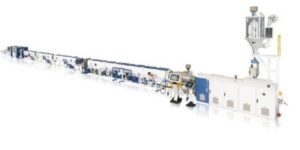
A linha de extrusão de chapas inclui alimentador, extrusora, molde, calandra de três rolos, suporte de resfriamento, dispositivo de aparagem, trator, dispositivo de laminação, dispositivo de suspensão de filme, máquina de corte, transportador, manipulador e controlador de temperatura dos rolos.
Os produtos desde a moldagem por extrusão até o processamento e a coleta dos produtos acabados são concluídos automaticamente em uma única linha, com alta eficiência produtiva, muito pouca utilização manual e formação rápida e estável das chapas.
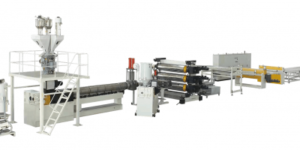
A linha de extrusão de perfil Jwell usa a matéria-prima para fabricar produtos extrudados de alta qualidade, que são usados para apoiar a construção, piso ou indústria de jogos.
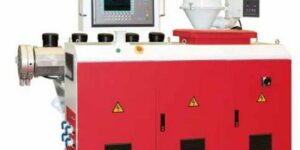
A linha de extrusão de hastes JWELL é um equipamento avançado, eficiente, flexível e economizador de energia que utiliza o processo de extrusão para fabricar diversos tipos de produtos plásticos, incluindo tubos, chapas e perfis. Suas características incluem capacidade de produção em alta velocidade, adaptabilidade diversificada aos produtos, sistemas de controle precisos e recursos econômicos e ambientalmente amigáveis. É amplamente utilizada no setor de produção de produtos plásticos, gerando benefícios econômicos significativos para os clientes e constituindo uma escolha ideal de equipamento de produção.
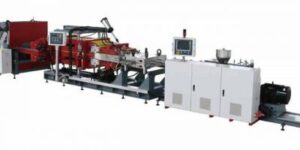
A sheet extrusion line includes an extruder (double or single screw), outfitted with a screen changer plus a gear pump, followed closely with a static mixer (occasionally feeding a coextrusion feed block that’s preceded by one or more added extruders sets as explained previously ), feeding a level sheet expire.
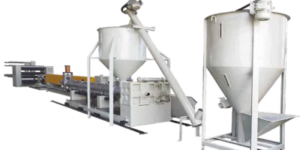
How does an extruder work?
The working process of an extruder mainly includes feeding, plasticizing, melting, compression, metering, molding and other links, which are usually completed by the following core components:
Hopper: The raw materials enter the equipment from here;
Parafuso: Rotates under the drive of the motor, pushes the material forward and melts it under heat;
Cilindro: Provides wrapping space for the screw and is equipped with a heating system;
Heating zone and cooling system: Control the temperature in sections to ensure stable processing of materials;
Die: Determines the shape of the product;
Traction device, cooling device: Assists in product shaping and output.
The principle of extrusion is to heat and melt the thermoplastic material under pressure, and continuously extrude and mold it, which can achieve efficient and large-scale production.
Extruder process flow
The following table shows the standard process flow of general plastic extrusion processing:
Raw material preparation: material drying, premixing, and impurity removal
Feeding: Put the raw materials into the hopper
Screw feeding and heating: Push and gradually heat to the set temperature through the screw
Melting and mixing: The material is fully melted and mixed evenly at high temperature
Metering and compression: Control the output to ensure product consistency
Mold forming: Press out the product shape through the mold, such as film, pipe, granules, etc.
Cooling and traction: Use air cooling, water cooling or vacuum cooling system for rapid shaping
Cutting and winding: The product is cut or wound according to specifications
The entire process is highly automated and suitable for manufacturing scenarios with strong continuity.
What does the extruder do?
The core functions of the extruder are as follows:
Material melting and plasticization: With the help of screw shearing and electric heating functions, solid materials are transformed into processable melts;
Material transportation and homogenization: High-efficiency continuous advancement, while mixing different components of raw materials;
Pressure construction: Increasing pressure through the metering section allows the melt to pass through the mold smoothly;
Continuous molding: Different mold structures determine the final shape of the product, such as diaphragms, pipes, sheets, etc.;
Control stability: The consistency of product quality can be controlled by parameter settings (temperature, pressure, speed).
In short, the extruder is the “core processing engine” that converts raw materials into functional end products.
How to remove consumables from the extruder?
When replacing consumables or maintenance, residual materials need to be removed from the extruder. The following are the general steps:
Stop feeding: turn off the hopper feed;
Empty the raw materials: continue to run the screw to push out the remaining raw materials in the barrel;
Add purging compound: special purging compound helps dissolve the residue;
Run idly for a few minutes: let the purging compound fully contact the entire screw and barrel;
Remove the die head (if necessary) :for physical cleaning;
Wait for cooling: After the temperature drops to a safe range, clean the residue manually.
Precautions:
Wear protective gloves and goggles during operation;
Avoid disassembling the mold when the screw is not stopped;
Some high-temperature materials such as PVC and PBT need to be cleaned by professionals to prevent poisoning or corrosion.
Main application areas of extruders
Extruders are widely used in the molding and processing of various raw materials. The following are the main areas:
Plastic processing: continuous products such as pipes, profiles, plates, films, cable sheaths, etc.
Packaging material manufacturing: multi-layer co-extruded films, shrink films, foam materials, heat-sealed films, etc.
Indústria alimentícia: noodles, puffed food, pet feed, energy bars, etc.
Rubber and seal manufacturing: automotive rubber strips, O-rings, shock-absorbing pads
Medical materials and consumables: medical hoses, catheters, infusion tubes, experimental consumables
Metal extrusion: aluminum profiles, copper tubes, alloy plates
3D printing consumables: preparation of wires such as PLA/ABS/TPU
Environmentally friendly materials: biodegradable films, EVA solar films, recycled plastic granulation
Comparative analysis of different types of extruders
| Production Line Type | Main Material | Final Product | Caraterísticas principais | Aplicações Típicas | Die Structure |
| Linha de extrusão de película soprada | LDPE, LLDPE, HDPE, EVA | Plastic films | Film is blown vertically by air ring; high transparency possible | Packaging, agricultural film, bags | Circular blown die |
| Linha de extrusão de chapa | PP, PS, PET, ABS | Sheets (1–10mm thickness) | Uniform thickness, wide format possible | Packaging trays, folders, signage | Flat T-die |
| Cast Film Extrusion Line | PP, PE, CPP, BOPP | Thin plastic films | Fast cooling, high gloss and clarity | Food packaging, stretch film, protective film | Flat die + chill roll |
| Flooring Extrusion Line | PVC, SPC, WPC, PP | Flooring panels (multi-layer) | Rigid, multilayer co-extrusion | Vinyl flooring, laminate floors, click floors | Complex die + calender rollers |
| Linha de extrusão de tubos | PVC, PE, PPR, PEX | Pipes/tubes (Ø5–1000mm) | Stable pressure, sizing sleeve cooling | Water pipes, gas pipes, conduit systems | Pipe die + vacuum tank |
| Linha de extrusão de perfis | PVC, ABS, ASA, WPC | Complex cross-section profiles | Customizable mold shapes, continuous profile | Window frames, cable ducts, wall panels | Profile die |
| Linha de Extrusão de Hastes | Nylon, PTFE, PP, POM | Solid plastic rods | Compact structure, used in CNC machining | Industrial parts, gears, sealing rods | Circular or annular die |
| Linha de Extrusão de Chapas | HDPE, UHMWPE, PP | Thick plates (10–60mm) | High rigidity, used in heavy industries | Chemical tanks, cutting boards, liners | Wide flat die + 3-roll stack |
| Sheet (Thin) Extrusion Line | PETG, PVC, PS | Thin sheets (0.2–2mm) | Fast production, ideal for thermoforming | Display covers, blister packaging | Flat die + cooling rolls |
Conclusão
As a key equipment for continuous, efficient and automated material forming in modern industry, extruder has been widely used in many industries. It is not only the main equipment in the plastics industry, but also plays an important role in food, medical, rubber, metal and even environmental protection.
When choosing an extruder, enterprises should consider the selection based on factors such as raw material type, target product form, output demand, budget range, etc. At the same time, in order to ensure efficient operation of the equipment and extend its service life, it is necessary to combine scientific operating procedures and regular maintenance strategies.
With the development of new materials and the upgrading of intelligent manufacturing, extrusion technology in the future will tend to be highly intelligent, highly integrated, energy-saving and environmentally friendly, and multi-functional, which will further promote the evolution of the industry.


 English
  Russian
  Spanish
  Arabic
  German
  French
  Persian
  Turkish
  Bulgarian
  Czech
Czech  Dutch
Dutch  Greek
Greek  Indonesian
  Japanese
  Korean
  Polish
  Portuguese
  Romanian
  Slovenian
  Ukrainian