
Abstract
Extrusion technology is a cornerstone of modern manufacturing, widely used across plastics, food processing, pharmaceuticals, and advanced materials engineering.
The extrusion process depends on regulated heat, pressure, and shear forces to convert raw materials into continuous profiles with uniform cross-sections. An extruder machine serves as the core system that facilitates this transformation, combining mechanical conveying, thermal regulation, and die shaping into a single process.
This industry guide for 2026 offers a thorough, technically detailed explanation of the functioning of an Strangpressmaschine, covering its components, operational principles, process parameters, industrial uses, and upcoming innovations.
Introduction: Why Extruder Machines Are Essential in Modern Industry?
In today’s manufacturing landscape, efficiency, scalability, and material consistency are critical drivers of success.
The extruder machine is essential for accomplishing these goals by allowing the ongoing manufacture of materials with accurate shapes and characteristics. Extrusion technology underpins numerous industries, from plastic pipes and films to food items and pharmaceutical substances.
Unlike batch processing methods, extrusion is a continuous process that significantly enhances productivity and minimizes material waste.
As industries move toward automation and sustainability, the significance of extruder machines keeps increasing, making them essential in both traditional and emerging manufacturing sectors.
What Is an Extruder Machine?
An extruder machine is a mechanical system designed to process raw materials—typically in the form of pellets, powders, or granules—by melting, mixing, and forcing them through a die to create a continuous shape.
Key Functional Characteristics:
- It enables continuous material processing
- It involves controlled heating and melting
- It allows high-pressure material flow
- It provides precise shaping via dies
- It ensures consistent output quality
Jwell extruder machines are widely used in industries such as plastics manufacturing, food processing, and chemical engineering.
Core Components of an Extruder Machine
Understanding how an extruder machine works requires a detailed look at its main components.
Component Breakdown
| Komponente | Funktion |
| Trichter | Feeds raw material into the system |
| Trommel | Houses the screw and provides heating |
| Schraube | Transports, melts, and mixes material |
| Heaters | Control temperature along the barrel |
| Die | Shapes the material into the desired form |
| Drive Motor | Powers the screw rotation |
| Kühlsystem | Solidifies the extruded product |
Each component must operate in harmony to ensure efficient and high-quality extrusion.
How Does an Extruder Machine Work? Step-by-Step Process
- Materialzufuhr
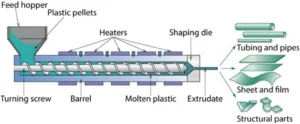
The process starts when raw material enters the hopper. These materials may consist of plastic pellets, food ingredients, or chemical powders. It is essential to control the feeding rate to maintain consistent processing.
- Conveying and Compression
The screw turns inside the barrel, pushing the material ahead. As the material advances, it becomes compressed because the screw channel depth decreases.
- Erhitzen und Schmelzen
External heaters and friction created by the screw increase the material temperature. The material changes from a solid to a molten state, ensuring consistent texture.
- Mischen und Homogenisieren
The screw design facilitates mixing, guaranteeing even distribution of additives, color, and fillers. This stage is essential for maintaining product quality.
- Pressurization and Shaping
The die shapes the molten material as it is pushed through, creating products like pipes, sheets, or films.
- Abkühlung und Erstarrung
Once the material leaves the die, it is cooled with air or water systems to harden and keep its form.
Process Flow Summary Table
| Stage | Beschreibung |
| Feeding | Raw material enters the hopper |
| Conveying | Screw moves material forward |
| Melting | Heat and friction melt the material |
| Mixing | Uniform composition achieved |
| Shaping | Material forced through the die |
| Kühlung | Product solidified |
Types of Extruder Machines
-
Einschneckenextruder
Single-screw extruders are the most common type of extruder machine. They consist of a single rotating screw within a cylindrical barrel that transports, melts, and mixes material before pushing it through a die. This straightforward design is very efficient for processing thermoplastic polymers, basic compounding, and some food products.
Structure and Working Principle:
- A single screw rotates inside a stationary barrel, pushing raw material from the feed hopper toward the die.
- The screw’s geometry, including the feed, compression, and metering zones, regulates material flow, pressure, and melting rate.
- Heat is supplied through barrel heaters, while the screw provides shear and mixing to homogenize the material.
-
Doppelschneckenextruder
These extruder models are fitted with two screws that work in tandem. The two main configurations of twin screw extruders are co-rotating or counter-rotating, the main difference being the direction of the screws’ rotation.
Co-rotating twin screw extruders:
- In a co-rotating twin screw extruder, both screws turn in the same direction, either both clockwise or both counterclockwise.
- This setup is the most common and provides increased flexibility in manufacturing a wide variety of plastic materials.
- Rotation in the same direction helps maintain good contact between the screws, which contributes to improved mixing and consistency in the molten material.
Counter-rotating twin screw extruders:
- In counter-rotating twin screw extruders, the two screws rotate in opposite directions, meaning one turns clockwise and the other counterclockwise.
- This configuration is less common, but it can be advantageous in some specific applications.
- Rotating in opposite directions can enhance the efficiency of the mixing process, aiding in better dispersion of the additives and chemical substances throughout the molten plastic material.
Generally, the decision to use a co-rotating or counter-rotating twin screw extruder depends on the particular needs of the extrusion process and the type of plastic material being manufactured. Each configuration offers its own benefits and drawbacks, and the choice will be influenced by factors such as the material’s viscosity, mixing needs, process temperature, and the desired characteristics of the final product.
-
Ram Extruders
Ram extruders are machines designed to use hydraulic or mechanical pressure to force material through a die. Instead of a screw, a piston (ram) moves the material in separate steps, not in a continuous rotation. This setup is especially beneficial for precisely extruding materials with high viscosity or low melt flow, such as ceramics, metals, and specialty polymers.
Structure and Working Principle:
- The extruder is made up of a material chamber, a hydraulic or mechanical ram, and a die at the exit.
- Material is loaded into the chamber and then pushed through the die by the reciprocating ram.
- Pressure and temperature can be accurately regulated, enabling consistent density and shape in the finished product.
-
Specialty Extruders
These include food extruders, foam extruders, profile extruders, and sheet or film extruders.
Tailored to industry-specific requirements like shaping snacks, foam insulation, or PVC window profiles.
Comparison Table
| Typ | Vorteile | Anwendungen |
| Ein-Schraube | Simple, cost-effective | Plastic pipes, films |
| Twin-Screw | Better mixing, versatility | Compounding, food processing |
| Ram Extruder | High-pressure capability | Specialized materials |
Key Process Parameters
Critical Variables
| Parameter | Impact on Process |
| Temperature | Determines նյութ melting |
| Screw Speed | Affects throughput and mixing |
| Pressure | Influences flow and product quality |
| Aufenthaltsdauer | Affects material properties |
| Cooling Rate | Determines final structure |
Optimizing these parameters is essential for achieving consistent product quality.
Applications of Extruder Machines
JWELL extruder machines are highly versatile industrial devices used to shape and process a wide range of materials. Their applications span multiple industries due to their ability to continuously form complex profiles and maintain consistent material properties.
- Kunststoffindustrie
- Pipe and Profile Extrusion: They produce PVC, PE, and PP pipes, window profiles, and tubing.
- Sheet and Film Extrusion: They manufacture plastic sheets, films, and laminates for packaging and construction.
- Plastic Compounding: Involves blending polymers with additives, colorants, or fillers to achieve desired material properties.
- Rubber and Elastomers
Rubbers and elastomers are processed by extruders for automotive parts, seals, hoses, and gaskets.
This process allows for consistent shape and density in molded and semi-finished products.
- Food Industry
In the food industry, snack and cereal production involves extruding dough, cereal, pasta, and pet food into uniform shapes.
Texturized protein products are created as plant-based meat analogs and other processed foods.
- Chemical and Pharmaceutical Industry
Granulation and Pelletizing involve creating consistent chemical pellets or pharmaceutical tablets.
Encapsulation entails extruding active ingredients to develop controlled-release products.
- Textile and Fiber Industry
Extruders are used to process synthetic fibers such as nylon, polyester, and polypropylene.
They are utilized in yarn production, filament extrusion, and non-woven fabrics.
- Baustoffe
Extrusion of cementitious materials, gypsum profiles, and insulation boards.
It enables precise shapes and high throughput for building applications.
- Recycling and Reprocessing
Plastic and rubber waste can be reprocessed through extrusion into reusable pellets or sheets.
This supports sustainable manufacturing practices by minimizing material waste.
Extruder machines serve as a backbone for industries ranging from plastics, rubber, and textiles to food and pharmaceuticals.
Their ability to produce uniform, complex shapes at high efficiency makes them indispensable for modern manufacturing and processing operations.
Advantages of Extruder Machines
- High Production Efficiency – Continuous processing allows for large-scale and consistent production with high efficiency.
- Präzision und Konsistenz – Maintaining strict control over temperature, pressure, and speed guarantees uniform quality of the product.
- Versatility – It is versatile, capable of handling various materials and creating different shapes with interchangeable dies.
- Kosten-Wirksamkeit – Operational costs are lowered due to minimal labor requirements, decreased material waste, and ongoing operation.
- Enhanced Material Properties – Twin-screw extruders allow for blending, compounding, and the integration of functional additives to improve material properties.
- Automation Compatibility – Modern extruders are compatible with CNC, PLC, and IoT systems, facilitating smart production line integration.
Maintenance and Optimization
- Regular Cleaning and Lubrication
To prevent buildup, contamination, and friction in screws and barrels.
Apply recommended lubricants to bearings, gearboxes, and moving components.
- Inspection of Wear Parts
Check screws, barrels, and dies regularly for signs of wear or erosion to ensure precision.
- Temperature and Pressure Calibration
Calibrate heating zones and cooling systems accurately to avoid material degradation.
- Preventive Maintenance
Scheduled downtime for inspection, replacement of critical components, and realignment extends the lifespan of the machine.
- Process Optimization
Adjust screw speed, feed rate, and die design to boost energy efficiency, minimize material waste, and improve product quality.
Comparison with Other Manufacturing Processes
| Merkmal | Extrusion | Injection Molding |
| Process Type | Continuous | Batch |
| उत्पादन Shape | Continuous profiles | Complex shapes |
| Effizienz | High | Moderate |
| Tooling Cost | Lower | Higher |
Future Trends (2026–2030)
- Smart Extruders and Industry 4.0 Integration
Sensors enabled by IoT for monitoring pressure, temperature, and torque in real time.
AI-assisted process optimization and predictive maintenance decrease downtime.
- Energy-Efficient Designs
Power consumption is reduced through variable-frequency drives, improved barrel insulation, and optimized screw profiles.
- Advanced Materials and Hybrid Extrusion
The ability to process bio-based polymers, recycled plastics, and composite materials.
Multi-material and co-extrusion processes are becoming increasingly common.
- Automation and Robotics Integration
Systems for feeding, extrusion, cutting, and stacking that are fully automated support high-volume production.
- Verbesserte Nachhaltigkeit
Green extrusion solutions will be driven by closed-loop material recycling, waste reduction, and eco-friendly additives.
- Miniaturization for Specialized Applications
Small extruders are used for R&D, laboratory work, or small-batch manufacturing of pharmaceuticals, electronics, and high-value polymers.
Mitmachen in our commitment to a sustainable future. Choose Jwell for solutions that not only meet the requirements of the present but also help actively preserve our planet for future generations.
FAQ: Extruder Machine
- How does an extruder machine work?
It melts raw material and forces it through a die to create continuous shapes.
- What materials can be processed?
Plastics, food, pharmaceuticals, and composites.
- What is the difference between single and twin-screw extruders?
Twin-screw extruders offer better mixing and flexibility.
- Is extrusion energy-intensive?
Yes, but modern systems are becoming more efficient.
- What industries use extruder machines?
Plastics, food, pharmaceutical, and construction industries.
Schlussfolgerung
The extruder machine plays a crucial role in modern manufacturing, allowing for efficient and continuous production in various industries. By understanding how it works, its parts, and process settings, companies can enhance performance, lower expenses, and boost product quality.
As technology advances, extruder machines will continue to evolve, integrating AI, sustainability, and smart manufacturing practices.



 English
  Russian
  Spanish
  Arabic
  German
  French
  Persian
  Turkish
  Bulgarian
  Czech
Czech  Dutch
Dutch  Greek
Greek  Indonesian
  Japanese
  Korean
  Polish
  Portuguese
  Romanian
  Slovenian
  Ukrainian