
Réponse rapide
A machine à film soufflé with internal bubble cooling (IBC) uses a controlled airflow inside the film bubble, in addition to the conventional external air ring. This increases heat removal and improves bubble stability. Research on blown-film heat transfer shows that significant temperature differences can exist between the inner and outer surfaces of the film near the die. Technical references on IBC identify internal cooling as a means of increasing cooling efficiency, supporting higher extrusion rates and improving bubble diameter control. The following discussion draws on the work of Sidiropoulos and Vlachopoulos (Temperature Gradients in Blown Film Bubbles, Advances in Polymer Technology), as well as the Film Extrusion & Conversion Technical Guide.
What Is a Blown Film Machine with IBC?
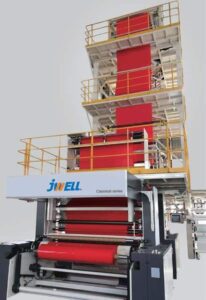
A blown film machine with an IBC (Internal Bubble Cooling) system is a blown film extrusion line equipped with this feature. The basic blown-film process remains the same: polymer pellets are melted in an extruder, pushed through an annular die, inflated into a tubular bubble, cooled, collapsed, and wound into film. The difference is that an IBC system actively manages the air inside the bubble, rather than allowing it to remain stagnant.
In a conventional blown film line, the main cooling action comes from the external air ring positioned around the die. This directs cooling air onto the outer surface of the hot polymer tube, while the air trapped inside the bubble provides comparatively limited heat transfer. An IBC system introduces conditioned or chilled air into the bubble and removes heated internal air. This allows heat to be transferred from both sides of the film. Technical literature describes IBC as a continuous heat-exchange process that brings cooler air into the bubble while removing warmer air from inside it.
This distinction is becoming increasingly important as producers move towards higher output, thinner gauges, wider film, and more demanding thickness tolerances, or polymers that are difficult to stabilise at high production rates. In these conditions, cooling capacity can become a bottleneck before the extruder itself reaches its theoretical output.
How Does a Blown Film Machine with IBC Work?
The easiest way to understand IBC is to follow the material and air through the machine.
Step 1: Polymer Melting and Extrusion
Plastic resin such as LDPE, LLDPE, HDPE, or a suitable blend is fed into the extruder. The screw conveys, melts, mixes, and pressurizes the polymer before delivering a homogeneous melt to the annular die.
At this point, the polymer is hot enough to remain molten and must still be stretched and cooled before it can become a stable film. The die produces a circular tube rather than a flat sheet, and air introduced through the center of the die inflates that tube into the characteristic bubble. The bubble is simultaneously stretched in the machine direction and circumferential direction, affecting final film thickness and molecular orientation.
Step 2: Bubble Formation
After leaving the die, the molten tube is inflated to the required bubble diameter. The blow-up ratio (BUR) determines the relationship between the bubble diameter and the die diameter and has a direct influence on film width and orientation.
The bubble must remain mechanically stable while it is still hot and deformable. Any significant variation in internal pressure, cooling intensity, extrusion output, or haul-off speed can disturb the bubble and eventually appear as film thickness variation, wrinkles, oscillation, or winding problems.
Step 3: External Cooling
The conventional air ring provides cooling to the outer surface. Depending on the machine configuration, this can be a single-lip or dual-lip air ring, with more advanced systems providing more controlled and uniform air distribution.
External cooling remains essential even when IBC is installed. IBC does not replace the air ring; it complements it. The result is a two-sided cooling arrangement in which the outside surface is cooled by the air ring while the inside surface receives controlled cooling air.
Step 4: Internal Bubble Cooling
The IBC system introduces cooling air into the bubble through passages integrated into or around the die assembly. The internal air contacts the hot inner film surface, absorbs heat, and is subsequently removed through an exhaust path.
A typical IBC arrangement therefore needs an air supply, cooling or conditioning equipment, internal distribution components, an exhaust route, and control logic. Some systems use separate supply and exhaust blowers so that the internal bubble environment can be actively regulated.
Step 5: Frost-Line Formation
As the polymer loses heat, it reaches the point at which it transitions from a molten or highly deformable state into a sufficiently solid film. This region is commonly identified by the frost line in many blown-film materials.
Cooling performance directly affects frost-line height. More effective and uniform cooling can allow the polymer to solidify sooner, but simply increasing airflow is not enough; excessive or uneven cooling can disturb the bubble and create new problems.
Step 6: Collapsing and Winding
Once the bubble has cooled sufficiently, it passes through the collapsing frame and nip section, where the tubular film is flattened. The resulting layflat film then travels through downstream equipment such as treatment, thickness measurement, slitting, or winding systems.
The quality of the finished roll therefore depends on everything that happens upstream. A stable IBC system can contribute to a more stable bubble, but it cannot compensate for poor extrusion control, incorrect die alignment, unstable resin feeding, or inadequate downstream tension control.
Why Is IBC Important in Blown Film Extrusion?
The main reason for using IBC is straightforward: the cooling capacity of many blown-film processes limits production speed.
Although film blowing has a high surface-area-to-volume ratio, making air cooling practical, the polymer still needs to release a large amount of heat over a short distance. According to ScienceDirect, the cooling rate can limit film-extrusion speed, and cooling can be assisted by air applied to the inside and outside of the bubble.
The research of Sidiropoulos and Vlachopoulos is particularly relevant as it demonstrated significant temperature gradients across the film thickness near the die exit. They also found that IBC can reduce these temperature differences, although they do not disappear completely under typical production conditions.
This helps to explain why IBC should not simply be viewed as an ‘extra fan’. It alters the thermal conditions under which the bubble is formed and stretched.
Main Advantages of a Blown Film Machine with IBC
- Higher Cooling Efficiency
The most obvious benefit is the increased heat-transfer capacity. Rather than relying solely on the outer surface of the bubble, the process also removes heat from the inner surface.
This is particularly useful when production rates increase, and the polymer spends less time in the cooling zone. IBC can expand the practical operating window of a blown-film line by improving heat removal without necessarily requiring a much taller tower. Technical guides specifically identify internal bubble cooling as a method for increasing both cooling efficiency and production rates.
- Better Bubble Stability
Bubble stability is one of the most important factors in achieving consistent blown film. The bubble diameter, frost-line position, and deformation behaviour are influenced by internal pressure and cooling conditions.
Modern IBC systems use a controlled air supply and exhaust to help maintain the desired bubble conditions. Some systems measure bubble size and automatically adjust the cooling airflow to maintain a consistent layflat width.
However, IBC alone does not guarantee a stable bubble. Polymer rheology, die design, air-ring performance, tower alignment, extrusion stability, and haul-off conditions all remain important factors.
- Potentially Higher Output
If cooling is the production bottleneck, increasing the extruder’s heat-transfer capacity can enable it to operate at a higher throughput while maintaining acceptable bubble stability and film quality.
However, the exact production increase cannot be represented by one universal percentage. This depends on factors such as polymer grade, film thickness, die diameter, bubble uniformity coefficient (BUR), external air ring, melt temperature, cooling-air temperature, machine design, and the original production limit. While technical references report increased output as a major objective of IBC, actual gains should be established through machine trials rather than assumed from a supplier’s headline figure.
- Improved Control of Bubble Diameter
A conventional bubble is partly maintained through internal air pressure. In an IBC system, the internal air is actively circulated, enabling the system to influence the bubble’s thermal conditions and pressure behaviour.
Closed-loop control uses bubble-diameter information to regulate airflow. This is particularly useful in automated production, as operators do not have to rely solely on manual adjustments when operating conditions change.
- Faster Start-Up and Process Changes
IBC can also be useful during start-up. A blown film line must bring the bubble, melt temperature, cooling conditions, and haul-off into a stable operating relationship before producing saleable film.
Active internal cooling can accelerate the removal of heat and help the bubble reach its target condition sooner. Technical descriptions of IBC identify faster start-up as one of the benefits associated with controlled internal cooling and automated bubble-diameter regulation.
Blown Film Machine With IBC vs. Without IBC
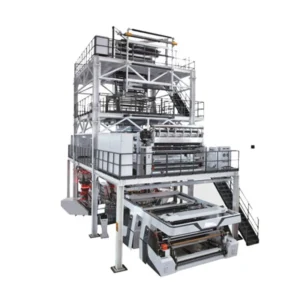
The most useful comparison is not “old machine versus new machine,” but passive internal cooling versus actively controlled internal cooling.
| Fonctionnalité | Blown Film Machine Without IBC | Blown Film Machine With IBC |
| External cooling | Air ring | Air ring |
| Internal bubble cooling | Limited/passive | Active and controlled |
| Heat removal | Primarily from outside | From both outside and inside |
| Bubble control | Mainly through internal pressure and external cooling | Internal airflow, pressure, and thermal conditions can be controlled |
| Cooling capacity | More limited at high output | Higher potential cooling capacity |
| High-speed production | More likely to encounter cooling limits | Better suited to demanding high-output conditions |
| Frost-line control | Mainly external cooling dependent | Can benefit from two-sided cooling |
| Automation potential | Moderate | Higher, especially with bubble-width feedback |
| System complexity | Lower | Higher |
| Investment | Lower | Higher |
| Maintenance | Simpler | Additional blowers, ducts, cooling components, and controls |
| Typical justification | Standard or moderate-output production | High-output, thin-gauge or tighter-control applications |
The comparison does not mean that every film producer needs IBC. If a conventional line already achieves the required output, gauge control, bubble stability, and product quality, adding IBC may not produce enough commercial benefit to justify the additional capital and maintenance requirements.
IBC vs. Conventional External Air Cooling: What Is the Real Difference?
The most significant difference lies in where the cooling action occurs.
In the case of conventional external cooling, the air ring primarily transfers heat away from the outer surface of the bubble. The inner surface is cooled indirectly, as heat conducts through the film towards the outside.
In contrast, with IBC, the inner surface is also exposed to actively moving cooling air. This shortens the effective heat-transfer path and creates a more balanced thermal environment across the film’s thickness. A published study on blown-film temperature gradients supports this mechanism, showing that temperature differences from the inside to the outside are important near the die and that IBC can reduce these gradients.
This distinction is particularly significant for thicker films and high-throughput production. As the amount of heat that must be removed increases, having two cooling surfaces can provide a substantial process advantage.
What Films Are Suitable for IBC?
An IBC can be used with many common blown-film polymers, including LDPE, LLDPE, and HDPE, as well as various multilayer structures. However, the entire machine must be designed around the material and application in question.
LLDPE is of particular interest as its bubble can be more sensitive to disturbances than LDPE. According to a technical guide from Qenos, LLDPE may exhibit vertical oscillations, corkscrew motion, or bubble sagging. The guide identifies internal cooling as a way of improving cooling efficiency and supporting higher output.
Nevertheless, the choice of IBC should be based on the entire process window. Resin rheology, melt strength, die gap, bubble uniformity ratio (BUR), film gauge, cooling temperature, air-ring design, and desired output must all be considered.
This is an even more important consideration for multilayer films because different polymers can have different rheological and thermal characteristics. While a stable cooling system helps, the process must still be tuned to the complete layer structure.
Applications of Blown Film Machines with IBC
A blown film machine with an IBC is particularly useful in situations where production efficiency and film consistency directly impact commercial outcomes.
Les applications typiques incluent :
Packaging film, including shopping bags, garbage bags, food packaging and industrial packaging.
Stretch and protective films, where stable gauge and consistent mechanical properties are important;
Agricultural films, such as greenhouse films, mulch films and silage-related structures.
Heavy-duty industrial films, where relatively high output and controlled thickness are required.
Multilayer barrier films, where process stability across several polymer layers is important.
High-speed, thin-gauge films are used where cooling capacity can become a major production constraint.
The important point is that IBC is not an application-specific technology. Rather, it is a process technology that becomes more valuable when cooling and bubble control are limiting factors.
What Parameters Should Be Controlled?
Installing IBC is only the beginning. Its performance depends on how accurately the system is integrated and controlled.
Key parameters include:
- internal cooling-air temperature;
- internal airflow rate;
- exhaust airflow;
- bubble diameter;
- layflat width;
- frost-line height;
- extruder output;
- melt temperature;
- die temperature;
- air-ring airflow;
- BUR;
- haul-off speed;
- film thickness;
- ambient temperature and humidity
A useful way to approach IBC optimization is to change one variable at a time while monitoring bubble diameter, frost-line behavior, gauge variation, and output. Excessive internal airflow can itself create instability, so “more cooling” should never be treated as automatically better.
Recent technical guidance on bubble stability similarly emphasizes that air volume, internal pressure, extrusion output, cooling performance, haul-off speed, and machine alignment interact with one another.
Does IBC Automatically Improve Film Thickness?
No, while IBC can create conditions that facilitate thickness control, thickness uniformity is the result of the entire extrusion system.
Variation in thickness can originate from non-uniformity in the die gap, unstable melt output, temperature variation, movement of the bubble, improper air-ring alignment, inconsistent resin feeding, fluctuation in the haul-off, or downstream winding conditions.
IBC can help by stabilising the bubble and controlling its thermal behaviour. However, if the die is poorly designed or the extrusion output fluctuates, internal cooling cannot solve the underlying problem.
It is important to understand this distinction when evaluating supplier claims. A statement such as ‘IBC reduces thickness variation’ should be interpreted as indicating potential at a process level, rather than as guaranteeing a specific gauge tolerance independent of the rest of the machine.
Is a Blown Film Machine with IBC Worth the Investment?
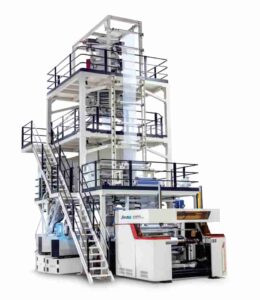
For a low-output line producing standard film with relatively relaxed specifications, the answer may be no. Additional equipment, controls, cooling capacity, installation requirements, and maintenance can increase costs without providing a significant commercial return.
However, for high-output lines, thin films, challenging bubble conditions, demanding thickness tolerances, or operations where waste and downtime are costly, the calculation can be very different. IBC’s value comes from the combined effect of higher usable output, reduced process instability, shorter start-up periods, and more consistent production rather than cooling alone.
Therefore, before purchasing, buyers should request production data based on the actual resin, film thickness, die diameter, BUB, target output, and quality specification. Ideally, a supplier’s test should demonstrate stable production over a meaningful period rather than reporting only a short peak-output run.
How to Choose the Right IBC Blown Film Machine?
A professional machine-selection process should begin with the product rather than the equipment brochure.
First define the target film structure, resin types, thickness range, film width, annual production requirement, acceptable gauge variation, and operating schedule. Then evaluate the extruder, die, air ring, IBC system, automatic gauge control, haul-off, winding system, and automation as one integrated production line.
The IBC itself should be evaluated for airflow capacity, cooling method, temperature control, supply/exhaust configuration, bubble measurement, response time, accessibility, and maintenance requirements. Die compatibility is also critical because IBC airflow passages and exhaust arrangements are integrated into the die design in many systems; retrofitting is therefore not always a simple add-on.
For a new line, it is usually more practical to specify IBC during the original machine and die design than to assume it can easily be added later.
FAQ: Blown Film Machine with IBC
- What is IBC in a blown film machine?
IBC stands for Internal Bubble Cooling and uses controlled air to cool the inside surface of the blown film bubble. It works together with the external air ring to increase overall cooling capacity.
- How does a blown film machine with IBC work?
The system supplies cooling air into the bubble and removes warmer internal air through an exhaust path. This increases heat transfer from the inner film surface while the external air ring continues cooling the outside.
- What are the advantages of IBC in blown film extrusion?
IBC can improve cooling efficiency, bubble control, start-up behavior, and the practical operating window of the extrusion line. It can also support higher output when cooling is the limiting factor.
- Does IBC increase blown film machine output?
IBC can increase output when the existing process is limited by cooling capacity or bubble stability. The actual improvement depends on resin, film thickness, die size, air-ring design, and other operating conditions.
- Is IBC necessary for every blown film machine?
No, a conventional air-cooled line can be sufficient for many standard production requirements. IBC becomes more attractive when higher output, thinner gauges, tighter process control, or difficult bubble behavior justify the additional investment.
- What is the difference between IBC and an air ring?
An air ring cools the outside surface of the blown film bubble. IBC introduces controlled cooling inside the bubble, so the two systems provide complementary external and internal cooling.
Conclusion
A blown film machine with IBC is essentially a conventional blown-film extrusion system that has been enhanced with active internal bubble cooling. Its core value lies not only in its increased air usage, but also in its ability to create a more effective and controllable heat-transfer environment around the molten film bubble.
This technology is particularly valuable when the conventional process is limited by cooling capacity, bubble stability, or production speed. Research into blown-film temperature gradients confirms that the inner and outer surfaces of the film can experience different thermal conditions near the die. Established technical references also identify IBC as a practical way to improve internal cooling and support higher production rates.
However, for manufacturers, IBC should be evaluated as part of the complete blown film line rather than as an isolated upgrade. The final result is influenced by the die, extruder, air ring, cooling system, bubble-control system, haul-off, resin properties, film thickness, and downstream equipment. When these components are properly matched, an IBC-equipped blown film machine can provide a wider and more stable processing window for high-output film production.



 English
 Russian
 Spanish
 Arabic
 German
 French
 Persian
 Turkish
 Bulgarian
 Czech
 Dutch
 Greek
 Indonesian
 Japanese
 Korean
 Polish
 Portuguese
 Romanian
 Slovenian
 Ukrainian