Suzhou Jwell Machinery Co, Ltd. is a large-scale plastic extrusion machinery manufacturer in China. The company produces more than 2,000 advanced extrusion production lines each year. Its products are exported to all over the world, including Germany, the United States, Japan, Spain and other developed countries. Today, we will introduce Suzhou Jwell Machinery’s extruder products in detail. If you are interested, let’s learn about it together!
Co to jest ekstruder?
An extruder is a mechanical device that continuously transports, melts and extrudes raw materials (such as plastics, metals, foods, etc.) from a mold by heating, pressurizing, shearing and pushing. It is widely used in plastic processing, rubber molding, food manufacturing, metal molding, cable coating and other fields.
In the plastics industry, extruders are key equipment for the production of sheets, films, pipes, profiles, hollow products, granular materials and other products. Due to its advantages of high degree of automation, large output, strong continuity and strong customizability, it has become an indispensable core equipment in modern manufacturing.
Jwell Extruder Introduction
1、Linia do wytłaczania folii rozdmuchiwanej
Linia do wytłaczania folii nadmuchowej to urządzenie produkcyjne specjalnie zaprojektowane do wytwarzania folii plastycznych. Proces wykorzystania maszyny do wytłaczania folii nadmuchowej do produkcji folii plastycznych obejmuje topienie granulatów żywicy plastycznej i wytłaczanie ich przez formę okrągłą w postaci rozpuszczonego rury z tworzywa sztucznego. Ta rura jest napompowywana, nabierając kształtu balonu o określonej wielkości i grubości. Kiedy ochłodzi się, zostaje spłaszczona i zwinięta w rolkę. Ten proces nazywa się wytłaczaniem folii nadmuchowej i służy do wytwarzania folii plastycznych o stałej grubości i jakości.
Linia do wytłaczania folii nadmuchowej odgrywa kluczową rolę w produkcji folii plastycznych, odpowiadając za cały proces – od topienia żywicy plastycznej po zwijanie gotowego produktu w rolki. Maszyna ta posiada kilka kluczowych komponentów, w tym ekstruder, formę, pierścień gazowy, wałek dociskowy i nawijarkę. Każdy z tych komponentów został zaprojektowany tak, by spełniać konkretną funkcję, np. ogrzewanie i topienie żywicy plastycznej, formowanie i chłodzenie stopionego tworzywa sztucznego w rurę oraz zwijanie gotowej folii plastycznej w rolki.
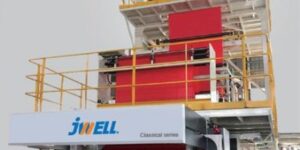
Linia do wytłaczania płyt Jwell jest kompaktowa w konstrukcji i przewyższa inne pod względem wydajności. Śruba i cylindry są optymalizowane pod względem projektu i profesjonalnie obrabiane ze stali stopowej o wysokiej wytrzymałości, dzięki czemu cała linia produkcyjna charakteryzuje się równomiernej plastycyzacją, stabilnym wytłaczaniu i długą żywotnością.
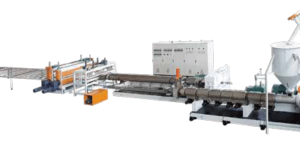
Linia do wytłaczania folii to proces produkcyjny, który produkuje folie plastikowe za pomocą ekstrudera. Proces rozpoczyna się od granulowania surowca plastycznego, który następnie wprowadza się do ekstrudera. Następnie materiał zostaje roztopiony, filtrowany i wypychany przez formę, tworząc ciągłą folię. Później folia jest chłodzona, spłaszczana i nawijana na role do dalszej obróbki lub pakowania. Linia do wytłaczania folii służy do produkcji różnych folii plastikowych, takich jak folia LDPE, HDPE, PVC, PP itp., które są szeroko stosowane w opakowaniach, rolnictwie, budownictwie i innych branżach.
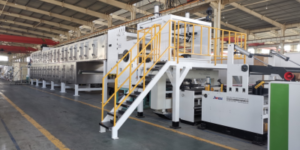
Linia do wytłaczania podłóg to popularny produkt maszyn jwell; wykorzystuje ekstruderzy do produkcji ciągłych i jednorodnych arkuszy z tworzyw sztucznych, PVC lub innych materiałów, które następnie są formowane w różnego rodzaju produkty podłogowe, takie jak płytki, deski czy role. Proces obejmuje stopienie surowca w ekstruderze i przepchnięcie go przez matrycę, która określa ostateczny kształt i rozmiar produktu. Powstałe płyty są następnie chłodzone, obrabiane i cięte na długości przed pakowaniem i wysyłką klientom.
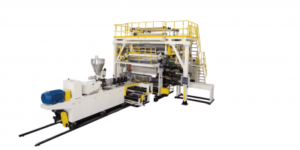
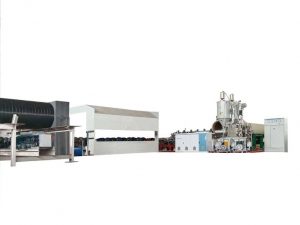
Wytłaczarka do rur PP PPR PE PVC może być wytłaczarką jednoślimakową lub wytłaczarką dwuślimakową.
Wytłaczarka jednoślimakowa przenosi materiały przez tarcie, a jej efekt topienia i plastyfikacji nie jest tak dobry jak w przypadku wytłaczarki dwuślimakowej, ale jej koszt jest bardzo niski.
Obecnie granulki polietylenu i polipropylenu są zazwyczaj formowane za pomocą wytłaczarek jednoślimakowych. Większość ślimaków nie jest konwencjonalnymi trzyczęściowymi ślimakami z pełnym gwintem, ale elementy mieszające są dodawane do ślimaka w celu zwiększenia efektu mieszania i plastyfikacji.
Surowiec polichlorku winylu ma postać proszku. Jeśli jest produkowany przez wytłaczarkę jednoślimakową, musi być wcześniej mieszany i granulowany, co wydłuża proces produkcji.
Dlatego obecna produkcja proszku PVC bezpośrednio wykorzystuje stożkową wytłaczarkę dwuślimakową do mieszania i formowania. Projektując lub wybierając ślimak wytłaczarki do wytłaczarki rur PVC, jego struktura i parametry powinny uwzględniać wrażliwość na ciepło PVC (zwłaszcza sztywnego PVC).
Jwell Pipe Extrusion Line is able be easily controlled. With stable performance, pipelines can keep high efficient output capacity. Further, that PP PPR PE PVC pipe extruder machine’s long service life is also the reason that you can trust Jwell.
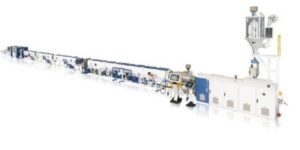
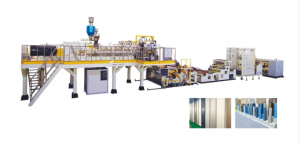
Linia do wytłaczania płyt zawiera podajnik, ekstruder, formę, trzypasmowy kalendarz, stojak chłodzący, urządzenie do obróbki krawędzi, ciągnik, urządzenie do laminowania, urządzenie do wieszania folii, maszynę do cięcia, przenośnik, manipulator oraz kontroler temperatury rolki.
Produkty od wytłaczania przez przetwórstwo gotowych wyrobów aż po ich zbieranie są realizowane automatycznie w jednej linii, z wysoką wydajnością produkcyjną, minimalnym udziałem ręcznego działania oraz szybkim i stabilnym formowaniem arkuszy.
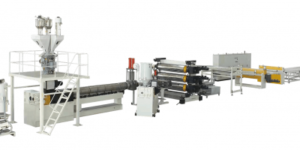
7、Linia do wytłaczania profili
Jwell profile extrusion lineuses the raw material to manufacture high-quality extruded products, which are used to support building, floor, or play industry.
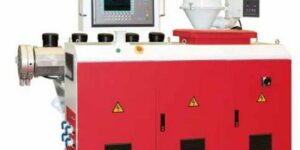
Linia do wytłaczania prętów JWELL to wydajne, elastyczne i energooszczędne zaawansowane urządzenie, które wykorzystuje proces wytłaczania do produkcji różnego rodzaju wyrobów z tworzyw sztucznych, w tym rur, płyt i profili. Jej cechami są wysoka szybkość produkcji, różnorodność możliwości dostosowania do różnych produktów, precyzyjne systemy sterowania oraz funkcje oszczędzające energię i przyjazne dla środowiska. Jest ona powszechnie stosowana w dziedzinie produkcji wyrobów z tworzyw sztucznych, przynosząc klientom znaczące korzyści ekonomiczne i stanowiąc idealny wybór sprzętu produkcyjnego.
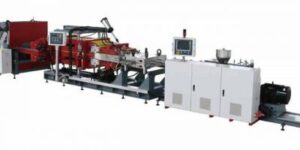
9、Linia do wytłaczania arkuszy
A sheet extrusion line includes an extruder (double or single screw), outfitted with a screen changer plus a gear pump, followed closely with a static mixer (occasionally feeding a coextrusion feed block that’s preceded by one or more added extruders sets as explained previously ), feeding a level sheet expire.
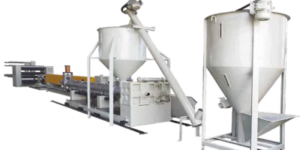
How does an extruder work?
The working process of an extruder mainly includes feeding, plasticizing, melting, compression, metering, molding and other links, which are usually completed by the following core components:
Hopper: The raw materials enter the equipment from here;
Śruba: Rotates under the drive of the motor, pushes the material forward and melts it under heat;
Barrel: Provides wrapping space for the screw and is equipped with a heating system;
Heating zone and cooling system: Control the temperature in sections to ensure stable processing of materials;
Die: Determines the shape of the product;
Traction device, cooling device: Assists in product shaping and output.
The principle of extrusion is to heat and melt the thermoplastic material under pressure, and continuously extrude and mold it, which can achieve efficient and large-scale production.
Extruder process flow
The following table shows the standard process flow of general plastic extrusion processing:
Raw material preparation: material drying, premixing, and impurity removal
Feeding: Put the raw materials into the hopper
Screw feeding and heating: Push and gradually heat to the set temperature through the screw
Melting and mixing: The material is fully melted and mixed evenly at high temperature
Metering and compression: Control the output to ensure product consistency
Mold forming: Press out the product shape through the mold, such as film, pipe, granules, etc.
Cooling and traction: Use air cooling, water cooling or vacuum cooling system for rapid shaping
Cutting and winding: The product is cut or wound according to specifications
The entire process is highly automated and suitable for manufacturing scenarios with strong continuity.
What does the extruder do?
The core functions of the extruder are as follows:
Material melting and plasticization: With the help of screw shearing and electric heating functions, solid materials are transformed into processable melts;
Material transportation and homogenization: High-efficiency continuous advancement, while mixing different components of raw materials;
Pressure construction: Increasing pressure through the metering section allows the melt to pass through the mold smoothly;
Continuous molding: Different mold structures determine the final shape of the product, such as diaphragms, pipes, sheets, etc.;
Control stability: The consistency of product quality can be controlled by parameter settings (temperature, pressure, speed).
In short, the extruder is the “core processing engine” that converts raw materials into functional end products.
How to remove consumables from the extruder?
When replacing consumables or maintenance, residual materials need to be removed from the extruder. The following are the general steps:
Stop feeding: turn off the hopper feed;
Empty the raw materials: continue to run the screw to push out the remaining raw materials in the barrel;
Add purging compound: special purging compound helps dissolve the residue;
Run idly for a few minutes: let the purging compound fully contact the entire screw and barrel;
Remove the die head (if necessary) :for physical cleaning;
Wait for cooling: After the temperature drops to a safe range, clean the residue manually.
Precautions:
Wear protective gloves and goggles during operation;
Avoid disassembling the mold when the screw is not stopped;
Some high-temperature materials such as PVC and PBT need to be cleaned by professionals to prevent poisoning or corrosion.
Main application areas of extruders
Extruders are widely used in the molding and processing of various raw materials. The following are the main areas:
Plastic processing: continuous products such as pipes, profiles, plates, films, cable sheaths, etc.
Packaging material manufacturing: multi-layer co-extruded films, shrink films, foam materials, heat-sealed films, etc.
Food industry: noodles, puffed food, pet feed, energy bars, etc.
Rubber and seal manufacturing: automotive rubber strips, O-rings, shock-absorbing pads
Medical materials and consumables: medical hoses, catheters, infusion tubes, experimental consumables
Metal extrusion: aluminum profiles, copper tubes, alloy plates
3D printing consumables: preparation of wires such as PLA/ABS/TPU
Environmentally friendly materials: biodegradable films, EVA solar films, recycled plastic granulation
Comparative analysis of different types of extruders
| Production Line Type | Main Material | Final Product | Główne cechy | Typowe zastosowania | Die Structure |
| Linia do wytłaczania folii rozdmuchiwanej | LDPE, LLDPE, HDPE, EVA | Plastic films | Film is blown vertically by air ring; high transparency possible | Packaging, agricultural film, bags | Circular blown die |
| Linia do wytłaczania arkuszy | PP, PS, PET, ABS | Sheets (1–10mm thickness) | Uniform thickness, wide format possible | Packaging trays, folders, signage | Flat T-die |
| Cast Film Extrusion Line | PP, PE, CPP, BOPP | Thin plastic films | Fast cooling, high gloss and clarity | Food packaging, stretch film, protective film | Flat die + chill roll |
| Flooring Extrusion Line | PVC, SPC, WPC, PP | Flooring panels (multi-layer) | Rigid, multilayer co-extrusion | Vinyl flooring, laminate floors, click floors | Complex die + calender rollers |
| Linia do wytłaczania rur | PVC, PE, PPR, PEX | Pipes/tubes (Ø5–1000mm) | Stable pressure, sizing sleeve cooling | Water pipes, gas pipes, conduit systems | Pipe die + vacuum tank |
| Linia do wytłaczania profili | PVC, ABS, ASA, WPC | Complex cross-section profiles | Customizable mold shapes, continuous profile | Window frames, cable ducts, wall panels | Profile die |
| Linia do wytłaczania prętów | Nylon, PTFE, PP, POM | Solid plastic rods | Compact structure, used in CNC machining | Industrial parts, gears, sealing rods | Circular or annular die |
| Linia do wytłaczania płyt | HDPE, UHMWPE, PP | Thick plates (10–60mm) | High rigidity, used in heavy industries | Chemical tanks, cutting boards, liners | Wide flat die + 3-roll stack |
| Sheet (Thin) Extrusion Line | PETG, PVC, PS | Thin sheets (0.2–2mm) | Fast production, ideal for thermoforming | Display covers, blister packaging | Flat die + cooling rolls |
Wnioski
As a key equipment for continuous, efficient and automated material forming in modern industry, extruder has been widely used in many industries. It is not only the main equipment in the plastics industry, but also plays an important role in food, medical, rubber, metal and even environmental protection.
When choosing an extruder, enterprises should consider the selection based on factors such as raw material type, target product form, output demand, budget range, etc. At the same time, in order to ensure efficient operation of the equipment and extend its service life, it is necessary to combine scientific operating procedures and regular maintenance strategies.
With the development of new materials and the upgrading of intelligent manufacturing, extrusion technology in the future will tend to be highly intelligent, highly integrated, energy-saving and environmentally friendly, and multi-functional, which will further promote the evolution of the industry.


 English
  Russian
  Spanish
  Arabic
  German
  French
  Persian
  Turkish
  Bulgarian
  Czech
Czech  Dutch
Dutch  Greek
Greek  Indonesian
  Japanese
  Korean
  Polish
  Portuguese
  Romanian
  Slovenian
  Ukrainian