
Quick Answer:
The difference between a одношнековый экструдер and a двухвинтовой экструзионной машиной is in structure and processing performance. A single screw extruder has one rotating screw, enabling straightforward and cost-effective extrusion, whereas twin screw extruders have two intermeshing screws, allowing for better mixing, increased output, and better handling of complex materials.
Industry research and engineering guides indicate that twin screw systems are more homogeneous in material and can be processed more easily, whereas single screw systems are simpler and cost-efficient. Depending on the complexity of the application, the material, and the production goals, a twin screw system will have the best performance.
Introduction: Why This Comparison Matters in Modern Manufacturing
For the plastics, polymer, and advanced materials industries, the choice of a single screw or twin screw extruder is one of the most important decisions regarding machinery. The choice of materials is closely related to the product quality, production efficiency, the consumption of energy, and the return on investment in the long run.
In cases where extruders are to produce high-performance materials, multi-component compounds, or environmentally safer systems and equipment, creators must be content with merely knowing the basic principle. Companies like Джвелл are pushing forward the two technologies and providing customized solutions for a wide range of applications, from ordinary pipe extruders to high-end compounding lines.
This guide does in-depth, industry-grade analysis beyond the basic comparisons that helps engineers, procurement teams, and decision makers choose their best-fit solution.
What Is a Single Screw Extruder?
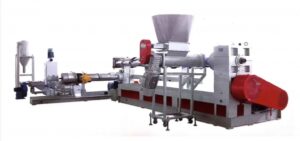
A single screw extruder is composed of one rotating screw in a heated barrel that will be used to deliver, melt, and shape materials into a uniform profile. It is the most well-known and widely used extrusion technique.
Working Principle:
The process relies on the friction and shear between the screw, barrel, and the material. As the screw rotates, material is transported forward, melted, and pushed through a die to create the final product.
Key Characteristics:
Simple mechanical design, low capital investment, stable operation for uniform materials, widely used in pipe, film, and sheet production.
One-screw extruders are most commonly used in areas where the material composition is already homogeneous, and no mixing is required.
What Is a Twin Screw Extruder?
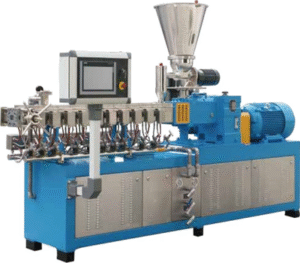
A twin-screw type extruder is an экструдер that has two screws (co-rotating or counter-rotating) inside the barrel. The screws mesh together to enhance the processing of materials.
Working Principle:
The intermeshing screws generate controlled shear, compression, and mixing zones, which can precisely manage material properties. The design promotes the efficiency of melting and the uniformity of mixing.
Key Characteristics:
Superior mixing capacity. With high quantity and high efficiency, it can handle complicated formulations and is suitable for mixing, plasticizing, and reactive extrusion.
Twin screw systems are the core of modern high-performance material processing.
Core Differences: Single Screw vs Twin Screw Extruder
| Характеристика | Одношнековый экструдер | Twin Screw Extruder |
| Screw Design | One screw | Two intermeshing screws |
| Возможность смешивания | Limited | Отличный |
| Выходная мощность | Moderate | High |
| Гибкость материала | Low–Moderate | Very High |
| Расходы | Lower | Higher |
| Техническое обслуживание | Simple | Complex |
| Управление процессом | Basic | Advanced |
The most important takeaway is that twin screw extruders prioritize performance and flexibility, while single screw extruders prioritize simplicity and cost-efficiency.
Structural Differences Explained
In polymer processing, an extruder’s structural design directly determines its processing capability, flexibility, and maintenance requirements. The key distinction lies in how the material is conveyed, mixed, and controlled within the barrel.
Single screw structure
Core design:
- One rotating screw inside a fixed barrel
- Relatively simple geometry and construction
- Fewer moving parts and components
Characteristics:
- Straightforward material flow (feed → melt → push forward)
- Limited mixing capability compared to twin screw systems
- Easier to operate and maintain
Преимущества:
- Lower cost (equipment and maintenance)
- High reliability due to mechanical simplicity
- Ideal for stable, uniform materials
Typical applications:
- Film and sheet extrusion
- Pipe and profile production
- Basic polymer melting and conveying
Insight:
Single screw extruders excel in continuous, high-volume production where material formulations are consistent.
Twin Screw Structure
Core design:
- Two screws rotating within the barrel
- Parallel or conical configurations
- Segmented (modular) barrel sections
- Integrated systems for feeding, mixing, and venting
Advanced features:
- Intermeshing or co-rotating screw designs
- Multiple feeding zones for additives or fillers
- Venting/devolatilisation ports for removing gases or moisture
Преимущества:
- Superior mixing and compounding capability
- High process control and flexibility
- Customisable configuration for specific materials and processes
Приложения:
- Polymer compounding (additives, fillers, and colour masterbatch)
- Reactive extrusion
- Devolatilisation processes
- Advanced material development
Insight:
Twin screw extruders are designed for complex formulations and precision processing, where control and customisation are critical.
Key structural comparison:
- Single screw: simple, stable, cost-efficient
- Twin screw: complex, flexible, high-performance
Mixing and Compounding Performance
Одношнековый экструдер
Whiles single screw system mainly completes dispersive mixing, it is difficult to uniformly distribute additives and fillers. This renders them less appropriate for more complex formulations.
Twin Screw Extruder
Twin screw systems offer advantages in both distributive and dispersive mixing. They have the feature of perfect blending of polymers, fillers, and additives; therefore are suited for high-end materials and the compounding industry.
Research also demonstrates that the multi-screw system has better mixing efficiency than the single screw system based on the improved flow pattern and the ability to control shearing force.
Processing Capability and Material Handling
| Тип материала | Recommended Extruder | Reason |
| Granular polymers (PE, PP) | Single screw | Efficient and cost-effective |
| PVC powder | Twin screw | Better temperature control |
| Filled compounds | Twin screw | Superior mixing |
| Recycled materials | Twin screw | Enhanced homogenization |
| Simple extrusion products | Single screw | Lower cost |
Twin screw extruders are particularly effective for heat-sensitive or additive-rich materials because they provide better temperature and shear control.
Output and Efficiency Comparison
In polymer processing, output and efficiency are critical factors when selecting extrusion equipment. The structural differences between single-screw and twin-screw systems directly affect throughput, processing speed, and consistency.
- Throughput and output
Single screw extruders:
moderate output levels; material conveyed in a relatively simple, linear flow; limited mixing reduces processing speed for complex materials; best suited for:
- Stable, homogeneous polymers
- Continuous, high-volume but less complex production
Twin screw extruders:
- Higher throughput capacity
- Improved conveying due to intermeshing screw design
- Enhanced mixing allows faster and more efficient processing
Why is higher output possible:
- Better material feeding and distribution
- Reduced risk of flow stagnation
- Continuous renewal of material surfaces during processing
- Material residence time
Key difference:
Single screw:
Longer and less controlled residence time, with potential for uneven heating or material degradation.
Twin screw:
- Shorter, more controlled residence time
- Faster material movement through the system
Impact:
- Improved production speed
- More consistent material properties
- Reduced thermal degradation
- Processing efficiency
Single screw: efficient for simple melting and extrusion tasks; lower energy consumption in straightforward processes; limited adaptability to complex formulations.
Twin screw: optimised for complex compounding and multi-component systems; superior mixing efficiency reduces processing steps; better dispersion of additives, fillers, and reinforcements.
Result:
Higher overall process efficiency and product uniformity
- Consistency and product quality
Single screw:
- Good consistency for uniform material
- Less effective for blends or additives
Twin screw:
- Excellent consistency due to intensive mixing
- More uniform final product quality across batches
Final takeaway:
Single screw extruders:
- Moderate output
- Best suited to stable, simple processes
- Cost-effective and reliable
Twin screw extruders:
- High output and throughput
- Shorter residence time → faster production
- Superior efficiency for complex materials
Bottom line:
If your priority is simplicity and steady production, single-screw systems are sufficient.
However, if you require high efficiency, speed, and advanced material processing, twin screw extruders are the better choice.
Cost and Investment Analysis
Initial cost:
- Single screw: Lower investment
- Twin screw: Higher capital cost (often up to twice as much)
Operational cost:
- Single screw: Lower maintenance and energy use
- Twin screw: Higher maintenance costs, but improved productivity.
ROI perspective:
- For simple production, single screw systems offer a faster ROI.
- For complex or high-value products, twin screw systems deliver better long-term returns.
Применение в различных отраслях промышленности
In polymer processing, the choice between single-screw and twin-screw extruders is largely driven by the complexity of the material and the processing requirements. Each type plays a distinct role in different industries.
Applications of Single Screw Extruders
Best suited to: stable materials and continuous production
- Pipe and tubing: PVC, HDPE, and PP pipes for water supply, drainage, and gas systems, which require consistent melt flow and dimensional stability
- Film and sheet: packaging films and plastic sheets for thermoforming, which require uniform thickness and a smooth surface finish
- Simple profiles: window frames and basic plastic trims, which require consistent geometry with minimal formulation changes
Why single screw extruders work here:
- Simple material systems
- High efficiency in continuous production
- Lower operational complexity
Twin Screw Extruder Applications
Best for: complex materials and advanced processing
- Polymer compounding: mixing polymers with additives, fillers, or reinforcements to produce engineered plastics with specific properties
- Masterbatch production: concentrated colour or additive mixtures
- Recycling and reprocessing: handling mixed or contaminated plastics, melting, filtering, and re-compounding materials
- Food and pharmaceutical processing: food extrusion (snacks, cereals), pharmaceutical granulation and formulation
Why twin screw excels:
- Precise control of temperature, mixing, and shear
- Ability to handle multi-component systems
- Modular configuration for customised processes
Key industry insight:
Single screw extruders:
Ideal for standardised, high-volume products with minimal variation
Twin screw extruders:
Essential for innovation-driven industries requiring formulation control and flexibility
Advantages and Disadvantages
When it comes to polymer processing, choosing the right extruder requires a balance of cost, complexity, and processing capability. The strengths and trade-offs of each system depend on the application.
Одношнековый экструдер
Преимущества:
- Simple operation
- Straightforward design
- Requires less specialised operator training
- Lower cost
- Lower initial investment
- Reduced operating and maintenance expenses
- Easy maintenance
- Fewer components → fewer wear points
- Faster cleaning and servicing
Disadvantages:
- Limited mixing ability
- Not ideal for blending multiple materials or additives
- Less effective for compounding applications
- Lower flexibility
- Designed for stable, uniform materials
- Difficult to adapt to changing formulations
- Reduced efficiency for complex materials
- Struggles with fillers, reinforcements, or recycled material
- May lead to inconsistent product quality in advanced applications
Twin Screw Extruder
Преимущества:
- Excellent mixing and compounding
- Superior dispersion of additives, fillers, and colourants
- Ideal for engineered and speciality materials
- High output
- Efficient material conveying and processing
- Higher throughput in complex production environments
- Versatile processing
- Modular design allows customisation
- Supports multiple processes (compounding, devolatilisation, reactive extrusion)
Disadvantages:
- Higher cost
- Greater initial investment
- Higher operating and tooling costs
- Complex operation
- Requires skilled operators
- More parameters to control (temperature, screw configuration, feeding)
- Increased maintenance requirements
- More components → more wear and replacement parts
- Longer downtime for servicing
Key insight:
Single screw extruders prioritise simplicity, reliability, and cost-efficiency, while twin screw extruders prioritise performance, flexibility, and advanced processing capability.
Industry Trends in 2026
The extrusion industry is evolving rapidly, driven by trends such as:
- Increased demand for recycled materials;
- Growth in high-performance polymers;
- Automation and smart manufacturing;
- Energy-efficient extrusion systems.
Manufacturers such as Jwell are integrating intelligent control systems and modular designs to enhance both single and twin-screw extruders.
How to Choose the Right Extruder?
Choose a Single Screw Extruder If:
- Your material is pre-mixed and homogeneous
- You require cost-effective production
- Your application is simple and stable
Choose a Twin Screw Extruder If:
- You need advanced mixing or compounding
- You process complex or heat-sensitive materials
- You require high productivity and flexibility
FAQ: Single Screw Extruder vs Twin Screw Extruder
- What is the main difference between single and twin screw extruders?
The main difference is the number of screws and their processing capability—single screw for simplicity, twin screw for advanced mixing and flexibility.
- Which extruder is better for compounding?
Twin screw extruders are significantly better due to superior mixing performance.
- Is a twin-screw extruder more expensive?
Yes, both initial investment and maintenance costs are higher.
- Can a single screw extruder handle all materials?
No, it struggles with complex or additive-rich materials.
- Which extruder has higher output?
Twin screw extruders generally provide higher throughput.
- Which one is easier to maintain?
Single screw extruders are simpler and easier to maintain.
Заключение
Single screw extruder vs twin screw extruder is not an issue of which is more efficient for everyone. It’s about which one is right for your particular project.
Single screw extruders are highly simple, cost-effective, and reliable.
The Twin screw extruders are the industry’s leading products in terms of mixing, flexibility, and advanced materials processing.
Twin screw extruders have become an increasingly sophisticated and quality-driven manufacturing system. They remain essential on less complicated and cost-effective production lines.
The best option for your business is going to depend on your materials, production size, and performance requirements—and working with professionals like Jwell can help you make the right selection.



 English
  Russian
  Spanish
  Arabic
  German
  French
  Persian
  Turkish
  Bulgarian
  Czech
Czech  Dutch
Dutch  Greek
Greek  Indonesian
  Japanese
  Korean
  Polish
  Portuguese
  Romanian
  Slovenian
  Ukrainian