
Коротка відповідь
A 7-layer, high-barrier co-extruded blown film line is an industrial extrusion system that combines seven individually controlled polymer layers to form a single blown film structure. Typically, materials such as polyethylene (PE), polyamide (PA), ethylene-vinyl alcohol copolymer (EVOH), and tie-layer resins are used to balance oxygen barrier properties, moisture resistance, mechanical strength, heat sealing, and processability. A published study has demonstrated the production of a seven-layer blown film containing LLDPE, LDPE, adhesive PE, PA, and EVOH. This shows that this configuration can be used to engineer high-performance, multilayer packaging films.
The key advantage lies in assigning each layer a specific function. Barrier polymers such as EVOH restrict oxygen transmission, while polyolefin layers provide moisture resistance and sealing performance. Tie layers maintain adhesion between polymers that would otherwise have poor interfacial compatibility. ASTM methods such as D3985 and F1927 are commonly used to evaluate oxygen transmission performance under controlled test conditions.
What Is a 7-Layer High Barrier Co-Extrusion Blown Film Line?
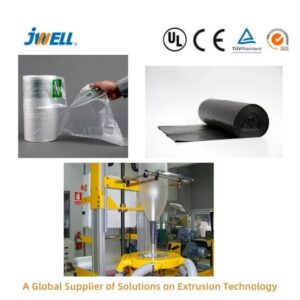
A 7-layer, high-barrier co-extruded blown film line is a complete film production system designed to manufacture multilayer blown films that require high levels of gas and moisture barrier protection. Unlike a conventional single-layer blown film line, which melts and forms one polymer into a tubular film, a seven-layer system processes multiple polymer streams simultaneously and combines them within a multilayer die before inflating, cooling, collapsing, and winding the material.
The term ‘7-layer’ refers to the number of functional polymer layers in the finished film, rather than the number of visible extruders on the machine. In a typical configuration, each extruder supplies a controlled melt stream, while a feed block or specialised multilayer die establishes the desired layer sequence and thickness distribution. Depending on the packaging application, the structure may include PE-based sealing and moisture-barrier layers, PA for toughness and puncture resistance, and EVOH for oxygen barrier performance. Tie resins are also used to bond incompatible materials.
A useful example comes from peer-reviewed research in the Journal of Applied Polymer Science. Researchers manufactured a seven-layer blown film using LLDPE, LDPE, adhesive PE, PA-6/6.6, and EVOH, with a total film thickness of 100 µm and a blow-up ratio of 2.5. This demonstrates that seven-layer blown-film technology can be used to engineer real multilayer structures for barrier-film development and recycling studies, rather than being merely a theoretical machine configuration.
The “high barrier” part of the description is equally important. A multilayer film is normally designed so that no single polymer has to provide every required property. Instead, the film architecture divides the workload among different materials. EVOH can provide strong oxygen-barrier performance, PA can contribute mechanical strength, and polyethylene can provide moisture resistance and reliable heat sealing. This material specialization is one of the main reasons multilayer co-extrusion has become important in food, pharmaceutical, medical, and industrial packaging.
Why Does a Film Need Seven Layers?
Seven layers are useful when the required combination of properties cannot be reliably or economically achieved with one, two, or three polymer layers. For example, a packaging film may need to resist oxygen, water vapour, oil, puncture, impact and heat, all while running efficiently on a filling and sealing machine. As these requirements often conflict with one another, a multilayer architecture provides a way to combine materials with different strengths.
For instance, EVOH is highly effective as an oxygen barrier, but its performance is sensitive to humidity due to its hydrophilic structure, which can absorb moisture. Research on multilayer food packaging has shown that this moisture sensitivity can be mitigated by encapsulating the EVOH layer in moisture-resistant polymers, such as polyethylene or polypropylene.
This is why high-barrier films are rarely designed as ‘EVOH film’ alone. A more practical structure would place the EVOH towards the centre of the film and protect it with appropriate surrounding layers. Tie resins would be used to create strong interfaces, and an outer PE layer would be reserved for mechanical protection or printing compatibility. The final structure therefore functions as a system rather than a random assortment of materials.
Typical Functional Structure
| Layer | Typical Material | Primary Function |
| Layer 1 | PE / mPE | Heat sealing, moisture resistance |
| Layer 2 | Tie resin | Adhesion between incompatible polymers |
| Layer 3 | PA | Puncture and impact resistance |
| Layer 4 | EVOH | Oxygen and aroma barrier |
| Layer 5 | PA | Mechanical protection and support |
| Layer 6 | Tie resin | Interlayer adhesion |
| Layer 7 | PE / mPE | Sealing, moisture barrier, processability |
This is only a representative architecture rather than a universal recipe. The correct structure depends on the resin grades, required barrier level, sealing temperature, film thickness, forming process, product chemistry, and target shelf life.
How Does a 7-Layer Blown Film Line Work?
The production process begins with seven separate systems for feeding materials and extruding them. Each extruder melts and conveys a designated polymer at a controlled temperature, pressure, and throughput. As materials such as PE, PA, EVOH, and tie resins exhibit different melting behaviour and processing windows, independent extrusion control is essential.
After melting, the individual polymer streams are filtered and metered before entering the multilayer combining system. The aim is to deliver each material at a stable flow rate while maintaining the target layer ratio. If the EVOH layer becomes too thin, the oxygen barrier performance may decline, and if one sealing layer becomes too thick, material consumption can rise without producing a proportional performance benefit.
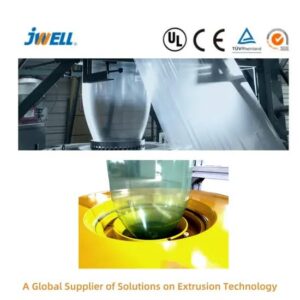
The combined melt then enters the annular blown-film die. Inside the die, the seven melt streams are arranged concentrically so that they emerge as a multilayer tubular melt. The die must distribute the materials uniformly around the circumference, as variations in layer thickness can result in inconsistent barrier performance, mechanical properties, and sealing behaviour.
Once the multilayer tube leaves the die, air is introduced into the bubble to establish the desired diameter. External cooling air removes heat from the film while the haul-off system controls the bubble and pulls the film upwards. The relationship between extrusion output, haul-off speed, bubble diameter, cooling conditions, and blow-up ratio has a strong influence on the final film’s thickness and orientation.
The bubble is then collapsed using a collapsing frame and converted into a flat film. Depending on the equipment configuration, the film can be wound directly as a single flattened web or slit into separate rolls. Automated systems for thickness measurement, bubble control, tension regulation, and winding can be integrated to improve consistency during continuous production.
What Materials Are Used in High Barrier 7-Layer Film?
Selecting the right material is one of the most important decisions in the design of a 7-layer high-barrier co-extruded blown film line. The machine itself does not automatically produce a “high barrier” film; the final performance depends on a combination of factors, including resin chemistry, layer sequence, thickness, processing conditions, and interfacial quality.
EVOH is often chosen when a high level of oxygen barrier performance is required. While its barrier behaviour can be excellent under relatively dry conditions, humidity can significantly impact oxygen transmission. This is why EVOH is usually protected by hydrophobic layers rather than being exposed directly to a high-moisture environment. ASTM F1927 specifically emphasises that oxygen transmission should be measured under defined temperature and relative humidity conditions because humidity can influence the measured result.
Polyamide, often referred to as PA or nylon, is frequently used when toughness, puncture resistance, stiffness, or thermal resistance are important factors. PA can also improve barrier performance, but its moisture sensitivity means it should be evaluated in the context of the entire multilayer structure rather than in isolation.
Polyethylene, including LDPE, LLDPE, and metallocene PE grades, is commonly used for sealing and moisture resistance. PE also offers good processability and can provide films with the flexibility needed for pouch and bag production. Different PE grades can be selected according to sealing temperature, stiffness, puncture resistance, coefficient of friction, and packaging machine requirements.
Tie resins are essential in structures where two polymers do not naturally adhere sufficiently to one another. Without an effective tie layer, a film may delaminate during conversion, moulding, filling, or transportation. Therefore, the tie resin does more than simply ‘glue’ the structure together; it maintains the mechanical integrity of the entire multilayer architecture.
What Makes the Film “High Barrier”?
The term ‘high barrier’ should be treated as a performance specification rather than the name of a specific material. In packaging engineering, barrier performance is usually expressed in terms of measurable parameters, such as oxygen transmission rate (OTR) and water vapour transmission rate (WVTR).
OTR describes the amount of oxygen that passes through a defined area of film over a specified period under controlled conditions. ASTM D3985, for instance, provides a standardised method of measuring the transmission of oxygen gas through plastic films, sheets, laminates and co-extrusions using a coulometric sensor.
A lower OTR generally indicates stronger resistance to oxygen ingress. This is important for products sensitive to oxidation, aroma loss, colour change, microbial activity or quality deterioration. However, OTR should never be evaluated in isolation, as packaging performance also depends on water vapour transmission, seal integrity, pinholes, defects, package geometry, temperature, humidity and the properties of the packaged product.
The importance of structure becomes particularly clear with EVOH. Research on multilayer films has shown that EVOH provides strong oxygen-barrier performance but that moisture can reduce its effectiveness. Consequently, the surrounding layers and their moisture-barrier characteristics are essential to maintaining the intended performance of the central barrier layer.
| Performance Parameter | What It Measures | Why It Matters |
| OTR | Oxygen transmission | Oxidation and shelf-life protection |
| WVTR | Water vapor transmission | Moisture protection |
| Seal strength | Strength of sealed area | Package integrity |
| Puncture resistance | Resistance to penetration | Protection during handling |
| Tear resistance | Resistance to propagation of tears | Package durability |
| Adhesion | Strength between layers | Prevents delamination |
| Thickness uniformity | Consistency of film gauge | Stable barrier and mechanical performance |
| COF | Surface friction | Machine running and package handling |
| Haze/clarity | Optical appearance | Product presentation |
| Dart impact | Impact resistance | Drop and handling performance |
For this reason, a serious high-barrier film project should establish target specifications before selecting the machine. The extrusion line should be designed around the required film rather than the film being forced to match a machine that was selected without sufficient application analysis.
What Are the Main Applications?
A 7-layer, high-barrier co-extruded blown film line is particularly suitable for applications where the performance of the packaging needs to exceed that of conventional PE films. One of the most important areas is food packaging, including meat, cheese, processed foods, sauces, snacks, pet food, and products requiring protection from oxygen and moisture.
Additional caution is required for retort and sterilisation applications. Exposure to temperature, pressure, and moisture can alter the structure of polymers and their barrier properties. Research on EVOH-containing multilayer packaging has demonstrated that thermal sterilisation can affect oxygen transmission. This shows why it is necessary to test barrier performance under actual processing conditions rather than assuming it from room-temperature material data.
This technology is also relevant for pharmaceutical and medical packaging, where protection from oxygen, moisture, aroma, and contamination can be critical. Multilayer structures can also benefit industrial products such as chemicals, agricultural products, powders, and specialty materials when moisture or oxygen exposure affects product stability.
The application determines the appropriate layer design. For example, a film intended for frozen meat may prioritise puncture resistance and low-temperature toughness, whereas a dry-food package may place greater emphasis on oxygen and aroma protection. A retort pouch requires a different combination of thermal resistance, adhesion, seal performance, and barrier stability than a conventional form-fill-seal bag.
Key Advantages of a 7-Layer High Barrier Co-Extrusion Blown Film Line
The greatest advantage lies in material efficiency through functional layering. Rather than making the entire film from an expensive, high-performance polymer, the designer can place a small quantity of barrier resin in the layer where it will be most effective, using less expensive polymers for bulk, sealing, and moisture resistance.
Another advantage is the elimination of some downstream lamination steps. A co-extruded structure can be formed as a single multilayer film directly from the extrusion line, eliminating the need for multiple films to be manufactured and laminated separately. This can simplify production and reduce the need for adhesive-related considerations in suitable co-extrusion applications.
The technology also provides substantial design flexibility. Layer ratios can be adjusted to optimise cost and performance, and different resin families can be combined according to application requirements. In practice, this means that a film producer can develop several products based on the same core production line by altering the combinations of materials and processing recipes used.
However, having seven layers also increases process complexity. More extruders mean more temperature control zones, melt pressure relationships, material interfaces, and process variables. Even a small instability in one extrusion stream can affect the entire film. Therefore, as the number of layers increases, automation, gravimetric dosing, melt filtration, thickness measurement, and stable bubble control become increasingly valuable.
What Should Buyers Consider When Choosing a 7-Layer Line?
A buyer should start with the target film specification rather than the equipment catalogue. Before selecting a line, the required film width, thickness range, output, layer structure, resin types, OTR and WVTR targets, sealing characteristics, and mechanical requirements should be defined, as well as the intended packaging process.
The second consideration is ensuring compatibility between the extrusion system and the selected resins. EVOH, PA, PE, and tie materials do not necessarily have the same ideal processing temperatures or residence time requirements. Therefore, extruders, screws, adapters, melt pumps, filters, and die components need to be selected according to the actual materials.
The third consideration is quality control. High-barrier films are sensitive to thickness variation and layer-ratio instability because the barrier layer may represent only a small fraction of the total film thickness. A modern system should therefore provide accurate gravimetric feeding, stable extrusion pressure, automatic thickness control where appropriate, reliable bubble stabilisation and consistent winding tension.
Finally, buyers should evaluate the manufacturer’s ability to support process development, as well as machine delivery. A seven-layer line is a process platform and successful production depends on commissioning, resin trials, optimising the layer ratio, tuning the die, cooling conditions and quality control procedures. A supplier that can support all of these stages may add more value than one competing only on headline extrusion output.
FAQ: 7-Layer High Barrier Co-Extrusion Blown Film Line
- What is a 7-layer blown film line used for?
A 7-layer blown film line is used to manufacture multilayer plastic films with different functional layers combined in one structure. It is particularly suitable for high-performance food, pharmaceutical, medical, and industrial packaging.
- Why use seven layers instead of three layers?
Seven layers provide greater flexibility to separate barrier, sealing, structural, moisture-resistant, and adhesive functions. This can produce a better balance between performance and material cost when the application has demanding requirements.
- What materials are commonly used in a 7-layer barrier film?
PE, PA, EVOH, and specialized tie resins are common choices. The exact combination depends on the required oxygen barrier, moisture barrier, puncture resistance, sealing performance, and processing conditions.
- Is EVOH necessary for a high barrier film?
Not necessarily, because “high barrier” is application-dependent and other barrier technologies can be used. However, EVOH is widely used when strong oxygen-barrier performance is required, particularly in multilayer structures that protect it from moisture.
- What is the difference between a 5-layer and 7-layer blown film line?
A 7-layer line provides two additional material layers, allowing more precise separation of functions or more complex combinations of polymers. The extra layers can improve design flexibility, but they also increase equipment complexity and process-control requirements.
- How is the barrier performance of the film tested?
Oxygen transmission can be evaluated using standardized methods such as ASTM D3985 or ASTM F1927 under defined temperature and humidity conditions. WVTR, seal strength, puncture resistance, adhesion, and other properties should also be tested when they are relevant to the final packaging application.
Висновок
A 7-layer, high barrier co-extruded blown film line is best understood as a precision, multilayer manufacturing platform, rather than simply a blown-film machine with seven extruders. It is the combination of polymers with complementary functions — such as EVOH for oxygen protection, PA for mechanical performance, PE for sealing and moisture resistance, and tie resins for interlayer adhesion — within a controlled seven-layer architecture that gives it its value.
The most important design principle is that the number of layers alone does not determine barrier performance. Resin selection, layer thickness, humidity, processing stability, film defects, interfacial adhesion, and final package design all influence the actual result. ASTM’s oxygen transmission methods specifically emphasise controlled environmental conditions, while packaging research demonstrates that factors such as EVOH thickness and moisture exposure can significantly impact oxygen barrier performance.
Therefore, the best approach for manufacturers evaluating this technology is to work backwards from the final application. They should define the required OTR and WVTR, establish mechanical and sealing targets, determine the appropriate layer structure, select compatible resins, and then specify the necessary extrusion, die, cooling, thickness control, and winding systems to produce that structure consistently.
The seven-layer architecture is particularly valuable when high barrier performance is required without using an expensive barrier polymer for the entire film. With appropriate engineering and process control, it enables packaging manufacturers to position each material to maximise its value, producing films that are lighter, more functional and better suited to demanding packaging applications.


 English
 Russian
 Spanish
 Arabic
 German
 French
 Persian
 Turkish
 Bulgarian
 Czech
 Dutch
 Greek
 Indonesian
 Japanese
 Korean
 Polish
 Portuguese
 Romanian
 Slovenian
 Ukrainian