Suzhou Jwell Machinery Co, Ltd. is a large-scale plastic extrusion machinery manufacturer in China. The company produces more than 2,000 advanced extrusion production lines each year. Its products are exported to all over the world, including Germany, the United States, Japan, Spain and other developed countries. Today, we will introduce Suzhou Jwell Machinery’s extruder products in detail. If you are interested, let’s learn about it together!
Apa itu ekstruder?
An extruder is a mechanical device that continuously transports, melts and extrudes raw materials (such as plastics, metals, foods, etc.) from a mold by heating, pressurizing, shearing and pushing. It is widely used in plastic processing, rubber molding, food manufacturing, metal molding, cable coating and other fields.
In the plastics industry, extruders are key equipment for the production of sheets, films, pipes, profiles, hollow products, granular materials and other products. Due to its advantages of high degree of automation, large output, strong continuity and strong customizability, it has become an indispensable core equipment in modern manufacturing.
Jwell Extruder Introduction
1、Garis Ekstrusi Film yang Ditiup
Lini Ekstrusi Film Tiup adalah peralatan manufaktur yang dirancang khusus untuk memproduksi film plastik. Proses penggunaan mesin film tiup untuk membuat film plastik melibatkan pelelehan pelet resin plastik dan mengekstrusinya melalui cetakan berbentuk lingkaran menjadi tabung plastik cair. Tabung ini kemudian ditiup, mengembang seperti balon hingga mencapai ukuran dan ketebalan tertentu. Setelah mendingin, tabung tersebut diratakan dan digulung menjadi rol. Proses ini disebut ekstrusi film tiup, dan digunakan untuk menghasilkan film plastik dengan ketebalan dan kualitas yang seragam.
Lini Ekstrusi Film Tiup memainkan peran penting dalam produksi film plastik, mengurus seluruh proses mulai dari pelelehan resin plastik hingga penggulungan produk jadi menjadi rol. Mesin ini memiliki beberapa komponen utama, antara lain ekstruder, cetakan, cincin gas, roller tekanan, dan penggulung. Setiap komponen dirancang untuk melakukan fungsi tertentu, seperti memanaskan dan melelehkan resin plastik, membentuk dan mendinginkan plastik cair menjadi tabung, serta menggulung film plastik jadi menjadi rol.
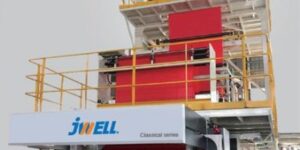
Lini Ekstrusi Papan Jwell memiliki struktur yang kompak dan kinerja yang unggul. Sekrup dan laras dirancang secara optimal serta diproses secara profesional dengan baja paduan berperforma tinggi sehingga seluruh lini produksi memiliki keunggulan plastisasi seragam, ekstrusi stabil, dan umur pakai yang panjang.
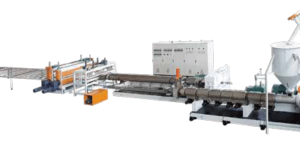
Lini ekstrusi film adalah proses manufaktur yang menghasilkan film plastik dengan menggunakan mesin ekstruder. Proses ini dimulai dengan peletisasi bahan baku plastik, yang kemudian dimasukkan ke dalam mesin ekstruder. Bahan tersebut kemudian dilelehkan, disaring, dan dipaksa melalui cetakan untuk membentuk film kontinu. Selanjutnya, film tersebut didinginkan, diratakan, dan digulung menjadi rol untuk diproses lebih lanjut atau dikemas. Lini ekstrusi film digunakan untuk memproduksi berbagai jenis film plastik seperti LDPE, HDPE, PVC, film PP, dan lainnya, yang banyak digunakan dalam kemasan, pertanian, konstruksi, dan industri lainnya.
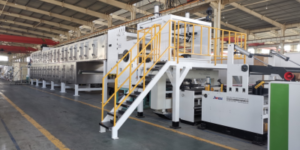
Lini ekstrusi lantai adalah produk populer dari mesin jwell; mesin ini menggunakan ekstruder untuk menghasilkan lembaran plastik, PVC, atau bahan lain yang kontinu dan seragam, yang kemudian dibentuk menjadi berbagai jenis produk lantai seperti ubin, papan, atau gulungan. Prosesnya melibatkan pelelehan bahan baku dalam ekstruder dan mendorongnya melalui cetakan yang menentukan bentuk dan ukuran akhir produk. Lembaran yang dihasilkan kemudian didinginkan, dipangkas, dan dipotong sesuai panjang sebelum dikemas dan dikirimkan kepada pelanggan.
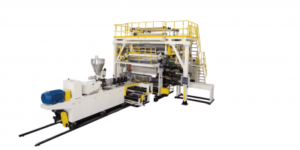
Mesin ekstruder pipa PP, PPR, PE, dan PVC dapat berupa ekstruder sekrup tunggal atau ekstruder sekrup kembar.
Ekstruder sekrup tunggal mentransportasi bahan melalui gesekan, dan efek pelelehan serta plastisasi-nya tidak sebaik ekstruder sekrup kembar, tetapi biayanya sangat rendah.
Saat ini, pelet polietilena dan polipropilena umumnya dibentuk oleh ekstruder sekrup tunggal. Sebagian besar sekrup bukanlah sekrup ulir penuh tiga bagian konvensional, tetapi elemen pencampur ditambahkan ke sekrup untuk meningkatkan efek pencampuran dan plastisasi.
Bahan baku polivinil klorida berbentuk bubuk. Jika diproduksi oleh ekstruder sekrup tunggal, bahan tersebut harus dicampur dan digranulasi terlebih dahulu, yang memperpanjang proses produksi.
Oleh karena itu, dalam produksi saat ini dari bubuk PVC langsung menggunakan ekstruder sekrup kembar kerucut untuk pencampuran dan pencetakan. Ketika merancang atau memilih sekrup ekstruder untuk mesin ekstruder pipa PVC, struktur dan parameter sekrup harus mempertimbangkan sifat sensitif panas PVC (terutama PVC kaku).
Jwell Pipe Extrusion Line is able be easily controlled. With stable performance, pipelines can keep high efficient output capacity. Further, that PP PPR PE PVC pipe extruder machine’s long service life is also the reason that you can trust Jwell.
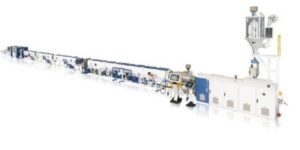
Plate extrusion Line includes feeder, extruder, mold, three-roll calender, cooling bracket, trimming device, tractor, laminating device, hanging film device, shearing machine, conveyor, manipulator and roll temperature Controller.
Products from extrusion molding to processing finished products to collection are completed automatically in one line, with high production efficiency, very few manual use, and rapid and stable sheet forming.
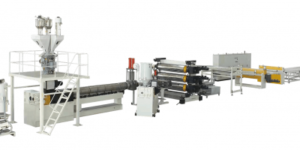
Jalur ekstrusi profil Jwell menggunakan bahan baku untuk memproduksi produk ekstrusi berkualitas tinggi, yang digunakan untuk mendukung industri konstruksi, lantai, atau permainan.
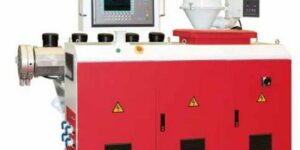
Lini ekstrusi batang JWELL adalah peralatan canggih yang efisien, fleksibel, dan hemat energi yang menggunakan proses ekstrusi untuk memproduksi berbagai jenis produk plastik, termasuk pipa, pelat, dan profil. Fitur-fiturnya meliputi kemampuan produksi berkecepatan tinggi, kemampuan adaptasi produk yang beragam, sistem kontrol yang presisi, serta fitur hemat energi dan ramah lingkungan. Lini ini banyak digunakan dalam bidang produksi produk plastik, memberikan manfaat ekonomi yang signifikan bagi pelanggan, dan merupakan pilihan peralatan produksi yang ideal.
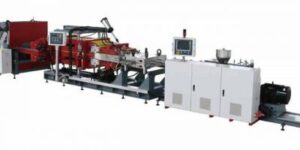
A sheet extrusion line includes an extruder (double or single screw), outfitted with a screen changer plus a gear pump, followed closely with a static mixer (occasionally feeding a coextrusion feed block that’s preceded by one or more added extruders sets as explained previously ), feeding a level sheet expire.
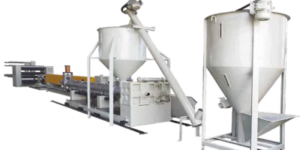
How does an extruder work?
The working process of an extruder mainly includes feeding, plasticizing, melting, compression, metering, molding and other links, which are usually completed by the following core components:
Hopper: The raw materials enter the equipment from here;
Sekrup: Rotates under the drive of the motor, pushes the material forward and melts it under heat;
Laras: Provides wrapping space for the screw and is equipped with a heating system;
Heating zone and cooling system: Control the temperature in sections to ensure stable processing of materials;
Die: Determines the shape of the product;
Traction device, cooling device: Assists in product shaping and output.
The principle of extrusion is to heat and melt the thermoplastic material under pressure, and continuously extrude and mold it, which can achieve efficient and large-scale production.
Extruder process flow
The following table shows the standard process flow of general plastic extrusion processing:
Raw material preparation: material drying, premixing, and impurity removal
Feeding: Put the raw materials into the hopper
Screw feeding and heating: Push and gradually heat to the set temperature through the screw
Melting and mixing: The material is fully melted and mixed evenly at high temperature
Metering and compression: Control the output to ensure product consistency
Mold forming: Press out the product shape through the mold, such as film, pipe, granules, etc.
Cooling and traction: Use air cooling, water cooling or vacuum cooling system for rapid shaping
Cutting and winding: The product is cut or wound according to specifications
The entire process is highly automated and suitable for manufacturing scenarios with strong continuity.
What does the extruder do?
The core functions of the extruder are as follows:
Material melting and plasticization: With the help of screw shearing and electric heating functions, solid materials are transformed into processable melts;
Material transportation and homogenization: High-efficiency continuous advancement, while mixing different components of raw materials;
Pressure construction: Increasing pressure through the metering section allows the melt to pass through the mold smoothly;
Continuous molding: Different mold structures determine the final shape of the product, such as diaphragms, pipes, sheets, etc.;
Control stability: The consistency of product quality can be controlled by parameter settings (temperature, pressure, speed).
In short, the extruder is the “core processing engine” that converts raw materials into functional end products.
How to remove consumables from the extruder?
When replacing consumables or maintenance, residual materials need to be removed from the extruder. The following are the general steps:
Stop feeding: turn off the hopper feed;
Empty the raw materials: continue to run the screw to push out the remaining raw materials in the barrel;
Add purging compound: special purging compound helps dissolve the residue;
Run idly for a few minutes: let the purging compound fully contact the entire screw and barrel;
Remove the die head (if necessary) :for physical cleaning;
Wait for cooling: After the temperature drops to a safe range, clean the residue manually.
Precautions:
Wear protective gloves and goggles during operation;
Avoid disassembling the mold when the screw is not stopped;
Some high-temperature materials such as PVC and PBT need to be cleaned by professionals to prevent poisoning or corrosion.
Main application areas of extruders
Extruders are widely used in the molding and processing of various raw materials. The following are the main areas:
Plastic processing: continuous products such as pipes, profiles, plates, films, cable sheaths, etc.
Packaging material manufacturing: multi-layer co-extruded films, shrink films, foam materials, heat-sealed films, etc.
Industri makanan: noodles, puffed food, pet feed, energy bars, etc.
Rubber and seal manufacturing: automotive rubber strips, O-rings, shock-absorbing pads
Medical materials and consumables: medical hoses, catheters, infusion tubes, experimental consumables
Metal extrusion: aluminum profiles, copper tubes, alloy plates
3D printing consumables: preparation of wires such as PLA/ABS/TPU
Environmentally friendly materials: biodegradable films, EVA solar films, recycled plastic granulation
Comparative analysis of different types of extruders
| Production Line Type | Main Material | Final Product | Fitur Utama | Aplikasi Khas | Die Structure |
| Garis Ekstrusi Film yang Ditiup | LDPE, LLDPE, HDPE, EVA | Plastic films | Film is blown vertically by air ring; high transparency possible | Packaging, agricultural film, bags | Circular blown die |
| Garis Ekstrusi Lembar | PP, PS, PET, ABS | Sheets (1–10mm thickness) | Uniform thickness, wide format possible | Packaging trays, folders, signage | Flat T-die |
| Cast Film Extrusion Line | PP, PE, CPP, BOPP | Thin plastic films | Fast cooling, high gloss and clarity | Food packaging, stretch film, protective film | Flat die + chill roll |
| Flooring Extrusion Line | PVC, SPC, WPC, PP | Flooring panels (multi-layer) | Rigid, multilayer co-extrusion | Vinyl flooring, laminate floors, click floors | Complex die + calender rollers |
| Garis Ekstrusi Pipa | PVC, PE, PPR, PEX | Pipes/tubes (Ø5–1000mm) | Stable pressure, sizing sleeve cooling | Water pipes, gas pipes, conduit systems | Pipe die + vacuum tank |
| Garis Ekstrusi Profil | PVC, ABS, ASA, WPC | Complex cross-section profiles | Customizable mold shapes, continuous profile | Window frames, cable ducts, wall panels | Profile die |
| Baris Ekstrusi Batang | Nylon, PTFE, PP, POM | Solid plastic rods | Compact structure, used in CNC machining | Industrial parts, gears, sealing rods | Circular or annular die |
| Garis Ekstrusi Pelat | HDPE, UHMWPE, PP | Thick plates (10–60mm) | High rigidity, used in heavy industries | Chemical tanks, cutting boards, liners | Wide flat die + 3-roll stack |
| Sheet (Thin) Extrusion Line | PETG, PVC, PS | Thin sheets (0.2–2mm) | Fast production, ideal for thermoforming | Display covers, blister packaging | Flat die + cooling rolls |
Kesimpulan
As a key equipment for continuous, efficient and automated material forming in modern industry, extruder has been widely used in many industries. It is not only the main equipment in the plastics industry, but also plays an important role in food, medical, rubber, metal and even environmental protection.
When choosing an extruder, enterprises should consider the selection based on factors such as raw material type, target product form, output demand, budget range, etc. At the same time, in order to ensure efficient operation of the equipment and extend its service life, it is necessary to combine scientific operating procedures and regular maintenance strategies.
With the development of new materials and the upgrading of intelligent manufacturing, extrusion technology in the future will tend to be highly intelligent, highly integrated, energy-saving and environmentally friendly, and multi-functional, which will further promote the evolution of the industry.



 English
  Russian
  Spanish
  Arabic
  German
  French
  Persian
  Turkish
  Bulgarian
  Czech
Czech  Dutch
Dutch  Greek
Greek  Indonesian
  Japanese
  Korean
  Polish
  Portuguese
  Romanian
  Slovenian
  Ukrainian