
Abstract
Plastic extrusion is widely recognised as one of the most efficient continuous manufacturing processes for thermoplastics. It involves melting polymer materials and forcing them through a die to create products with a uniform cross-section, such as pipes, sheets, and films.
This principle has been refined since the early 20th century and remains fundamental to high-volume production thanks to its consistency, scalability, and cost-effectiveness.
Introduction: Why Plastic Extrusion Matters?
A plastic extrusion machine is a cornerstone of modern manufacturing, enabling the mass production of continuous plastic products that are precisely shaped and of consistent quality. From construction pipes to packaging films, extrusion technology is essential for industries that require efficiency and customisation. Unlike batch processes, extrusion is continuous, making it ideal for high-output environments and reducing production costs over time.
Manufacturers such as Jwell (jwellmachine.com) have made significant advances in extrusion systems by integrating automation, energy efficiency, and intelligent control systems to meet the evolving needs of industry.
What Is a Plastic Extrusion Machine?
A plastic extrusion machine transforms raw plastic materials, typically in the form of pellets or granules, into continuous profiles by applying heat, pressure, and mechanical force. The process relies on a rotating screw inside a heated barrel to melt and transport the material towards a shaping die.
Core Function
- Convert solid plastic into molten form
- Shape material through a die
- Cool and solidify into final products
This continuous process ensures uniform cross-sections, making it ideal for products like tubing, sheets, and window profiles.
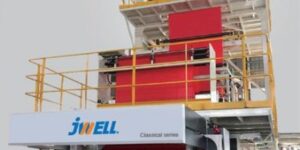
Key Components of a Plastic Extrusion Machine
| Component | Function | Importance |
| Hopper | Feeds raw plastic material | Ensures consistent input |
| Barrel | Heats and contains material | Controls the melting process |
| Screw | Moves and mixes material | Generates pressure & heat |
| Die | Shapes molten plastic | Determines the final product |
| Cooling System | Solidifies product | Maintains dimensional stability |
Each component works in synchronization to ensure a stable and efficient extrusion process.
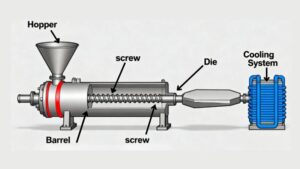
Step-by-Step: How a Plastic Extrusion Machine Works
Step 1: Material feeding
Plastic pellets are loaded into the hopper and fed into the barrel. This stage is crucial for consistent production, as uneven feeding can affect the quality of the output.
Step 2: Melting and plasticising
Inside the barrel, the rotating screw pushes the material forward while heaters raise the temperature to between 200 and 275°C, depending on the polymer. The friction and external heat generated melt the plastic into a viscous fluid.
Step 3: Mixing and homogenisation
The screw design ensures uniform melting and mixing, distributing additives such as colourants or stabilisers evenly throughout the material.
Step 4: Pressure build-up and filtration
A breaker plate and screen pack filter out impurities and stabilise the pressure, ensuring a smooth flow into the die.
Step 5: Shaping through the die
The molten plastic is forced through a die to determine the final shape. This is where the product profile — such as a pipe or sheet — is formed.
Step 6: Cooling and solidification
The extruded material is cooled using water baths or air systems to solidify it into its final form.
Step 7: Cutting or winding
Finally, the product is cut to length or wound into rolls, depending on the application.
Process Parameters That Influence Performance
| Parameter | Typical Range | Impact on Output |
| Temperature | 200–275°C | Affects viscosity and flow |
| Screw Speed | Up to 120 rpm | Controls throughput |
| Pressure | Up to 34 MPa | Ensures uniform shaping |
| Cooling Rate | Variable | Determines final strength |
Proper control of these parameters is essential for product quality and efficiency.
Types of Plastic Extrusion Machines
| Type | Description | Applications |
| Single-Screw Extruder | सरल design, widely used | Pipes, sheets |
| Twin-Screw Extruder | Better mixing & control | Compounding, complex مواد |
| Co-Extrusion Machine | Multiple layers | Packaging films |
Advanced manufacturers like Jwell offer customized solutions for each type, optimizing performance for specific industries.
Advantages of Plastic Extrusion
Plastic extrusion is one of the most widely used manufacturing processes for producing continuous plastic products. Thanks to its efficiency, scalability, and adaptability — core strengths within polymer processing — it has become the preferred solution in the construction, packaging, automotive, electronics, and industrial sectors. Below is a more in-depth, technical breakdown of its key advantages.
High production efficiency
Key features:
- Continuous, non-stop operation
- High throughput with minimal interruptions
- Suitable for 24/7 industrial production
Impact:
Extrusion lines can run continuously for extended periods, delivering consistent output at high speeds. This significantly reduces cycle times compared to batch processes such as injection moulding.
Technical insight:
Modern extrusion systems are optimised with high-efficiency screw designs (single-screw or twin-screw) to improve melting, mixing, and conveying efficiency.
Cost-effective manufacturing
Why it’s economical:
- Low raw material waste due to continuous flow
- Reduced labour requirements through automation
- Energy-efficient heating and melting systems
Scalability:
As production volume increases, the cost per unit decreases dramatically, making extrusion ideal for large-scale B2B manufacturing.
Insight:
Compared to processes that require moulds for each cycle, extrusion relies on fixed dies, which lowers tooling and operational costs over time.
Ability to produce complex cross-sections
Capabilities:
- Custom die engineering enables intricate profiles
- Consistent cross-sectional geometry throughout the entire product length
Examples:
- Window and door frames
- Multi-channel plastic profiles
- Precision tubing systems
Advantage:
- Extrusion allows manufacturers to create complex shapes in a single step, eliminating the need for secondary assembly or machining.
- Technical note: Advanced dies (e.g., multi-manifold or spiral dies) ensure uniform material flow, even in complex geometries.
Excellent material utilisation
Efficiency factors:
- Minimal scrap generation during production
- Recyclable offcuts and start-up waste (regrind reuse)
Result:
Higher material yield compared to subtractive processes, contributing to cost savings and environmental sustainability.
Sustainability insight:
Extrusion supports closed-loop recycling systems where waste material can be reintroduced into the production cycle with minimal performance loss.
Consistent product quality
Why consistency is high:
- Stable processing parameters (temperature, pressure, and speed)
- Continuous flow eliminates variation between batches
Outcome:
- Uniform dimensions
- Smooth surface finishes
- Reliable mechanical properties
Insight:
Extrusion is ideal for applications requiring tight tolerances and repeatability, such as medical tubing and electrical insulation.
Versatility in materials
Compatible materials:
- PVC (polyvinyl chloride)
- PE (polyethylene: HDPE and LDPE)
- PP (polypropylene)
- ABS (acrylonitrile butadiene styrene)
- Engineering plastics (PC, nylon, and TPU)
Benefit: This broad compatibility enables extrusion to be used in a variety of industries and for a range of applications, from flexible films to rigid structural components.
Continuous Length Production
Key capability:
Produces long, uninterrupted products without seams
Examples:
- Pipes and pipelines
- Plastic films and sheets
- Wire and cable insulation
Advantages:
Reduces or eliminates the need for joints, welding, or secondary processing, thereby improving product integrity and reducing failure points.
Co-extrusion capability
What it enables:
- Simultaneous processing of multiple materials
- Creation of multi-layer or multi-functional structures
Benefits:
- Enhanced barrier properties (e.g., oxygen and moisture resistance)
- Improved strength and durability
- Functional layering (e.g., a soft-touch exterior and a rigid core)
Insight:
Co-extrusion is essential for high-performance applications such as food packaging films, medical tubing, and automotive components.
Automation and process control
Modern features:
- Integration with PLC (programmable logic controller) systems
- Real-time monitoring of temperature, pressure, and thickness
- Automated calibration and feedback control
Results:
- Reduced human error
- Improved consistency and quality assurance
- Lower labour dependency
Advanced insight: Industry 4.0 integration enables data-driven optimisation, predictive maintenance, and remote monitoring of extrusion lines.
Wide Range of Applications
Industries Served:
- Construction: pipes, window profiles, and insulation panels
- Packaging: films, sheets, and containers
- Automotive: seals, trims, and lightweight components
- Electrical: cable insulation and conduits
Insight:
The adaptability of extrusion makes it a core industrial manufacturing method capable of meeting both commodity and high-performance product demands.
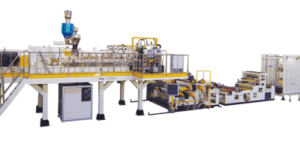
Industry Applications
Construction and infrastructure
Applications:
- PVC/HDPE pipes for water supply, sewage, and gas distribution
- Window and door frames (uPVC profiles)
- Wall panels, insulation boards, and roofing sheets
Why extrusion dominates:
- Enables the continuous production of long, uniform profiles without joints
- Maintains tight dimensional tolerances, which are critical for pipe fittings and sealing systems
- Compatible with additives for UV resistance, fire retardancy, and durability
Advanced insight:
Extrusion lines can integrate online calibration and vacuum sizing systems to ensure precise diameter and wall thickness, which is essential for compliance with international standards (e.g., ISO pipe specifications).
Industry relevance:
Extrusion is indispensable for large-scale infrastructure projects, particularly in rapidly urbanising regions where cost-effective, durable materials are required.
Packaging industry
Applications:
- Flexible films (e.g., food packaging, shrink wrap, and stretch films)
- Rigid sheets for thermoforming (e.g., food trays and blister packs)
- Multi-layer barrier films (e.g., oxygen and moisture protection)
Key advantages:
- High-speed production of ultra-thin, uniform films
- Capability for multi-layer co-extrusion, combining different polymers
Technical insight:
Co-extrusion enables manufacturers to combine materials such as PE, EVOH, and PP to create barrier films with customisable permeability, which significantly extends the shelf life of perishable goods.
Trend:
Growing demand for sustainable packaging, including recyclable mono-material films and biodegradable polymers.
Automotive industry
Applications:
- Interior trims, seals, and gaskets
- Wire and cable insulation
- Lightweight structural and semi-structural components
Benefits:
- Significant weight reduction compared to metal parts
- Lower production costs through continuous processing
- High design flexibility for complex cross-sections
Emerging trend:
Automakers are increasingly using extruded thermoplastics to meet fuel efficiency and emission targets, particularly for electric vehicles (EVs), as weight optimisation has a direct impact on battery performance.
Electrical and electronics
Applications:
- Cable insulation and jacketing
- Electrical conduits and protective tubing
- Fibre optic sheathing
Key requirements:
- Precise coating thickness to ensure electrical safety
- High dielectric strength and thermal stability
Technical insight:
Advanced extrusion lines use crosshead dies to apply uniform insulation layers around conductive cores, ensuring consistent electrical performance and compliance with safety standards.
Medical industry
Applications:
- Medical tubing (IV lines, dialysis tubing)
- Catheters and micro-bore tubing
- Disposable components (syringe parts, connectors)
Critical factors:
- Operation in cleanroom environments (ISO Class standards)
- Extremely tight tolerances and smooth surface finishes
- Use of biocompatible materials (e.g., medical-grade PVC and TPU)
Insight:
Extrusion enables the continuous, high-precision production of sterile components and is often integrated with in-line inspection systems (e.g., laser measurement and vision systems) to ensure zero-defect manufacturing.
Consumer goods
Applications:
- Household products (e.g., plastic rods, trims, and edging strips)
- Furniture components (e.g., profiles and decorative laminates)
- Appliance parts and accessories
Advantages:
- Ability to create custom cross-sectional shapes
- Consistent quality across high-volume production
- Wide range of surface finishes (matt, gloss, and textured)
Market insight:
Extrusion supports mass customisation, enabling manufacturers to swiftly adapt designs based on consumer trends without the need for extensive tooling modifications.
Agriculture
Applications:
- Irrigation pipes and drip lines
- Greenhouse covering films
- Mulch films for soil protection
Benefits:
- Products are weather-resistant, UV-stabilised and durable.
- Cost-effective for large-scale agricultural deployment.
Technical insight:
Multi-layer agricultural films can incorporate UV blockers, anti-fog agents, and infrared modifiers to improve crop yield and reduce water consumption.
Industrial and engineering applications
Applications:
- Conveyor belt components and guides
- Custom industrial profiles (e.g., machine guards and rails)
- Protective coverings and edge trims
Advantages:
- Enables engineered solutions tailored to specific mechanical requirements
- Compatible with high-performance polymers (e.g., ABS, nylon, and polycarbonate)
Insight:
Extrusion is widely used for functional parts, not just structural ones, especially where wear resistance, chemical stability, or impact strength are required.
Common Challenges and Solutions
| Challenge | Cause | Solution |
| Uneven thickness | Poor temperature control | Optimize heating zones |
| Surface defects | Contamination | Improve filtration |
| Inconsistent output | Feeding issues | Stabilize material flow |
Modern extrusion systems, including those from Jwell, integrate smart sensors and automation to address these issues.
Future Trends in Plastic Extrusion
AI-driven process optimization
Energy-efficient extrusion systems
Recycling-compatible machinery
Industry 4.0 integration
These innovations are reshaping how extrusion lines operate, improving both sustainability and productivity.
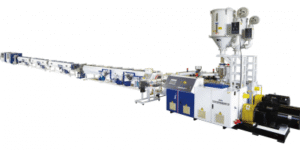
FAQ: Plastic Extrusion Machine
- What does a plastic extrusion machine do?
It melts plastic material and shapes it into continuous profiles like pipes, sheets, and films.
- What materials can be used in extrusion?
Common materials include PVC, PE, PP, ABS, and other thermoplastics.
- How is extrusion different from injection molding?
Extrusion produces continuous shapes, while injection molding creates discrete parts.
- What industries use plastic extrusion machines?
Construction, packaging, automotive, and electronics industries rely heavily on extrusion.
- How do you improve extrusion efficiency?
By optimizing temperature, screw speed, and material feeding consistency.
Conclusion
To optimise manufacturing efficiency and product quality, it is essential to understand how a plastic extrusion machine works. Extrusion enables the continuous production of high-quality plastic products by combining thermal processing, mechanical force, and precise control systems.
With leading manufacturers such as Jwell driving innovation, the future of extrusion technology lies in smarter, more sustainable, and highly automated solutions.


 English
  Russian
  Spanish
  Arabic
  German
  French
  Persian
  Turkish
  Bulgarian
  Czech
Czech  Dutch
Dutch  Greek
Greek  Indonesian
  Japanese
  Korean
  Polish
  Portuguese
  Romanian
  Slovenian
  Ukrainian