
Beneath seemingly ordinary roadbeds and within stable slopes lies an “invisibleskeleton” composed of high-strength polymers, silently safeguarding the safety otour projects.
Today, let’s delve into the world of geocells and geogrids, the core of these “skeletons”
![[Technical Deep Dive] Geocell vs. Geogrid Equipment](https://advich-wordpress-static-resources.s3.us-west-2.amazonaws.com/wp-content/uploads/2025/09/28103900/%E6%88%AA%E5%B1%8F2025-09-28-10.38.41-300x266.png "[Technical Deep Dive] Geocell vs. Geogrid Equipment 1")
![[Technical Deep Dive] Geocell vs. Geogrid Equipment](https://advich-wordpress-static-resources.s3.us-west-2.amazonaws.com/wp-content/uploads/2025/09/28103814/%E6%88%AA%E5%B1%8F2025-09-28-10.37.45-300x88.png "[Technical Deep Dive] Geocell vs. Geogrid Equipment 2")
1、WHAT ARE GEOCELLS AND GEOGRIDS?
01.Geocell
A three-dimensional honeycomb network structureconstructed from high-strength polymer sheetswelded together. Once deployed, it can be filled withsoil and rock, creating a strong lateral restraint.
Features
Three-dimensional and with a strong lateral restraint effect. lt primarily distributes loads and prevents deformation through confinement.
Metaphorically: The “skeleton” of an engineering structure, forming a strong, flexible whole.
02.Geogrid
A primarily flat geosynthetic material made frompunched and stretched polymer sheets, resulting in aregular grid structure.
Features
High tensile strength and low elongation. Similar to steel mesh, it primarily en-hances soil strength through reinforcement.
Metaphor: Like the “tendon” ofengineering, it provides tensile strength and strengthens the soil.
2、COMPARISON: TWIN BROTHERS, EACH WITH THEIR OWN UNIOUE ABILITIES
![[Technical Deep Dive] Geocell vs. Geogrid Equipment](https://advich-wordpress-static-resources.s3.us-west-2.amazonaws.com/wp-content/uploads/2025/09/28104132/%E6%88%AA%E5%B1%8F2025-09-28-10.41.16-300x162.png "[Technical Deep Dive] Geocell vs. Geogrid Equipment 3")
3、UNVEILING THE MANUFACTURING EOUIPMENT BEHIND THE SCENES
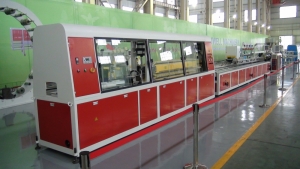
The geocell extruder is an automated machine specifically designed for producingpolymer geocells. Through high-temperature extrusion and precise stretching, itforms a honeycomb-like, three-dimensional structure. lt is widely used in civil engineering reinforcement.
![[Technical Deep Dive] Geocell vs. Geogrid Equipment](https://advich-wordpress-static-resources.s3.us-west-2.amazonaws.com/wp-content/uploads/2025/09/28104209/%E6%88%AA%E5%B1%8F2025-09-28-10.24.32-300x140.png "[Technical Deep Dive] Geocell vs. Geogrid Equipment 4")
![[Technical Deep Dive] Geocell vs. Geogrid Equipment](https://advich-wordpress-static-resources.s3.us-west-2.amazonaws.com/wp-content/uploads/2025/09/28104302/%E6%88%AA%E5%B1%8F2025-09-28-10.42.39-296x300.png "[Technical Deep Dive] Geocell vs. Geogrid Equipment 5")
Different products require completely different production equipment.
![[Technical Deep Dive] Geocell vs. Geogrid Equipment](https://advich-wordpress-static-resources.s3.us-west-2.amazonaws.com/wp-content/uploads/2025/09/28104329/%E6%88%AA%E5%B1%8F2025-09-28-10.25.39-300x100.png "[Technical Deep Dive] Geocell vs. Geogrid Equipment 6")
mainEquipment:
Extruder: Plasticizes the raw material and extrudes it through a die into sheets orstrips of a specific width..Ultrasonic Welder: The core technology. Using ultrasonic technology, high-frequency vibrations weld the strips at their joints, creating uniform, strong honeycomb connections.
Traction and Rewinding Device: Traces, folds, and rewinds the welded continu-ous cell product into bundles.Punch (Optional): To facilitate drainage in landscaping, some equipment per-forms simultaneous punching during welding.
![[Technical Deep Dive] Geocell vs. Geogrid Equipment](https://advich-wordpress-static-resources.s3.us-west-2.amazonaws.com/wp-content/uploads/2025/09/28104512/%E6%88%AA%E5%B1%8F2025-09-28-10.44.58-300x271.png "[Technical Deep Dive] Geocell vs. Geogrid Equipment 7")
![[Technical Deep Dive] Geocell vs. Geogrid Equipment](https://advich-wordpress-static-resources.s3.us-west-2.amazonaws.com/wp-content/uploads/2025/09/28104357/%E6%88%AA%E5%B1%8F2025-09-28-10.28.32-300x130.png "[Technical Deep Dive] Geocell vs. Geogrid Equipment 8")
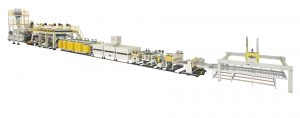
Main Equipment:
Extruder: Plasticizes and melts the raw material (such as HDPE) and extrudes itinto a sheet of uniform thickness.
Punching Machine: Punches the sheet with precise and regular patterns, a keystep in forming the initial grid pattern.
Longitudinal/Transverse Stretching Machine: The core technical component.The punched sheet is stretched unidirectionally or bidirectionally at high tem.perature, aligning the molecular chains along the stretching direction, resultingin extremely high tensile strength.
Winder: Automatically winds and packages the finished product.
4、APPLICATION:”STEEL BONES” IN ENGINEERING
01.Roadbed and foundation reinforcement for highways and railways(especially suitable for soft foundations)
Application Description: This is the most classic application of geocells. Geocellsare laid on a soft roadbed and filled with gravel or soil, The cells create a strongthree-dimensional constraint on the fill material, distributing localized loadsover a larger area, significantly reducing differential settlement and improvingthe bearing capacity of the foundation.
Difference from geocells: Geocells primarily increase bearing capacity through”reinforcement” and “tension membrane” effects, while geocells distribute loads through the “integral plate effect.” They are particularly effective in treating extremely soft foundations, making them difficult to replace with geocells.
02.Slope Protection and Greening (Ecological Slope Protection)
Application Description: Geocells are laid and secured on the slope surface, then filled with vegetative soil or concrete to form a solid, erosion-resistant slope protection structure. The cells provide an excellent growth space for plants, achiev
ing a perfect combination ofengineering protection and ecological restoration.Difference from geogrids: Geogrids, when used on slopes, primarily reinforce the soil and prevent shallow landslides. Geocells, on the other hand, not only rein-
force the slope but also actively protect it from rainwater erosion and provide apermanent platform for greening, offering greater ecological benefits.
03.Basic support of the load-bearing structure
Application Description: Used in locations with extremely high foundation bearing capacity requirements, such as large parking lots, port terminals, airport runways, and logistics yards. The cell system significantly reduces the thickness of the base layer, distributing the load, preventing rutting, depressions, and cracks in the surface, and maintaining a smooth and aesthetically pleasing surface.
Difference from grating: Both systems can be used in these applications andoften work in tandem. Grating provides tensile strength, while the cells provide a rigid foundation platform, resulting in a more effective combination.
04.Scour prevention and control of rivers, lakeshores, and seawalls
Application: Used for protecting the toes of riverbanks, lakeshores, and sea-walls to prevent scouring. Geocell mats (a type oflow-profile geocell filled with concrete or stone) offer exceptional scouring resistance and stability, and can adapt to uneven foundation deformation.
Difference from geogrids: Geogrids are not used directly to prevent scouring.
05.Road Construction in Deserts, Beaches, and Swamps
Application Description: In areas lacking stable foundations, geocells provide arapid road construction solution. They can consolidate loose sand and gravelinto a single unit, forming a temporary or permanent pathway, significantly reducing construction costs and time.
Difference from Geogrids: Geogrids struggle to function effectively on theirown on such soft foundations, while the “integral” advantage of geocells is ir-replaceable.
06.Bridge Abutment Bump Prevention
Application Description: Geocells installed in the bridgehead transition zone can effectively reduce differential settlement between the roadbed and abutment, thereby alleviating or eliminating the “bridgehead bump” phenome-non.
Difference from Geogrids: While similar in function, geocells provide a morerigid transition.
5、TRENDS: THE FUTURE OF TECHNOLOGYAND EOUIPMENT
With the advancement of smart manufacturing, geosynthetics productiorequipment is also developing towards intelligent, efficient, energy-saving, andenvironmentally friendly features:
Intelligent Control: PLC computer control systems precisely control parameters such as temperature, draw ratio, and weld strength to ensure product stability.
High Production and Efficiency: Technologies such as multi-layer co-extrusion and multi-head welding continuously improve production line speed andcapacity.
New Material Application: The equipment is more compatible, enabling theproduction of grid cells for recycled materials or new bio-based polymers, addressingenvironmental concerns..
Geocells and geogrids, while seemingly simple, are indispensable materials inmodern geotechnicalengineering. The precise and efficient production equipment behind them is the foundation and guarantee of all this. Selecting theright materials reguires a deep understanding of their properties and manufacturing processes.



 English
  Russian
  Spanish
  Arabic
  German
  French
  Persian
  Turkish
  Bulgarian
  Czech
Czech  Dutch
Dutch  Greek
Greek  Indonesian
  Japanese
  Korean
  Polish
  Portuguese
  Romanian
  Slovenian
  Ukrainian