
Photovoltaic Module Encapsulation Films: EVA vs. POE Performance Comparison. For dual-glass module encapsulation, EVA, POE, and EVAPOE blends are the mainstream options. The quality of the encapsulation film directly impacts the module’s power generation efficiency and service life, particularly affecting key performance factors such as potential-induced degradation (PID). Therefore, film material selection is crucial.
-
EVA and the PID Effect
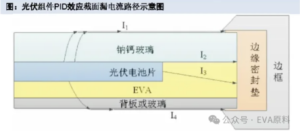
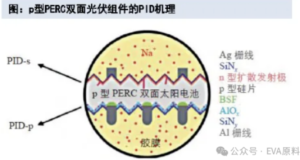
The PID effect can cause a sudden drop in module power. It’s caused by high system voltage and grounded module frames, which generate high DC voltages between the cells and the frame. EVA material cannot provide complete insulation, and when moisture penetrates the module, it decomposes upon contact with water, producing acetic acid. This acetic acid reacts with the base precipitated from the glass to form mobile sodium ions. Under the influence of an applied electric field, these sodium ions accumulate on the cell surface, causing surface passivation failure. In short, the four key steps in the development of PID are: moisture intrusion, EVA hydrolysis to produce acid, acid-base reaction to produce sodium, and sodium ion accumulation.
-
EVA and the PID Effect
The PID effect can cause a sudden drop in module power. It’s caused by high system voltage and grounded module frames, which generate high DC voltages between the cells and the frame. EVA material cannot completely insulate, and when moisture penetrates the module, it decomposes upon contact with water, producing acetic acid. This acetic acid reacts with the base precipitated from the glass to form mobile sodium ions. Under the influence of an applied electric field, these sodium ions accumulate on the cell surface, causing surface passivation failure. In short, the four key steps in the development of PID are: moisture intrusion, EVA hydrolysis to produce acid, acid-base reaction to produce sodium, and sodium ion accumulation.
-
EVA and the PID Effect
The PID effect can cause a sudden drop in module power. It’s caused by high system voltage and grounded module frames, which generate high DC voltages between the cells and the frame. EVA material cannot provide complete insulation, and when moisture penetrates the module, it decomposes upon contact with water, producing acetic acid. This acetic acid reacts with the base precipitated from the glass to form mobile sodium ions. Under the influence of an applied electric field, these sodium ions accumulate on the cell surface, causing surface passivation failure. In short, the four key steps in the development of PID are: moisture intrusion, EVA hydrolysis to produce acid, acid-base reaction to produce sodium, and sodium ion accumulation.



 English
  Russian
  Spanish
  Arabic
  German
  French
  Persian
  Turkish
  Bulgarian
  Czech
Czech  Dutch
Dutch  Greek
Greek  Indonesian
  Japanese
  Korean
  Polish
  Portuguese
  Romanian
  Slovenian
  Ukrainian