
Quick Answer:
Extrusion is a method with which to produce items of uniform cross-section, such as tubing, wire, pipe, and various other materials.
In general, manufacturers feed raw material into an extruder, then heat and move it along by means of a screw and barrel, extrude the material out of a die into its finished shape, cool it, and cut it into small pieces. This highly efficient continuous process allows large-scale production while offering precise control over dimensions and is widely applied in plastics, building, packaging, and other industries.
Introduction: Why Extrusion Lines Are the Backbone of Modern Manufacturing
For companies, a high degree of efficiency, consistency, and scalability is critical for staying competitive. The extrusion line is at the heart of this development, allowing manufacturers to make continuous products with remarkable precision and little waste.
From plastic pipes used in the infrastructure to films used in packaging and insulation layers in cables, extrusion lines power an array of industries. As the need for lightweight materials, recyclable plastics, and high-performance polymers grows around the globe, extrusion technology is constantly evolving.
Jwell has played a critical role in expanding extrusion systems with highly integrated lines that combine automation, energy savings, and versatility of materials. Understanding the operation of an extrusion line is also important for engineers, purchasing and plant managers, and investors testing production capabilities.
What Is an Extrusion Line? (Technical Definition)
An extrusion line is a fully integrated production system that uses mechanical and thermal processes to turn raw material into a continuous final product.
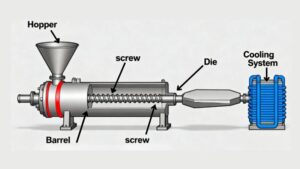
Key components of the system include:
- A feeding system (hopper) is provided in the equipment
- The extruder (crew and barrel) is an injector that is used to extrude a liquid
- A shaping die
- Equipment for cooling and calibration
- Haul-off and cutting units
As long as the material is supplied, the extrusion line will keep producing lengths of product. Extrusion is one of the most efficient methods of production.
Core Components of an Extrusion Line
To fully understand how an extrusion line works, it is essential to look at its fundamental components.
Feeding System (Hopper)
The raw material, usually pellets, powders, or flakes, is fed into the hopper to ensure a consistent and controlled flow of material into the machine.
Based on the use, different materials such as PE, PP, PVC, and PET can be used.
Extruder (Screw and Barrel System)
The extruder is the heart of the extrusion line. It consists of a rotating screw and a heated barrel.
As the screw rotates:
- I get that through my writing assistant.
- Friction and heaters increase the temperature.
- The material melts and becomes plasticized.
Using a combination of heat, pressure, and shear, an unstable material is condensed into a homogeneous molten state, ready for shaping.
Die (Shaping Tool)
Once fully molten, the molten material is forced through a die, which gives the final product its shape.
For example:
- Circular die – pipes or tubing.
- Flat die sheets or films.
- Complex die profilers are great for many applications.
Extrusion is a unique manufacturing process because it produces very complex shapes with consistent quality.
Cooling and Calibration System
Once the material exits from the die, it must be cooled and hardened quickly in order to maintain its shape.
Cooling methods include:
- Baths in water are bathing in the water.
- Air cooling is an important service in many applications.
- Calibration molds are used for the calibration of instruments in a calibration test.
- Proper cooling ensures the uniformity of the part and prevents deformation.
Haul-Off and Cutting Unit
After cooling, the product is pulled off the roll (hauled off) at a controlled rate and cut into lengths.
This phase ensures:
- Consistent product dimensions.
- Accurate length control of strings.
- Smooth downstream processing.
How Does an Extrusion Line Work? (Step-by-Step Process)
The extrusion process can be divided into several stages:
Step 1: Material Feeding
The product is loaded in the hopper and enters the extruder.
Step 2: Melting and Conveying
The moving screw moves the material forward while heating and melting it.
Step 3: Pressurization and Homogenization
The molten material is compressed and mixed to achieve a consistent consistency.
Step 4: Shaping Through the Die
The material is forced through the die, and the cross-sectional shape is created.
Step 5: Cooling and Solidification
It is cooled to maintain its shape and properties.
Step 6: Pulling and Cutting
The product is pulled at a controlled rate and cut or wound as required.
Extrusion lines can then run in continuous operation over long production runs.
Types of Extrusion Lines
Different applications require different extrusion line configurations.
| Type of Extrusion Line | Application | Key Feature |
| Pipe Extrusion Line | Water/gas pipes | Circular die |
| Sheet/Board Line | Panels, boards | Flat die |
| Film Extrusion Line | Packaging films | Blown or cast film |
| Profile Extrusion Line | Window frames | Complex shapes |
| Compounding Line | Material blending | Twin screw system |
Each type is optimized for specific materials and production requirements.
Single Screw vs Twin Screw in Extrusion Lines
| Feature | Single Screw Extrusion Line | Twin Screw Extrusion Line |
| Mixing Capability | Limited | Excellent |
| Material Flexibility | Moderate | High |
| Cost | Lower | Higher |
| Applications | Simple products | Complex compounds |
Twin screw systems are increasingly used for advanced materials, while single screw systems remain dominant for standard production.
Advantages of Using an Extrusion Line
In polymer processing, extrusion lines are valued for their ability to deliver efficient, scalable, and consistent production. Their continuous nature makes them a cornerstone of modern manufacturing.
Continuous production
How it works:
Materials are fed, melted, shaped, and cooled in a continuous process, eliminating frequent start-stop cycles.
Benefits:
- High production rates
- Reduced downtime
- Consistent output quality
Impact:
Ideal for industries requiring large volumes and a steady supply.
Material efficiency
Key advantage:
Generates minimal waste compared to batch processing.
Why?
- Continuous flow reduces off-cuts and excess material
- Scrap can often be recycled and reintroduced into the process
Result:
Lower material costs and improved sustainability.
Design flexibility
Capabilities:
- Produces complex shapes with uniform cross-sections
- Custom dies enable a wide range of profiles
Examples:
- Pipes and tubing
- Window profiles
- Plastic sheets and films
Insight:
Allows manufacturers to create custom-engineered products without complex assembly.
Scalability
Why extrusion scales well:
- Easily adjusted for higher production volumes
- Compatible with automation and continuous operation systems
Benefits:
- Efficient transition from small batches to mass production
- Supports growing market demand without major process changes
Final takeaway:
Extrusion lines offer a powerful combination of:
- High productivity (continuous operation)
- Cost efficiency (low waste)
- Design versatility (custom profiles)
- Scalability (industrial-level output)
These advantages make extrusion one of the most reliable and widely used manufacturing methods across multiple industries.
Applications Across Industries
Extrusion lines are a core technology in polymer processing, valued for their ability to produce uniform products continuously and on a large scale. Their adaptability means they can serve a wide range of industries.
Construction and infrastructure
Pipes (PVC and HDPE) for water, drainage, and gas systems
Window and door profiles
Insulation boards and structural components
Why extrusion is ideal:
- Continuous production of long profiles
- High dimensional consistency for large projects
Packaging industry
Plastic films (e.g., food packaging and shrink wrap)
Sheets for thermoforming (e.g., containers and trays)
Multi-layer barrier films
Key advantages:
- High-speed production of thin, uniform materials
- Enables advanced packaging with protective barrier properties
Automotive industry
Cable insulation and wire coatings
Seals, trims, and lightweight plastic components
Benefits:
Weight reduction → improved fuel efficiency
Design flexibility for complex parts
Medical industry
Medical tubing and catheters
Disposable plastic components
Critical requirements:
- Precision and tight tolerances
- Clean, controlled production environments
Insight:
Extrusion supports high-precision, hygienic manufacturing.
Consumer goods
- Household plastic items
- Furniture components
- Daily-use plastic products
Advantages:
Cost-effective mass production with consistent quality
Key insight:
Across industries, extrusion is preferred because it delivers:
- Consistency (uniform cross-sections)
- Efficiency (continuous production)
- Flexibility (custom shapes and materials)
Industry Trends in 2026
The extrusion industry is undergoing rapid changes, many of which are attributed to several trends.
- Smart extrusion lines with IoT integration
- Energy-efficient systems
- Recycling and sustainable materials
- High-speed automation
Companies such as Jwell are innovators in the industry with streamlined extrusion lines that are environmentally friendly.
How to Choose the Right Extrusion Line?
Selecting an extrusion line is not just a technical decision; it directly affects product quality, efficiency, and long-term profitability. At Polymer Processing, we believe that the best choice is to align machine capability with your specific production goals.
Material type
Why it matters:
Different materials behave differently during extrusion.
PVC requires precise temperature control, PE/PP has an easier flow and is suitable for high-speed production, and engineering plastics need advanced mixing and control.
Tip:
Choose equipment (single vs twin screw, screw design) that matches your material’s viscosity, thermal sensitivity and formulation complexity.
Product shape and size
Key considerations:
Extrusion is ideal for products with a constant cross-section, but size and complexity can vary.
Pipes and tubing require calibration and cooling systems, films and sheets require flat dies and precise thickness control, and complex profiles may need custom dies and tooling.
Impact:
The die design and downstream equipment must match your product specifications.
Production capacity
Questions to ask:
- What is your required output (kg/h or tons/day)?
- Will demand grow in the future?
Options:
- Small-scale lines for niche or custom production
- High-capacity lines for mass manufacturing
Insight:
Oversizing increases costs, while undersizing limits growth — balance is key.
Budget and ROI
Cost factors:
- Initial machine investment
- Energy consumption
- Maintenance and spare parts
- Labour requirements
ROI perspective:
- Higher upfront cost (e.g., twin screw) may deliver better efficiency and product quality
- Lower-cost systems may suit simple, stable production
Level of automation
Automation options:
- Manual or semi-automatic systems
- Fully automated lines with PLC control and monitoring
Benefits of automation:
- Reduced human error
- Consistent product quality
- Lower labour dependency
Best practice:
Choose the level of automation based on production scale and workforce capability.
Additional factors to consider:
- Energy efficiency: impacts long-term operating costs.
- Flexibility: ability to handle different products/materials.
- After-sales support: critical for maintenance and uptime.
Final takeaway:
To choose the right extrusion line, consider the following factors:
- Material requirements
- Product design
- Output goals
- Budget constraints
- Automation needs
A well-matched system doesn’t just run—it optimises efficiency, ensures consistent quality and maximises profitability over time.
FAQ: Extrusion Line
- What is an extrusion line used for?
It is used to produce continuous products like pipes, sheets, and films.
- How does an extrusion line work?
It melts material, pushes it through a die, and cools it into shape.
- What materials can be used?
Plastics, metals, rubber, and even food materials.
- What is the main advantage?
Continuous production with high efficiency.
- What is the difference between extrusion and injection molding?
Extrusion is continuous, while injection molding is batch-based.
- What industries use extrusion lines?
Construction, packaging, automotive, and more.
Conclusion
An extrusion line is a powerful continuous manufacturing process that turns raw materials into products with consistent shapes and sizes. Extrusion lines combine melting, shaping, cooling, and cutting in one smooth operation for unbeatable efficiency and scalability.
Whether it be to make simple pipes or compound complex materials, extrusion technology is still at the core of modern manufacturing. Manufacturers like Jwell continue to develop extrusion lines that are smarter, more efficient, and more adaptable, and they will likely remain relevant in the future of industrial production.


 English
  Russian
  Spanish
  Arabic
  German
  French
  Persian
  Turkish
  Bulgarian
  Czech
Czech  Dutch
Dutch  Greek
Greek  Indonesian
  Japanese
  Korean
  Polish
  Portuguese
  Romanian
  Slovenian
  Ukrainian