
In the high molecular polymer processing industry, the performance of granulation equipment directly affects the quality and production efficiency of semi-finished products. As a new type of processing machinery, the underwater pelletizer is named because the pelletizing process is completed in water. With its unique working principle and significant advantages, it is gradually becoming the preferred equipment in many fields.
Working principle: Precision granulation coordinated by water system and machinery
The granulation process of the underwater pelletizer reflects the efficient cooperation of machinery and fluid system. When the molten polymer is extruded from the die head, the high-speed rotating blade will accurately cut to form pellets, and then the pellets are quickly taken away from the pelletizing chamber by the circulating water system and enter the centrifugal drying system. In the drying process, the water is separated and returned to the storage tank, and re-circulated after cooling; the pellets are centrifuged to remove residual water, and finally form pellet products that meet the requirements. This continuous process design ensures the stability and efficiency of the granulation process.
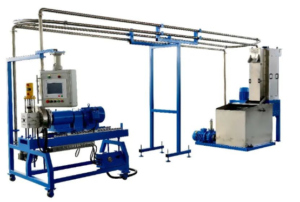
Core advantages: innovation beyond traditional granulation
Compared with the traditional extrusion cold cutting granulation method, the underwater pelletizer has achieved breakthroughs in multiple dimensions: Environmentally friendly and clean production environment: the closed-loop process water pipeline is used to avoid contact between materials and external pollutants throughout the process, which can not only keep the production process colorless and odorless, but also prevent secondary contamination of materials. The precise structural design of the equipment effectively eliminates water leakage problems, making it easier to keep the workshop environment clean, especially suitable for food-grade plastics, medical polymer materials and other scenes with strict requirements on hygiene standards.
Uniform and stable particle quality: Since the cutting action is completed in the molten state of the polymer, the pellets are quickly solidified after cooling with circulating water, avoiding dust and irregular particle morphology that may occur in the traditional cold cutting process. The final product particles are uniform in size and regular in shape, which can meet the requirements of high-precision processing for raw material consistency.
Flexible and intelligent parameter control: The equipment can automatically adjust the die head discharge, die hole diameter and pelletizing speed according to the extrusion volume to achieve dynamic adaptation of the particle size; at the same time, it supports manual replacement of the knife holder with different numbers of blades, and flexibly adjusts the particle shape (such as cylindrical, flat, etc.) to meet diverse production needs.
Cost advantage of high efficiency and low consumption: The automated granulation process reduces manual intervention, which not only reduces the difficulty of operation, but also significantly improves the stability of production. Compared with traditional strand pelletizing, its energy consumption is reduced by about 15%-30%, and the production capacity limit of a single production line is higher. Long-term use can effectively reduce production costs.
Application areas: covering multiple categories of polymer material processing
The adaptability of underwater pelletizers makes them widely used in the field of polymer processing, especially in the following scenarios:
General plastic processing: For general plastics with large output and wide application such as PP (polypropylene) and PE (polyethylene), underwater pelletizers can efficiently process materials in a molten state and produce uniform pellets, which can be directly used for subsequent processing such as injection molding and blow molding. For example, in the production of polyethylene film raw materials, the uniformity of its pelletization helps to improve the consistency of film thickness.
Elastomers and thermoplastic materials: Materials such as TPE (thermoplastic elastomer) and TPU (thermoplastic polyurethane) have the characteristics of high viscosity and easy adhesion, and traditional pelletizing methods are prone to pellet agglomeration problems. The cooling system of the underwater pelletizer can quickly solidify the pellets and effectively solve the adhesion problem. It is widely used in the raw material processing of elastomer products such as shoe materials and sealing strips.
Functional masterbatch production: In the pelletizing of functional masterbatches such as color masterbatches and filler masterbatches, the closed environment of the underwater pelletizer can avoid the scattering of pigments and fillers, and ensure the uniform distribution of functional components in the masterbatch. For example, in the production of modified masterbatches with fillers such as carbon black and glass fiber, it can reduce raw material loss and workshop pollution.
Special polymer material processing: For low-viscosity polymers (such as certain types of polyamides) or corrosive chemical raw materials, the circulating water system of the underwater pelletizer can reduce the adhesion and corrosion of the material to the equipment, while protecting the material performance through the inert water environment, which is suitable for the processing of high-end materials such as battery separator raw materials and special coating resins.
Existing challenges and development trends
Despite its significant advantages, underwater pelletizers still have some technical difficulties in operation. Does the secondary cutting of underwater pelletizers destroy the product? 5 breakthroughs are exposed! For example, the die head is easily blocked by material impurities, and the blade wear may affect the particle accuracy, which needs to be optimized through regular maintenance and technical upgrades. With the transformation of the plastics industry towards refinement and environmental protection, and the upgrading of demand for polymer materials in new energy, biomedicine and other fields, underwater pelletizers are moving towards higher automation (such as AI real-time monitoring of particle quality) and wider material adaptability (such as high-temperature resistant polymer processing), and are expected to play a more core role in the future polymer processing field.
The emergence of underwater pelletizers is not only a technical iteration of granulation equipment, but also promotes the transformation of polymer material processing from “extensive production” to “precision manufacturing”, providing a solid raw material guarantee for the high-quality development of downstream industries.


 English
  Russian
  Spanish
  Arabic
  German
  French
  Persian
  Turkish
  Bulgarian
  Czech
Czech  Dutch
Dutch  Greek
Greek  Indonesian
  Japanese
  Korean
  Polish
  Portuguese
  Romanian
  Slovenian
  Ukrainian