
A plastic edge banding extrusion line is a sophisticated and highly engineered system used to manufacture edge banding, which is commonly applied to the edges of wood-based panels in the furniture industry. This banding helps to enhance the appearance of furniture, protect the edges from moisture, and provide durability. Understanding how this system works requires a detailed look at its components, processes, and technologies involved.
Overview of the Plastic Edge Banding Extrusion Line
A plastic edge banding extrusion line typically consists of multiple sections that work in harmony to produce continuous strips of plastic edge banding material. The primary materials used in edge banding are thermoplastics such as PVC (Polyvinyl Chloride), ABS (Acrylonitrile Butadiene Styrene), or PP (Polypropylene). These materials are chosen for their durability, flexibility, and ease of processing.
1. Raw Material Feeding and Preparation
The first stage in the plastic edge banding extrusion line process is the feeding and preparation of raw materials. This typically involves the use of granulated thermoplastics, which are fed into the extrusion line through a hopper system. These plastic pellets are mixed with various additives, such as stabilizers, colorants, and fillers, depending on the desired properties of the finished product. The selection of additives is crucial as they impact the flexibility, surface finish, UV resistance, and overall strength of the edge banding.
In some cases, a plastic edge banding extrusion line may also use recycled plastic material, which must be carefully processed to ensure it meets the quality requirements. The hopper feeding system is automated to ensure a continuous supply of raw material, maintaining a consistent extrusion process.
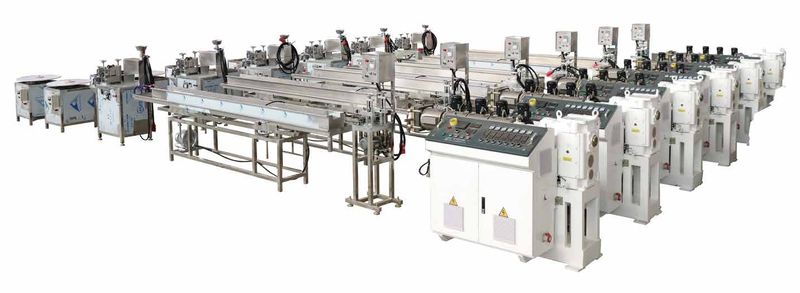
2. Extruder Machine
The core component of the plastic edge banding extrusion line is the extruder machine. This is where the plastic pellets are heated, melted, and formed into a continuous shape. The extruder consists of a heated barrel and a rotating screw (or screws, in the case of twin-screw extruders) that drives the plastic material through the barrel.
- Heating and Melting: The barrel is divided into several heating zones, each with precise temperature control. As the plastic pellets move through the barrel, they are gradually heated to a molten state. Temperature control is crucial to avoid overheating or underheating, which can negatively impact the plastic’s properties and the overall extrusion process.
- Mixing and Homogenization: The screw inside the extruder also plays a critical role in mixing the molten plastic and additives to ensure a homogeneous blend. The screw’s design (including its pitch, depth, and length) can be optimized to improve the plasticization and dispersion of additives.
- Compression and Conveyance: The screw also helps to compress the molten plastic, pushing it towards the extrusion die. This ensures that the material is in the correct form to be shaped into the edge banding.
3. Extrusion Die and Shaping
Once the plastic material is sufficiently melted and mixed, it is pushed through the extrusion die. The extrusion die is a precision-engineered tool that shapes the molten plastic into a continuous flat strip, which will become the plastic edge banding. The die design is crucial as it directly affects the shape, size, and thickness of the final edge banding.
- Die Design: The die for a plastic edge banding extrusion line is typically a narrow slit through which the molten plastic passes, forming a continuous strip. This strip will have the desired width and thickness of the edge banding. The die can be customized to produce edge banding with different profiles, including square or rounded edges, depending on the application.
- Calibration and Cooling: Immediately after the plastic exits the die, it enters the calibration section, where it is cooled and solidified. In some plastic edge banding extrusion lines, water baths or air-cooling systems are used to cool the plastic rapidly. Proper cooling is essential to ensure the material retains its shape and dimensional accuracy.
4. Surface Treatment and Embossing
At this stage, the surface of the plastic edge banding is treated to achieve the desired texture and finish. They often include an embossing roller or a texture roller that applies a specific surface pattern or grain. The pattern can mimic wood grain, leather, or other textures, depending on the aesthetic requirements of the furniture it will be used on.
- Embossing Rollers: The embossing rollers are heated to a specific temperature, allowing the pattern to be pressed into the surface of the plastic edge banding without damaging its structural integrity.
- Surface Finishing: After embossing, additional surface treatments, such as gloss or matte finishes, can be applied. This can be achieved through UV curing, heat treatment, or coating processes integrated into the plastic edge banding extrusion line.
5. Trimming and Cutting
Once the plastic edge banding has been extruded, shaped, cooled, and surface-treated, it is trimmed to achieve the precise dimensions required. Some plastic edge banding extrusion lines have integrated cutting systems that ensure the edges of the banding are smooth and even. This process also trims any excess material that may have formed during the extrusion.
The cutting system may be equipped with laser-guided precision tools to guarantee that the edge banding is produced within tight tolerances. The finished edge banding strips are then cut into manageable lengths or wound into rolls, depending on the customer’s requirements.
6. Quality Control and Inspection
A key aspect of any plastic edge banding extrusion line is the implementation of quality control mechanisms. Continuous monitoring of the production process ensures that the edge banding meets the required standards in terms of thickness, width, flexibility, and surface finish.
- Thickness Measurement: Automated gauges are often employed along the extrusion line to measure the thickness of the material. If deviations are detected, real-time adjustments can be made to the extrusion parameters.
- Surface Inspection: Cameras or human inspectors check the surface finish of the edge banding to ensure that there are no defects, such as scratches, blemishes, or inconsistencies in the embossed pattern.
- Tensile Testing: Some plastic edge banding extrusion lines include a tensile testing station to check the material’s strength and flexibility. This is particularly important for ensuring that the edge banding will perform well when applied to furniture.
7. Winding and Packaging
The final stage in the plastic edge banding extrusion line is the winding and packaging of the finished product. The edge banding is typically wound into rolls of specific lengths, which makes it easy to handle and transport. Automated winding systems ensure that the banding is neatly wound and tensioned properly to avoid wrinkles or kinks in the material.
After winding, the rolls are packaged and labeled according to customer specifications. Some extrusion lines may include automated packaging systems that wrap the rolls in protective material to prevent damage during shipping.
Advantages of a Plastic Edge Banding Extrusion Line
There are several advantages to using a plastic edge banding extrusion line for producing edge banding:
- Precision and Consistency: The automation and precision engineering of modern extrusion lines ensure consistent quality and dimensions across large production runs.
- Customizability: The extrusion dies, embossing rollers, and surface treatment options can be customized to produce edge banding in a wide variety of colors, textures, and finishes.
- Efficiency: A continuous extrusion process allows for high-volume production with minimal waste, making it a cost-effective solution for edge banding manufacturing.
- Material Flexibility: They can handle various thermoplastic materials, offering versatility in terms of the types of products that can be produced.
Conclusion
In conclusion, a plastic edge banding extrusion line is a highly efficient, precision-engineered system designed to produce edge banding for the furniture industry. The process involves several stages, including raw material preparation, extrusion, shaping, surface treatment, trimming, and packaging. Each component of the line is optimized to ensure the production of high-quality edge banding that meets the specific requirements of customers. By leveraging advanced technology and automation, they enables manufacturers to produce edge banding in a wide range of materials, colors, and textures, making them a vital part of modern furniture production.




 English
  Russian
  Spanish
  Arabic
  German
  French
  Persian
  Turkish
  Bulgarian
  Czech
Czech  Dutch
Dutch  Greek
Greek  Indonesian
  Japanese
  Korean
  Polish
  Portuguese
  Romanian
  Slovenian
  Ukrainian