
- If the screws of the electric control cabinet are not reset, there is a fatal risk of electric shock and fire
- 80% of post-earthquake equipment scrap cases, all start from “feel no problem” blind boot
📌The below is a “10-minute self-test flow chart.” Follow it to avoid 90% hidden risk!
Safe return to work = Stop loss million, this guide lets you start a step faster after the earthquake!
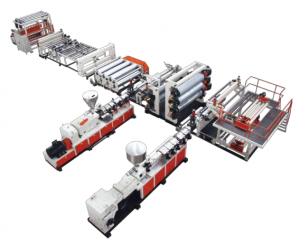
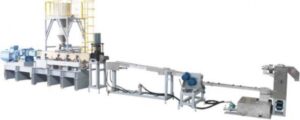
After the earthquake, the plastic extrusion equipment needs to do the following checks before starting:
1、Visual inspection of equipment
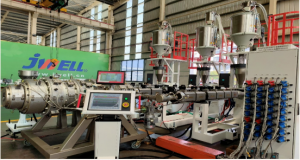
Check whether the whole equipment has obvious displacement, deformation, or damage, especially the key parts such as the equipment’s body and head.
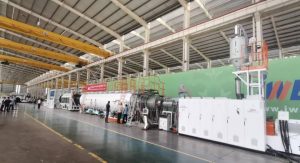
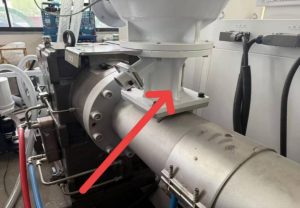
Check whether the hopper is cracked or damaged, observe whether the pipeline is bent or broken, and repair or replace it in time if a problem is found.
2、Electrical system inspection
Check whether the electrical components, control cabinets, operation panels, etc., are flooded or damp. If so, dry them in time.
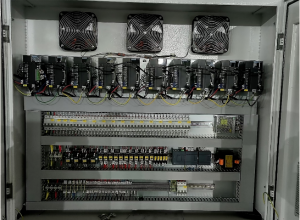
Check if the anchor screws of electrical components such as frequency converters, transformers and servo drivers are loose, fallen off or broken. If so, replace and tighten them in time. Also, check the fallen screws to prevent them from falling into the frequency converter and causing short circuit faults.
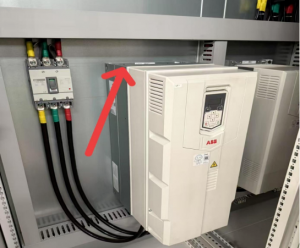
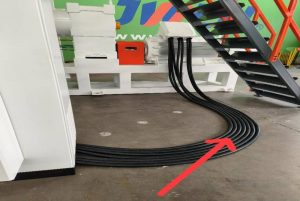
Check whether the wires and cables are damaged, broken, or short-circuited and whether the connection points are loose. Ensure that the grounding is good to avoid electric shock accidents.
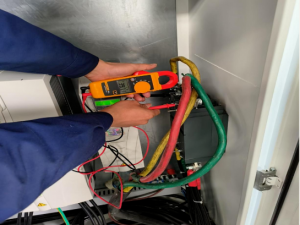
Measure whether the incoming line voltage of the three-phase power supply is normal and whether there is phase loss or not.
3、Inspection of mechanical parts
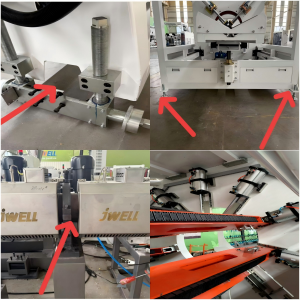
- Check whether the center height of each component is deviated and whether the ground under the equipment is cracked.
- Check whether the ground Angle of the equipment component is suspended and whether the equipment is tilted.d
- Check whether the barrel support seat is cracked.
- Check whether the haul-off arm is shaken off and the cylinder is damaged.
4、Heating and cooling system inspection
Check whether heating elements such as the heating ring and heating rod are damaged, whether the heating temperature control is accurate, and whether the temperature distribution in each heating area is uniform.
Check whether the cooling water pipeline is smooth, whether there is water leakage, and whether the cooling equipment, such as the cooling water pump and fan, can work normally.
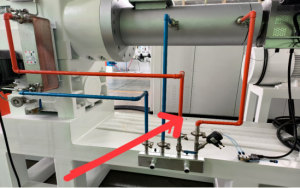
5、Auxiliary equipment inspection
Check whether the air source device (air compressor) can operate normally and whether the air source pipeline is broken and leaky. If so, repair and replace the equipment in time to ensure a stable air supply.
Check that the cooling circulation system, reservoir, circulation pump, cooling tower, and pipeline water pressure are normal.
Check the emergency power supply system (generator set), whether the line is damaged, and whether the power switch circuit breaker can work normally.
Check whether the centralized feeding system and the material conveying pipelines are damaged or broken.
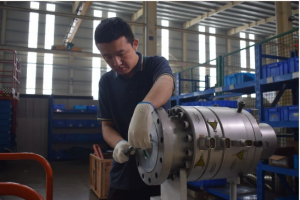
After completing the above checks and confirming that there is no problem with the equipment, a no-load test run can be carried out first to observe whether all parts of the equipment run normally. If there is an anomaly, stop the machine in time to troubleshoot the fault until the equipment can run normally and stably before formal production.


 English
  Russian
  Spanish
  Arabic
  German
  French
  Persian
  Turkish
  Bulgarian
  Czech
Czech  Dutch
Dutch  Greek
Greek  Indonesian
  Japanese
  Korean
  Polish
  Portuguese
  Romanian
  Slovenian
  Ukrainian