
Abstract:
In modern plastic packaging manufacturing, film extrusion technology is essential for creating flexible materials used in food packaging, medical packaging, agriculture, and industrial applications.
Research published by the Society of Plastics Engineers and industry reports from the Plastics Industry Association indicate that over 60% of flexible plastic packaging globally is made using blown film or cast film extrusion technologies.
Although both processes transform polymer resins into thin plastic films, they vary considerably in their processing techniques, film qualities, production speed, equipment setup, and suitability for different applications. These distinctions directly influence the performance features of the finished film products, including their strength, transparency, thickness regulation, barrier capabilities, and cost-effectiveness.
This guide offers a detailed technical comparison between blown film and cast film, emphasizing their operating principles, benefits, drawbacks, equipment configurations, and industrial uses.
The article also underscores how selecting the appropriate blown film machine or cast film production system can greatly influence manufacturing efficiency and product quality.
Understanding Film Extrusion Technology
Film extrusion is a fundamental manufacturing process in the plastics industry. It involves melting polymer resin pellets and forming them into thin films using specialized extrusion systems. There are two main technologies: blown film extrusion and cast film extrusion. Both methods depend on melting, extruding, and cooling the polymer, but they differ considerably in the way the molten plastic is shaped and solidified. These techniques are commonly employed to produce packaging films from polymers like:
- Polyethylene (PE)
- Polypropylene (PP)
- Polyamide (PA)
- Polyethylene Terephthalate (PET)
- EVA and other specialty polymers
The decision to use these processes typically relies on factors such as product performance needs, production rate, budget limitations, and specific application requirements.
What is Blown Film Extrusion?
Blown film extrusion involves extruding molten plastic through a circular die and inflating it with air to create a thin tubular bubble. The bubble is then stretched both vertically and radially, cooled by air, and flattened into rolls of film.
The equipment used in this process is commonly referred to as a blown film machine.
Basic Process Steps
- Plastic resin pellets are fed into the extruder hopper.
- The extruder melts and mixes the polymer.
- Molten plastic exits through a circular die.
- Air is blown into the tube to create a bubble.
- The bubble expands and cools with air rings.
- The film collapses between nip rollers.
- Film is wound into rolls.
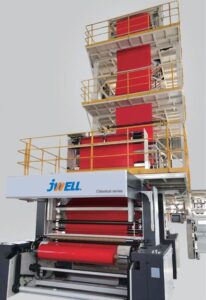
Typical Structure of a Blown Film Machine
A modern blown film machine usually consists of the following components:
| Component | Function |
| Extruder | Melts and conveys polymer resin |
| Die Head | Shapes molten polymer into a tubular form |
| Air Ring | Provides cooling air to stabilize the bubble |
| Bubble Stabilizer | Maintains bubble uniformity |
| Take-Up Unit | Pulls the film upward |
| Nip Rollers | Flatten the bubble into film |
| Winder | Collects finished film rolls |
The vertical configuration of blown film lines allows the film to be biaxially oriented, improving strength and durability.
What is Cast Film Extrusion?
Cast film extrusion involves pushing molten plastic through a flat die onto a cooled roller, where it quickly cools and hardens into a thin sheet. Unlike blown film, cast film does not include bubble creation or air inflation. Instead, the film is mainly stretched along the machine direction.
Basic Process Steps
- Resin pellets are fed into an extruder.
- Polymer is melted and homogenized.
- Molten plastic exits through a flat slot die.
- The film is deposited onto a chilled casting roll.
- Rapid cooling occurs through contact with the roll.
- The film passes through multiple rollers for thickness control.
- Finished film is wound into rolls.
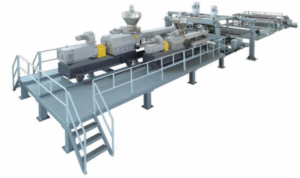
Typical Structure of a Cast Film Line
| Component | Function |
| Extruder | Melts and transports polymer |
| Flat Die | Distributes polymer into a sheet |
| Chill Roll | Rapid cooling and solidification |
| Edge Trimmer | Removes uneven film edges |
| Thickness Control System | Maintains uniform gauge |
| Winder | Collects finished film |
Cast film lines are usually horizontal systems, making them easier to integrate into high-speed production environments.
Key Differences Between Blown Film and Cast Film
Although both technologies produce plastic film, their production characteristics differ significantly.
Blown Film vs Cast Film Comparison
| Feature | Blown Film | Cast Film |
| Extrusion Method | Air-inflated bubble | Flat die extrusion |
| Cooling Method | Air cooling | Chill roll cooling |
| Film Orientation | Biaxial orientation | Mostly machine-direction |
| Film Clarity | Moderate | Very high clarity |
| Thickness Control | More variable | Very precise |
| Production Speed | Moderate | Very high |
| Equipment Layout | Vertical | Horizontal |
| Energy Consumption | Higher | Lower |
These differences affect both manufacturing efficiency and film performance characteristics.
Advantages of Blown Film Technology
Blown film extrusion continues to be one of the most popular methods in the packaging industry because of its flexibility and benefits in mechanical strength.
- Enhanced Mechanical Strength
Since the film is stretched in both the machine direction (MD) and transverse direction (TD), blown film generally possesses greater mechanical properties.
This makes it suitable for:
- Industrial packaging
- Heavy-duty bags
- Agricultural films
- Outstanding Barrier Properties
Blown films frequently show improved barrier features because of molecular orientation during bubble inflation.
These properties are crucial for:
- Food preservation
- Oxygen-sensitive products
- Pharmaceutical packaging
- Flexible Thickness Range
Blown film machines are capable of producing films that vary from very thin packaging materials to thick industrial liners.
Advantages of Cast Film Technology
Cast film extrusion provides numerous benefits, especially in uses where clarity and accuracy are essential.
- Exceptional Optical Transparency
Cast films are recognized for their:
- High clarity
- Shiny look
- Even surface texture
This makes them ideal for retail packaging and stretch wrap.
- Accurate Thickness Management
Since the film cools quickly on a chill roll, producers can attain very strict gauge tolerances.
- Higher Production Speeds
Cast film lines can operate at extremely high speeds, sometimes exceeding 500 meters per minute, depending on the material and equipment design.
Performance Characteristics Comparison
Film Property Comparison
| Property | Blown Film | Cast Film |
| Tensile Strength | High | Moderate |
| Tear Resistance | Excellent | Good |
| Clarity | Moderate | Excellent |
| Gloss | Medium | High |
| Thickness Uniformity | Moderate | Very high |
| Seal Strength | High | Moderate |
These performance differences influence which technology is chosen for specific products.
Applications of Blown Film
Blown film machines are commonly used in industries where strength and durability are essential.
Common Blown Film Products
| Industry | Applications |
| Packaging | Shopping bags, garbage bags |
| Agriculture | Greenhouse film, mulch film |
| Industrial | Heavy-duty liners |
| Food Packaging | Frozen food bags |
| Construction | Vapor barriers |
Blown film technology is especially dominant in polyethylene packaging production.
Applications of Cast Film
Cast film extrusion is preferred in applications requiring high clarity and smooth surface quality.
Common Cast Film Products
| Industry | Applications |
| Food Packaging | Cling film |
| Logistics | Stretch wrap |
| Consumer Goods | Protective films |
| Electronics | Surface protection film |
| Medical | Sterile packaging films |
Cast film’s smooth surface also makes it ideal for printing and lamination processes.
Blown Film Machine Technology Trends
Modern blown film machine technology has advanced considerably over the last ten years.
- Multi-Layer Co-Extrusion
Modern machines now allow for 3-layer, 5-layer, and even 9-layer film configurations, enhancing barrier qualities and optimizing materials.
- Automation and Smart Control Systems
Numerous manufacturers now incorporate:
- Automatic thickness tracking
- Digital control systems
- AI-driven bubble stability monitoring
These developments enhance both the consistency and efficiency of production.
- Energy Efficiency Improvements
New extrusion systems emphasize:
- highly efficient Screw designs
- Heating systems that consume less energy
- Cooling technologies that are optimized
These enhancements lower operational costs and boost output.
How to Choose Between Blown Film and Cast Film?
Choosing the correct film extrusion technology depends on several factors.
Key Decision Factors
| Factor | Recommended Process |
| High clarity packaging | Cast film |
| Strong industrial bags | Blown film |
| High-speed production | Cast film |
| Barrier packaging | Blown film |
| Precision thickness | Cast film |
Manufacturers often evaluate material compatibility, product requirements, and equipment cost before selecting the appropriate technology.
Future of Film Extrusion Technology
Film extrusion technology keeps advancing quickly as manufacturers address sustainability needs, automation requirements, and higher-performance packaging materials. In sectors like food packaging, agriculture, medical products, and industrial films, the upcoming generation of film extrusion systems is likely to emphasize efficiency, digitalization, and compatibility with advanced materials.
Below are the major trends shaping the future of film extrusion technology.
- Automation and Smart Manufacturing
Automation is increasingly a core component of contemporary film extrusion lines. Manufacturers are progressively incorporating intelligent control systems, sensors, and data analytics to enhance operational efficiency.
Key advancements involve real-time monitoring of temperature, pressure, and thickness; automated adjustments of thickness and die gap; predictive maintenance utilizing machine data; and AI-supported process optimization.
These innovations decrease human error, ensure consistent product quality, and enable operators to maintain stable film standards with minimal manual effort. 2. Compatibility with Sustainable and Recycled Materials
Sustainability is among the strongest forces propelling innovation in film extrusion.
Contemporary extrusion systems are being reengineered to process:
- Post-consumer recycled (PCR) plastics
- Biodegradable polymers like PLA and PBAT
- Compostable film materials
- Multi-layer structures that use less plastic
Enhanced screw designs and better temperature regulation allow machines to manage recycled materials without compromising film strength or clarity.
This capability is becoming more and more important as governments and brands advocate for circular packaging solutions.
- Advanced Multi-Layer Film Technology
Multi-layer extrusion is increasingly significant, especially for high-performance packaging films.
New systems enable manufacturers to create films with 5, 7, 9, or even more functional layers, each designed for a specific purpose, such as:
- Barrier protection against oxygen or moisture
- Mechanical strength and puncture resistance
- Sealability and flexibility
- Optical clarity and printability
These multi-layer structures enable producers to optimize material use while enhancing overall packaging performance.
- Energy-Efficient Extrusion Systems
Energy consumption is a major operating cost in film production.
As a result, equipment manufacturers are focusing heavily on energy-saving technologies.
Important innovations include:
- High-efficiency motors and drives
- Optimized heating and cooling systems
- Improved screw designs that reduce power consumption
- Heat recovery technologies
These improvements can significantly reduce energy usage while maintaining high production output.
- Digital Integration and Industry 4.0
The integration of Industry 4.0 technologies is transforming film extrusion lines into highly connected production systems.
Modern extrusion plants increasingly use:
- Cloud-based production monitoring
- Remote diagnostics and technical support
- Data-driven process optimization
- Integrated production management systems
Digital integration enables manufacturers to monitor machine performance across various factories and make operational decisions based on data.
- Precision Thickness Control
Film thickness uniformity is essential for product quality and material efficiency. Future extrusion systems are anticipated to attain highly accurate thickness control.
New technologies consist of:
- Automatic gauge control systems
- Advanced die bolt adjustment technology
- Optical thickness measurement systems
These innovations assist in minimizing raw material waste and maintaining consistent film performance throughout the entire roll.
- Flexible Production Capabilities
Modern manufacturers often need to produce multiple film types on a single extrusion line.
As a result, equipment is becoming more flexible and adaptable.
Future systems may support:
- Rapid product changeovers
- Modular extrusion components
- Adjustable die systems for different film widths
- Hybrid extrusion technologies combining cast and blown processes
This flexibility allows producers to respond quickly to changing market demands.
- Integration with Downstream Converting Processes
Film extrusion lines are becoming more connected with downstream processing equipment, leading to more efficient production systems.
These integrated systems might consist of:
- Automatic winding systems
- Inline printing or coating units
- Lamination equipment
- Slitting and converting modules
Integration reduces handling time and improves overall manufacturing efficiency.
FAQ: Blown Film Machine and Film Extrusion
What materials can be processed by a blown film machine?
Blown film machines commonly process polymers such as LDPE, LLDPE, HDPE, EVA, and biodegradable materials like PLA. These materials are widely used in packaging and industrial films.
Why is blown film stronger than cast film?
Blown film undergoes biaxial orientation, meaning the polymer chains are stretched in both directions during bubble inflation. This process increases mechanical strength and tear resistance.
Is cast film cheaper to produce?
Cast film production often has lower operational costs due to faster production speeds and more efficient cooling systems. However, the initial investment in equipment may vary depending on system complexity.
Can blown film machines produce multi-layer films?
Yes. Modern blown film machines can produce multi-layer films using co-extrusion technology, allowing manufacturers to combine different materials for improved barrier properties and functionality.
Which technology is better for food packaging?
Both technologies are used in food packaging. Blown film is typically used for bags and liners, while cast film is commonly used for cling wrap, stretch wrap, and laminated packaging films.
Conclusion
Blown film and cast film extrusion are two essential technologies in the plastic film manufacturing industry. Each provides unique benefits based on the specific application.
Blown film machines are particularly good at creating strong, durable films with excellent barrier properties. They are well-suited for industrial packaging, agricultural films, and heavy-duty bags. Conversely, cast film technology offers better clarity, smoother surfaces, and faster production rates.
It is the preferred option for stretch films, food wraps, and high-quality retail packaging.
Understanding the differences between these two processes allows manufacturers to improve production efficiency, reduce costs, and achieve the desired film performance.
As packaging needs evolve—driven by sustainability goals, new materials, and automation—both blown film machines and cast film lines will remain essential technologies shaping the future of flexible plastic packaging.



 English
  Russian
  Spanish
  Arabic
  German
  French
  Persian
  Turkish
  Bulgarian
  Czech
Czech  Dutch
Dutch  Greek
Greek  Indonesian
  Japanese
  Korean
  Polish
  Portuguese
  Romanian
  Slovenian
  Ukrainian