
Introduction
In the polyethylene (PE) pipe market, products are usually divided into two categories: national standard (in line with national standards) and non-national standard (enterprise standard or non-standard products). They have significant differences in raw materials, production processes, performance indicators, service life and application areas. Correctly distinguishing between national standard and non-national standard products will help users choose appropriate pipes according to actual needs and avoid engineering risks caused by quality problems.
Definition and characteristics of national standard PE pipes
- Definition
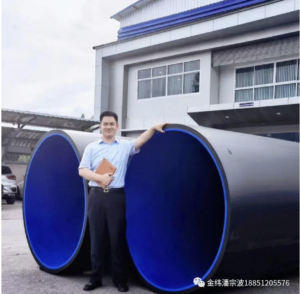
National standard PE pipes refer to pipes produced in strict accordance with national or industry standards (such as GB/T 13663-2018 “Polyethylene pipes for water supply”, GB 15558.1-2015 “Buried polyethylene pipes for gas”, etc.), and their raw materials, physical properties, chemical properties, dimensional tolerances, etc. must meet the standard requirements.
- Main features
High purity of raw materials: using new high-density polyethylene (HDPE) raw materials, without recycled materials or low-quality recycled materials.
Stable performance: Key indicators such as impact resistance, pressure resistance, and environmental stress cracking resistance (ESCR) meet the standards.
Long service life: The design life is usually ≥50 years (such as water supply pipes and gas pipes).
Safety and environmental protection: It meets health standards (such as GB/T 17219-2001 “Safety Evaluation Standards for Drinking Water Distribution Equipment and Protective Materials”) and is suitable for drinking water transportation.
Unified specifications: Parameters such as outer diameter, wall thickness, and pressure rating are strictly implemented in accordance with the standards to ensure project compatibility.
- Typical applications
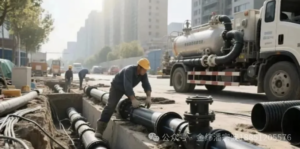
Municipal water supply and drainage pipelines (GB/T 13663)
Gas transmission pipelines (GB 15558.1)
High-standard power cable protection pipes (GB/T 13381.1)
Fluid transportation in the food and pharmaceutical industries
Definition and characteristics of non-national standard PE pipes
- Definition
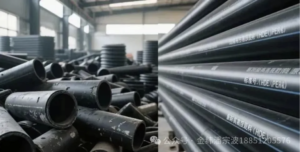
Non-national standard PE pipes usually refer to pipes that are not strictly in accordance with national standards, but are produced according to enterprise standards or market low-price demands. Its raw materials, production processes, and performance indicators may be lower than national standards, and the price is lower, but the quality stability is poor.
- Main features
Recycled materials may be mixed into raw materials: Some non-standard pipes use recycled materials or inferior PE materials, which affects strength and aging resistance.
Unstable performance: The pressure resistance, impact resistance, and UV resistance may not meet the standards, and they are prone to brittle cracks or deformation.
Short life: The service life is usually 10-20 years, and inferior products may age and leak within a few years.
Inconsistent specifications: Uneven wall thickness and large outer diameter deviation may lead to construction difficulties or loose connections.
Possible safety hazards: Some non-standard pipes have not passed the sanitation test and may precipitate harmful substances (such as those used in drinking water pipes).
- Common types
Low-cost drainage pipes (not in accordance with GB/T 19472.1 standard)
Poor-quality threading pipes (insufficient wall thickness, easy to flatten)
Adulterated gas pipes (not in accordance with GB 15558.1, with leakage risk)
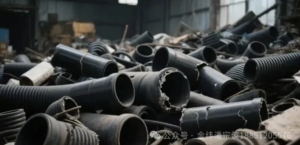
Recycled PE pipes (made of recycled plastic, poor performance)
Key comparison between national standard and non-national standard PE pipes
| Comparison Item | National Standard PE Pipe | Non-standard PE Pipe |
| Raw Material | new HDPE, no recycled material | PEMay contain recycled or inferior PE |
| Production Standard | Complies with GB/T 13663, national standards | No unified or self-made standards |
| Compressive Strength | High, meets MRS grade (e.g., PE100) | May be weak, prone to deformation or bursting |
| Aging Resistance | UV-resistant, over 50 years lifespan | Brittle, 10–20 years lifespan |
| Hygienic Safety | Meets drinking water standards (GB/T 17219) | May contain impurities or leach harmful substances |
| Price | Relatively higher | Lower (with potential hidden costs) |
| Application Fields | Municipal, gas, high-spec projects | Temporary, low-requirement drainage/conduit |
How to distinguish national standard and non-national standard PE pipes?
Look at the logo
National standard pipes are usually printed with standard numbers (such as GB/T 13663), raw material grades (such as PE100), manufacturers, specifications and models, etc.
Non-standard pipes may not have standard numbers, or the markings may be vague.
Measure performance
Wall thickness inspection: Measure with a caliper. The wall thickness of national standard pipes is uniform, and non-standard pipes may be cut corners.
Bending test: High-quality PE pipes are flexible and not easy to break, while inferior pipes may be brittle.
Burning test (non-destructive): Brand new materials have a paraffin smell when burning, and recycled materials may emit black smoke and have a pungent smell when burning.
Check certification
National standard pipes should have health permits (water-related products), pressure pipeline certification (such as TS certification), etc.
Non-standard pipes may not have relevant certifications.
Compare prices
National standard pipes are more expensive. If the market quotation is far lower than the industry average price, you need to be alert whether it is a non-standard product.
Purchase suggestions
Key projects must choose national standards (such as gas, drinking water, power protection, etc.).
Temporary or low-requirement projects can consider non-standard (such as agricultural drainage, temporary threading), but basic strength must be ensured.
Request a test report to ensure that the product meets the requirements.
Choose a regular manufacturer to avoid buying three-no products.
Conclusion
National standard PE pipes are of reliable quality and suitable for high-standard projects, while non-national standard pipes have low costs but higher risks. Users should make reasonable choices based on project requirements, budgets and safety requirements to avoid late repairs or safety accidents due to greed for low prices.
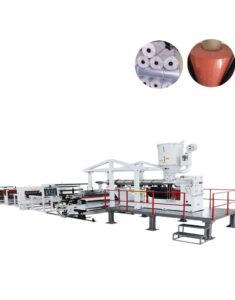
If you need to find stable performance and high-standard pipeline production equipment, you can consult the well-known brand in the industry-Jinwei Machinery


 English
  Russian
  Spanish
  Arabic
  German
  French
  Persian
  Turkish
  Bulgarian
  Czech
Czech  Dutch
Dutch  Greek
Greek  Indonesian
  Japanese
  Korean
  Polish
  Portuguese
  Romanian
  Slovenian
  Ukrainian