
Abstract
A blown film machine is an industrial extrusion system used to produce thin plastic films. It melts polymer resin and inflates it into a continuous tubular bubble, which is then cooled, flattened, and wound into rolls.
According to references in polymer processing and extrusion engineering, blown film technology is widely used for producing packaging films, agricultural films, shopping bags, industrial liners, and multilayer barrier materials, as it offers excellent flexibility, mechanical strength, and cost efficiency.
At Jwell, we are continuously improving our blown film systems by incorporating high-output extrusion, energy-saving automation, multilayer co-extrusion technology, and intelligent thickness control systems to meet the growing global demand for packaging.
Why Are Blown Film Machines Essential in Modern Plastic Manufacturing?
The global packaging industry relies heavily on the production of plastic film, and the blown film machine is one of the most important and widely used systems among all plastic processing technologies in modern manufacturing. Blown film products, ranging from food packaging and industrial liners to agricultural films and medical packaging, have become integral to global logistics, retail, agriculture, healthcare, and industrial supply chains.
Blown film machines convert raw polymer materials into thin, flexible plastic film through a carefully controlled extrusion and inflation process. Although the final film may appear simple, the manufacturing system behind it involves highly sophisticated engineering that combines polymer science, thermal control, extrusion technology, air pressure management, cooling systems, automation, material rheology, and precision thickness control.
The popularity of blown film technology is largely due to its ability to produce plastic films with high flexibility, excellent tensile strength, strong puncture resistance, uniform thickness, scalable production efficiency, multilayer barrier capability, and vacuum packaging.
Today, blown film products are used for food packaging, frozen food bags, stretch film, shrink film, garbage bags, industrial liners, agricultural greenhouse films, medical packaging, courier bags, vacuum packaging, heavy-duty sacks, and construction membranes.
The rapid growth of e-commerce, food delivery systems, and the logistics industry, as well as the increased use of flexible packaging, has led to a further increase in the global demand for blown film production equipment.
Modern blown film manufacturing has evolved far beyond the production of simple, single-layer polyethylene film. Advanced systems now incorporate the following technologies:
- Multilayer co-extrusion
- Automatic gauge control
- Internal bubble cooling
- Gravimetric dosing
- Corona treatment
- Intelligent process monitoring
- Energy-saving drive systems
- Recyclable material processing
These technologies enable manufacturers to produce films with specialised properties, such as oxygen barriers, moisture resistance, UV protection, anti-static performance, puncture resistance, sealability, optical clarity and thermal insulation.
The blown film process itself is highly efficient, allowing continuous production with relatively low material waste. Compared with some alternative film production technologies, blown film extrusion offers high production flexibility, lower tooling costs, excellent film orientation, scalable widths and thicknesses, and efficient multilayer integration.
At the same time, environmental pressures are reshaping the industry. Manufacturers are increasingly seeking blown film systems that can process recycled plastics, biodegradable polymers, bio-based materials, downgauged films, and sustainable packaging materials.
This has accelerated innovation in machine design, automation, melt stability, and material compatibility.
Companies such as Jwell are continuing to develop advanced blown film production systems that are optimised for higher output, energy efficiency, intelligent automation, multilayer precision, reduced downtime, and sustainable manufacturing.
Understanding how a blown film machine works therefore requires an examination of extrusion principles, bubble formation, polymer melting, cooling technology, film orientation, multilayer structures, industrial applications, and modern automation systems.
Although consumers may only see the finished plastic film, the manufacturing technology behind it represents one of the most important segments of modern polymer processing and industrial packaging engineering.
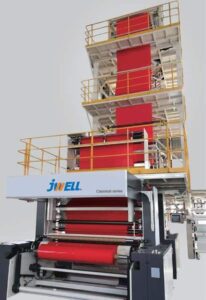
What Is a Blown Film Machine?
A blown film machine is a type of plastic extrusion system that is designed to produce thin plastic film via an inflated, tubular extrusion process.
The machine melts plastic resin and pushes it through a circular die to create a continuous plastic tube. Air is then introduced into the tube to inflate it into a bubble shape.
The bubble is:
- Cooled
- Stabilized
- Flattened
- Wound into rolls
This process creates flexible plastic film with controlled thickness and mechanical properties.
Main Components of a Blown Film Machine
Modern blown film systems comprise several essential components.
The extruder
This melts and conveys plastic material.
Key parts include the hopper, screw, barrel, heaters, and drive motor.
Die head
The die forms molten plastic into a tubular shape.
Air ring
The air ring cools the expanding bubble uniformly.
Bubble cage
The bubble cage stabilises the inflated film bubble.
Take-up unit
This section pulls the film upwards at a controlled speed.
Winder
The finished film is wound into rolls for further processing.
How Does the Blown Film Process Work?
The blown film process involves multiple carefully controlled stages.
Step 1: Raw material feeding
Plastic pellets enter the hopper.
Common materials include:
- LDPE
- HDPE
- LLDPE
- PP
- EVA
Step 2: Plastic melting
The extruder heats and melts the polymer resin.
Step 3: Extrusion through a circular die
The molten plastic exits the die as a thin tube.
Step 4: Bubble inflation
Compressed air inflates the tube into a bubble.
Step 5: Cooling
Air cooling solidifies the plastic film.
Step 6: Flattening and winding
The film is flattened and wound onto rolls.
Why is Bubble Formation so Important?
Bubble stability directly affects film quality.
Key bubble control factors:
- Internal air pressure
- Cooling balance
- Extrusion speed
- Melt temperature
- Haul-off speed
Unstable bubbles may cause:
- Thickness variation
- Wrinkles
- Film breakage
- Poor optical quality
Modern systems increasingly use automatic bubble stabilisation technologies.
Types of Blown Film Machines
Different blown film systems are designed for different applications.
| Machine Type | Main Application | Key Advantage |
| Single-Layer Blown Film Machine | General packaging | Lower cost |
| ABA Blown Film Machine | Recycled content film | Material savings |
| Multilayer Co-Extrusion Machine | Barrier packaging | Enhanced functionality |
| High-Speed Blown Film Machine | Mass production | Higher productivity |
| Agricultural Film Machine | Greenhouse films | Large-width production |
Materials Used in Blown Film Production
Different polymers create different film properties.
| Material | Main Characteristics | Common Uses |
| LDPE | Soft and flexible | Shopping bags |
| HDPE | Strong and stiff | Grocery bags |
| LLDPE | High puncture resistance | Stretch film |
| PP | Heat resistance | Food packaging |
| EVA | Flexibility and sealing | Specialty packaging |
Modern blown film systems often process multilayer combinations for enhanced performance.
Advantages of Blown Film Technology
Blown film extrusion offers several significant industrial advantages.
- Excellent mechanical strength
The inflation process creates a biaxial molecular orientation, which improves tensile strength, impact resistance, and puncture resistance.
- Production flexibility
Manufacturers can easily adjust:
- Thickness
- Width
- Layer structure
- Material composition
- Cost efficiency
Continuous production lowers manufacturing costs.
- Multilayer capability
Advanced systems produce films with multiple functional layers.
Common Applications of Blown Film Products
Blown film products are used in many different industries.
Packaging industry:
- Applications include:
- Food bags
- Vacuum packaging
- Courier bags
- Retail packaging
- Agricultural industry
Films are used for:
- Greenhouse covering
- Silage wrapping
- Mulch film
- Industrial applications
Heavy-duty films are used for:
- Construction
- Logistics
- Pallet wrapping
- Industrial liners
- Medical packaging
Blown films are used for:
- Sterile packaging
- Medical waste bags
- Pharmaceutical packaging
Blown Film vs Cast Film
Blown film and cast film are different production methods.
| Feature | Blown Film | Cast Film |
| Cooling Method | Air cooling | Chill roller cooling |
| Film Strength | Higher biaxial strength | Better optical clarity |
| Production Speed | Moderate | Higher |
| Flexibility | Excellent | Good |
| Typical Use | Bags and liners | Stretch film |
Challenges in Blown Film Production
Despite its advantages, producing blown film involves technical challenges.
- Thickness variation
Uneven cooling may cause gauge inconsistency.
- Bubble instability
Poor process control may lead to film defects.
- Melt fracture
Improper temperature or pressure may distort the surface of the film.
- Energy consumption
Extrusion systems require substantial heating energy.
Modern Innovations in Blown Film Technology
The blown film industry is continuing to evolve rapidly.
- Multilayer co-extruded films
Modern machines produce:
- 3-layer films
- 5-layer films
- 7-layer barrier films
These films offer improved oxygen resistance, moisture barriers, and mechanical performance.
- Automatic thickness control
Sensors monitor the film gauge in real time.
- Energy-saving systems
Modern systems use servo motors, optimised heaters, and efficient cooling.
- Smart manufacturing
Industry 4.0 technologies now offer remote monitoring, predictive maintenance, and AI process optimisation.
Manufacturers such as Jwell are increasingly focusing on intelligent blown film production systems with high automation and energy efficiency.
Sustainability Trends in the Blown Film Industry
Environmental concerns are changing the way films are produced.
Recycled material processing
Modern machines are increasingly processing:
- PCR plastics
- Recycled PE
- Downgauged materials
Biodegradable films
Blown film systems now support:
- PLA
- PBAT
- Compostable polymers
Material reduction
Thin-film engineering reduces plastic consumption while maintaining performance.
Importance of Cooling Systems in Blown Film Machines
Directly affected by cooling:
- Transparency
- Strength
- Output speed
- Bubble stability
- Air Ring Technology:
Advanced air rings improve cooling uniformity.
- Internal Bubble Cooling
IBC systems increase productivity, dimensional stability, and output efficiency.
Maintenance Considerations for Blown Film Machines
Proper maintenance improves both the lifespan of the machine and the quality of the film.
- Screw and barrel inspection
Wear can reduce extrusion efficiency.
- Die cleaning
Contaminated dies may cause film defects.
- Cooling system maintenance
Blocked air systems reduce production stability.
- Automation calibration
Sensors require periodic calibration to ensure accurate control.
Why Blown Film Machines Remain Critical for Global Packaging?
The use of flexible packaging is growing worldwide because it offers the following advantages:
- Lightweight transportation
- Lower packaging costs
- Improved shelf life
- Reduced material usage
Blown film technology is one of the most efficient manufacturing methods for meeting these demands.
FAQ About Blown Film Machines
- What does a blown film machine produce?
A blown film machine produces thin plastic film used in packaging, agriculture, industrial liners, and flexible plastic products.
- What materials are commonly used in blown film extrusion?
Common materials include LDPE, HDPE, LLDPE, PP, and EVA.
- Why is the bubble important in blown film production?
The bubble determines film orientation, strength, thickness uniformity, and production stability.
- What is the difference between blown film and cast film?
Blown film uses air cooling and offers better biaxial strength, while cast film uses chill rollers and provides higher clarity.
- Can blown film machines produce multilayer films?
Yes. Modern co-extrusion systems can produce multilayer barrier films with specialized properties.
- Why are modern blown film machines becoming more automated?
Automation improves production efficiency, thickness consistency, energy savings, and process stability.
Conclusion
A blown film machine is one of the most important technologies in modern plastic processing. It enables the efficient production of flexible plastic films, which are used in a variety of sectors, including packaging, agriculture, logistics, healthcare, construction, and industrial manufacturing. Blown film systems transform raw polymer materials into highly functional films with excellent flexibility, strength, puncture resistance, and multilayer barrier performance through a carefully controlled extrusion and bubble inflation process. The technology’s capacity to support continuous, high-volume production while maintaining strong material efficiency has established blown film extrusion as a critical foundation of the global packaging industry.
As demands for higher performance, sustainability, automation, and recyclable material integration in packaging continue to evolve, blown film technology is advancing rapidly through innovations such as multilayer co-extrusion, intelligent thickness control, energy-saving systems, recycled polymer processing, and Industry 4.0 automation. Manufacturers such as Jwell are continuing to develop advanced blown film solutions that are optimised for productivity, film quality, operational stability and sustainable manufacturing. Ultimately, the blown film machine is a highly adaptable and indispensable production system that will continue to shape the future of flexible packaging and industrial plastic manufacturing worldwide.


 English
  Russian
  Spanish
  Arabic
  German
  French
  Persian
  Turkish
  Bulgarian
  Czech
Czech  Dutch
Dutch  Greek
Greek  Indonesian
  Japanese
  Korean
  Polish
  Portuguese
  Romanian
  Slovenian
  Ukrainian