
Коротка відповідь
A Лінія екструзії труб з ПЕ — це промислова система виробництва, яка використовується для безперервного виготовлення труб і трубок з поліетилену з контролем діаметра, товщини стінок, довжини та якості поверхні. Згідно з ISO 4427, поліетиленові трубопроводи широко застосовуються для водопостачання та супутніх застосувань. У той же час промислові системи екструзії розширюють можливості виробництва труб з ПЕ, включаючи газорозподіл, зрошення, дренаж, переробку промислових рідин, морські трубопроводи та захисні або ізольовані трубопроводи. Процес екструзії загалом включає подачу матеріалу, його розплавлення та пластифікацію, формування у матриці, калібрування, охолодження, витягування, різання або намотування, а також онлайн-контроль якості.
У практичному виробництві значення лінії екструзії труб з ПЕ полягає не тільки в її здатності виготовляти пластикові труби, але й у її можливості перетворювати поліетиленову смолу на труби з постійними розмірами, призначеними для конкретних застосувань та вимог до продуктивності. Залежно від таких факторів, як марка смоли, діаметр труби, товщина стінок, клас тиску, швидкість виробництва та кінцеве використання, лінію можна налаштувати на виготовлення гнучких труб невеликого діаметра, стандартних водопровідних труб з HDPE, газових труб, труб для зрошення, інфраструктурних труб великого діаметра або спеціалізованих захисних труб з ПЕ.
Що таке лінія екструзії труб з ПЕ?
Лінія екструзії труб з ПЕ — це безперервна виробнича система, призначена для перетворення поліетиленової смоли на готові труби чи трубки. На відміну від процесів ливарного формування порціями, екструзія виробляє безперервний полий профіль шляхом розплавлення полімерних гранул, пропускання розплавленого матеріалу через кільцеву матрицю, формування гарячої труби за допомогою калібрувальних та охолоджувальних пристроїв, а потім витягування стабілізованої труби через обладнання нижнього потоку.
Термін ‘екструзія труб з ПЕ» лінія екструзії труб з ПЕ»‘охоплює широкий спектр обладнання, оскільки поліетиленові вироби виготовляються у багатьох різних діаметрах та конфігураціях. Трубки з ПЕ малого діаметра можна намотувати безпосередньо в котушки, тоді як труби з HDPE великого діаметра зазвичай виготовляються у вигляді прямолінійних відрізків і потребують кількох доріжок для витягування, великих вакуумних резервуарів, важкого різального обладнання та автоматизованого складування. Тому конфігурацію обладнання потрібно підбирати відповідно до запланованих характеристик труб, а не лише за назвою полімеру.
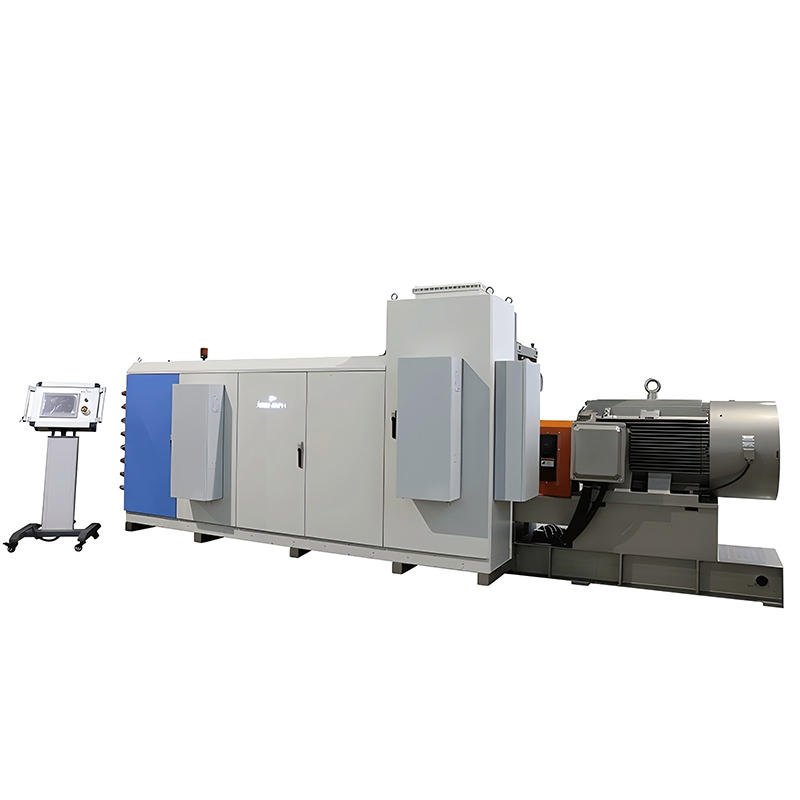
Типова виробнича система містить блок подачі матеріалу, бункер або гравіметричну систему дозування, односхідний екструдер, екструзійну матрицю, вакуумну калібрувальну камеру, секцію охолодження, блок витягування, різак або намотувач, а також обладнання для обробки труб. Сучасні системи також можуть включати лазерне вимірювання діаметра, онлайн-моніторинг товщини стінок, контроль маси, автоматичне маркування та централізоване управління PLC/HMI. Ці компоненти працюють разом як єдина технологічна ланцюг, оскільки точність розмірів залежить від синхронізації викиду розплаву, тиску в матриці, охолодження, швидкості витягування та обробки нижнього потоку.
Які матеріали може обробляти лінія екструзії труб з ПЕ?
Поліетилен не є одним матеріалом. Виробництво труб з ПЕ може включати поліетилен високої щільності (HDPE), поліетилен середньої щільності (MDPE) та інші формулювання поліетилену, які вибираються з урахуванням таких факторів, як вимоги до тиску, гнучкість, екологічні умови, хімічне вплив, температура та відповідний стандарт труб. HDPE особливо важливий у інфраструктурі, оскільки поєднує високу міцність з гнучкістю, корозійною стійкістю та хорошими характеристиками зварювання.
Марка смоли безпосередньо впливає на конструкцію та режим роботи лінії екструзії. Наприклад, матеріал, призначений для напірної труби великого діаметра, може потребувати іншої конфігурації шнека, потужності викиду, стратегії охолодження та організації витягування, ніж труба для зрошення малого діаметра. Підготовка матеріалу також має важливе значення, оскільки постійна подача та стабільна температура розплаву допомагають запобігти коливанням розмірів, дефектам поверхні та варіаціям товщини стінок.
Деякі сучасні трубопроводи також можна налаштувати на багатошарове виробництво. Додаткові екструдери можна інтегрувати для виготовлення двошарових або трьошарових труб з ПЕ, що дозволяє включати різні формулювання матеріалів або функціональні шари в одну трубну структуру. Така гнучкість корисна, коли виробники потребують поєднати продуктивність, колірну ідентифікацію, вміст переробленого матеріалу та специфічні характеристики поверхні в одному продукті.
Як працює лінія екструзії труб з ПЕ?
Виробничий процес починається з того, що поліетиленова смола подається в екструдер. Усередині циліндру полімер переміщується вперед завдяки обертанню шнеків, а тепло та механічний зсув поступово розплавляють і гомогенізують матеріал. Система шнека та циліндра повинна бути розроблена таким чином, щоб забезпечувати стабільний розплав з постійною температурою та тиском, оскільки коливання на цьому етапі можуть врешті-решт призвести до варіацій товщини стінок, дефектів поверхні або нестабільних розмірів труб.
Гомогенний розплав полімеру потім надходить у головку матриці, де розподіляється навколо центрального сердечника, щоб створити безперервний трубчастий профіль. На цьому етапі матеріал все ще гарячий і відносно м'який, тому для збереження кінцевих розмірів необхідне контрольоване калібрування та охолодження. Труба, таким чином, проходить через калібрувальну систему з вакуумним калібруванням для досягнення бажаної геометрії труби, а потім охолоджується водою, щоб відвести тепло та стабілізувати полімер.
Як тільки труба досягає достатньої стабільності розмірів, блок витягування безперервно тягне її через лінію. Взаємозв'язок між викидом екструдера та швидкістю витягування має критичне значення: якщо лінія тягне занадто швидко відповідно до швидкості викиду матеріалу, стінки труби можуть стати занадто тонкими; якщо тягнення занадто повільне, труба може стати завеликою або надто товстою. Тому сучасні системи екструзії все частіше використовують синхронізоване управління для підтримки стабільних виробничих умов. Наприклад, системи Jwell для труб з ПЕ та HDPE включають екструзію, вакуумне калібрування, охолодження, сервопривідний блок витягування, різальний блок та централізоване управління, з можливістю додавання онлайн-систем вимірювання для моніторингу виробництва.
Які основні застосування труб з ПЕ?
Найбільші сфери застосування труб з поліетилену (ПЕ) включають водопостачання, газорозподіл, зрошення, дренаж, транспортування промислових рідин, гірничодобувну галузь, морську інфраструктуру та захисні трубопроводи. ПЕ широко використовується в цих сферах завдяки своїй корозійній стійкості, гнучкості, відносно низькій вазі та тому, що труби можна з'єднувати методом термічного зварювання в підходящих умовах.
У водопровідній інфраструктурі труби з ПЕ можуть транспортувати питну воду та інші водопостачання, якщо матеріал, конструкція труби та сертифікація відповідають відповідним вимогам. Відповідно підібрані труби з поліетилену широко використовуються для газорозподілу, оскільки ПЕ не кородує так, як звичайні металеві труби, і може легше адаптуватися до руху ґрунту, ніж жорсткі матеріали в багатьох умовах монтажу.
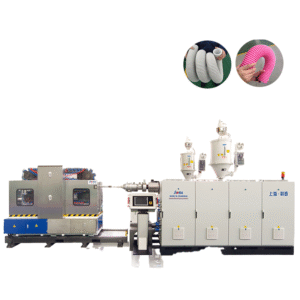
Сільськогосподарське зрошення — ще один великий ринок для труб та трубок з ПЕ менших розмірів. Ці вироби можна виготовляти у безперервних відрізках і намотувати в котушки, що спрощує транспортування та монтаж у полі. Залежно від конструкції, лінії екструзії ПЕ також можуть виготовляти труби для дренажу, доставки води для сільськогосподарських потреб, захисту кабелів та інших застосувань з низьким і середнім тиском.
Large-diameter PE extrusion expands the range of applications into municipal infrastructure, industrial water systems, dredging and marine pipelines. Therefore, equipment manufacturers offer substantially different line architectures for small tubes and large pipes. Published Jwell equipment information, for example, includes large-diameter HDPE systems covering pipe ranges extending into the metre scale. This demonstrates how extrusion line configuration changes substantially as diameter and throughput increase.
PE Pipe Applications and Corresponding Production Requirements
The relationship between application and machine configuration is important for anyone purchasing a PE pipe extrusion line. A manufacturer should not specify the line only from a desired output number because pipe diameter, wall thickness, resin grade, pressure class, cooling requirements, and product handling can all influence the equipment configuration.
| PE Pipe Application | Typical Product Characteristics | Important Extrusion-Line Requirements |
| Water supply | Pressure-rated PE pipe, multiple diameters | Stable melt output, precise sizing, controlled cooling |
| Gas distribution | Pressure-rated PE pipe with controlled dimensions | Consistent wall thickness, reliable process control, marking |
| Agricultural irrigation | Small or medium diameter pipe/tube, often coiled | High-speed extrusion, efficient cooling, winder capability |
| Drainage | Solid-wall or specialized drainage pipe | Appropriate die and sizing system, dimensional stability |
| Industrial fluid transport | Application-specific diameter and pressure class | Material compatibility, robust extrusion and cooling |
| Marine pipelines | Large-diameter HDPE pipe | High extrusion capacity, heavy-duty haul-off and handling |
| Cable or pipe protection | Tubes and protective conduits | Surface quality, dimensional control, flexible production |
| Pre-insulated piping | HDPE outer protective jacket | Accurate diameter, roundness, and stable surface quality |
| Mining applications | Heavy-duty PE pipe | High throughput, thick-wall capability, reliable cooling |
| Multilayer pipe | Two- or three-layer construction | Multiple extruders and synchronized layer distribution |
The table illustrates why “PE pipe extrusion machine” and “PE pipe production line” are not necessarily interchangeable specifications. A small-diameter irrigation tube and a 1,000 mm infrastructure pipe may both be PE products, but their extrusion capacity, die dimensions, cooling system, haul-off configuration, and handling requirements are fundamentally different.
What Equipment Does a PE Pipe Tube Extrusion Line Include?
Although the extruder is the core of the system, it is just one component of a complete production line. A modern line can be better understood as a coordinated manufacturing system, where the quality of the final pipe is affected by every downstream unit.
The first stage is material handling. Resin is delivered to the extruder by automatic feeders or vacuum conveying systems, while gravimetric dosing improves control of material throughput and formulation. The extruder then melts, mixes, and conveys the polymer; barrel temperature zones and screw geometry control the processing conditions in this stage.
The die head determines the distribution of the molten polymer into the tubular shape. After leaving the die, calibration and cooling equipment control the external dimensions and roundness. Vacuum calibration is particularly important for maintaining stable geometry, while multi-stage water cooling enables heat to be removed gradually rather than suddenly.
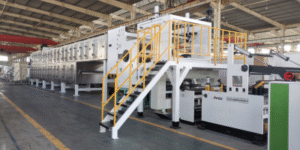
The haul-off provides controlled traction. For large-diameter pipes, several crawler tracks may be required to distribute the pulling force evenly and prevent damage to the pipe surface. Depending on the product, the line may use a chipless or saw cutter, an automatic stacker or a winder. Optional additional equipment can include laser marking systems, laser diameter measurement systems, gravimetric control systems, wall-thickness monitoring systems, belling machines and mixers.
What Determines PE Pipe Extrusion Line Output?
The output of an extruder is determined by much more than just the power of its motor. The effective production rate depends on the following factors: screw diameter and design; screw speed; polymer grade; melt temperature; die design; pipe diameter; wall thickness; cooling capacity; haul-off speed; and the stability of the entire process.
For small-diameter products, a dual-strand configuration can increase productivity by producing two pipes simultaneously, rather than doubling the number of production lines. Jwell’s small-diameter PE/PPR/PE-RT/PA line, for instance, features dual-pipe configurations for products measuring 16–75 mm and includes servo-controlled haul-off and optional winding or cutting equipment.
At the other end of the scale, large-diameter HDPE pipe requires much higher material throughput and more substantial downstream equipment. Published specifications for one Jwell HDPE pipe system show models ranging from 400–800 mm to 2,000–3,000 mm, with increasing listed outputs as the line configuration becomes larger and more powerful. However, these figures are supplier-specific reference values rather than universal industry standards, so production capacity should always be confirmed through a material trial using the buyer’s actual resin and pipe specification.
What Quality Factors Should Manufacturers Control?
The most important quality variables in PE pipe extrusion are outside diameter, wall thickness, roundness, weight per metre, surface condition, material uniformity, and dimensional stability. As these parameters are interconnected, correcting one process variable without understanding the effect on the rest of the line can create another problem.
Melt temperature and pressure must be kept stable to prevent inconsistent polymer flow, which can result in uneven wall thickness or surface fluctuations. The pipe must then be cooled uniformly by the calibration and cooling processes so that it retains its required dimensions after leaving the sizing section. Haul-off speed must be synchronised with extrusion output, as even a stable die cannot compensate indefinitely for an unstable traction ratio.
Online monitoring can significantly reduce the time between a process deviation being detected and corrective action being taken. Laser diameter measurement can continuously monitor the external diameter, while meter-weight control can help identify changes in material output. For high-value or pressure-rated pipes, manufacturers should also maintain documented laboratory testing procedures that cover the relevant mechanical and hydrostatic performance requirements of the applicable standard.
For buyers, this means that evaluation of the production line should focus on process stability rather than maximum theoretical output. A machine capable of producing 1,000 kg/h would not necessarily be more useful than a lower-output system if the application required tight dimensional tolerances and consistent production over long operating periods.
How to Choose the Right PE Pipe Tube Extrusion Line?
Rather than starting with the machine, the first step is to define the finished pipe. The buyer should specify the material grade, pipe diameter range, wall thickness or SDR requirements, applicable pressure class, required output, production length, coiling or cutting method, colour, multilayer requirements, target market and standard.
The second step is to determine the production range. A line optimised for pipes with a diameter of 20–110 mm is fundamentally different from one intended for pipes with a diameter of 630–1,600 mm. Small-diameter lines can prioritise high line speed, compact cooling systems and winding, whereas large-diameter lines require high melt throughput, powerful haul-off systems, extended cooling capacity and heavy-duty handling equipment.
The third step is to evaluate automation and quality control. PLC/HMI systems, automatic temperature control, servo haul-off, online diameter measurement, and meter-weight control can reduce manual intervention and improve repeatability. However, automation should be selected according to actual production requirements rather than being treated as a collection of marketing features.
When evaluating a PE pipeline from a supplier such as our Джейвел., it is important to look beyond the headline output and examine the complete process configuration, including the extruder design, die structure, vacuum sizing, cooling capacity, haul-off arrangement, cutting or winding system, control architecture, and optional online inspection. Jwell’s published PE/HDPE systems illustrate configurations ranging from small-diameter, single- or dual-pipe production to large-diameter HDPE lines. Therefore, the exact model and technical configuration should be matched to the intended product, rather than being selected from a generic capacity table.
FAQ About PE Pipe Tube Extrusion Lines
- Для чого використовується лінія екструзії труб з ПЕ?
A PE pipe tube extrusion line is used to continuously manufacture polyethylene pipes and tubes with controlled dimensions and wall thickness. Common applications include water supply, gas distribution, irrigation, drainage, industrial fluid transport, and protective piping.
- What materials can a PE pipe extrusion line process?
PE extrusion lines can be configured for polyethylene materials such as HDPE and MDPE, depending on the product specification and machine design. Some systems can also be adapted for related polyolefin materials or multilayer structures.
- How does a PE pipe extrusion line work?
The line melts PE resin in an extruder and pushes the homogeneous melt through an annular die to form a tube. Vacuum sizing, cooling, haul-off, and cutting or winding then stabilize and finish the pipe.
- What pipes can be produced by a PE extrusion machine?
A suitable PE extrusion machine can produce small-diameter tubes, irrigation pipes, water pipes, gas pipes, industrial pipes, and large-diameter HDPE pipelines. The actual diameter and wall-thickness range depend on the extruder, die, calibration system, and downstream equipment.
- What determines the output of a PE pipe extrusion line?
Output depends on screw design, extruder size, polymer grade, pipe diameter, wall thickness, screw speed, die design, and cooling capacity. A stable production rate should be confirmed through testing with the actual PE resin and finished-pipe specification.
- How do I choose a PE pipe tube extrusion line?
Start with the finished pipe specification, including material, diameter, wall thickness, application, output, and applicable standard. Then select the extruder, die, sizing, cooling, haul-off, cutting or winding, and automation systems that can reliably meet those requirements.
Висновок
A PE pipe tube extrusion line is essentially a continuous polymer processing system designed to turn polyethylene resin into dimensional pipes for use in infrastructure, utilities, agriculture, industry, and specialised applications. The extruder establishes melt quality, the die creates the tubular geometry, and the haul-off controls production speed. Calibration and cooling then establish dimensions, and cutting, winding, and inspection equipment convert the stabilised pipe into a usable commercial product.
Therefore, the most important consideration when selecting such a line is not simply maximum output. The right system must match the PE material grade, pipe diameter, wall thickness, application, production capacity, quality standard, and downstream handling method, while providing sufficient process control to ensure consistent dimensions during continuous production. When comparing extrusion equipment, manufacturers should evaluate the entire process chain and validate the line using the actual resin and pipe specifications, rather than comparing extruder power or advertised capacity alone.


 English
 Russian
 Spanish
 Arabic
 German
 French
 Persian
 Turkish
 Bulgarian
 Czech
 Dutch
 Greek
 Indonesian
 Japanese
 Korean
 Polish
 Portuguese
 Romanian
 Slovenian
 Ukrainian